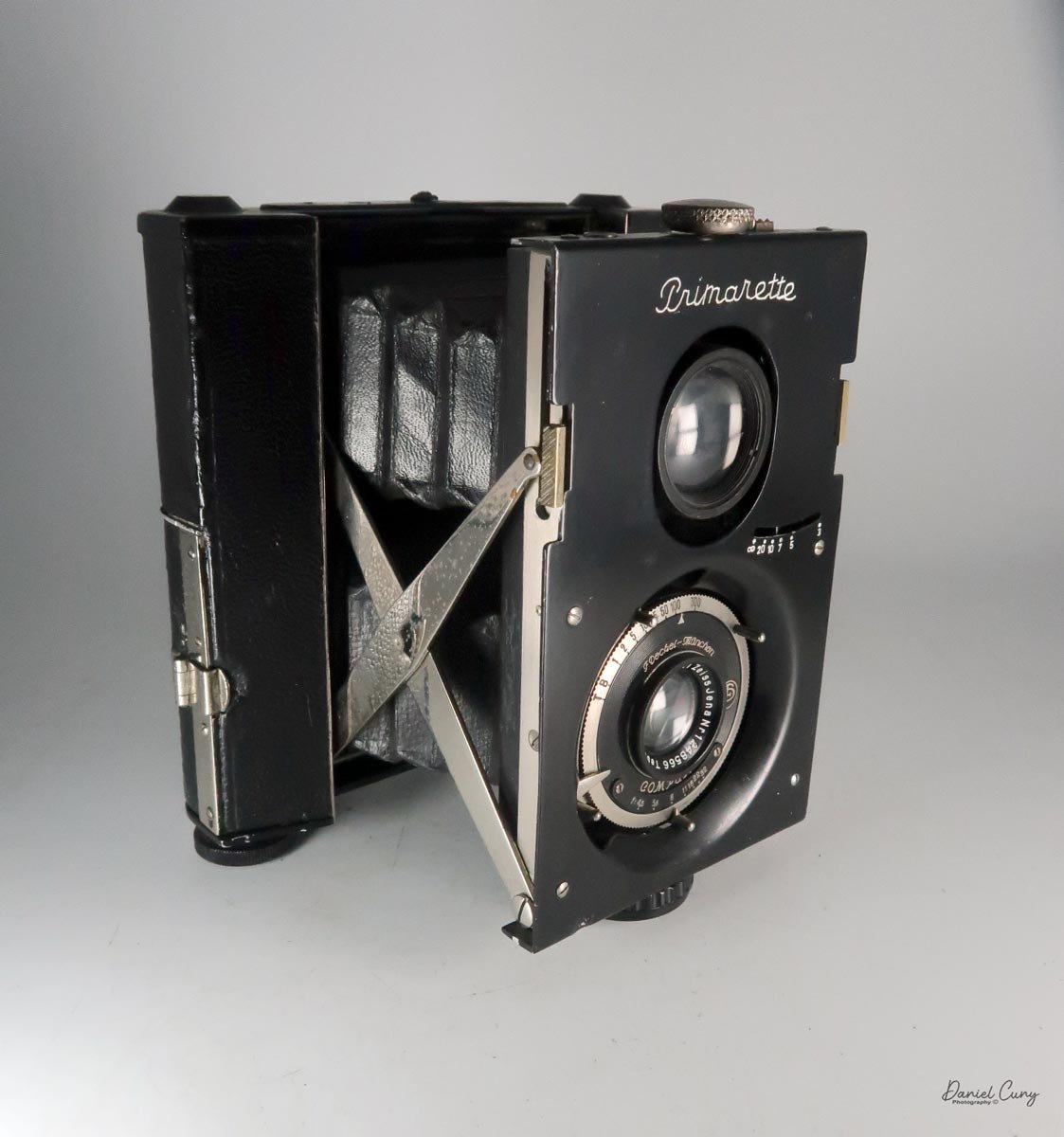
My Bentzin Primarette camera
My main objective during my trip to Tokyo a couple of weeks ago was to find cameras to write about for my camera-collecting blog. I believe I have another fun and interesting camera for this week's blog: a 1930s German-made Bentzin Primarette.
I found this wonderfully thin twin-lens camera, along with last week's blog camera, the Ebner camera, during my visit to Kitamura's flagship store. It was on the 3rd floor, in their "bargain" section, along with many other wonderful cameras I wanted to purchase. Unfortunately, not winning the lottery, I had to be selective in my camera purchases, but I couldn't pass up this beauty.
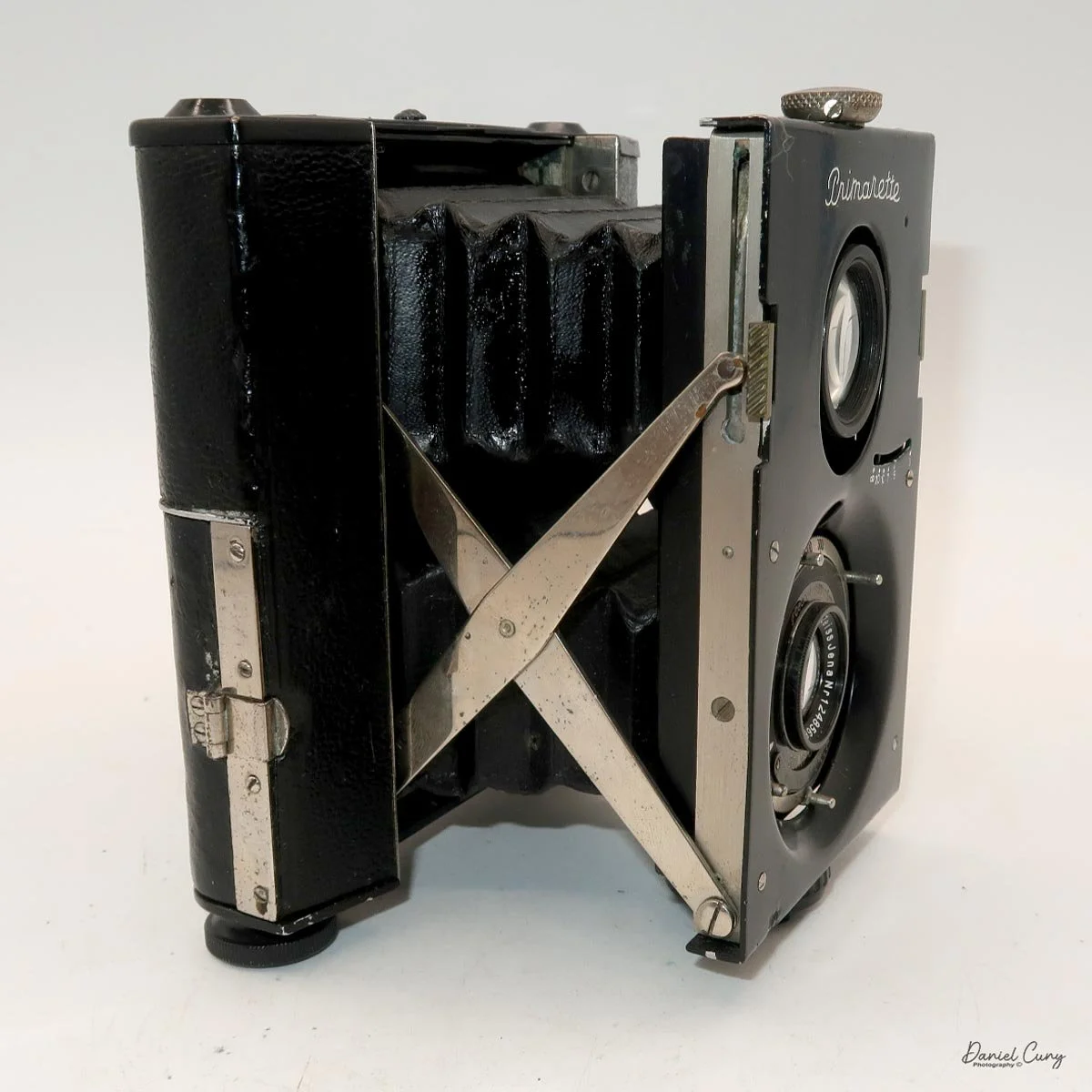
While the Bentzin Primarette has two lenses, it isn't a reflex model like the Rolleiflex, Yashicaflex, or Minolta Autocord, or some of the hundreds of other Twin Lens Reflex models. The camera is a folding camera with two sets of bellows: the top for focusing and the bottom for taking the image. Unlike a "Reflex" camera, there is no mirror in the top portion through which you focus, so the image you see is upside down, just like viewing through a view camera, with the image directly on the ground glass.
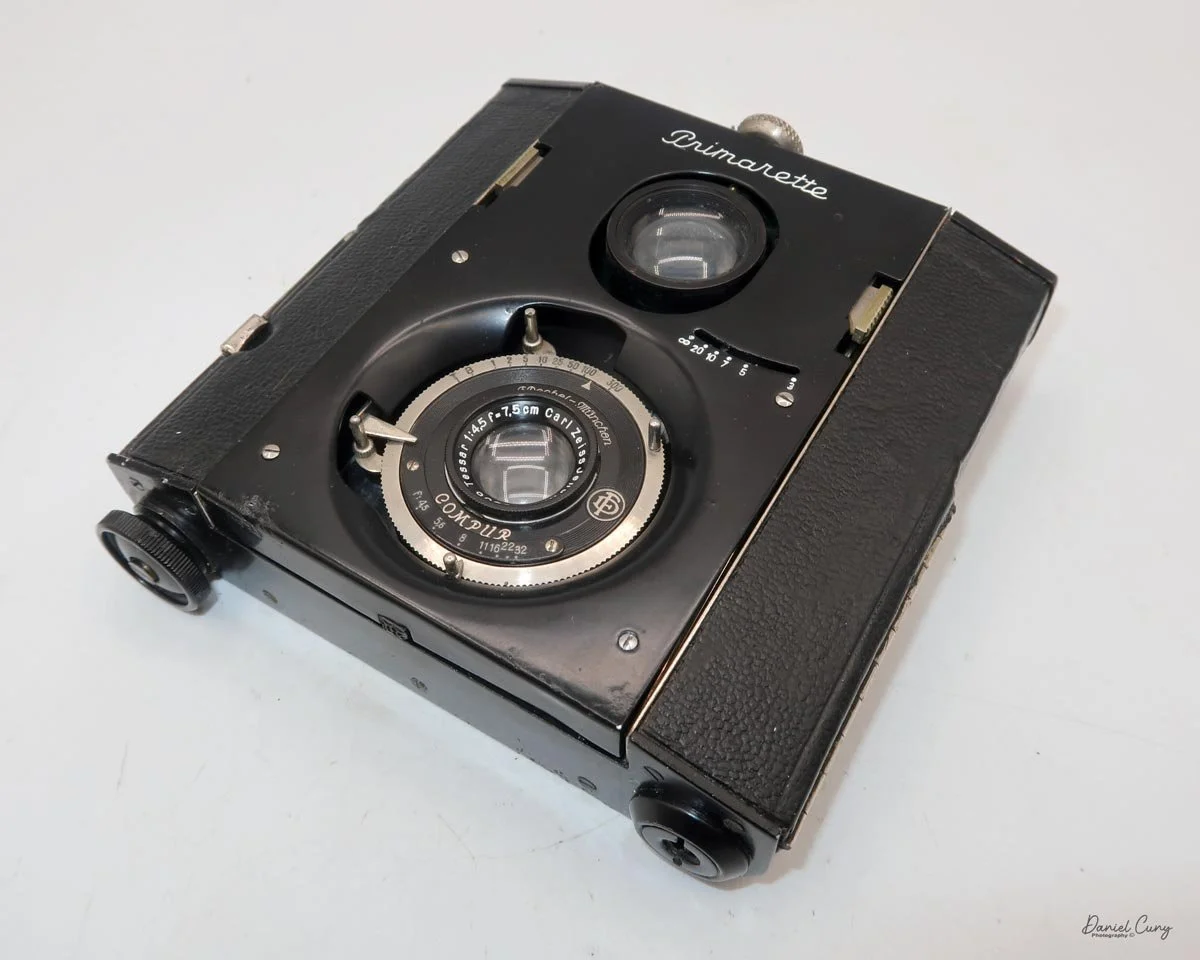
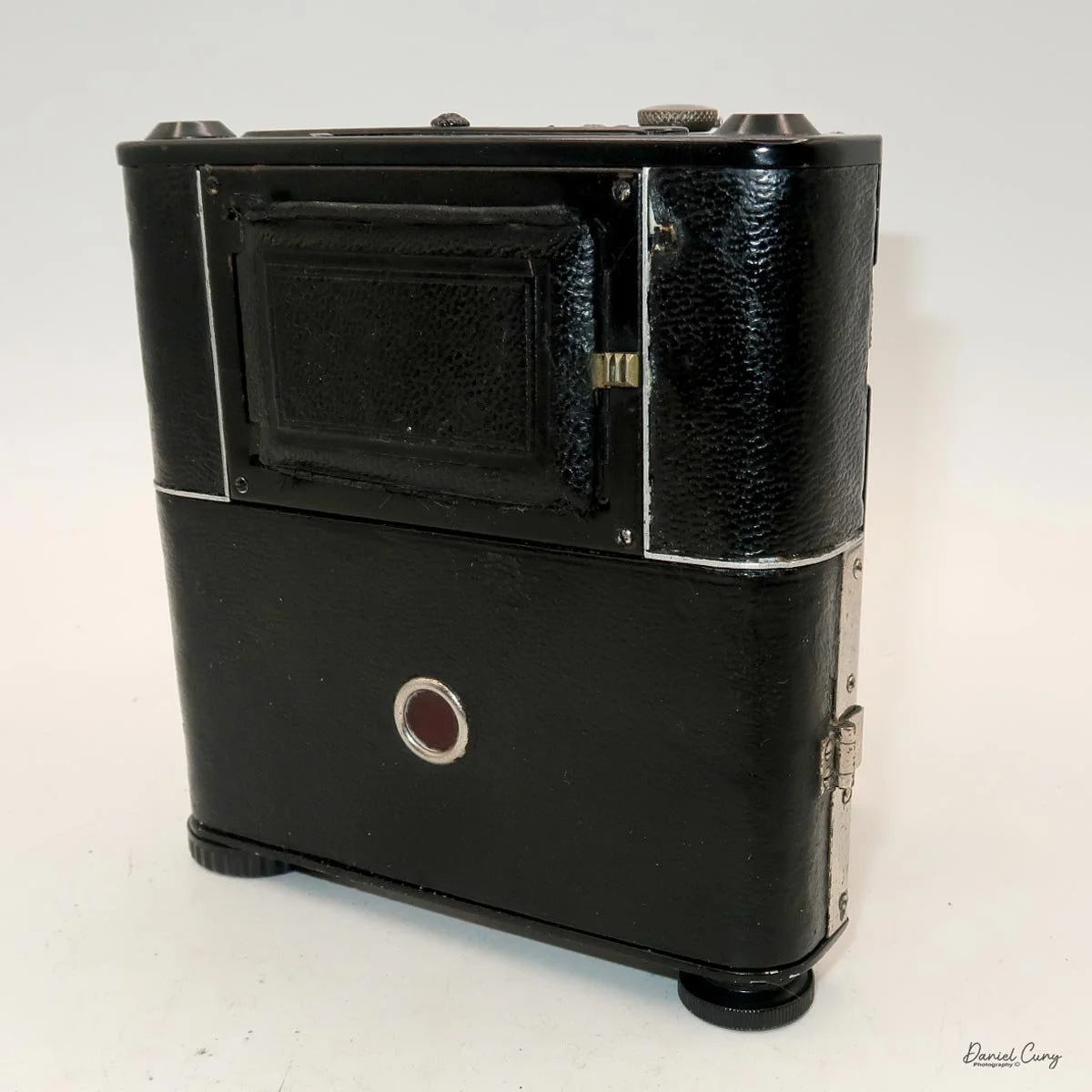
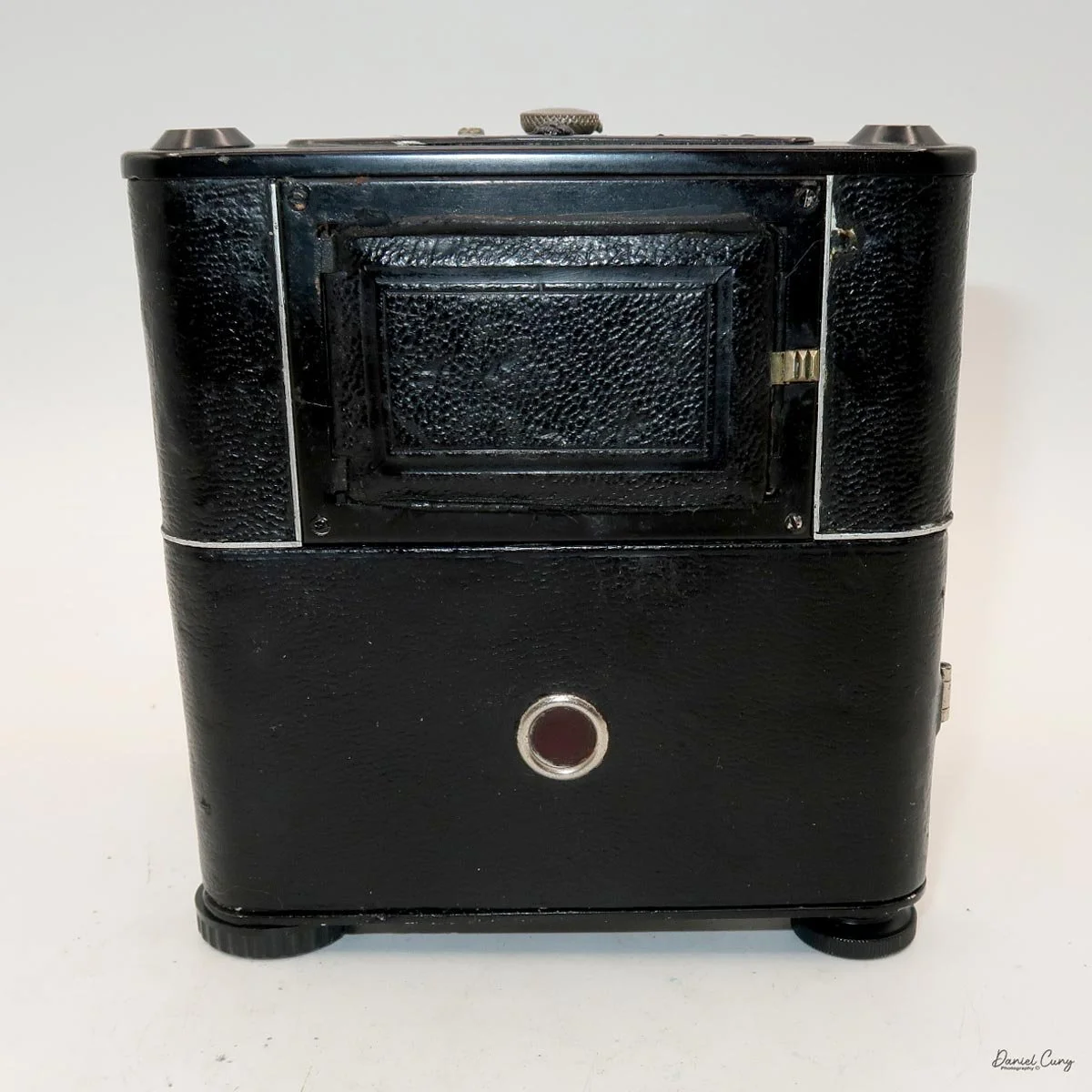
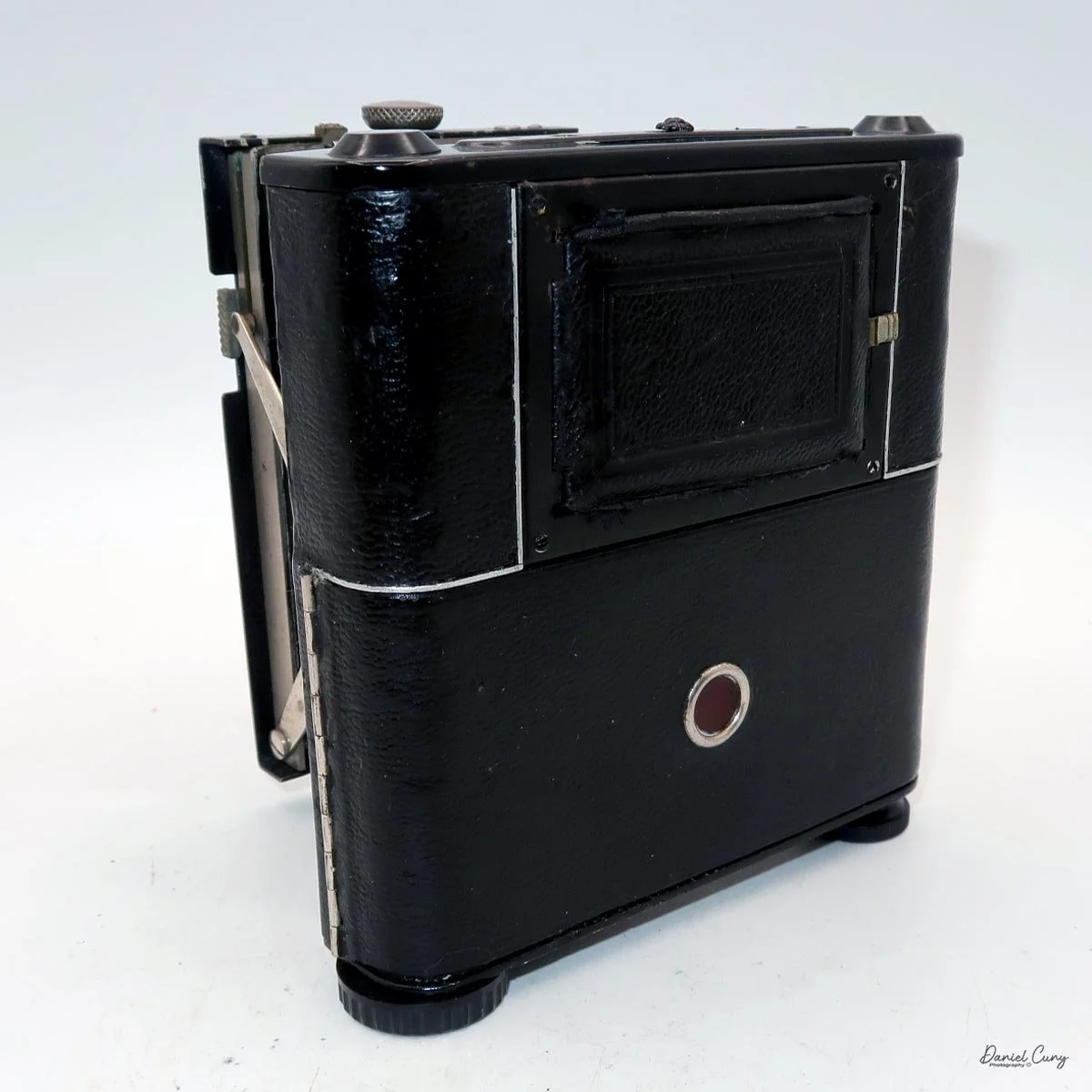
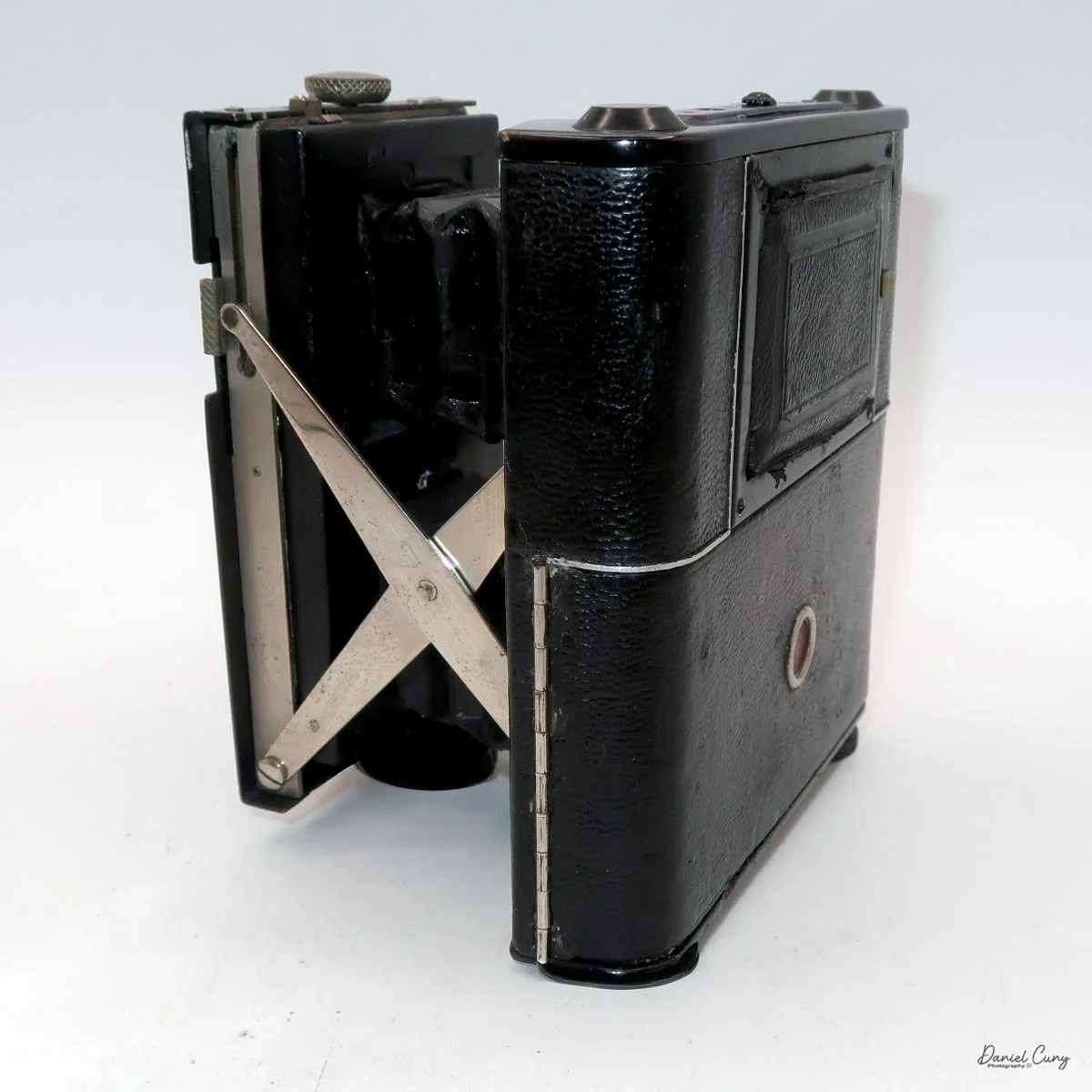
The Bentzin Primarette when closed.
During my inspection of the camera, I noticed a few minor issues with the Bentzin Primarette. The viewfinder cover is a bit tattered, yet fully intact. The focus seemed a bit loose, especially at the closest point, and the winding knob may have been replaced, as I've generally seen this camera with a chrome winding knob. The winding knob may be original, as cameras from this era often have parts swapped, so I'm uncertain about its originality.
The good parts of the Bentzin Primarette camera are that the shutter fired on all speeds, the aperture moved smoothly, there were no holes in the bellows for either the upper or lower portion, and the camera opens and closes smoothly. To me, the camera is just a work of art. It's sleek, compact, and just odd enough to make it very interesting.
To make the camera complete, I would have preferred the fitted case and some lens caps, but the positives outweighed the negatives, and the issues are minor to me, so I let the salesperson know I'd like to purchase it along with a few other cameras.
History:
Bentzin was a German camera maker founded by Curt Bentzin in 1889 in Görlitz, and it became known for well-made, innovative cameras aimed at serious amateurs and professionals. The company's history mirrors the broader rise of German photographic manufacturing in the late 19th and early 20th centuries, with Bentzin building a reputation for technical refinement rather than mass production.
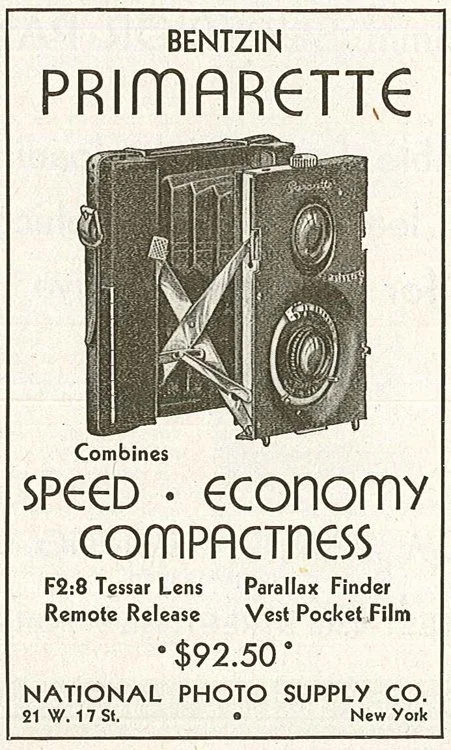
Advertisment for Bentzin Primarette camera
Curt Bentzin established the firm as a workshop for photographic apparatus. By the turn of the century, the company was already connected with Carl Zeiss Jena, reflecting its standing in the optical industry. Sources note collaboration as early as 1899 or 1902, when Bentzin helped Zeiss develop camera manufacturing processes, underscoring the company's close ties to Germany's leading optical specialists. That relationship helped position Bentzin cameras as high-quality products with strong mechanical and optical credentials.
Bentzin's best-known cameras included the Primar, Primarflex, Reflex-Primar, Primarette, and Luxus Reisekamera, models that collectors still prize for their engineering and scarcity. The company produced a range of plate, folder, and reflex cameras, often using premium components from firms like Zeiss. Because production runs were relatively small, Bentzin never became a giant like Zeiss Ikon or Voigtländer, but it earned a distinct niche through craftsmanship and inventive design.
The company's fate changed after World War II. In 1945, Bentzin was placed under state control in the Soviet occupation zone, then renamed and reorganized through a series of East German state enterprises, including VEB Görlitzer Kamerawerke and later VEB Primar-Kamerawerk Görlitz. By 1951, it had been absorbed into VEB Feinoptisches Werk Görlitz, and the original Bentzin line was discontinued by 1954.
Today, Bentzin is remembered as a respected but relatively small German camera manufacturer whose surviving cameras appeal strongly to collectors and historians. Its story is especially interesting because it combines regional industrial history, close ties to Zeiss, and the transformation of private German industry into East German state production after the war.
My Camera:
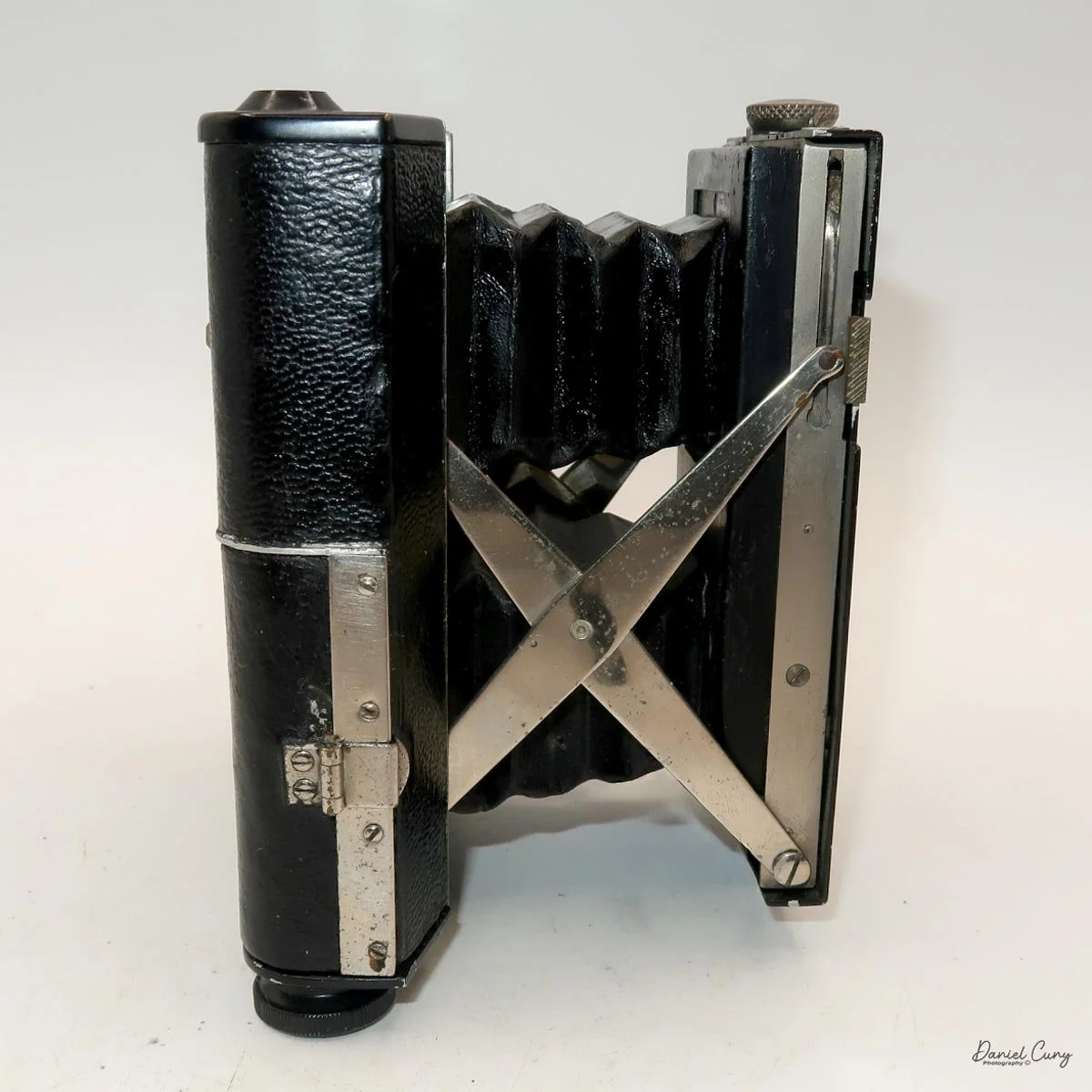
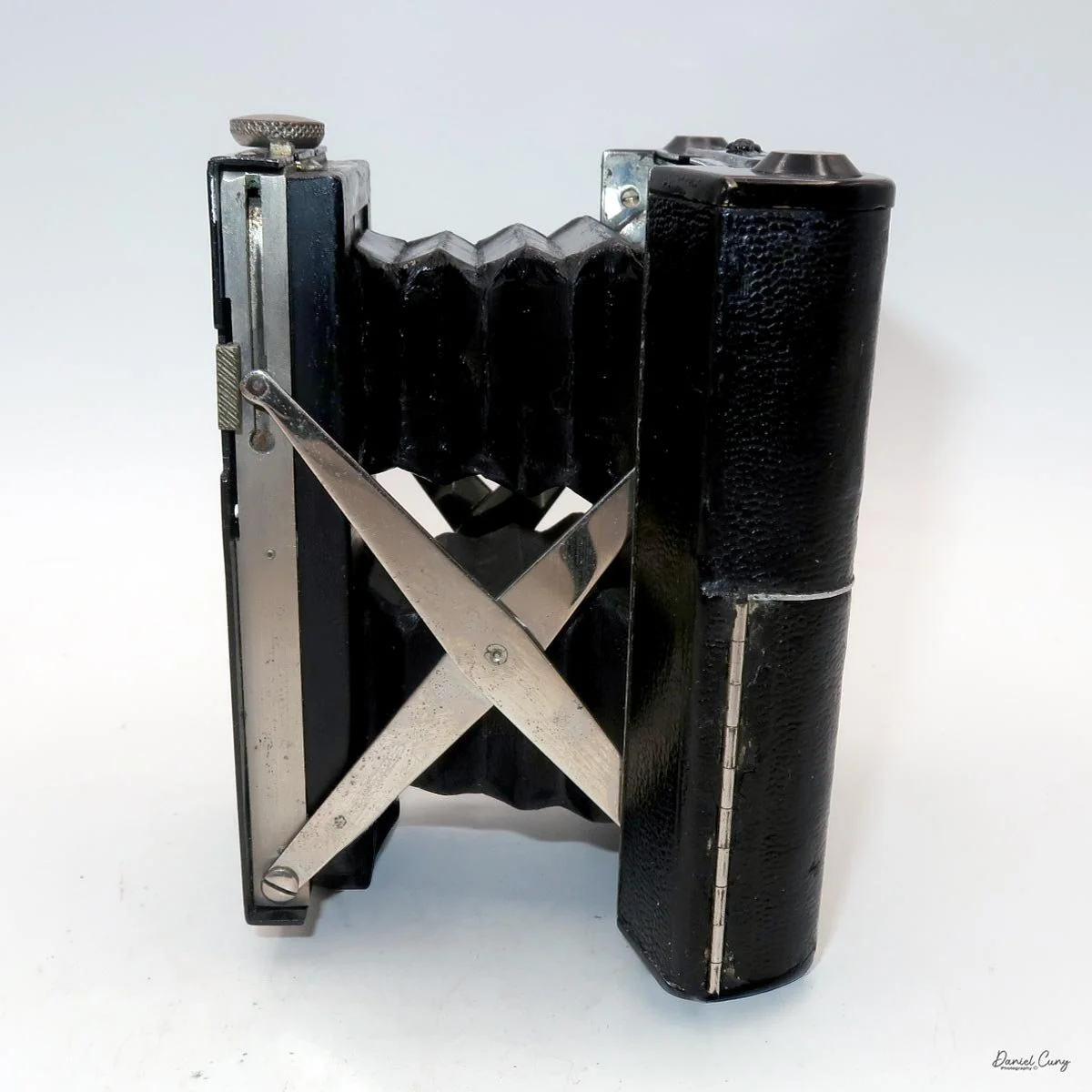
My Bentzin Primarette camera is 5.25" tall by 5" wide, and only 1.25" deep when the lenses are retracted, and 4" deep with both lenses extended into the viewing and taking positions. The camera weighs 1 pound and 5.1 ounces.
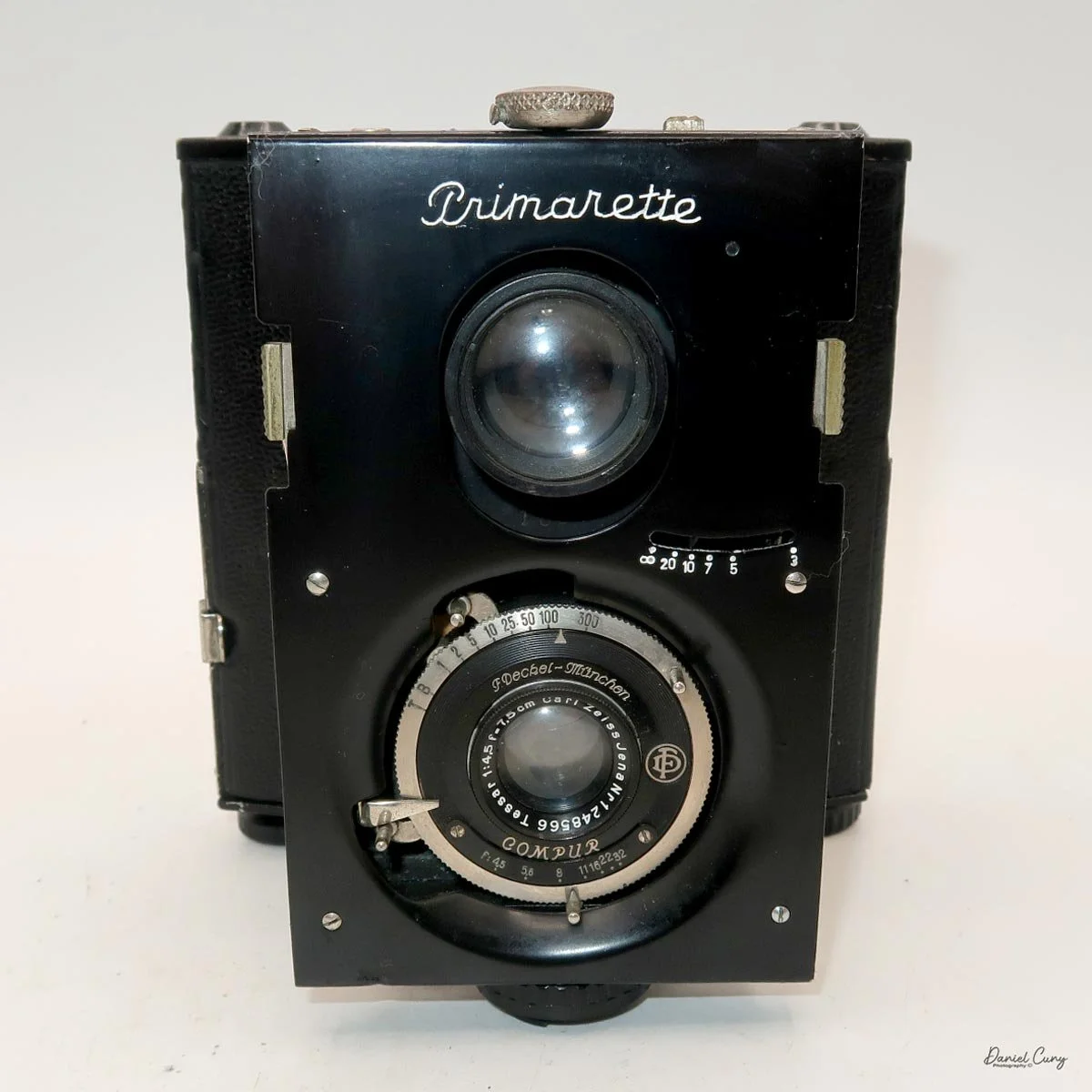
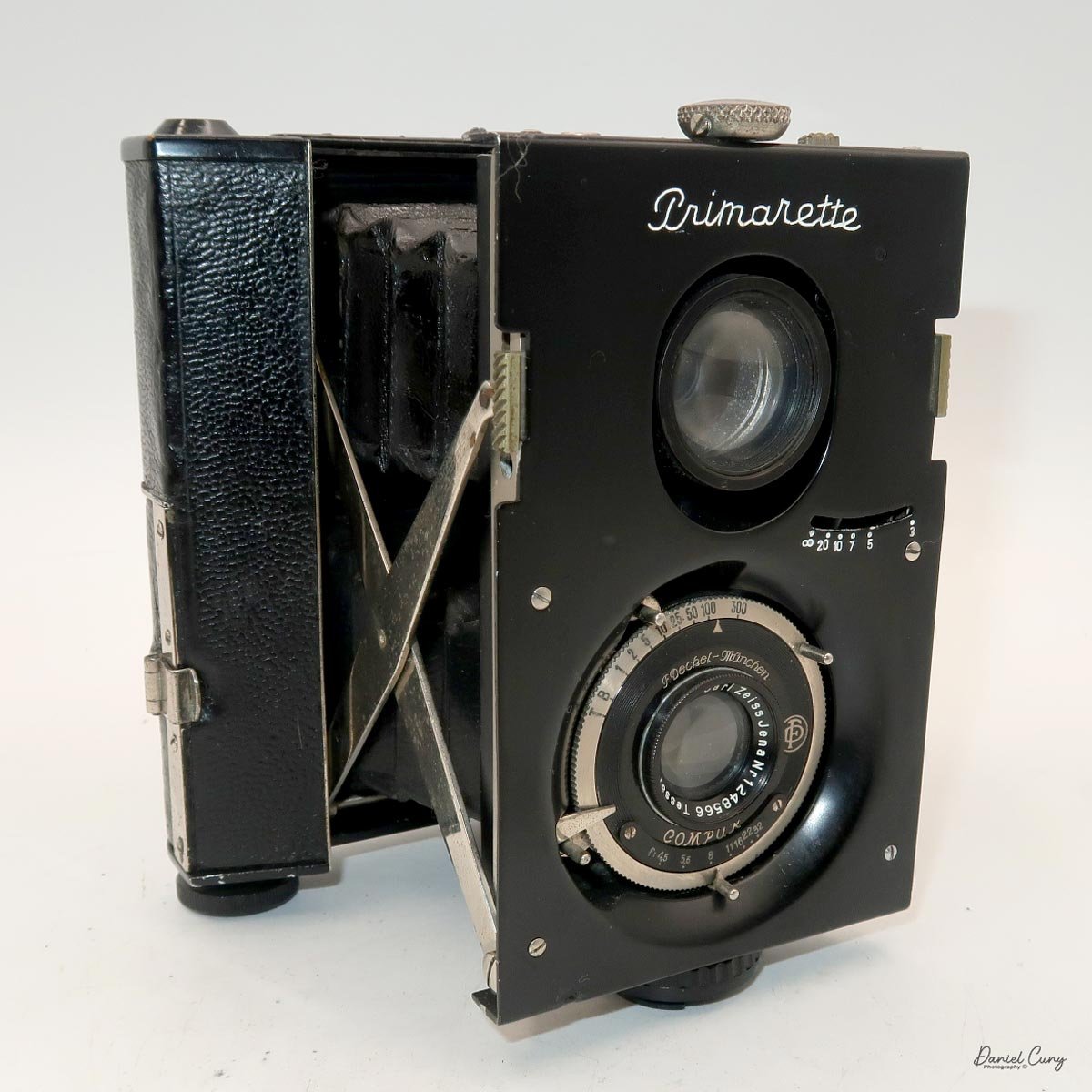
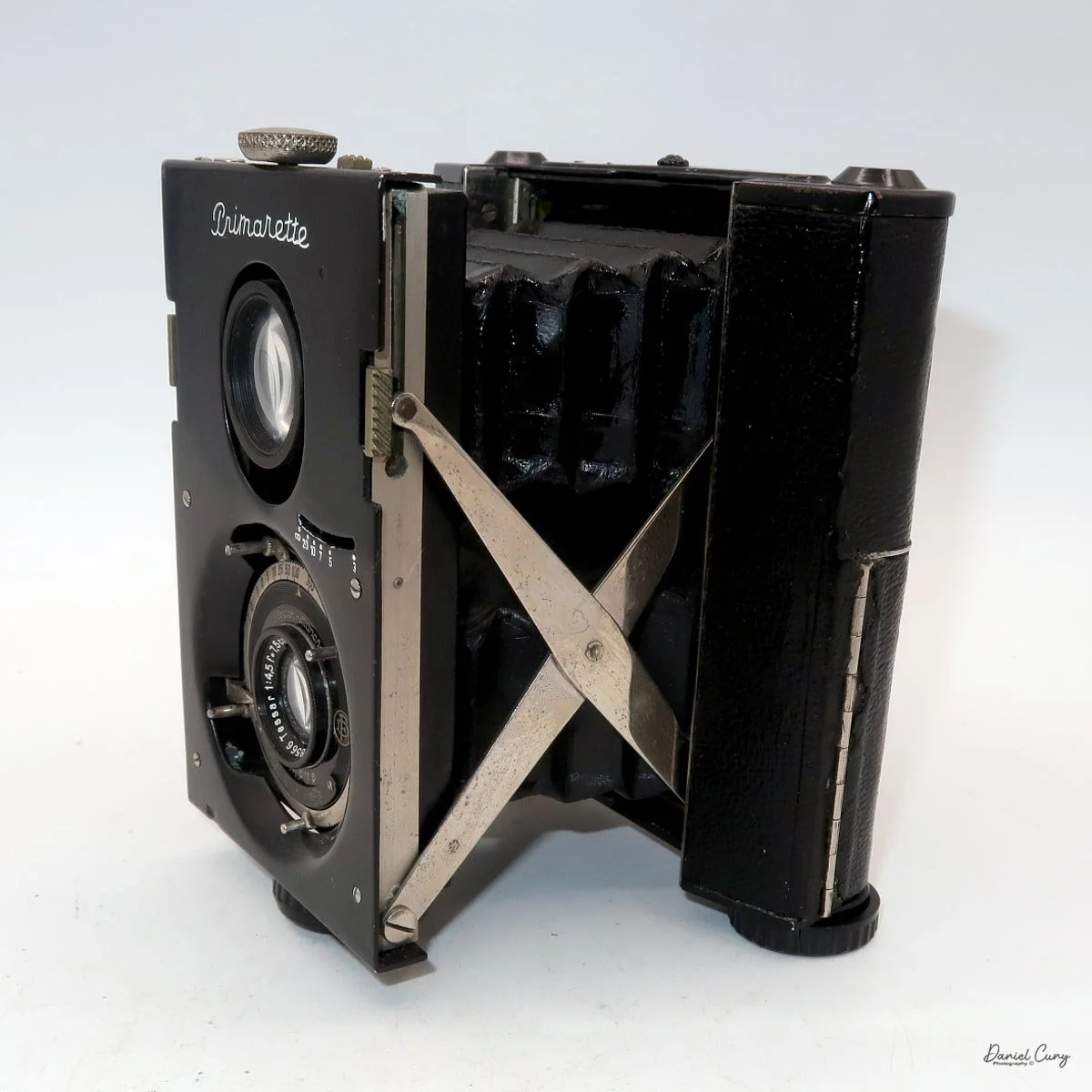
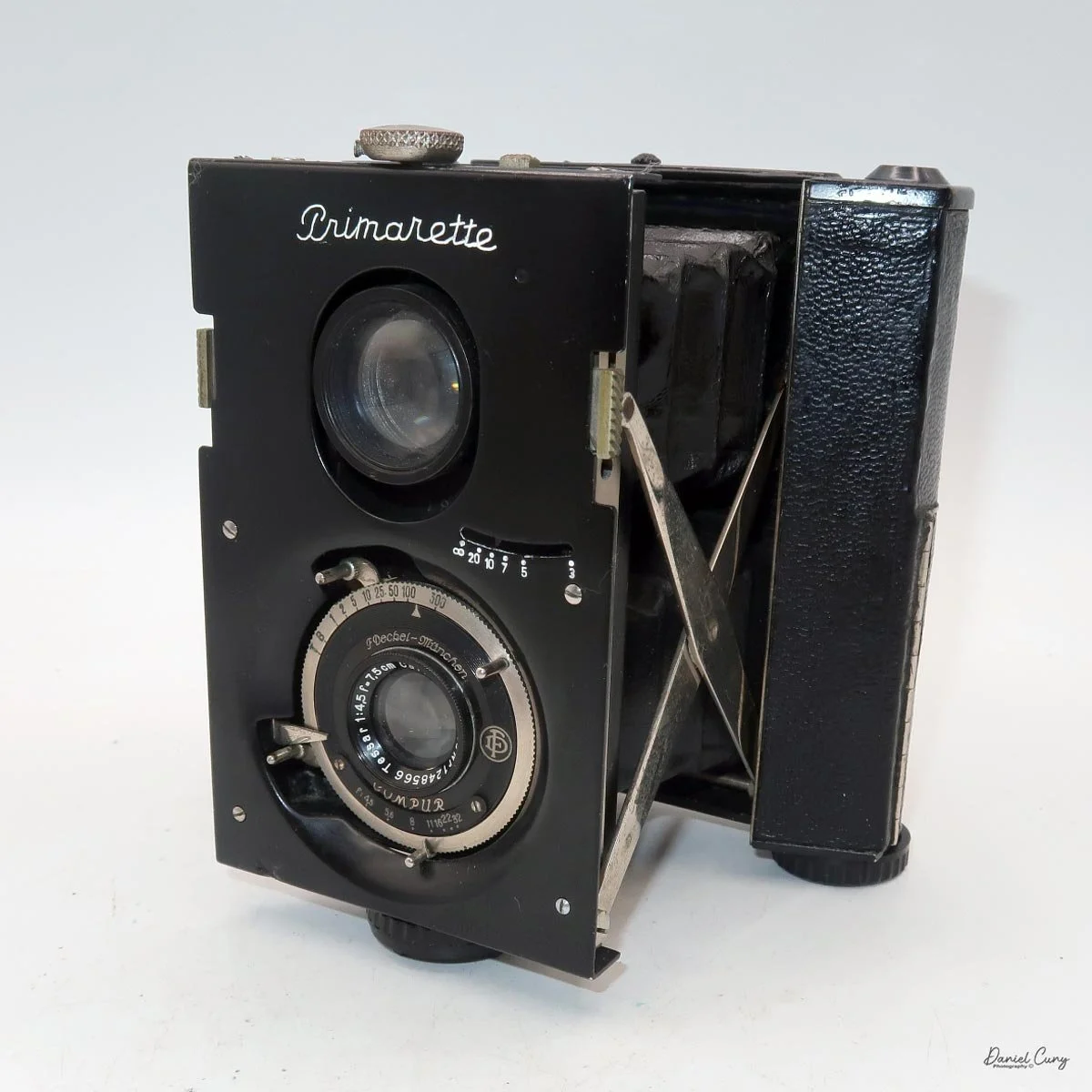
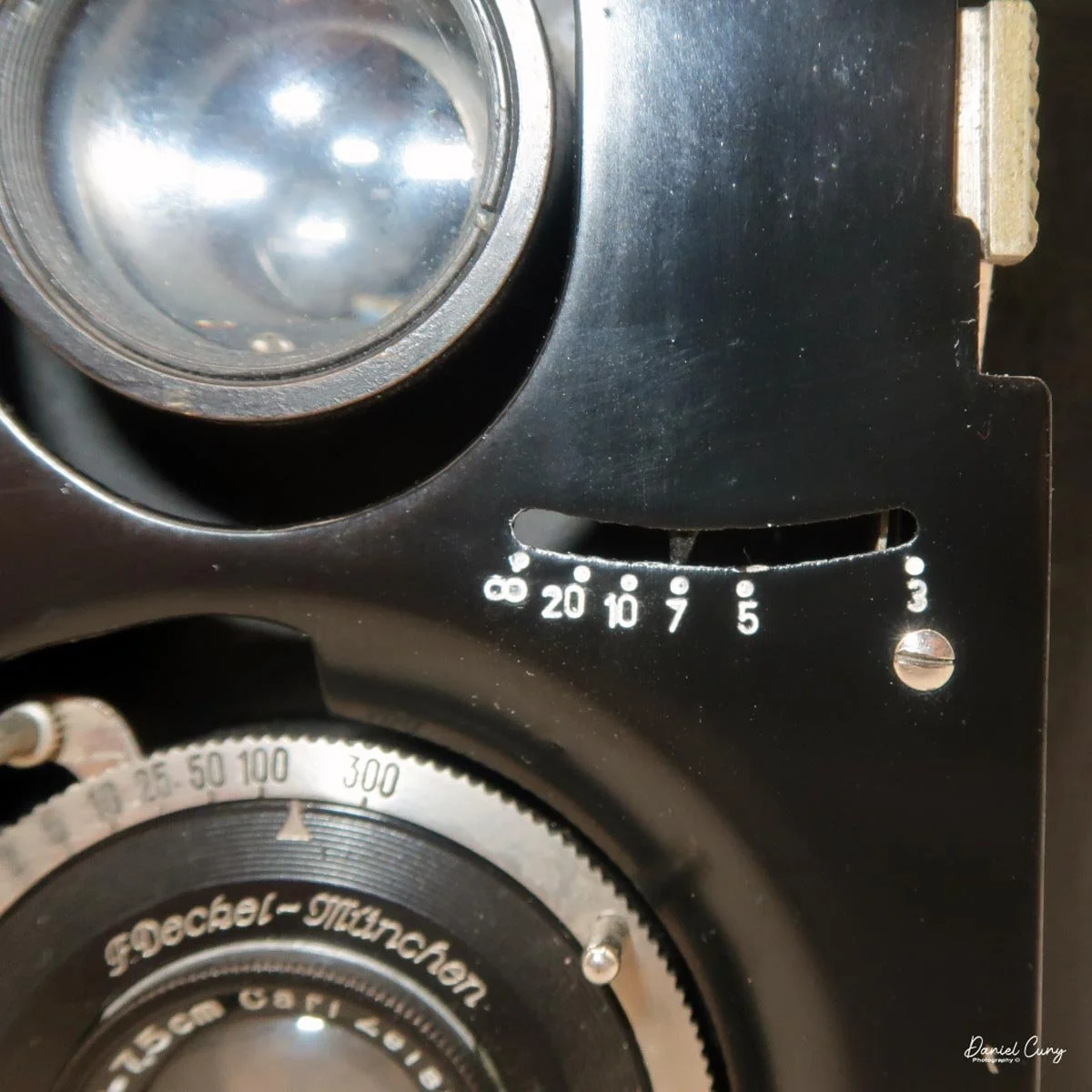
The camera has a Carl Zeiss Jena Tessar 7.5cm, F/4.5 lens, serial number 1248566, with a Compur shutter that ranges from 1/300 to 1 sec. along with "B" and "T". The aperture ranges from F/4.5 to 32. Both the shutter speeds and aperture are set by rotating the ring to the desired setting. Since the lens is a bit recessed into the camera body, both the shutter speed and aperture selectors have a protruding arm that allows you to set both settings, making it considerably easier.
Think of the camera as two cameras in one, yet connected top to bottom. The top is for focus and composition, while the bottom is for taking images, yet both fold down into one compact camera.
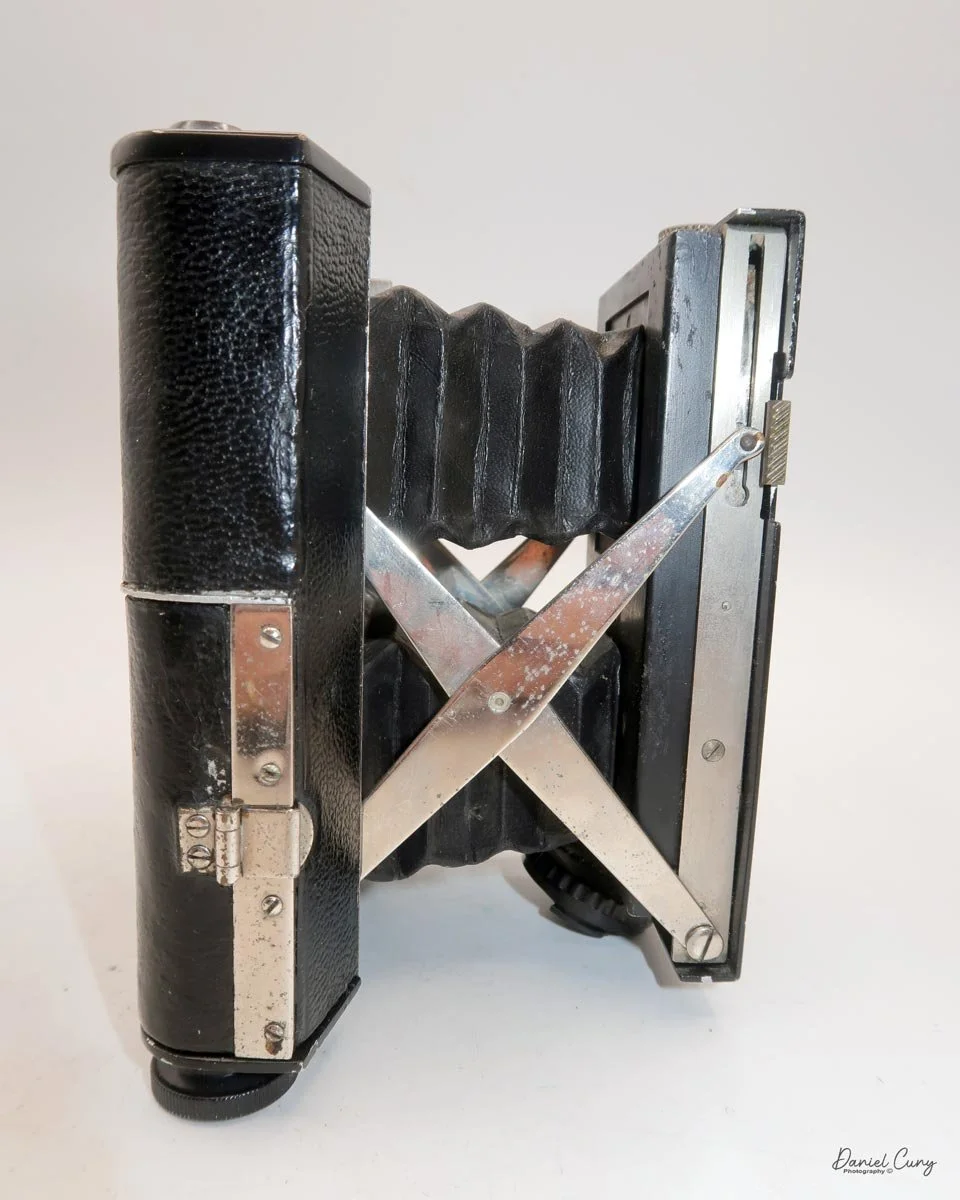
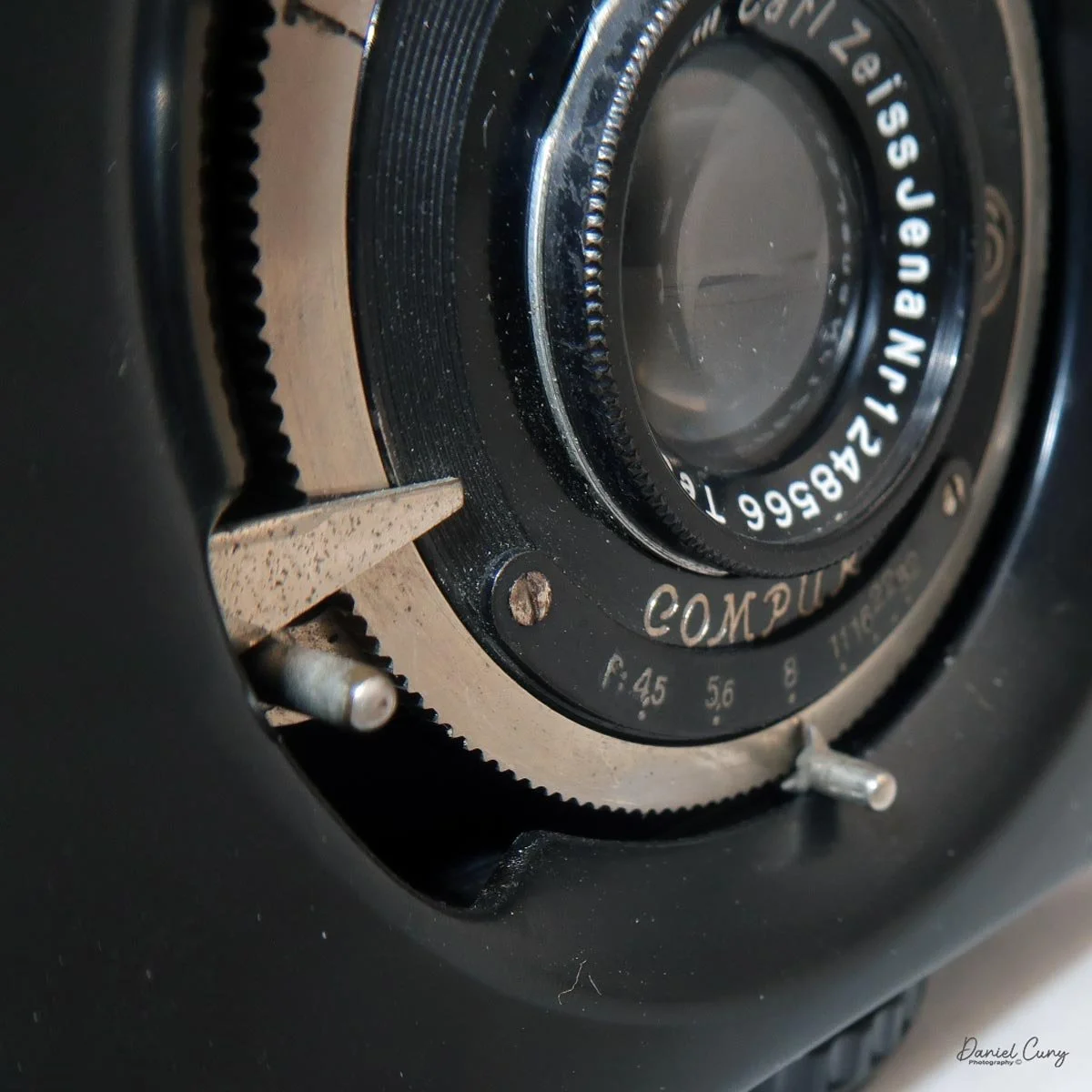
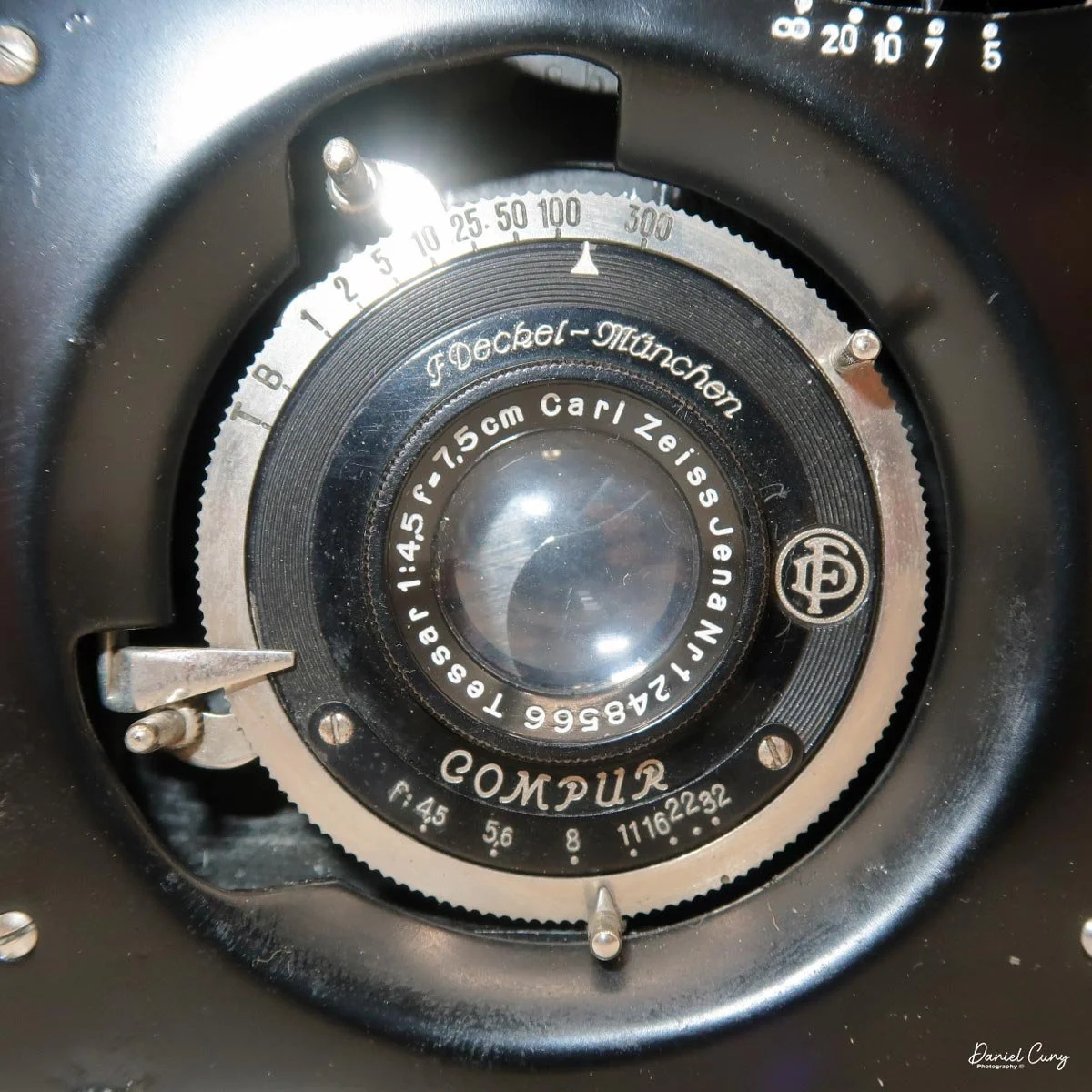
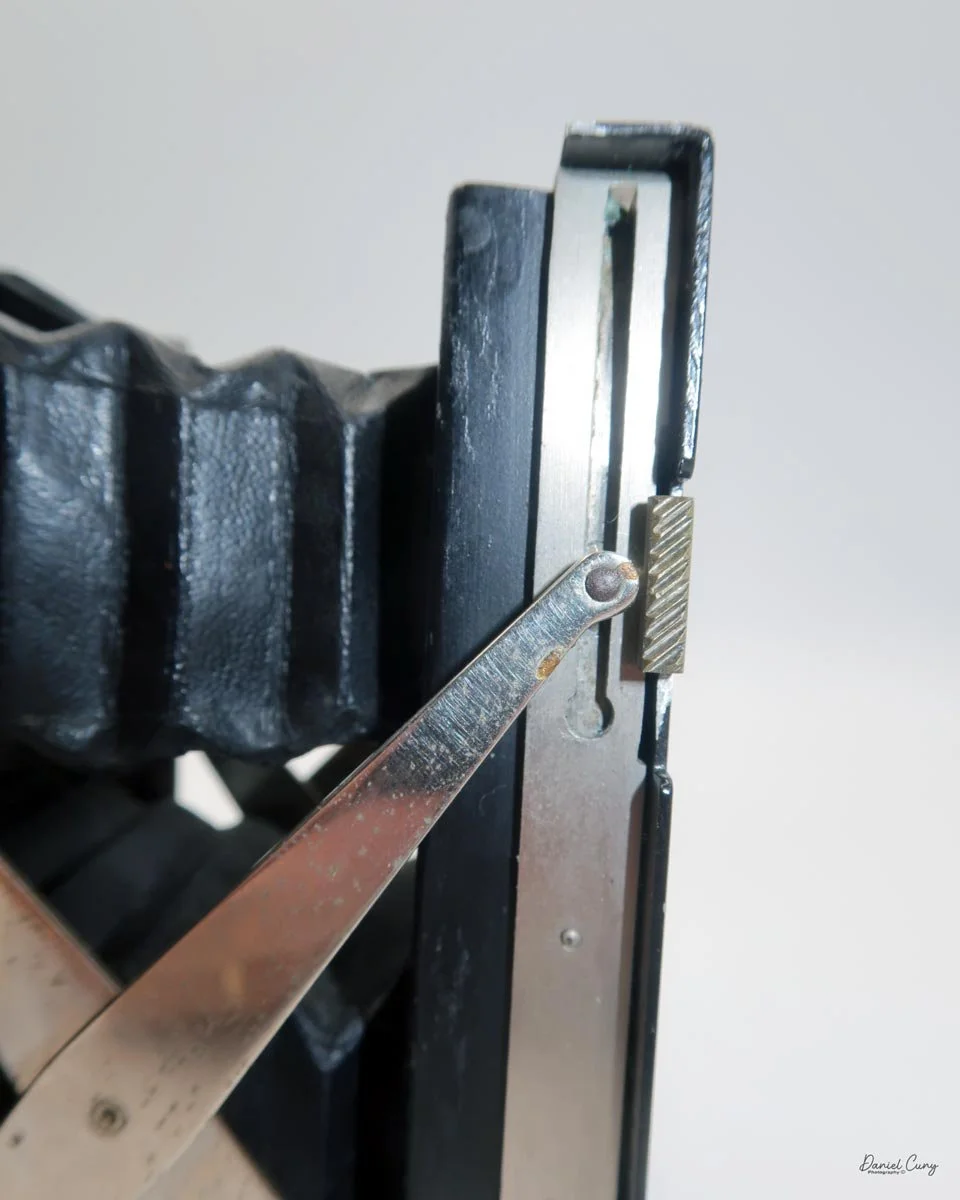
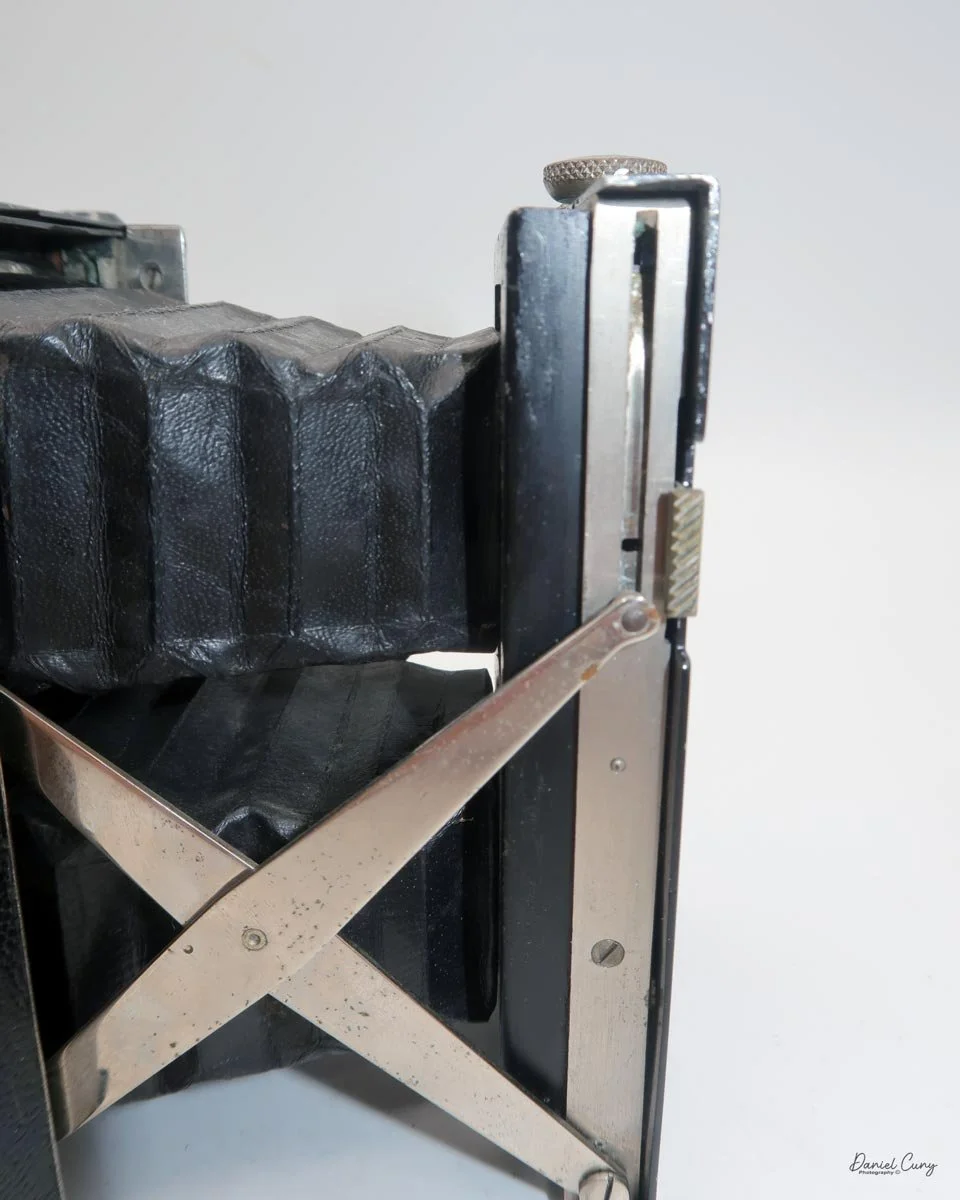
To extend the lenses from the camera body, there are two knurled pins on the top and bottom of the lens board that you depress to unlock. This allows you to pull the lens board away from the camera body, which is on struts, and lock the camera into the taking position. PLEASE NOTE, there are two positions the lens board can stop at. The first position doesn't allow the camera to focus on the closest three-meter position. This is the position I took for the majority of the photos for the article.
Pressing in the two knurled pins on the sides of the camera, on either side of the camera's top and viewing lens, allows you to pull the lens board out further, allowing the camera to focus all the way to the three-meter position. These two pins also allow you to press the lens board back into the camera's body to close and transport the camera. I discuss this a bit in the conclusion portion of the post, too.
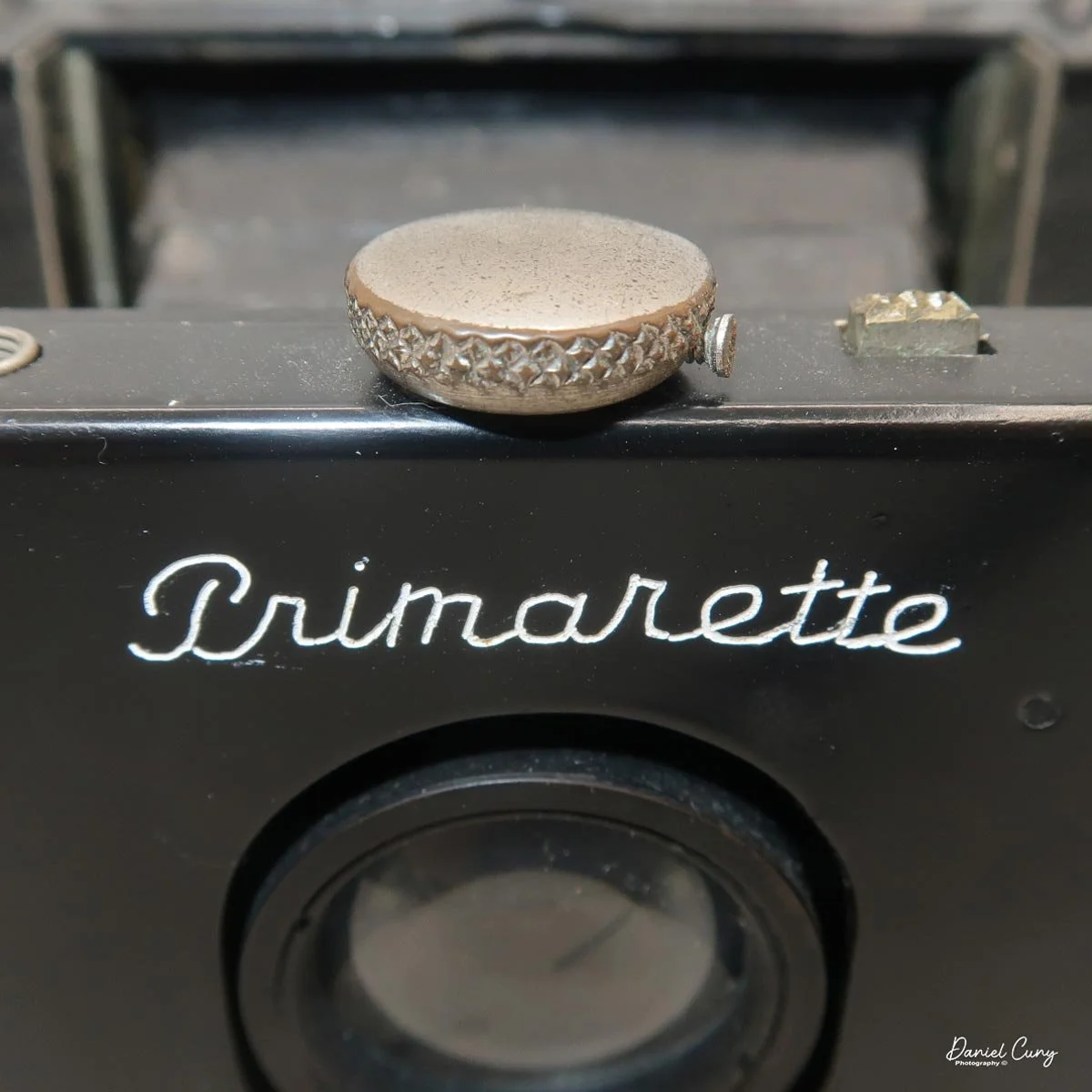
At the top of the lens board is a large chrome disk that you turn to focus the lens. The lens will point down as you focus closer to your subject to compensate for parallax. To the right of the focusing wheel is the shutter release cable socket.
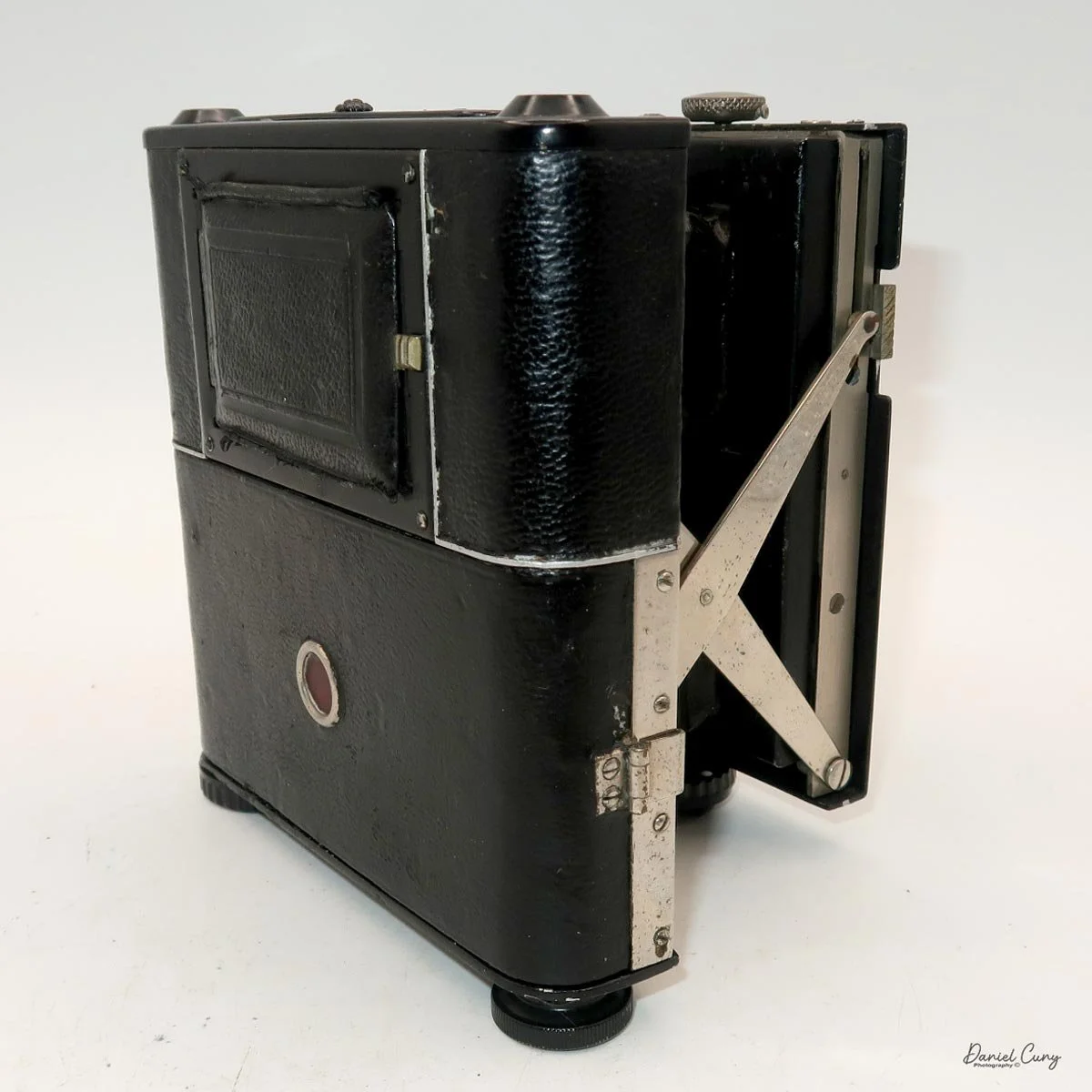
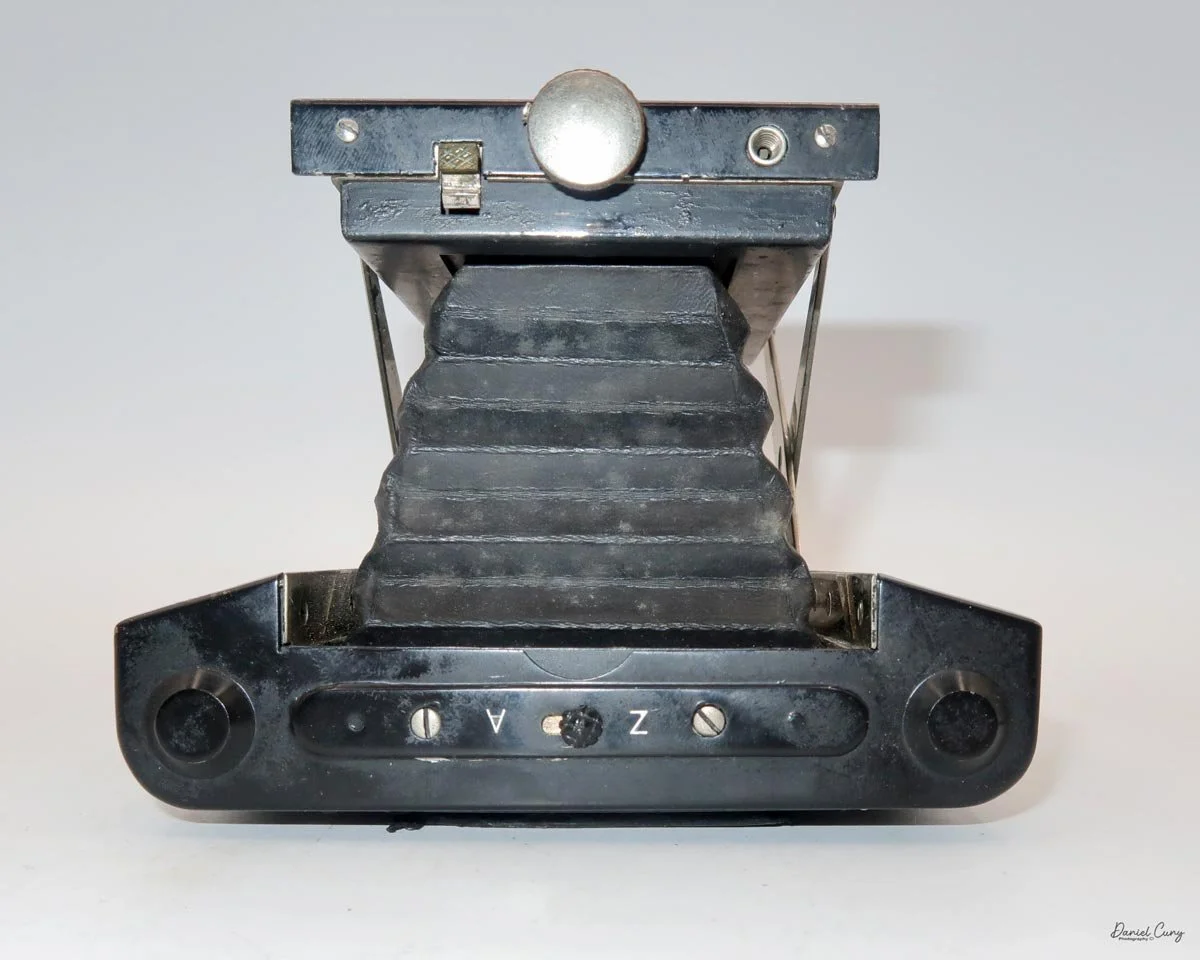
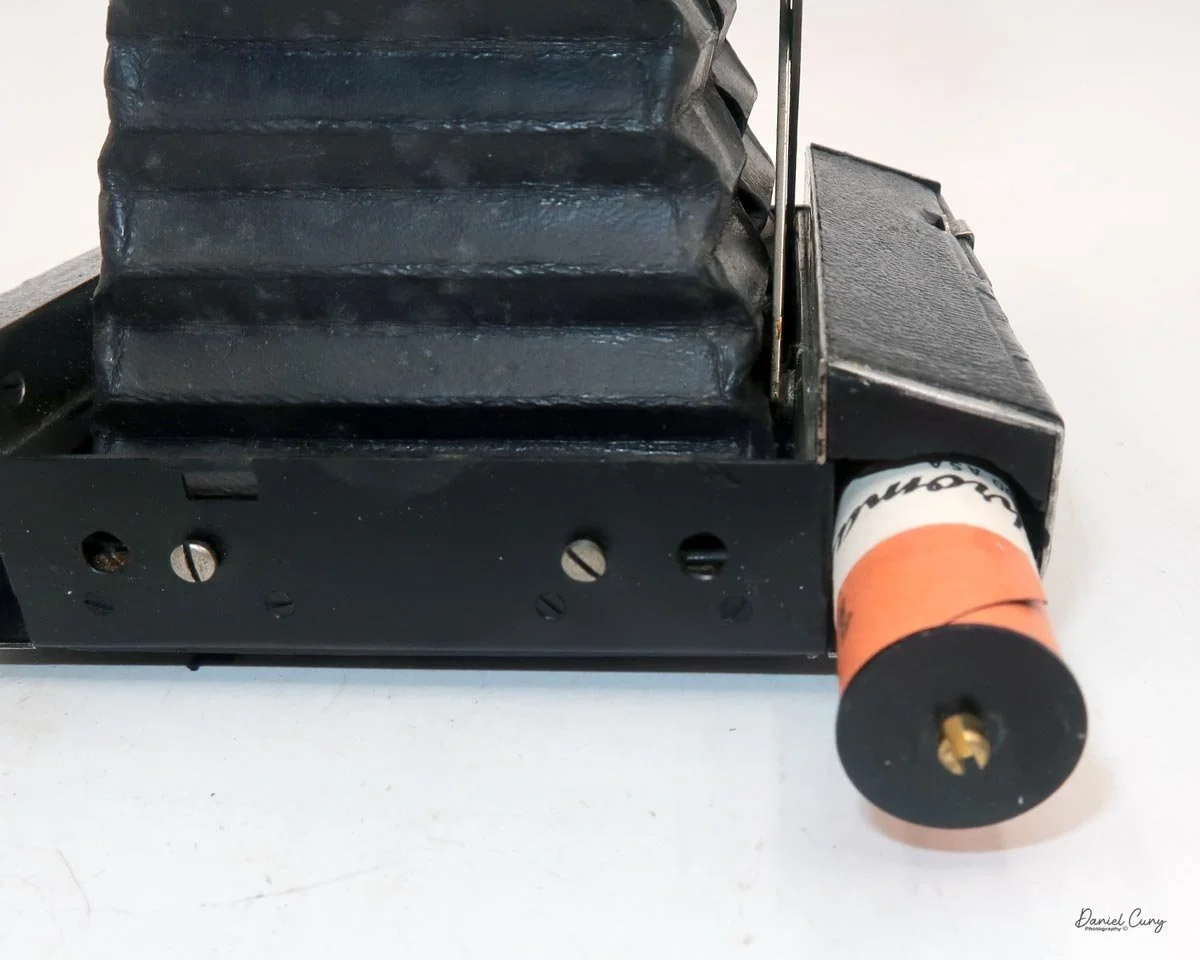
An interesting part of the camera is something I didn't even notice until I got it home and started to really play with it: on the camera's body, in the rear, is a removable cover that allows the photographer to carry two extra rolls of film in the camera. You can use these for both exposed and unexposed film. Just slide the lever from "Z", the locked position, to "A", and the cover comes off, exposing where the film can go. That's very clever.
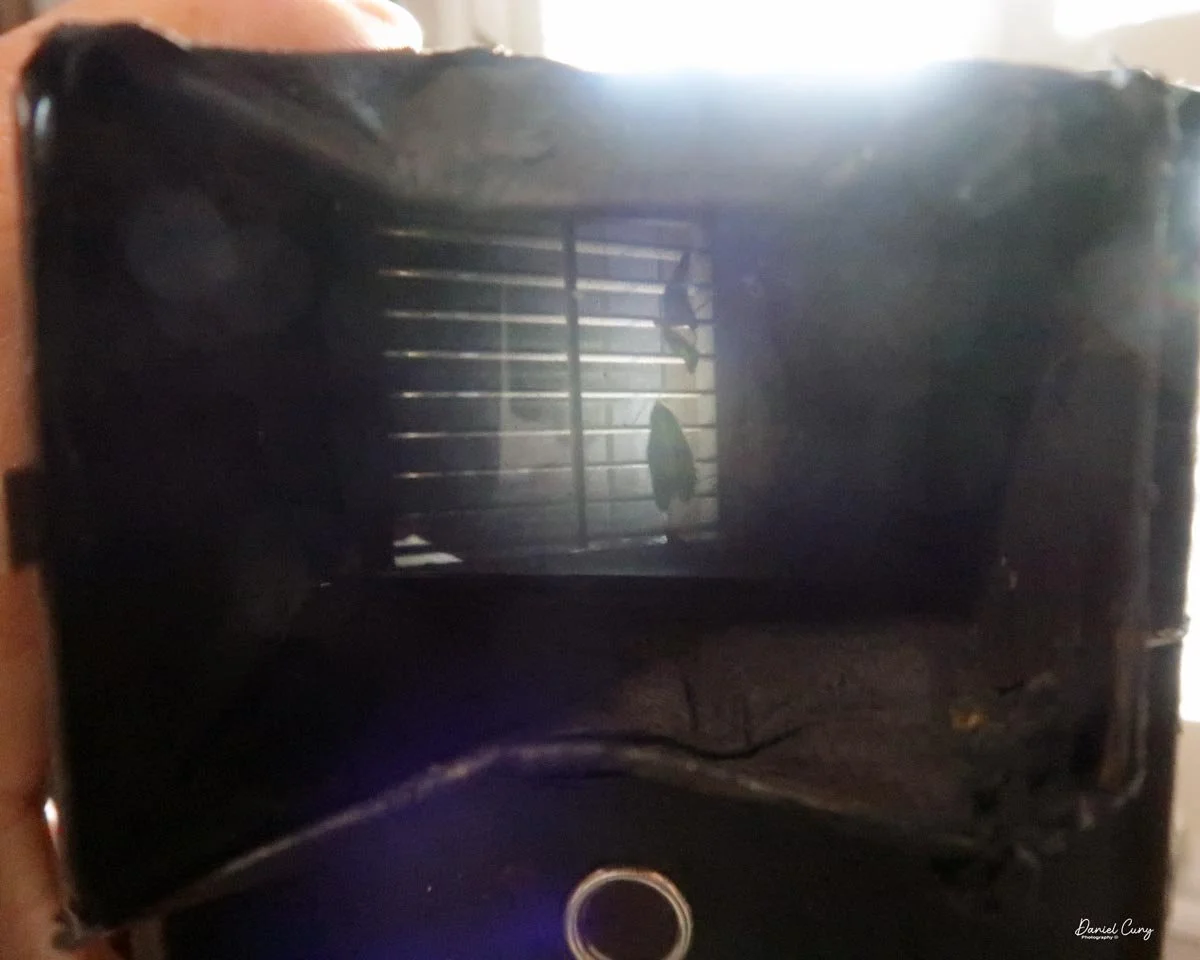
On the back of the camera, on the top, is a small lever you slide to the right; when you do, the focusing hood opens, exposing the ground glass on the camera, which you use to focus on the subject. For me, the area is pretty small, and on my camera, it's missing the magnifying lens, which I've seen on other cameras, so I'm unsure if there is supposed to be one. To close, press the right side of the hood, and the fabric hood collapses, allowing you to close it back into the camera's body.
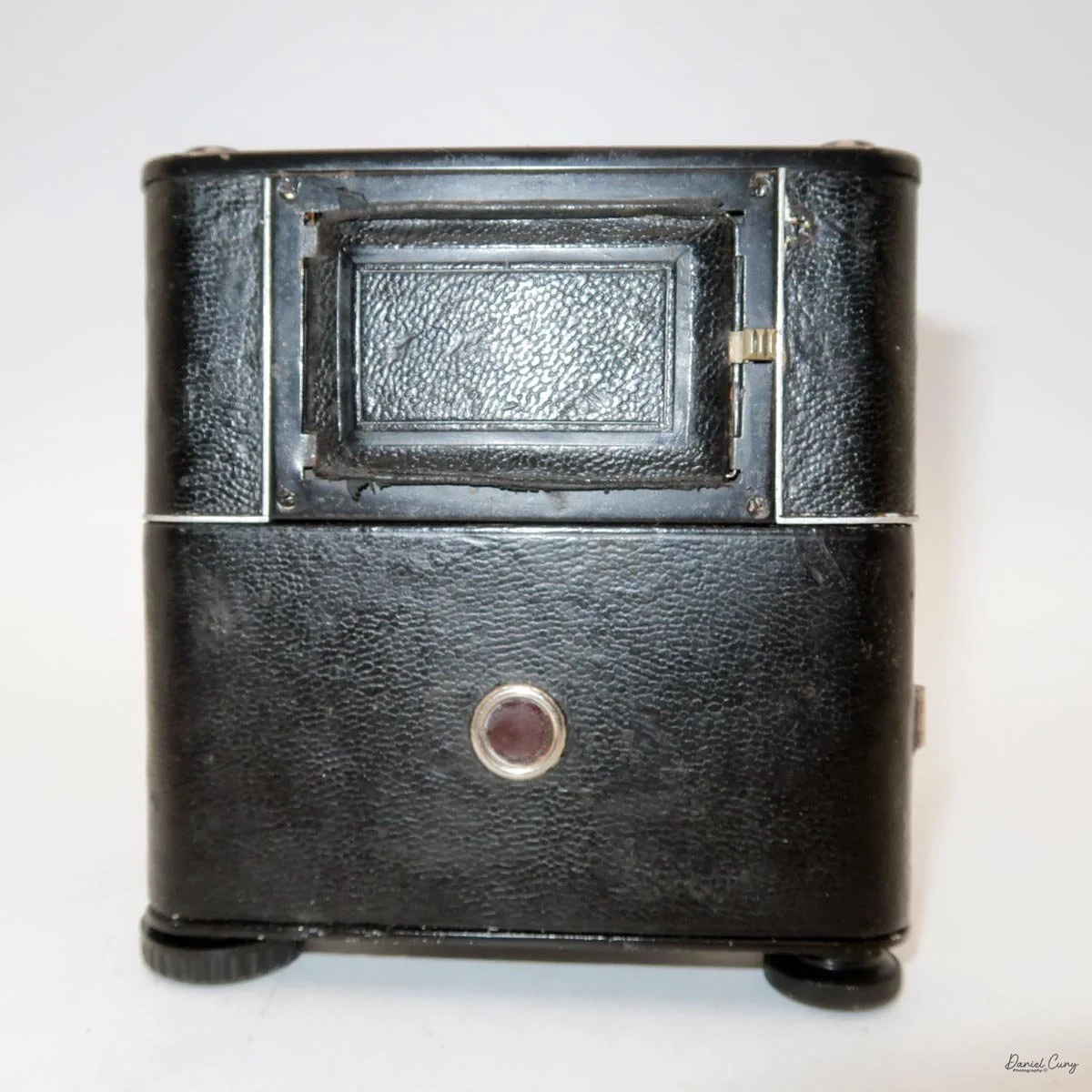
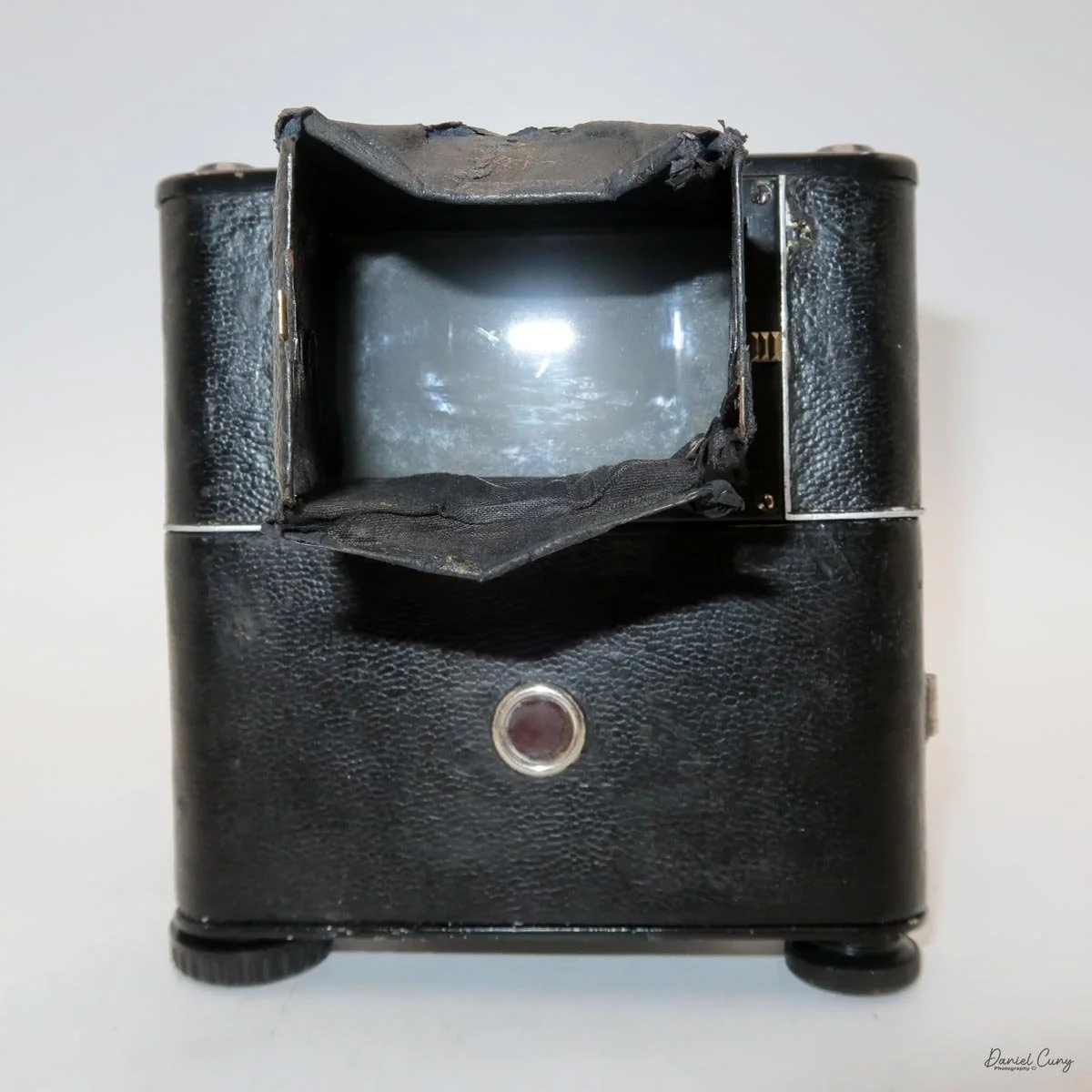
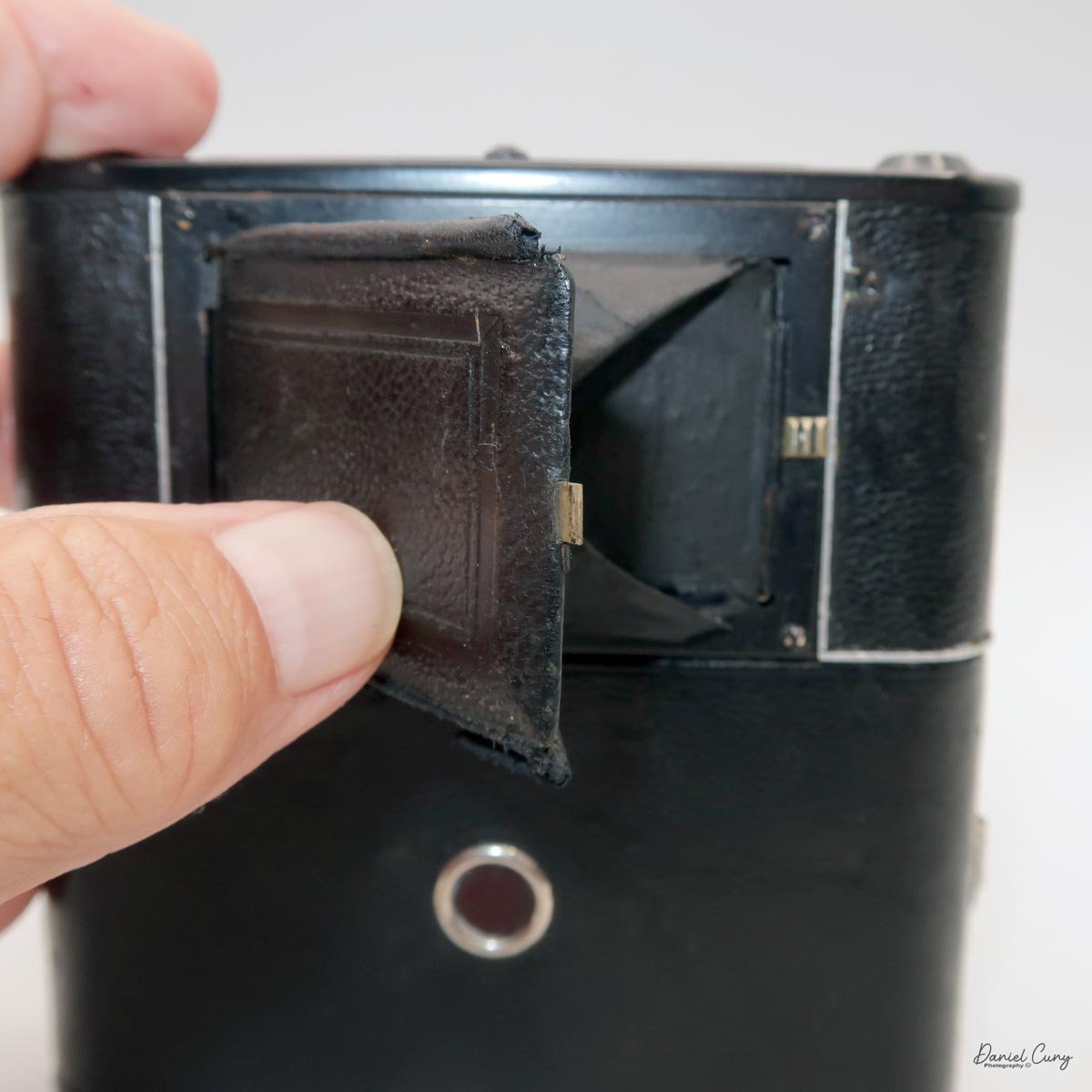
On the bottom of the camera, on the right side, is a metal locking hook that you pull back, and the film door opens, allowing the photographer to change the 127-size film the camera uses. It's similar to many other 127-size cameras: you put the empty spool on the left and take up a spool on the right side of the camera, where the winding knob connects to it. Pull back the winding knob and insert the take-up spool.
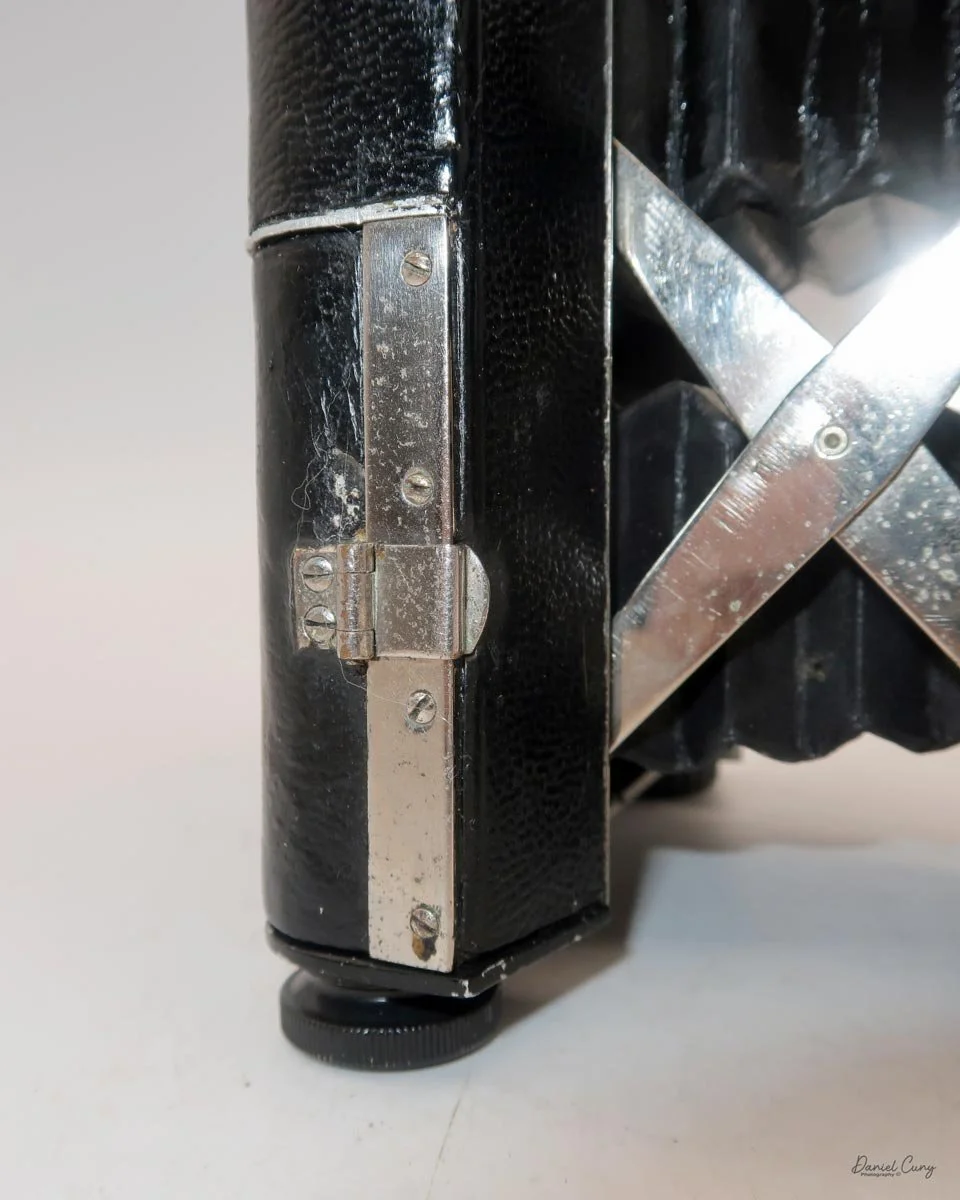
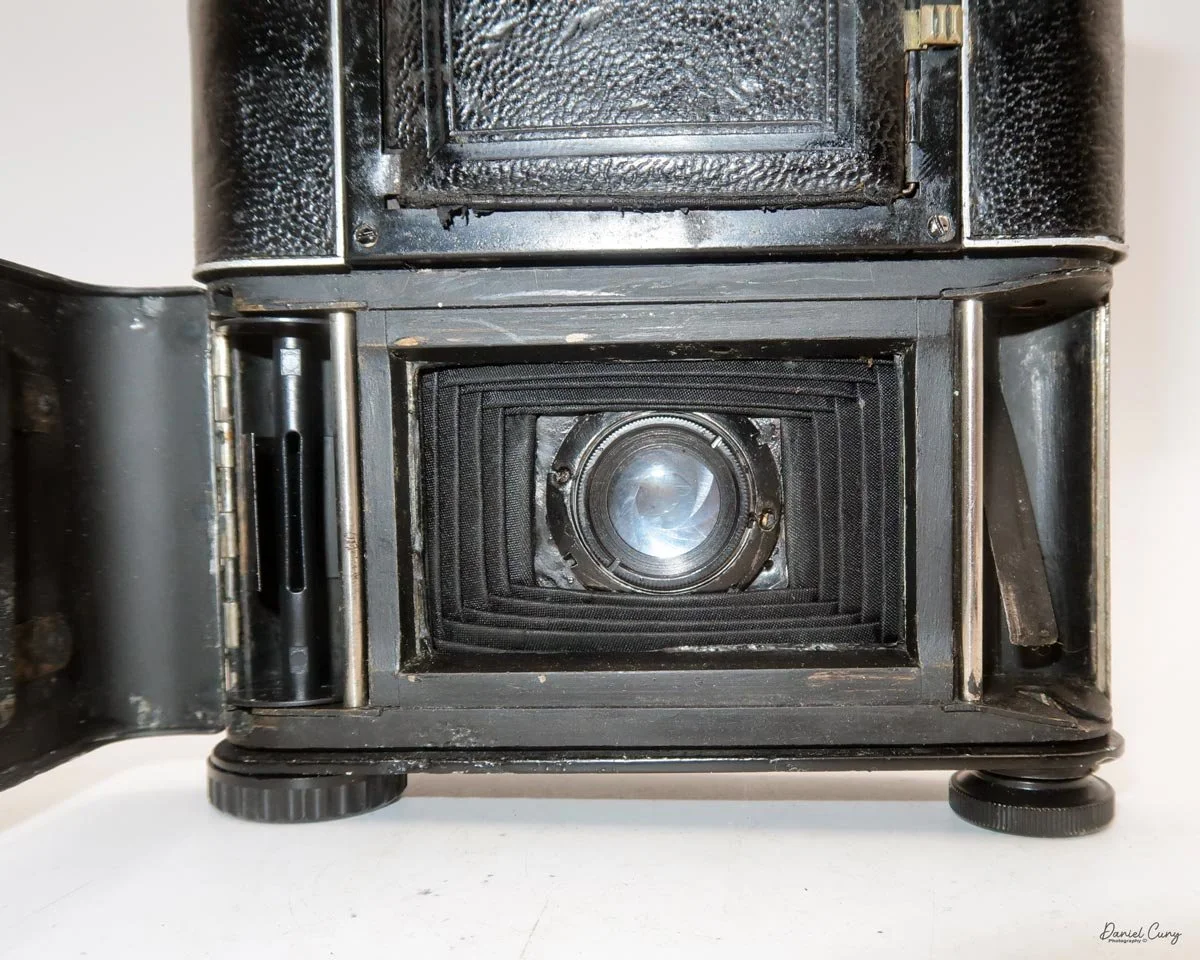
Load the fresh roll of film into the left side of the camera, and bring the film's leader to the take-up spool. Put the leader into the take-up spool and start winding, making sure the film is transporting and you can see the starting "arrows". Close up the camera back, lock the door, and wind the film until you see the number one in the red window on the back of the camera. At this point, you're ready to take your first photo.
Now that you have film loaded in the camera, let's take a walk through the neighborhood and see what this camera can do.
Video Overview
I made a short video overview of the camera. Click the image to go to the video.
Bentzin Primarette Video
Results:
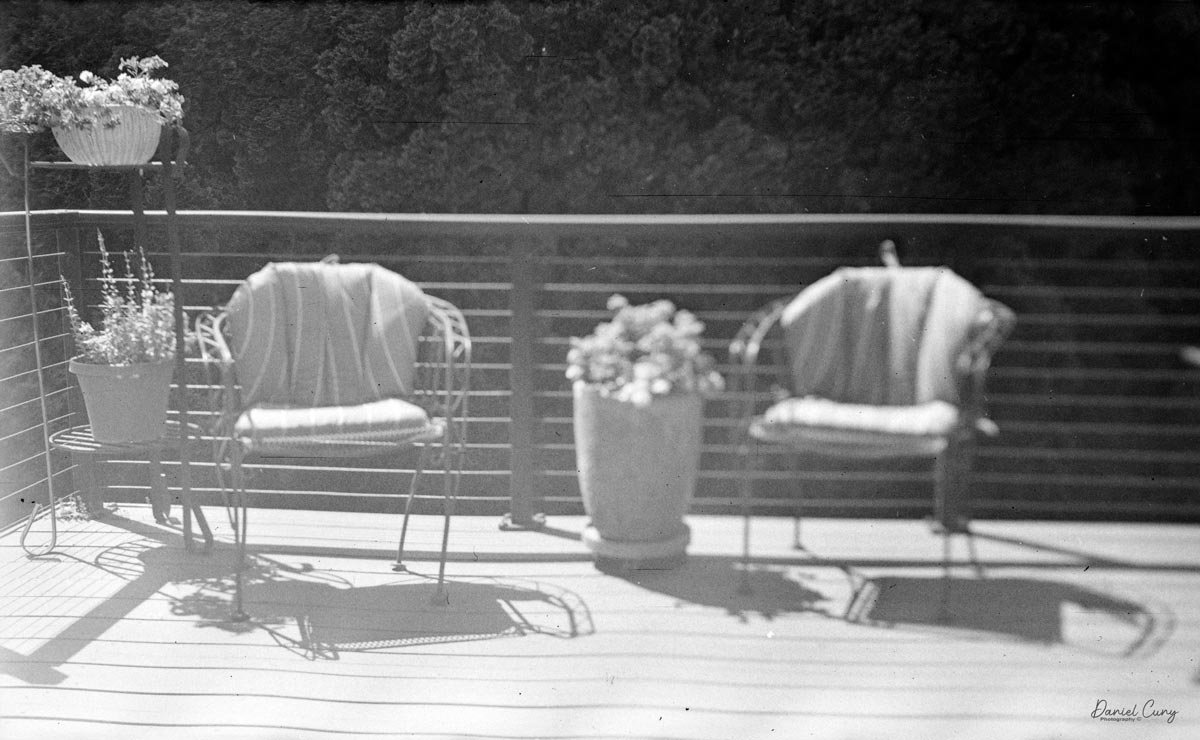
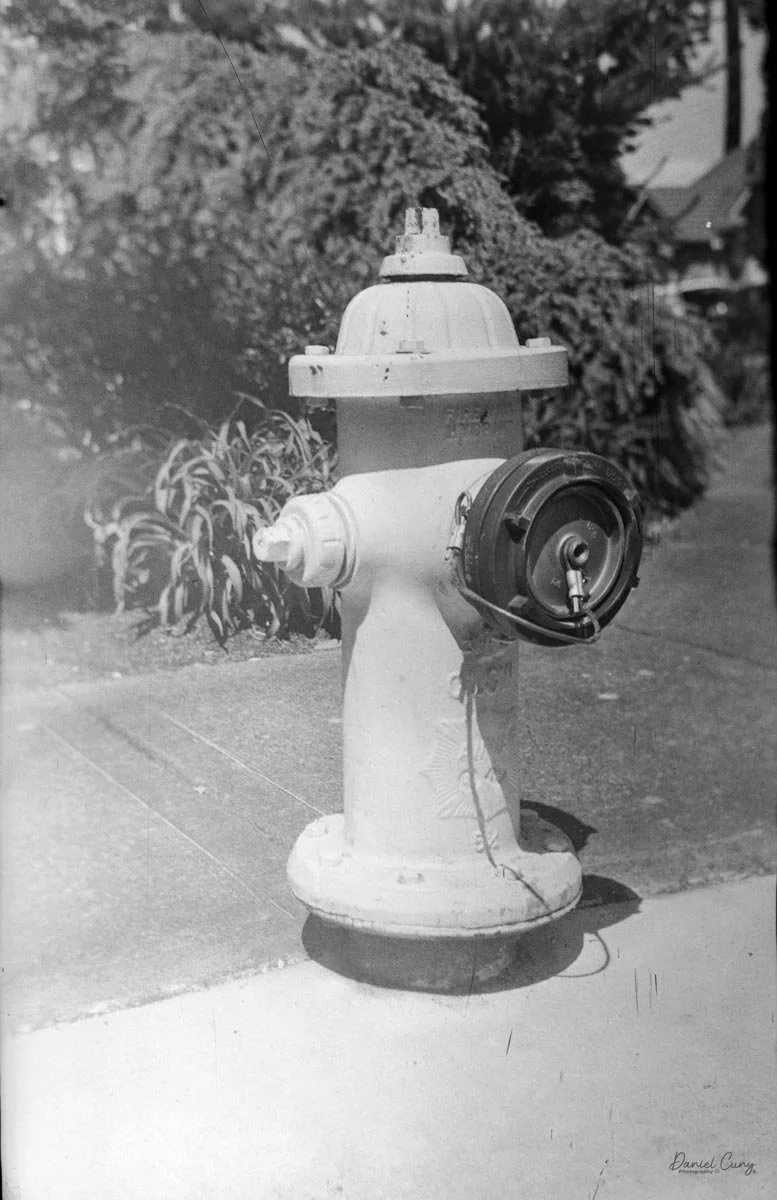
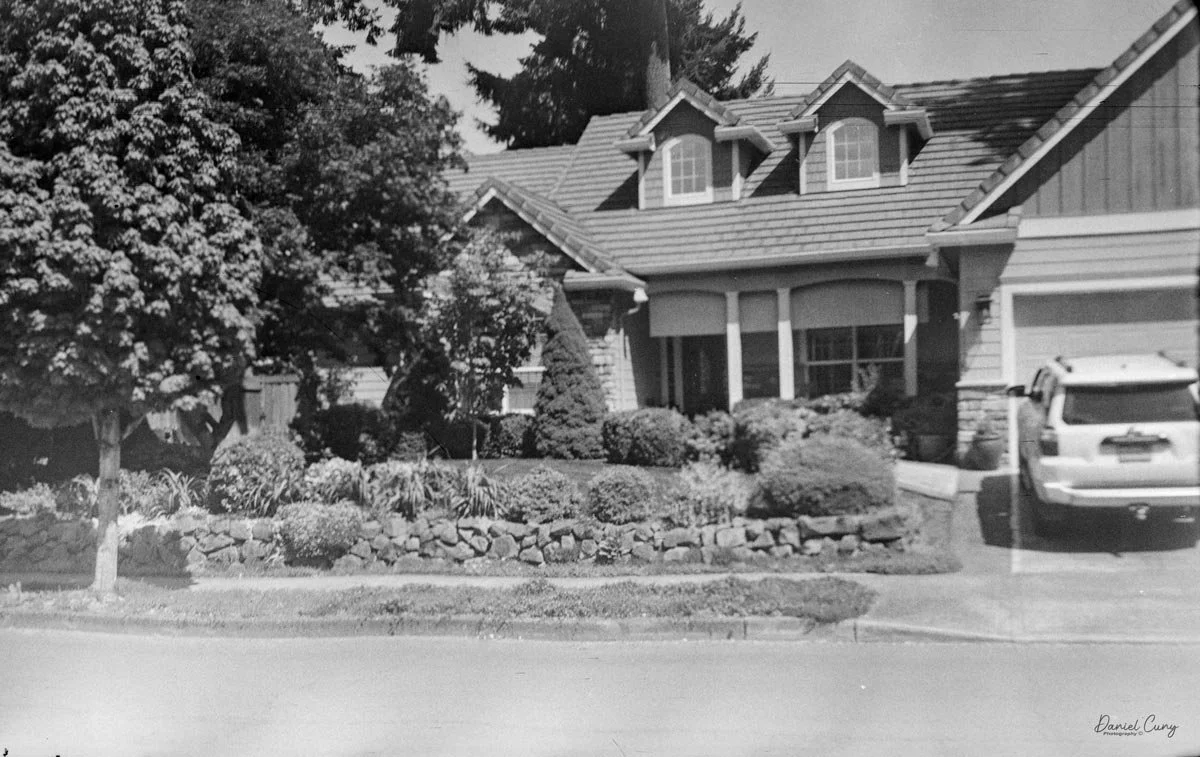
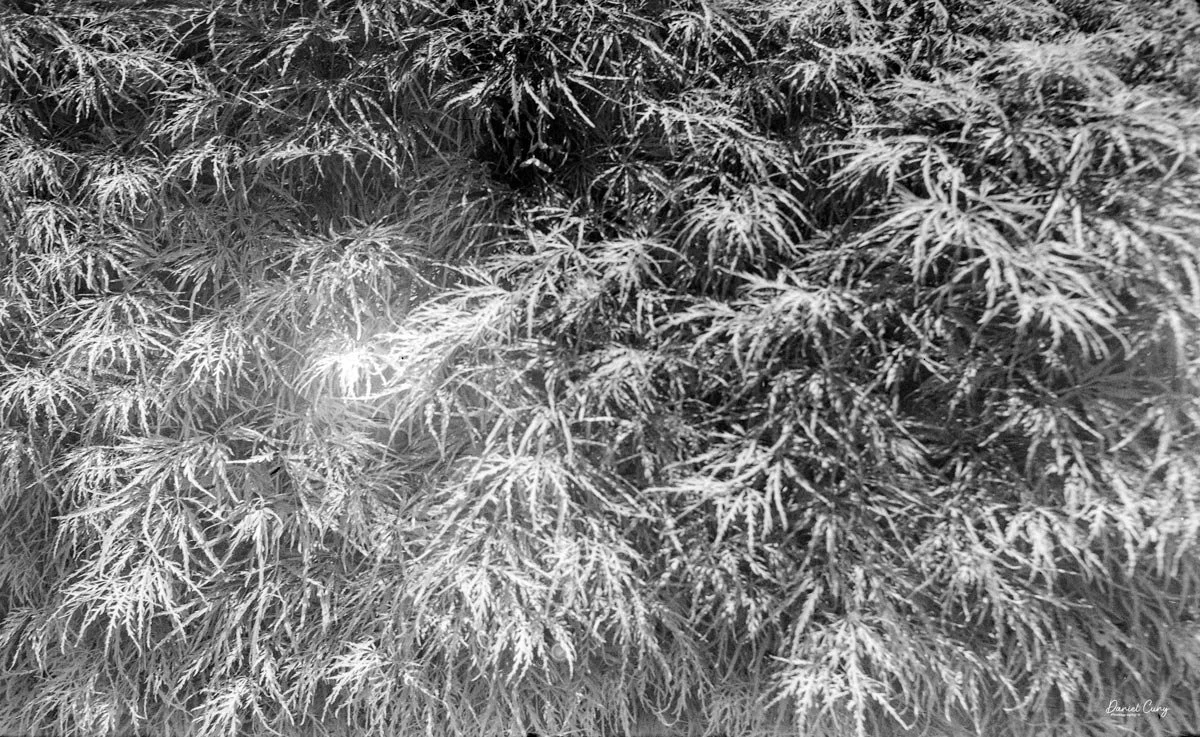
I loaded the camera with a roll of 100 ISO 127 film I'd purchased a while ago and walked through the neighborhood, taking photos of some of the usual items to get a reference for the camera's images.
Here are some of the results I had with the Bentzin Primarette camera.
Conclusion:
I didn't have an instruction manual for the camera, nor have I seen one online. It wasn't until after taking some of the photos that I realized the camera has two areas where the lens board stops.
Stopping at the first point prevents the camera from focusing on the closest 3 meters. That's why the first couple of photos are sharp on one side and blurry or out of focus on the other. One side of the lens board was pulled all the way back, and the other wasn't providing the camera with an angled plane of focus.
Once I noticed that, and pulled the other side of the lens board out to the correct position, the camera's images turned out sharper from left to right as they should. I noticed the camera could focus all the way to the 3-meter mark, too.
Another point is that the camera doesn't close all the way at its closest focusing distance. You'll need to back off the focus before the camera will smoothly retract into its body. That's interesting, and makes sense.
For me, the focus was easy, but the viewing area was small, and magnified viewing would have been helpful. I addressed that earlier.
What a wonderful camera to have in my collection. It's an odd, unusual camera, which makes it even more special to me, and one I'll cherish in my collection for many more years.
Thank you for taking the time to read a bit about this compact twin-lens camera from Germany, built in the early 1930s. I'd love to get your feedback regarding this or any other cameras I've reviewed.
Here are my other Camera Reviews.
Cuny's Camera and Photos is my online eBay store where I sell some of the cameras I've reviewed, along with many other lenses and camera accessories. Stop by and take a look at your leisure.
Until next week, please be safe.