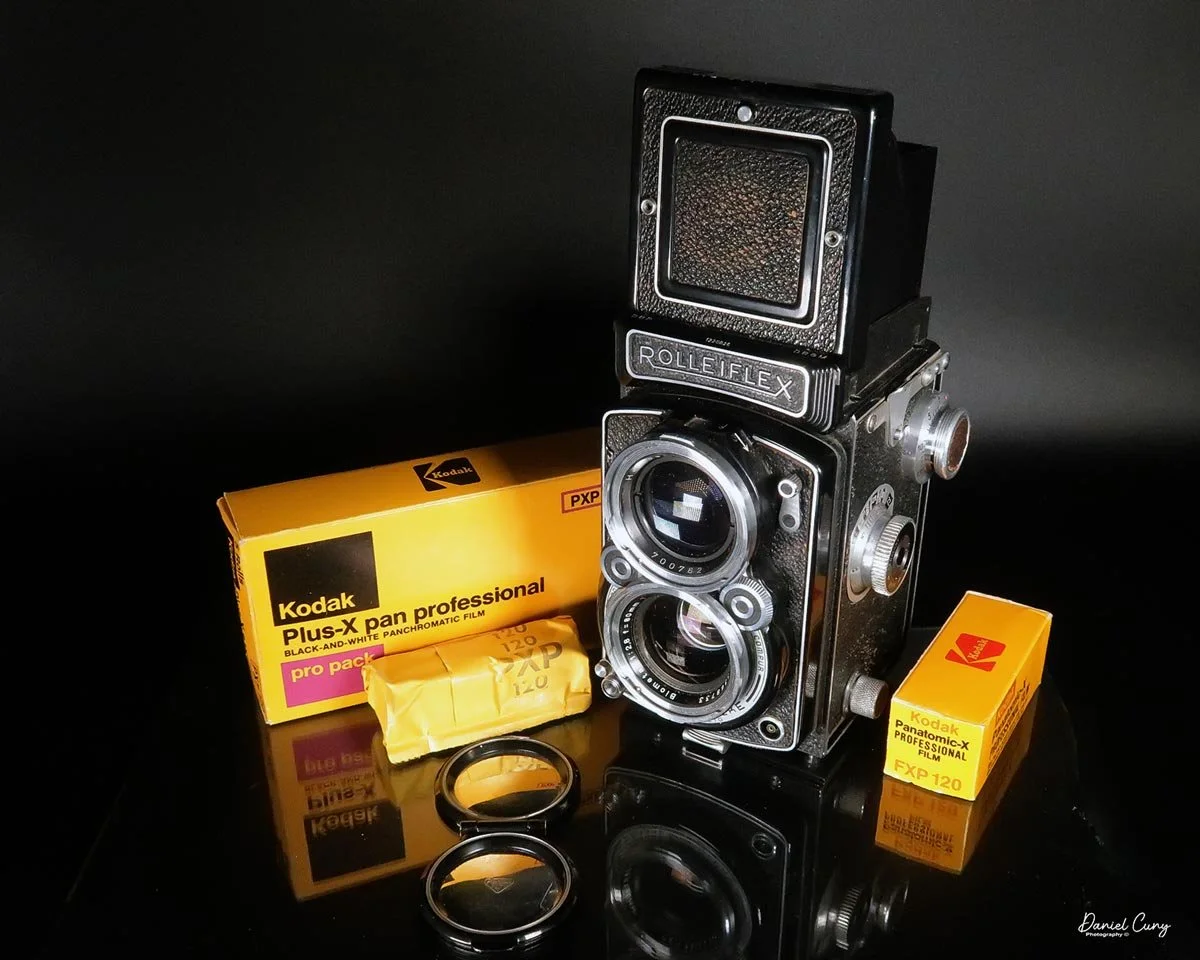
My Rolleiflex 2.8B camera
I've long wanted a Rolleiflex 2.8 in my collection and almost pulled the trigger a few times, but it wasn't until the most recent camera show in Kent, WA, that I finally did.
It wasn't a true purchase; it was a trade for something equally rare: an early Hasselblad Super Wide that I had recently had completely overhauled by a tremendous technician on the east coast. I had written about the Hasselblad Super Wide years ago, and the camera didn't include a film back or finder, so I figured it was a fair trade for both of us.
I was told that the Rolleiflex 2.8B was overhauled by a Portland, OR repair shop I was familiar with, which made the camera even more desirable in the trade. It didn't include a strap or case, but it did have the lens cap, which was good. I had played around with the camera briefly at the show, and it was from one of the other sellers, which carries weight with me, since it wasn't a random passerby looking to sell equipment, which happens at the show.
Don't get me wrong, I have bought items from people walking the show, and I always like interacting with them, seeing what they have, and making deals. I'm not an expert on lenses and optics, but the dealer said the 2.8B was rarer because of the Carl Zeiss Biometar lens.
Being a fan of anything Zeiss, the Rolleiflex cameras I've passed on in the past have had Schneider lenses, as I've known that while the Schneider lenses are good, the Zeiss lenses are more desirable.
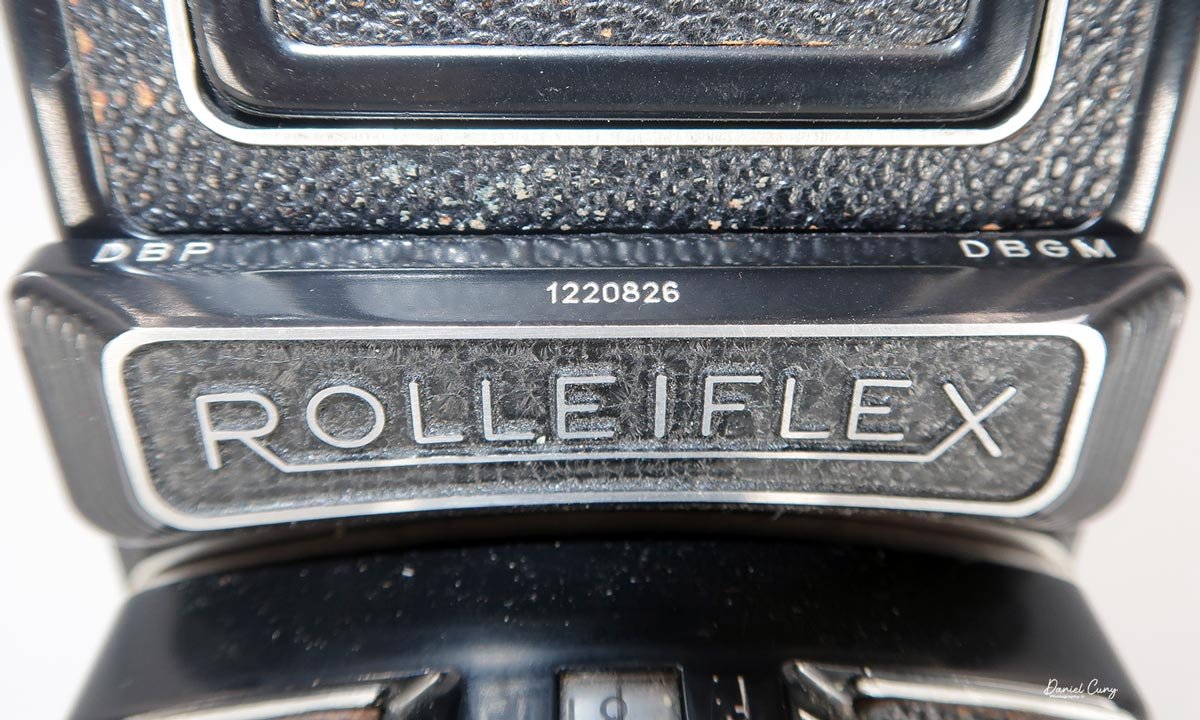
Rolleiflex nameplate with serial number
As I generally do when I check out a camera, I check the slow shutter speeds first. I feel that if the camera has an issue, the slow shutter speeds fail before the faster ones, so I set the shutter speed on the Rolleiflex 2.8B to 1 second, and it sounded accurate. That was a good sign to me, but the one thing I failed to do until I got home with the camera was to check the high-end speeds. The shutter speed and aperture wheels moved smoothly, and the lens was bright and clean. The dealer mentioned that he replaced the normal focusing screen with a brighter focusing screen.
It wasn't until I got home and put film in the camera that I noticed it wouldn't go to the highest speed of 1/500. It went partway toward the setting, but not all the way. I don't force a camera to a specific setting, because it can do more harm. Maybe the gears aren't meshing properly, or the lubrication has gummed up a bit.
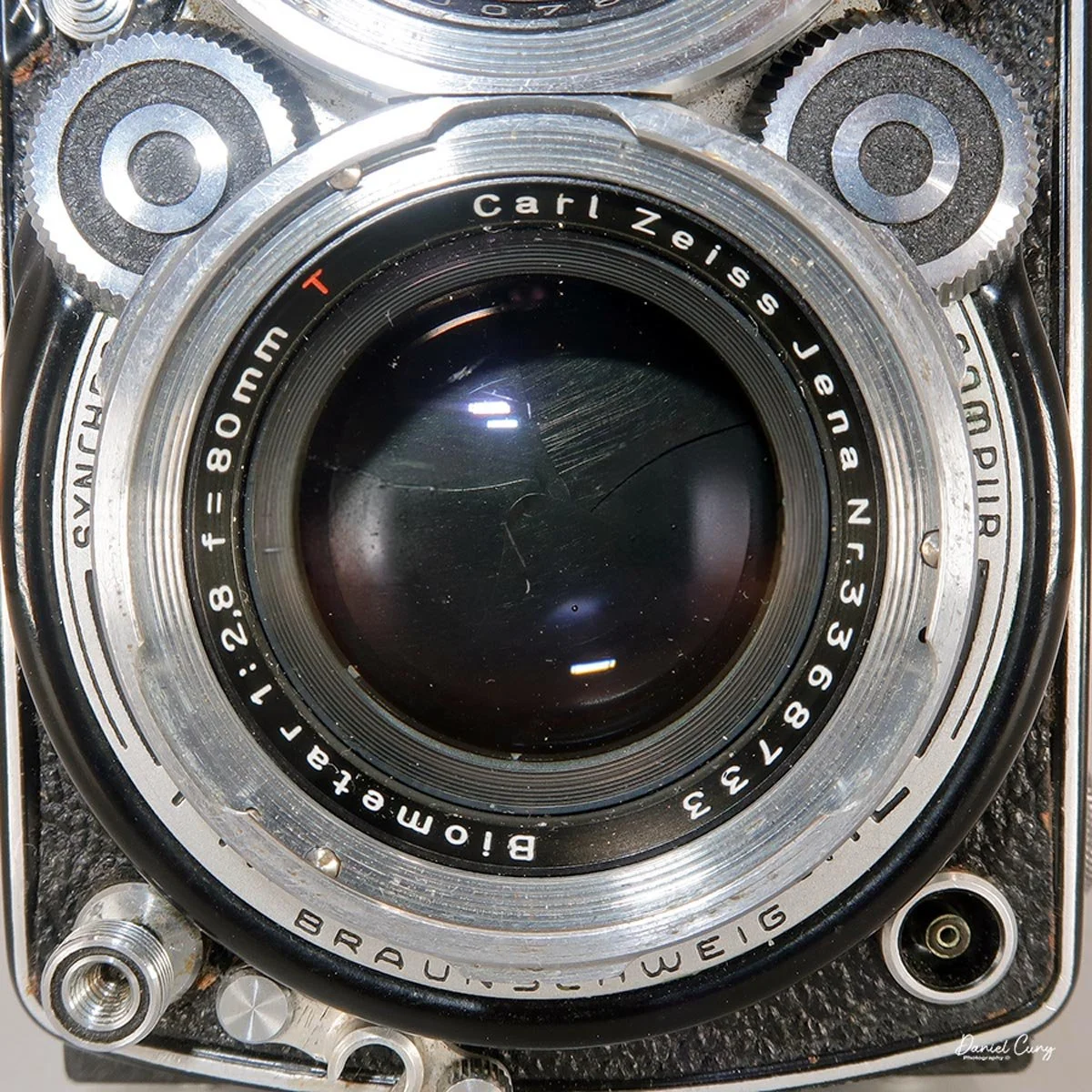
Infamous Carl Zeiss Biometar lens
At this point, I'll need a technician to look at the camera and see why it didn't reach the highest speed. I also didn't ask when the camera was overhauled, as it may have been done a few years ago, so I'm not going to fault the dealer.
It's not a huge factor that soured my taste for the camera, but one reason I liked the f/2.8 version was to shoot at the widest setting to get shallow depth of field and see the bokeh the lens produces.
Other than that one item, the camera is in wonderful condition. I'm still happy I made the trade, especially after showing the camera to another collector friend who is a big vintage collector and user and said the 2.8B is a VERY collectible version because of the lens and the low number of units made with it.
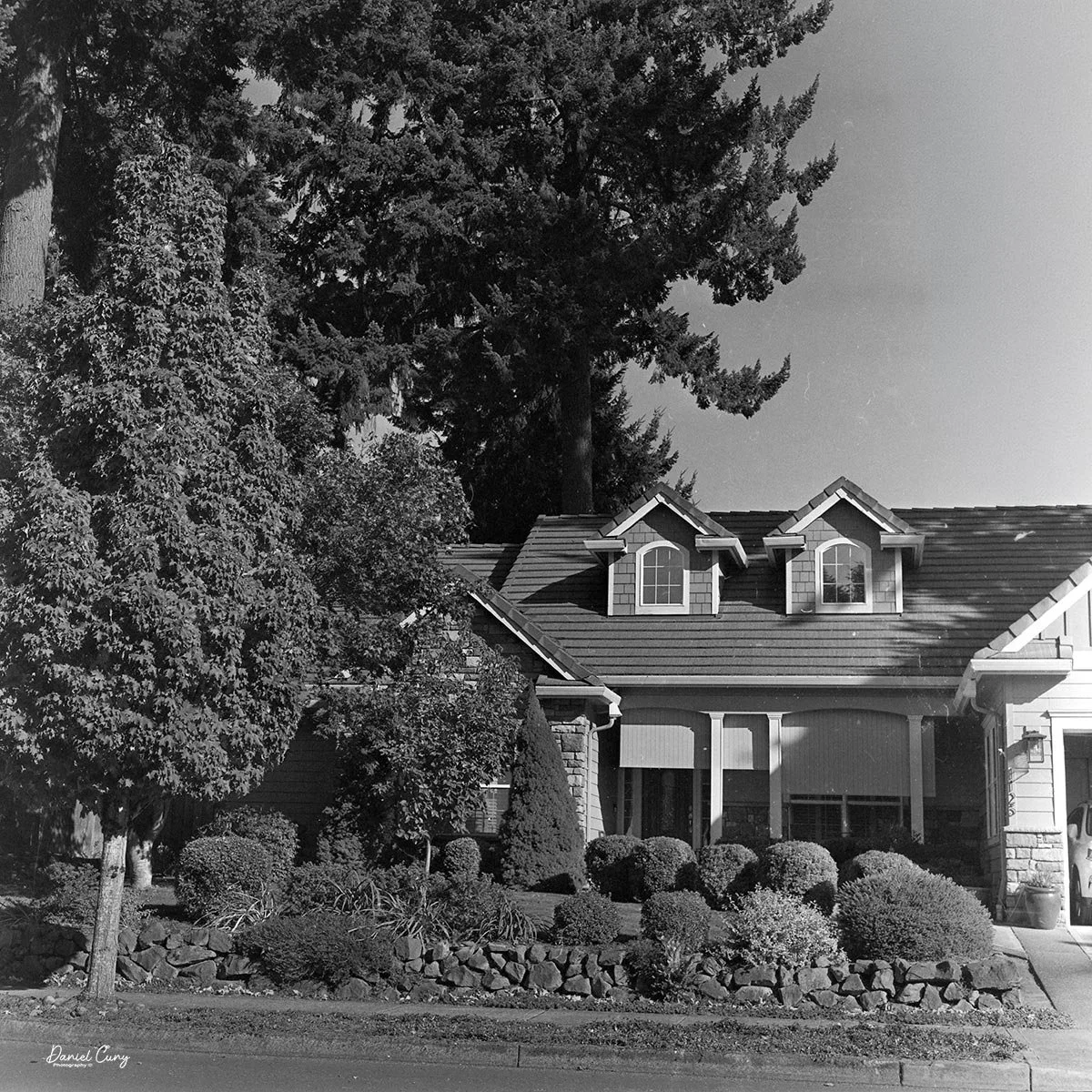
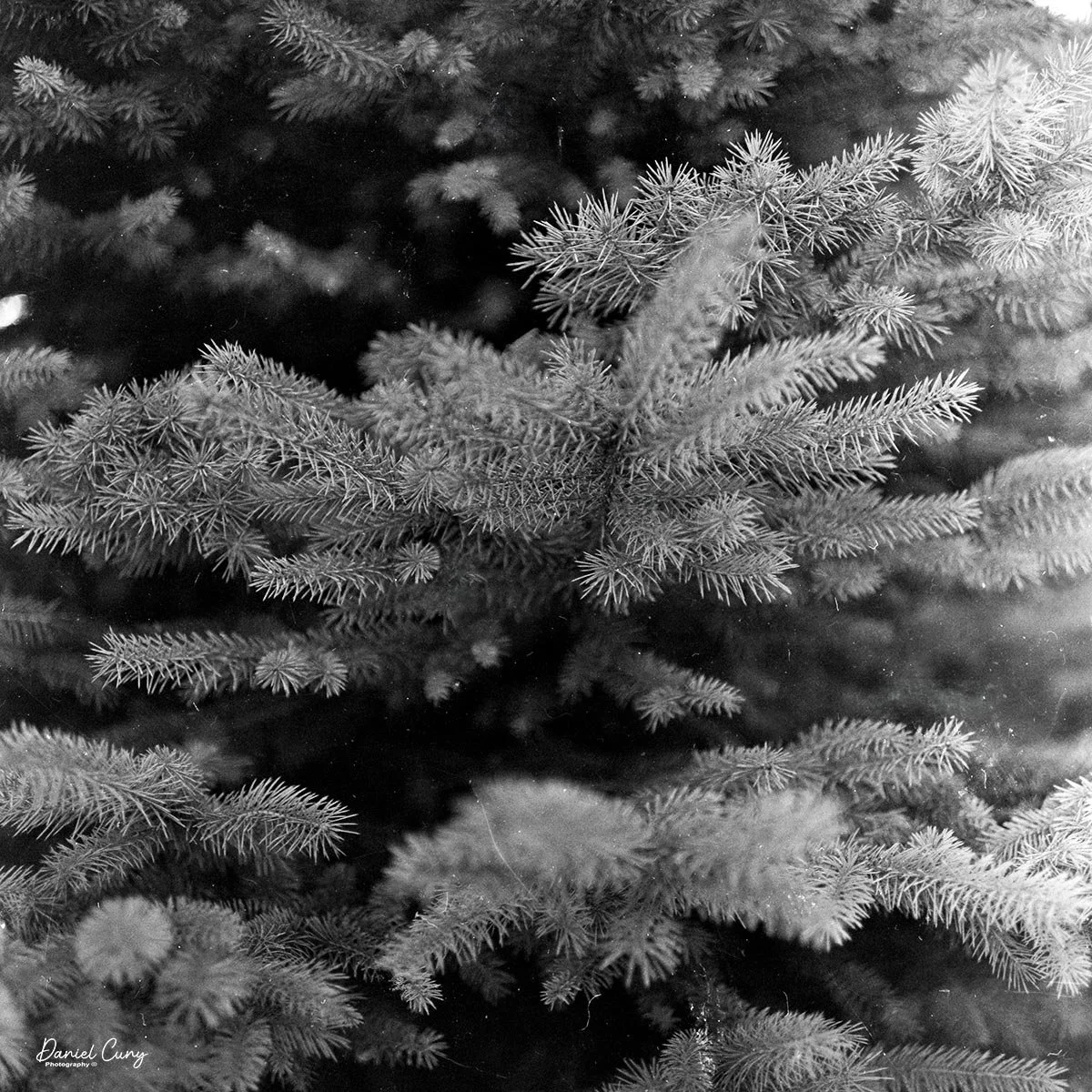
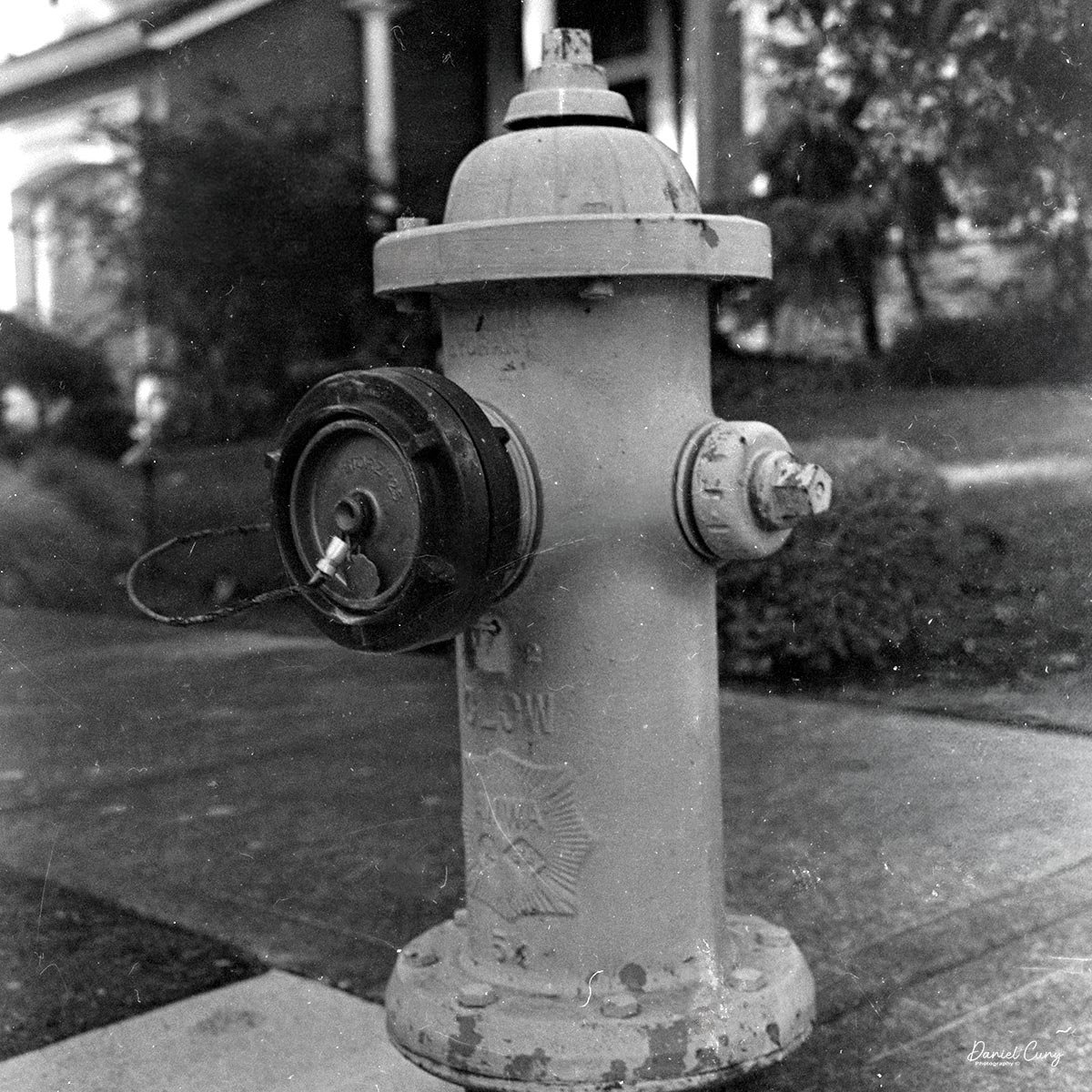
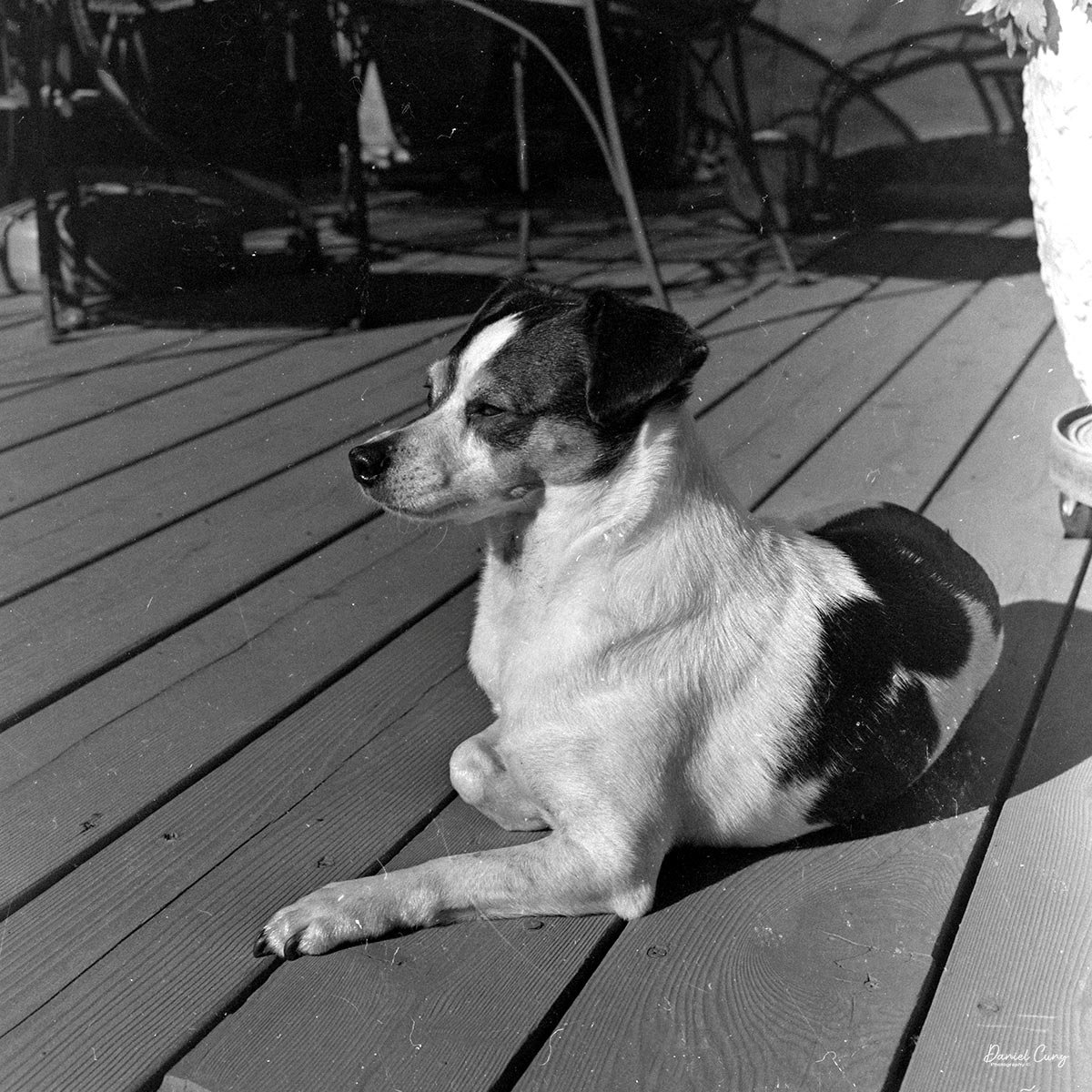
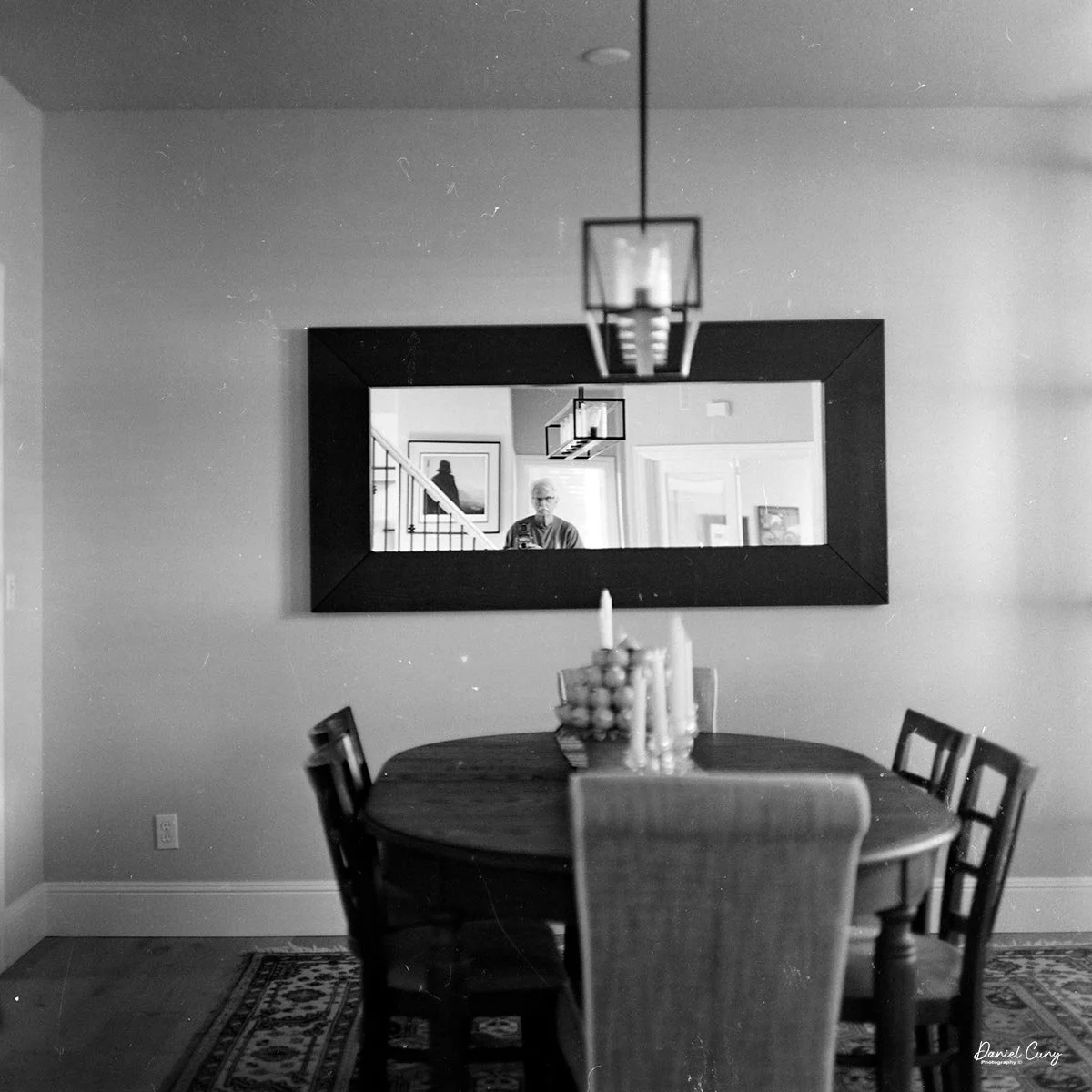
I had some expired Plus-X film in my drawer, which I generally like to use when testing a camera, so I put a roll in the Rolleiflex 2.8B and took a walk through the neighborhood to see how the camera would perform and look at the images it produced.
History:
Rollei's story starts in 1920, when Paul Franke and Reinhold Heidecke founded Franke & Heidecke in Braunschweig, Germany. Their Rolleiflex of 1929 invented the modern twin-lens reflex, and by the 1950s and '60s the 2.8F and 3.5F — carrying 80mm f/2.8 and 75mm f/3.5 Planar and Xenotar lenses — had made Rolleiflex the gold standard of medium format. Few people realize that those famous Western lenses had an identical twin on the other side of the Iron Curtain: the Carl Zeiss Jena Biometar.
The Biometar descends from Willi Merté's 1927 Biotar, the great six-element Double Gauss design. After the war, designer Harry Zöllner at Zeiss Jena set out to simplify it. Working with Rudolf Solisch, he kept the Biotar's front group. Still, he replaced the rear cemented doublet with a single, steeply curved thin meniscus element — five elements in four groups in all. That one element carried the lens's entire correction, and it was brutally hard to manufacture: center-grinding such a thin, curved piece of glass pushed the era's machinery to its limits. The Biometar could never be cheap, but it was brilliant.
Then politics split the design in two. When Solisch left Jena for the West, he carried the Biometar type with him to Schneider — and Schneider's Xenotar for the Rolleiflex 2.8 is virtually identical in shape to the Biometar. Zeiss Oberkochen's Planar for the same camera was a parallel five-element variation. One design family, two Germanys: in the East it wore the Biometar name, in the West it focused the Rolleiflex.
You'll most often meet the Biometar 80mm f/2.8. Calculated in June 1956 and first produced in March 1959, it replaced the Tessar as the standard lens of the Praktisix — soon renamed the Pentacon Six — and held that job for the system's entire life, some thirty years of production. It came in silver, then the famous "zebra" finish, then all-black multi-coated form. Zeiss Jena even made batches for Japan's Bronica in the 1970s, when Bronica's usual supplier, Nikon, grew too expensive.
The Pentacon Six was the Eastern rival Rollei answered with the SL66 in 1966 — and the Biometar-equipped system outlived its Western challenger. Franke & Heidecke went bankrupt in 1981; a decade later, Biometars were still rolling out of Jena. It's a lens with two histories, and the Rolleiflex carries one of them in every 2.8F ever made.
The Rolleiflex 2.8B: The Rarest of Them All
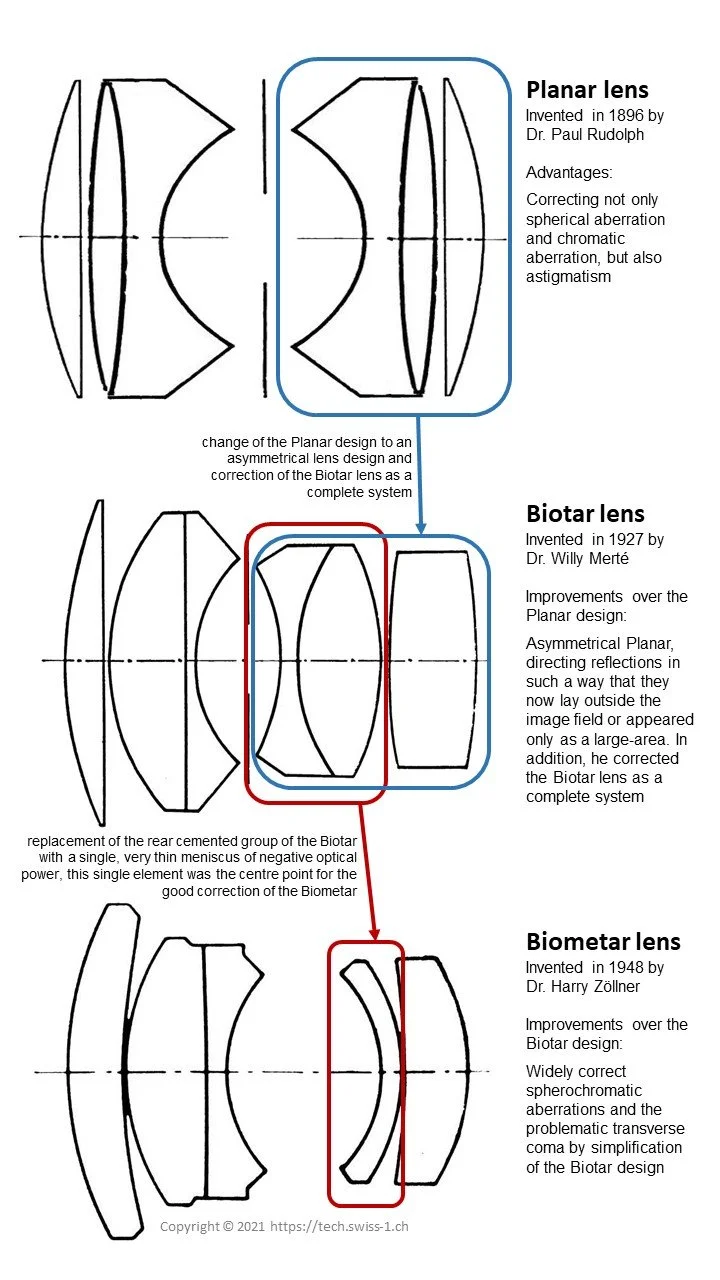
Zeiss Lens designs
But the Biometar's most famous appearance came a decade before the Pentacon Six, on a Rolleiflex itself—and it's why collectors hunt the Rolleiflex 2.8B. Rollei's first f/2.8 attempt, the 2.8A of 1949, carried an 80mm Tessar that wasn't sharp enough at f/2.8; some cameras were even recalled for lens replacement, and Zeiss-Opton's postwar production was too limited to fix the problem. The answer came from the other Germany. Zöllner had finished his Biometar 2.8/80 back in September 1948, and it was the best lens available for a Rolleiflex 2.8. From February 1952, Franke & Heidecke fitted it to the new 2.8B.
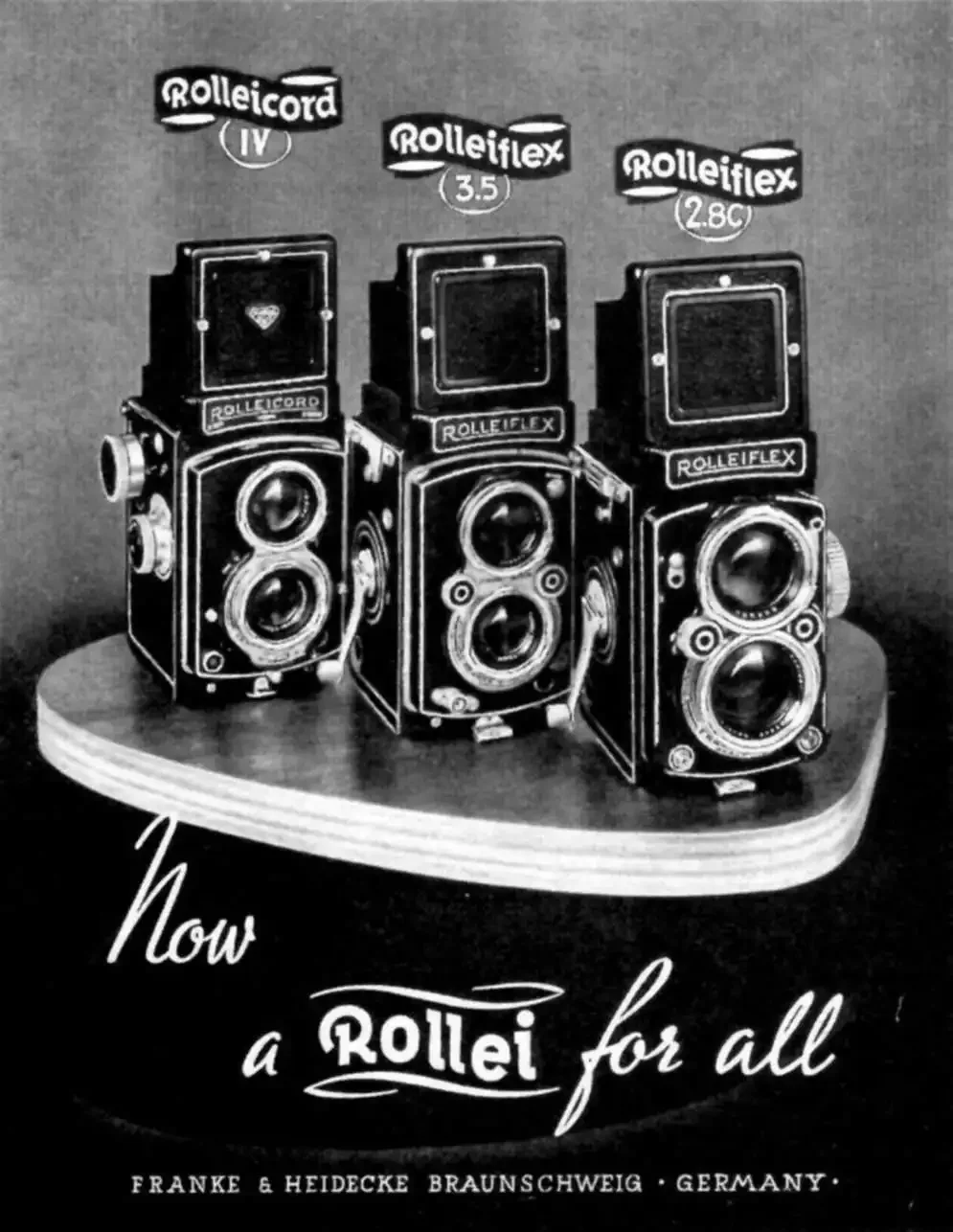
Then the Cold War shut the door. As the two German states hardened into enemies — and the two Zeiss companies into legal combatants — getting lenses out of Soviet-occupied Jena and into Braunschweig became harder by the month—production of the 2.8B ended in March 1953, after just thirteen months. Only 1,250 cameras were made, making it one of the rarest standard-production Rolleiflexes ever sold — no prototype, no special edition, just a regular model that politics strangled in its crib. Rollei barely advertised it; most were built for delivery to the USA, so even the German and British press largely ignored it. By December 1952, the replacement was ready: the 2.8C, carrying the Western twins of the Biometar — Oberkochen's Planar and Schneider's Xenotar.
For collectors, the 2.8B checks every box. Production numbers are tiny and well documented. It's the only Rolleiflex ever fitted with an East German lens — a West German camera wearing Jena glass, a combination that would have been impossible a few years later. And the Biometar itself, the first of Zöllner's five-element designs, has its own rendering. Find one with the "Carl Zeiss Jena Biometar" engraving and Bay III fittings, and you're holding the rarest production Rolleiflex of them all.
My Camera:
My Rolleiflex 2.8B is 5.5" tall with the light chimney closed and 8" tall with it extended, 3.5" wide, and 4.25" deep with the lens focused to infinity, serial # 1220826. The Rolleiflex 2.8B has a Carl Zeiss Jena Biometar 80mm f/2.8 "taking" lens, serial # 33687733, and a Heidosmat 80mm f/2.8 viewing lens, serial # 700782. The camera weighs 2 pounds, 7.6 ounces without film.
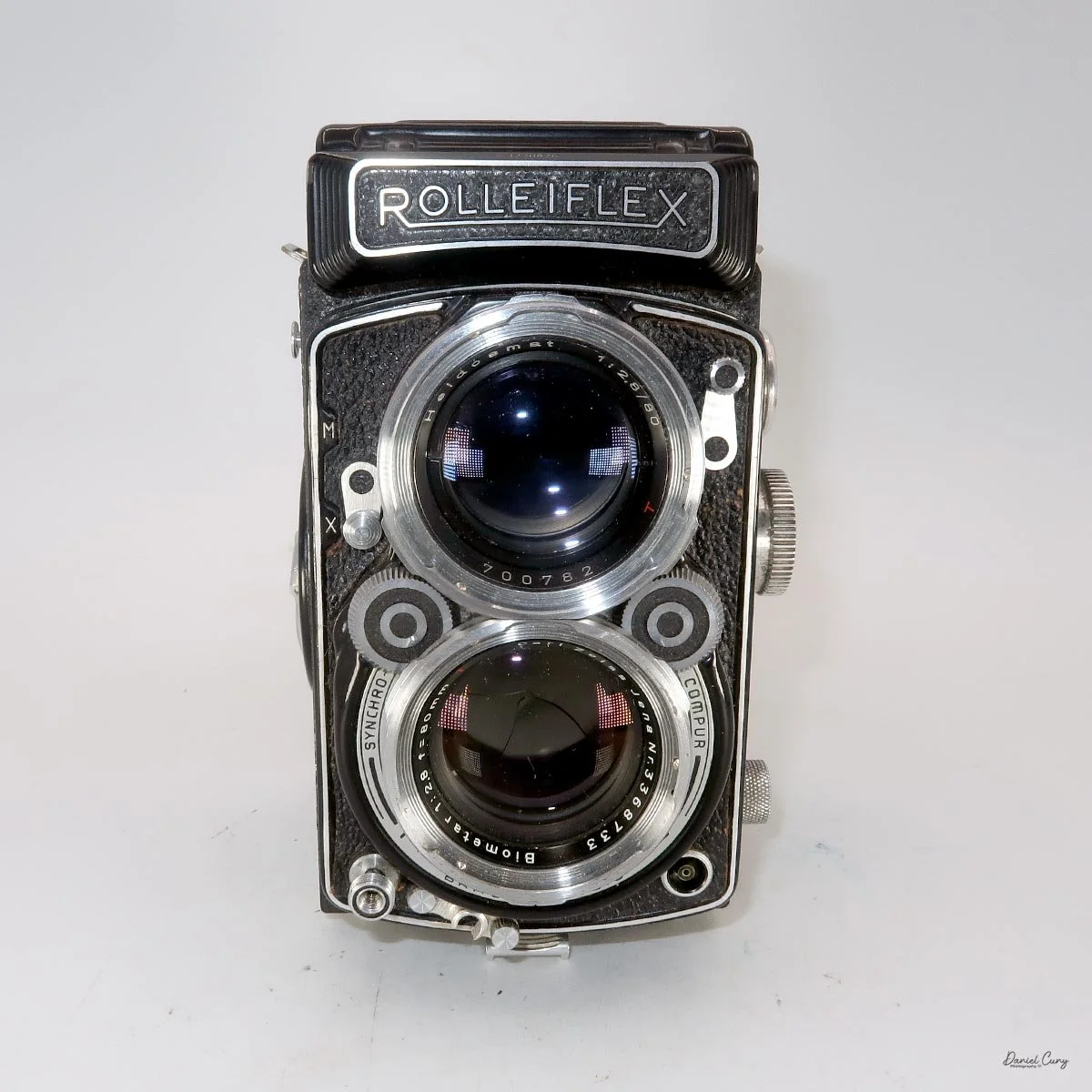
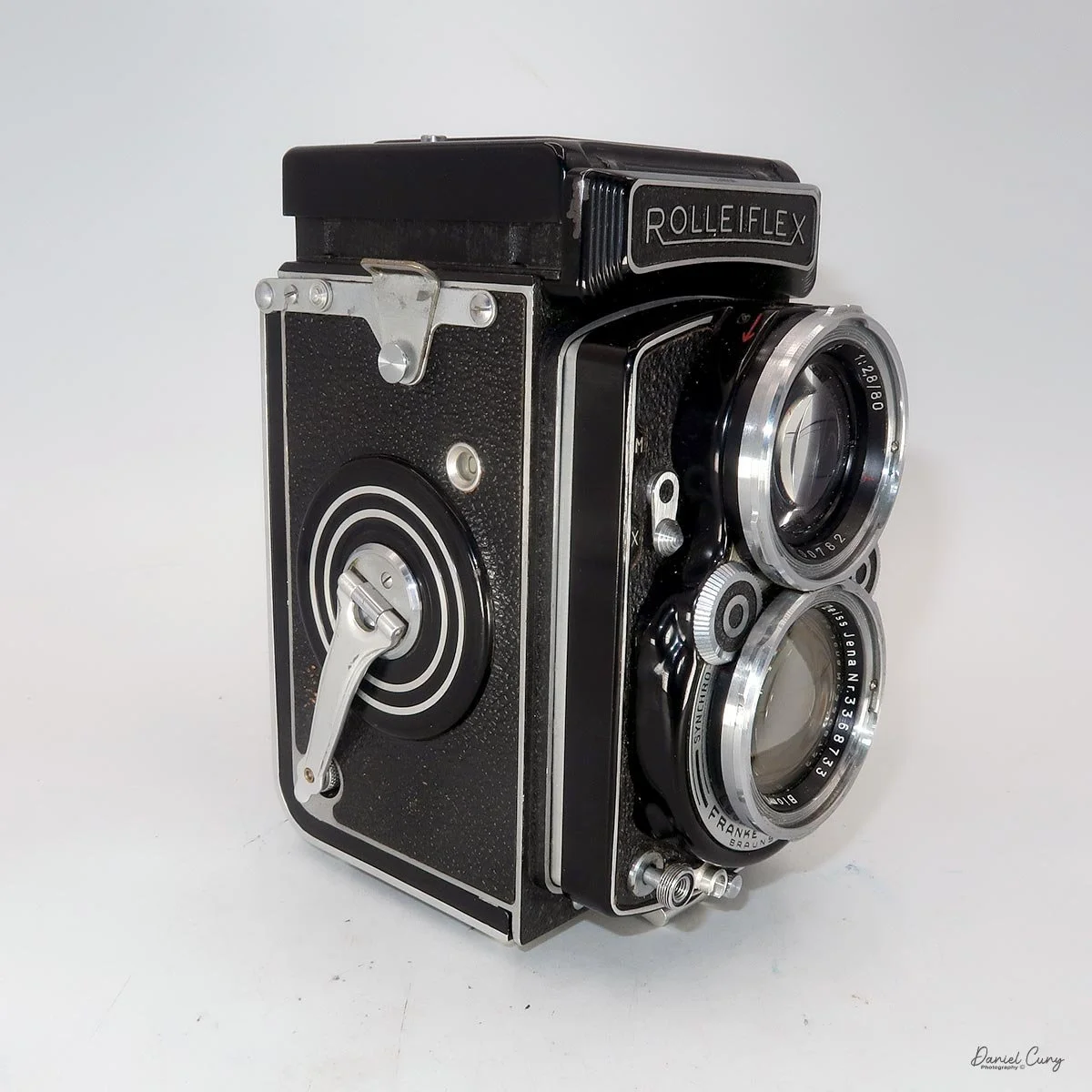
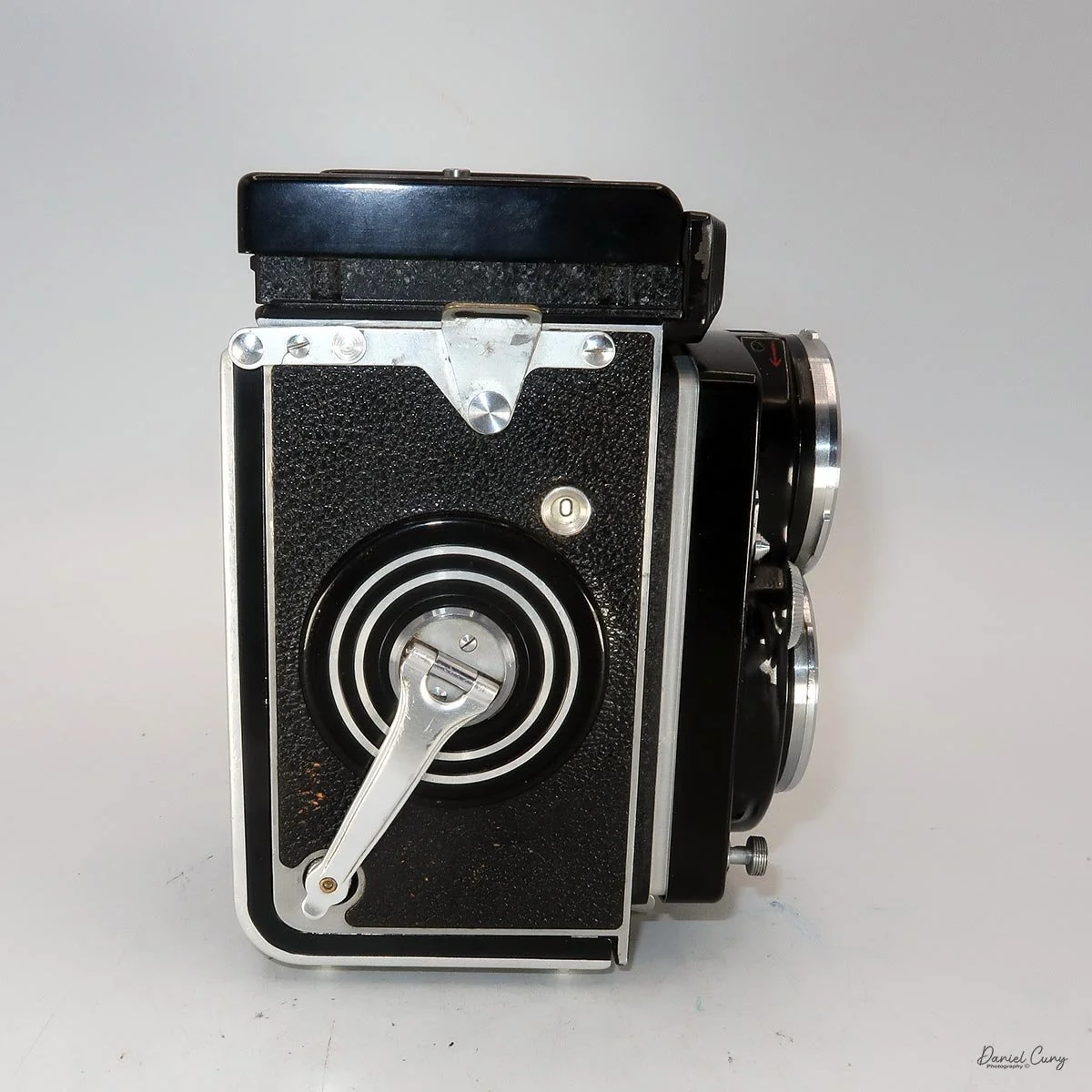
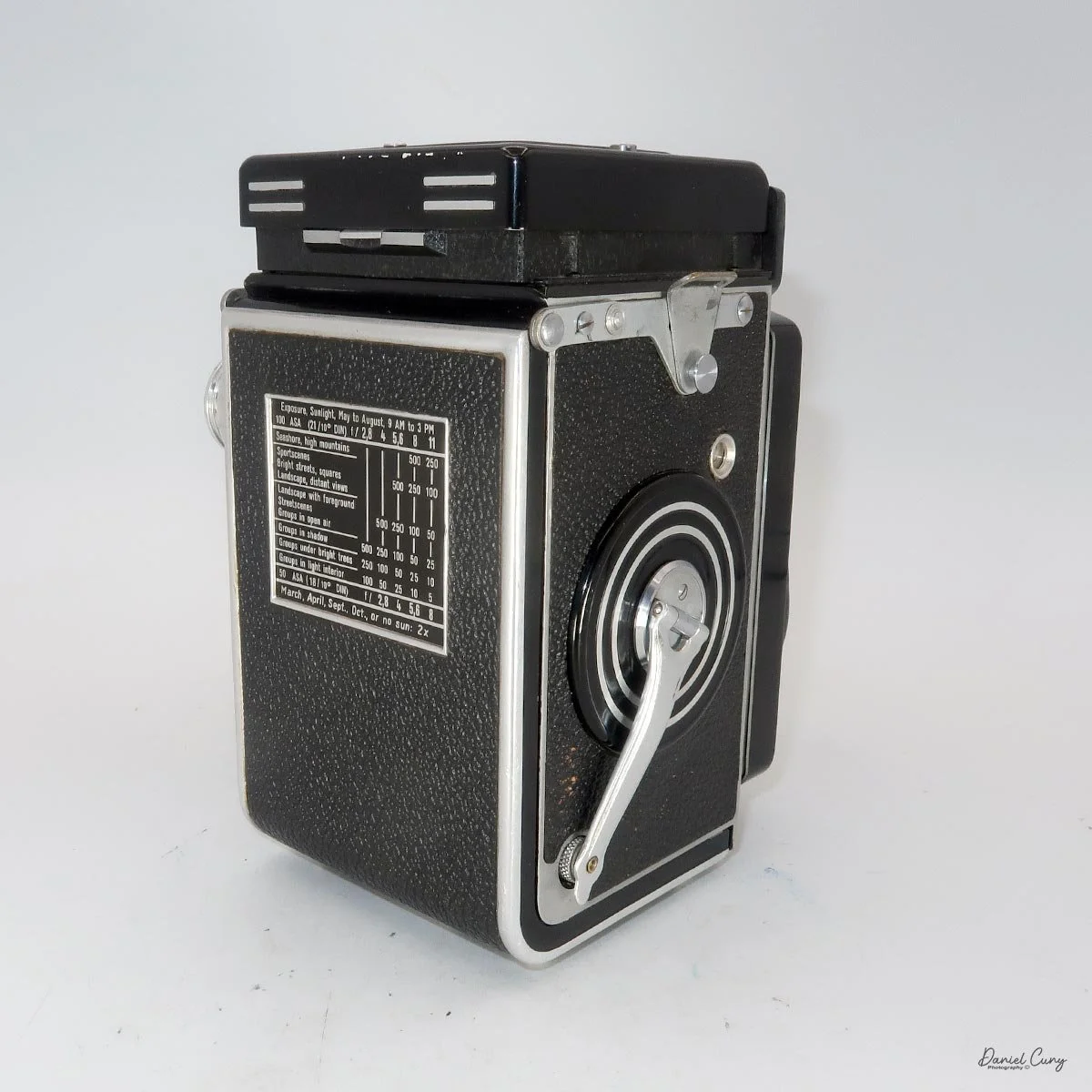
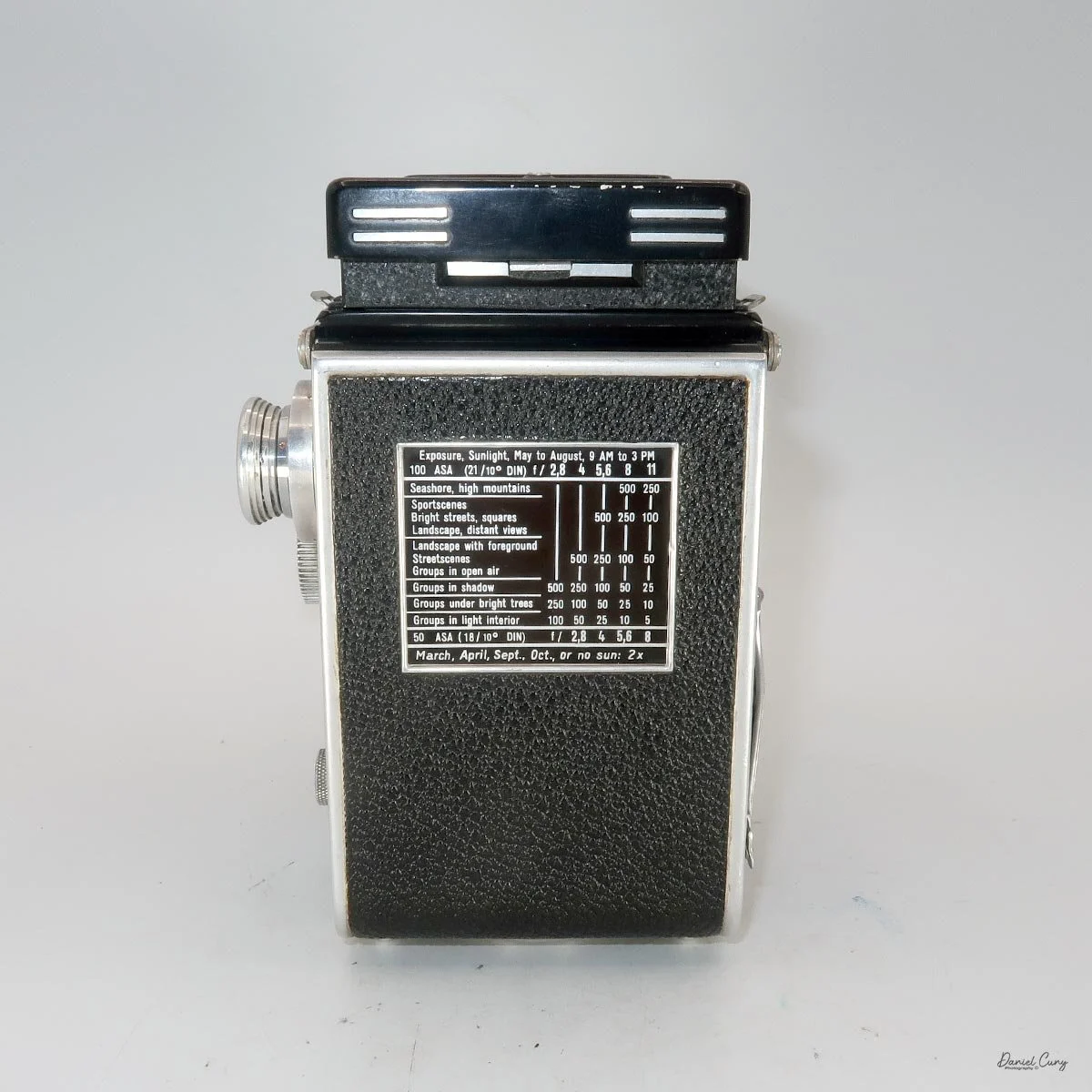
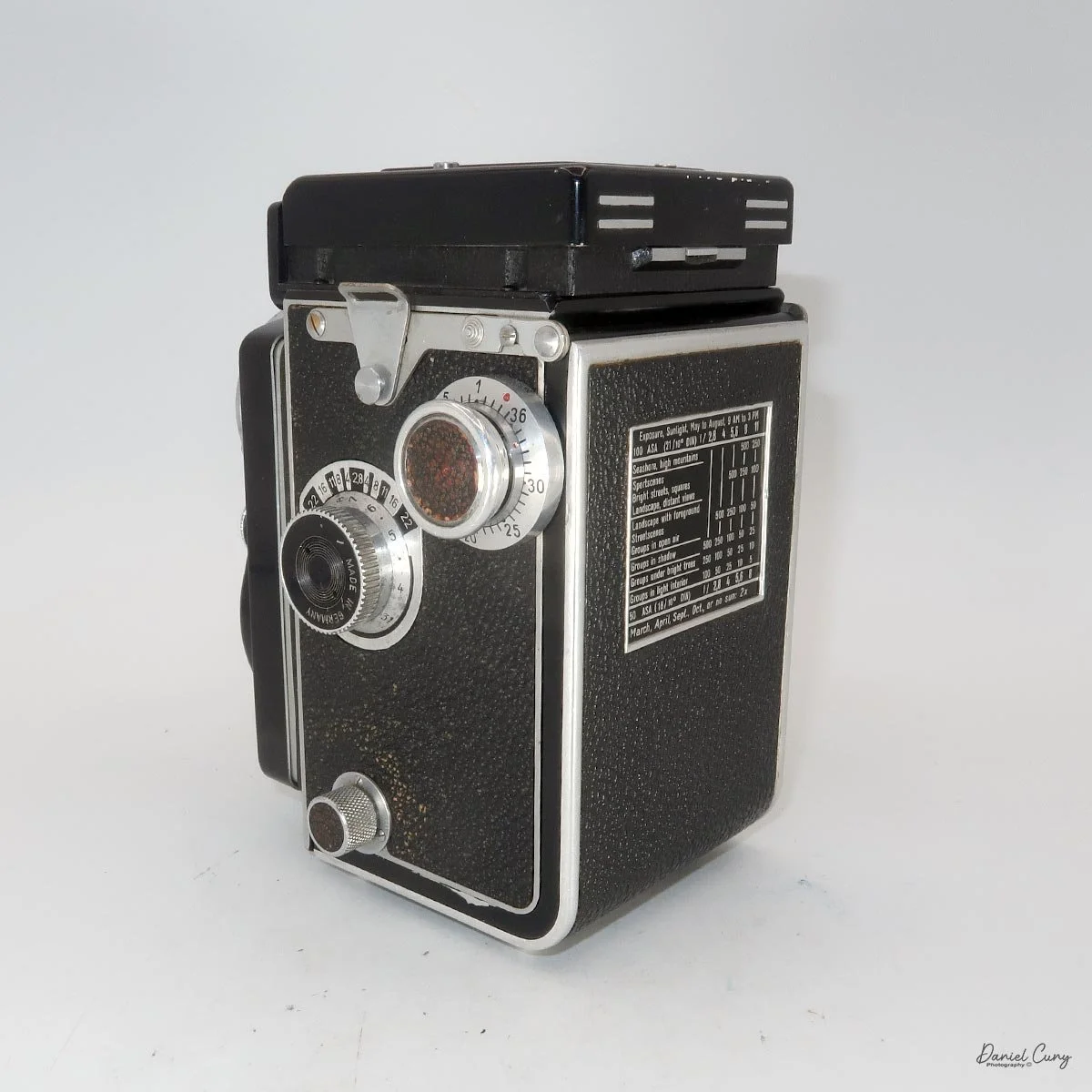
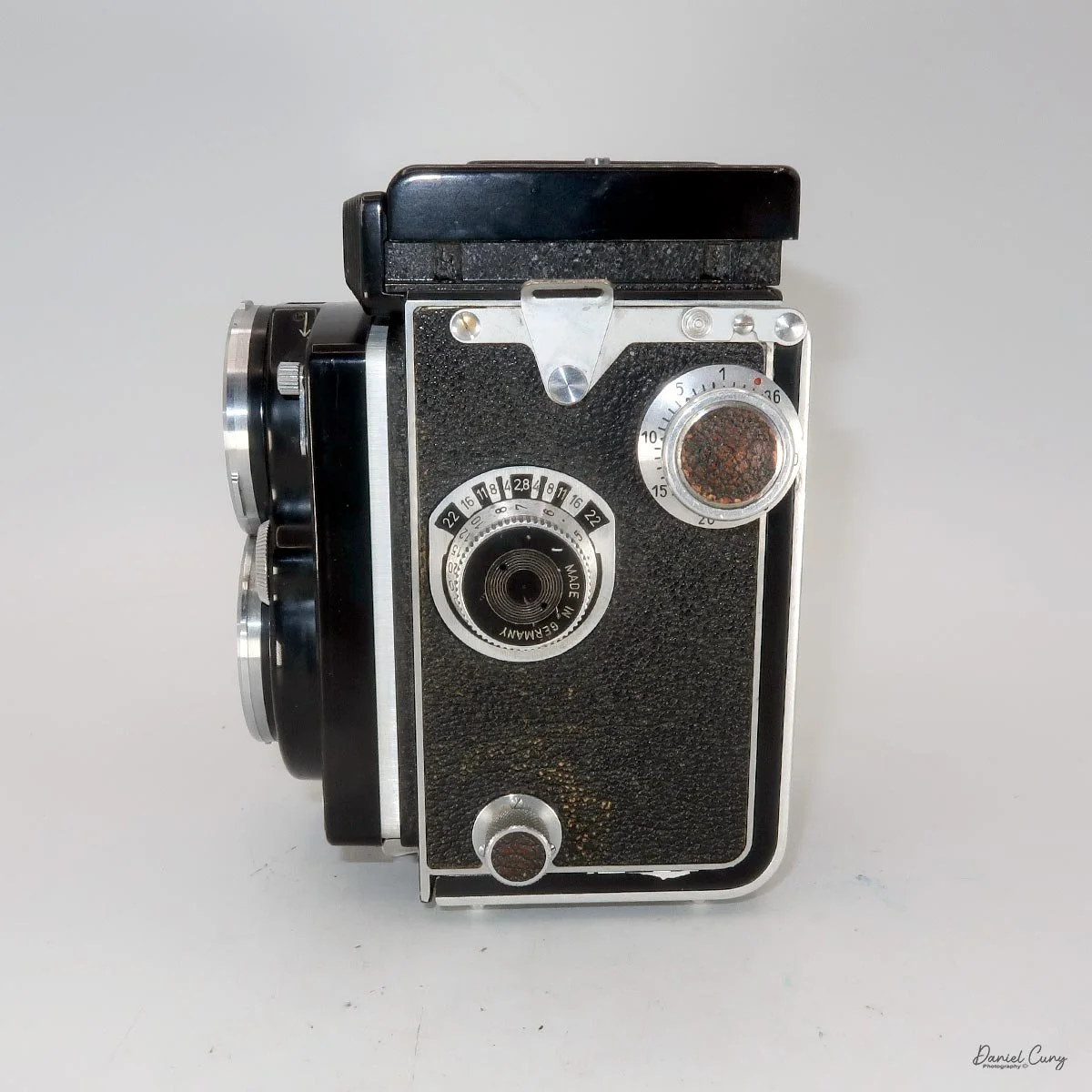
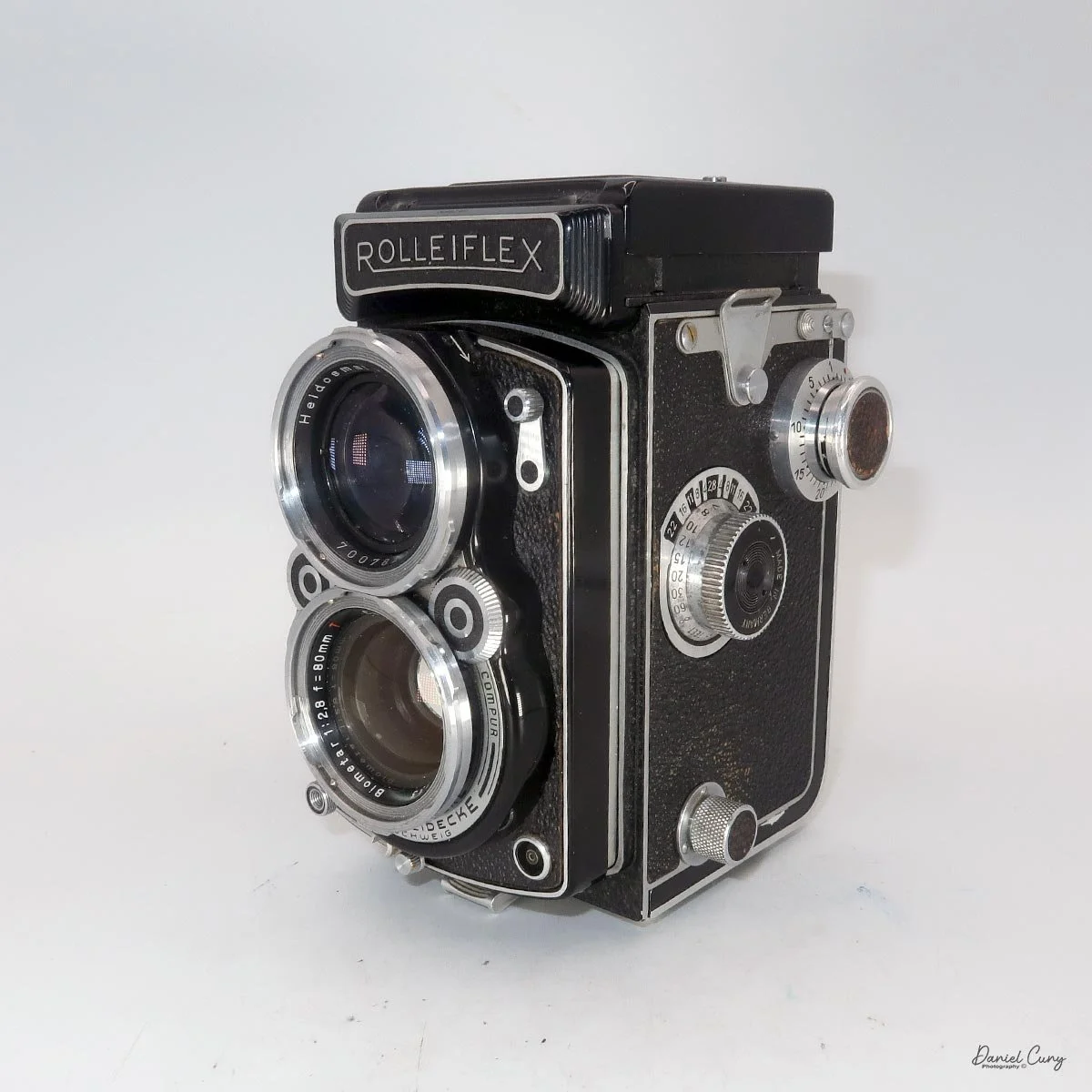
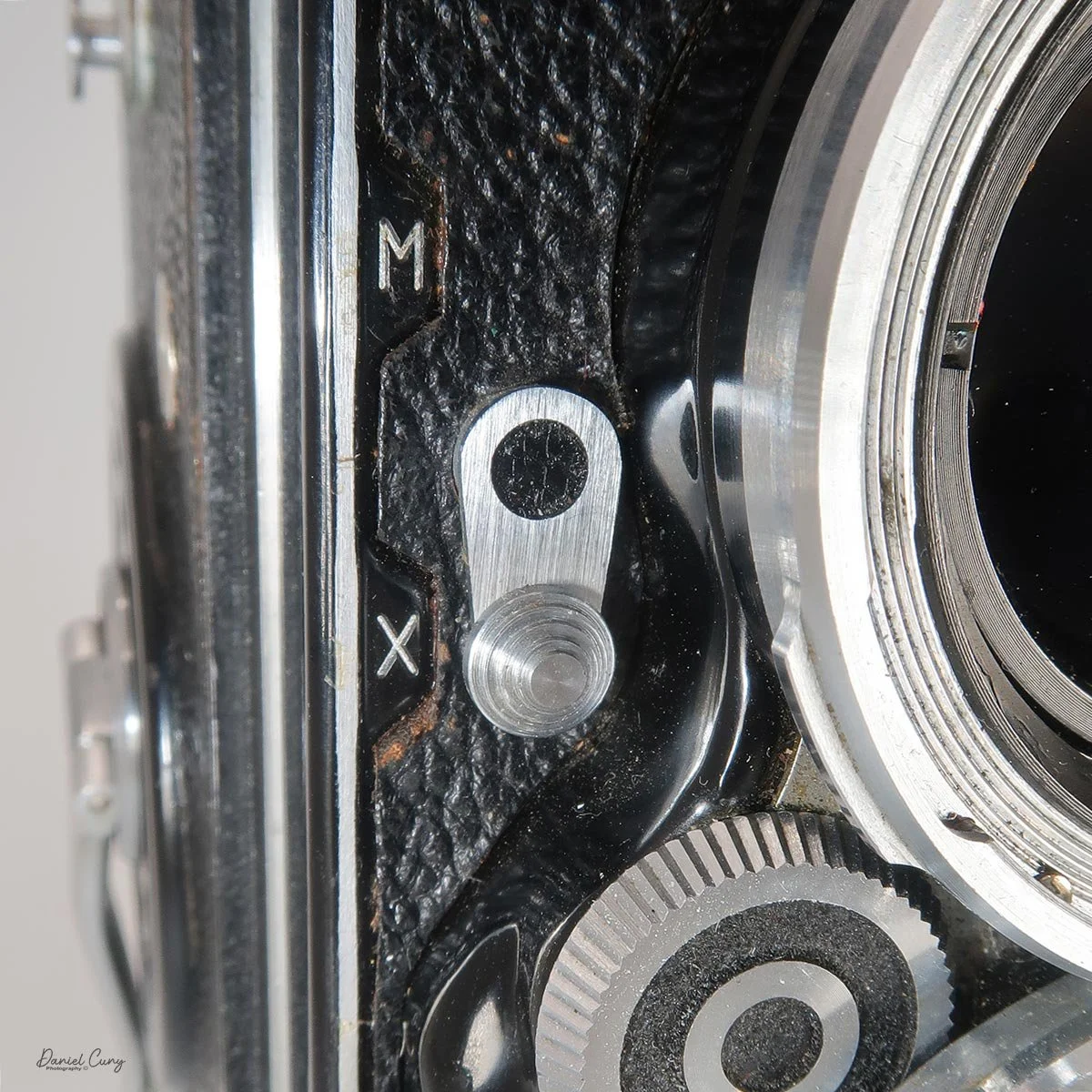
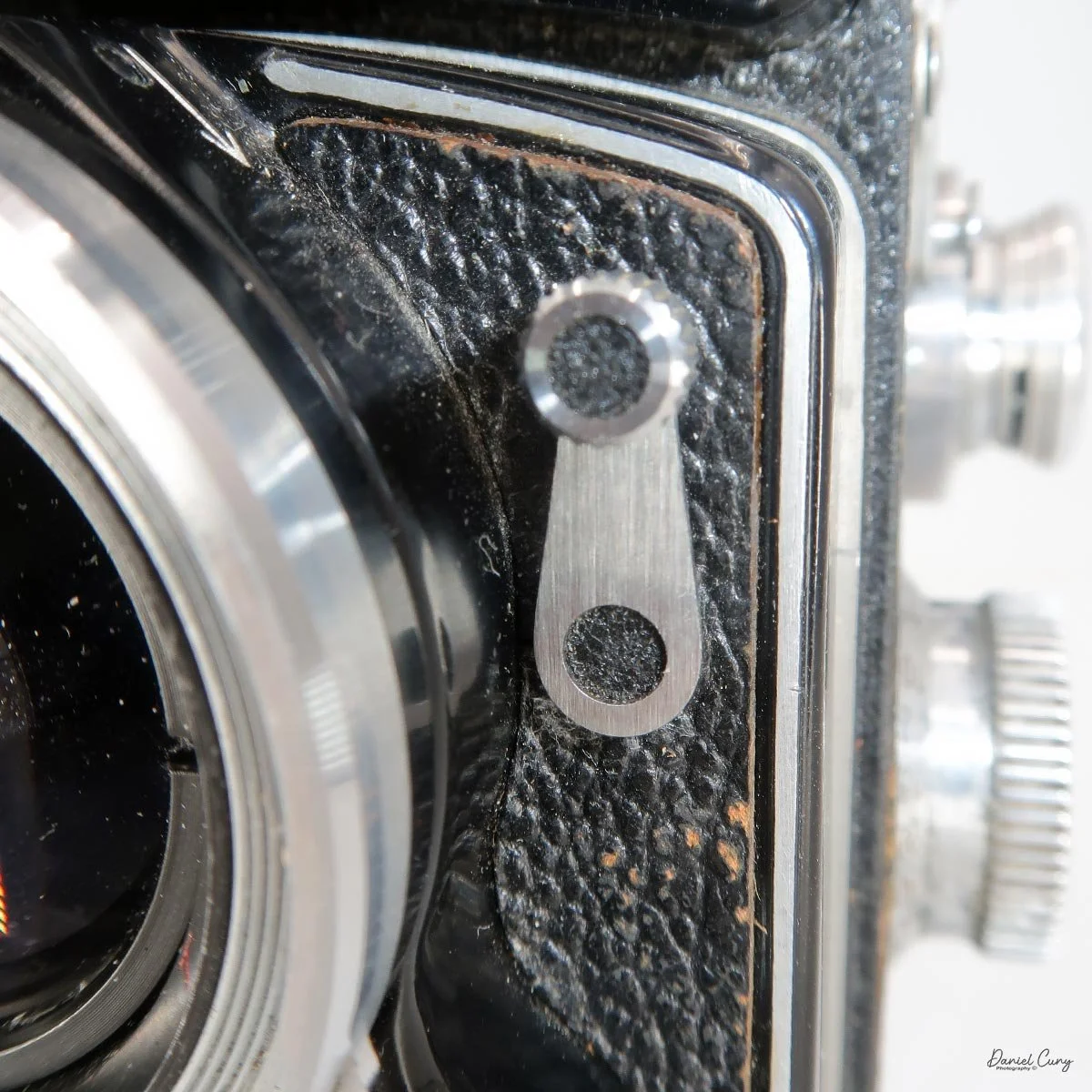
Let me start with the front of the camera. Looking at the camera straight on, the upper left corner has a switch to set either "X" (electronic) or "M" (bulb) sync for the flash. In the upper right corner is another lever, the camera's self-timer, which, when pulled down and the shutter is tripped, gives the photographer approximately a 10-second delay.
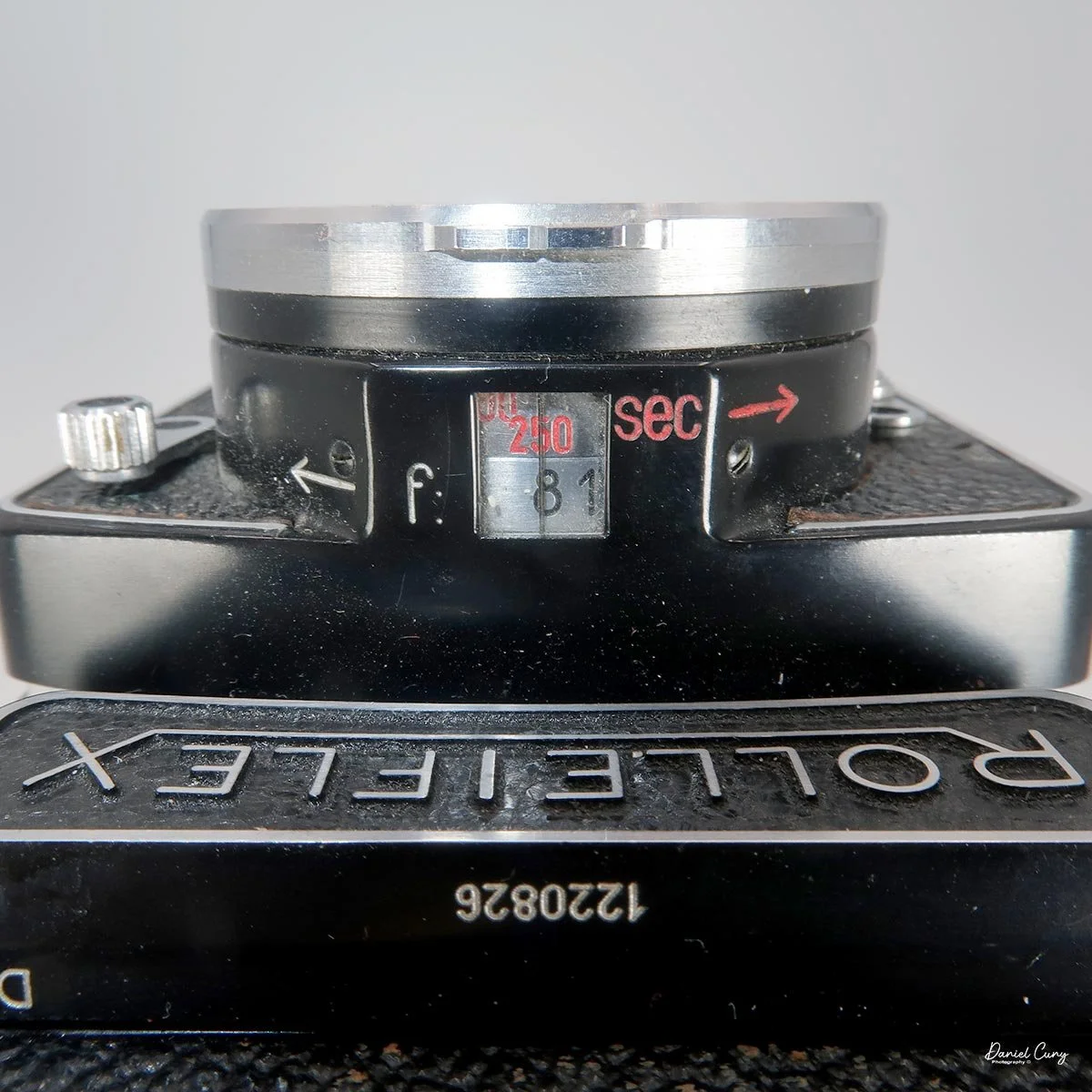
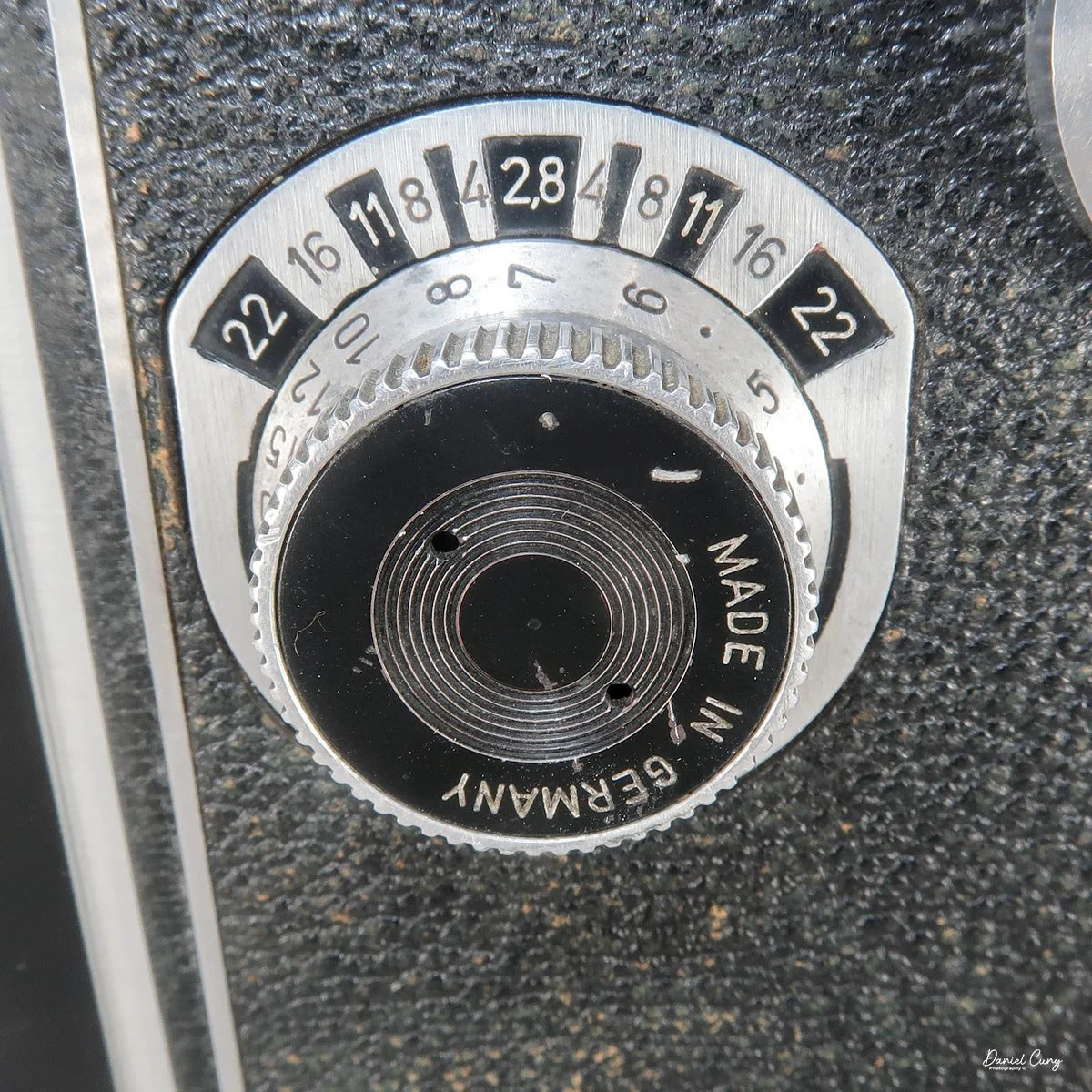
On top of the viewfinder is a window showing the current shutter speed and aperture settings. A red arrow points down to the right with "SEC," and a black arrow points left with "F." The arrows point to the two wheels on either side of the camera, between the viewing and taking lenses: the right wheel sets the shutter speed, and the left sets the aperture.
Turning these wheels changes these settings, which you view from the top, looking down onto the camera. The shutter speed range on the Rolleiflex 2.8B runs from 1/500 to 1 sec., plus "B" for timed exposures. The aperture settings range from F/2.8 to f/22.
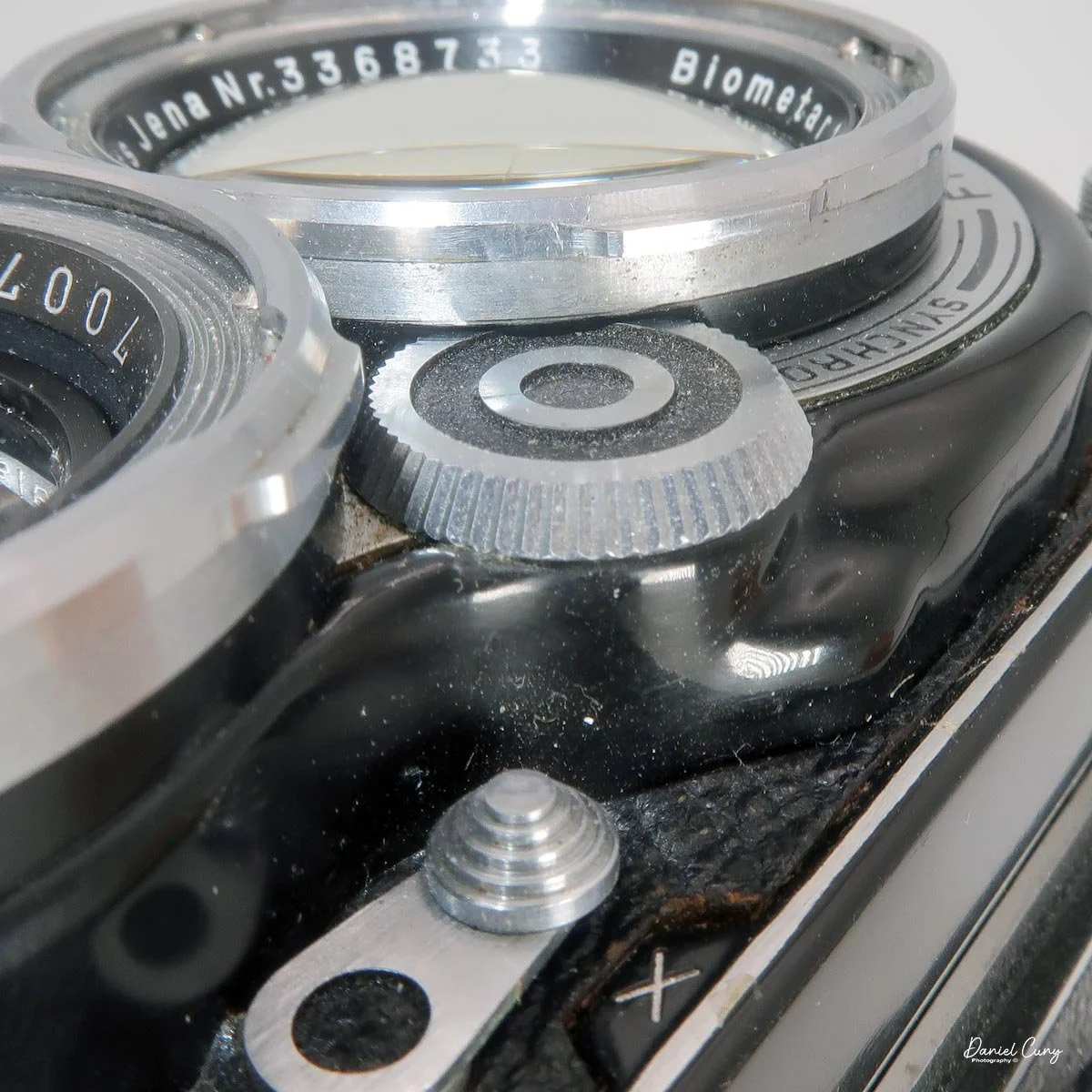
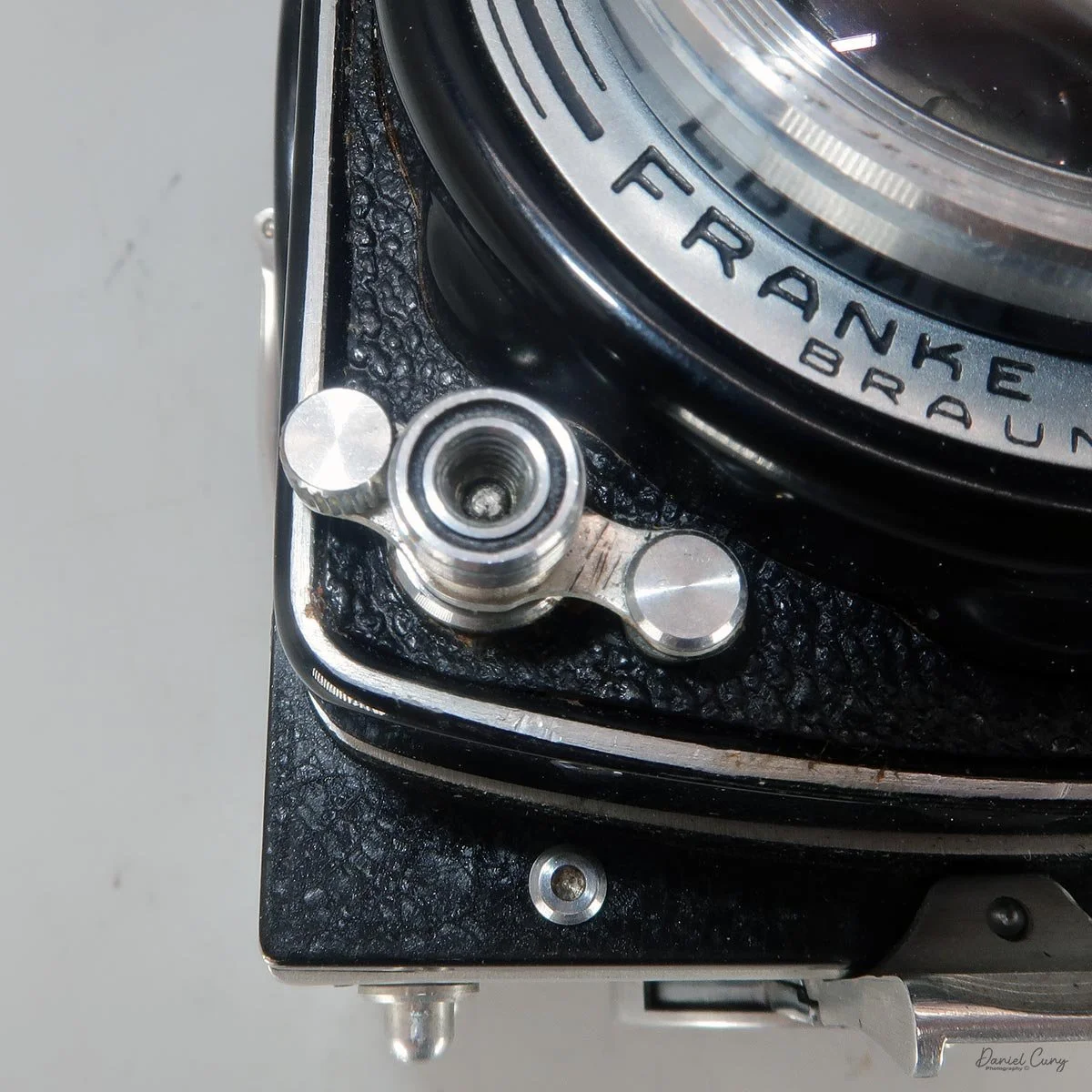
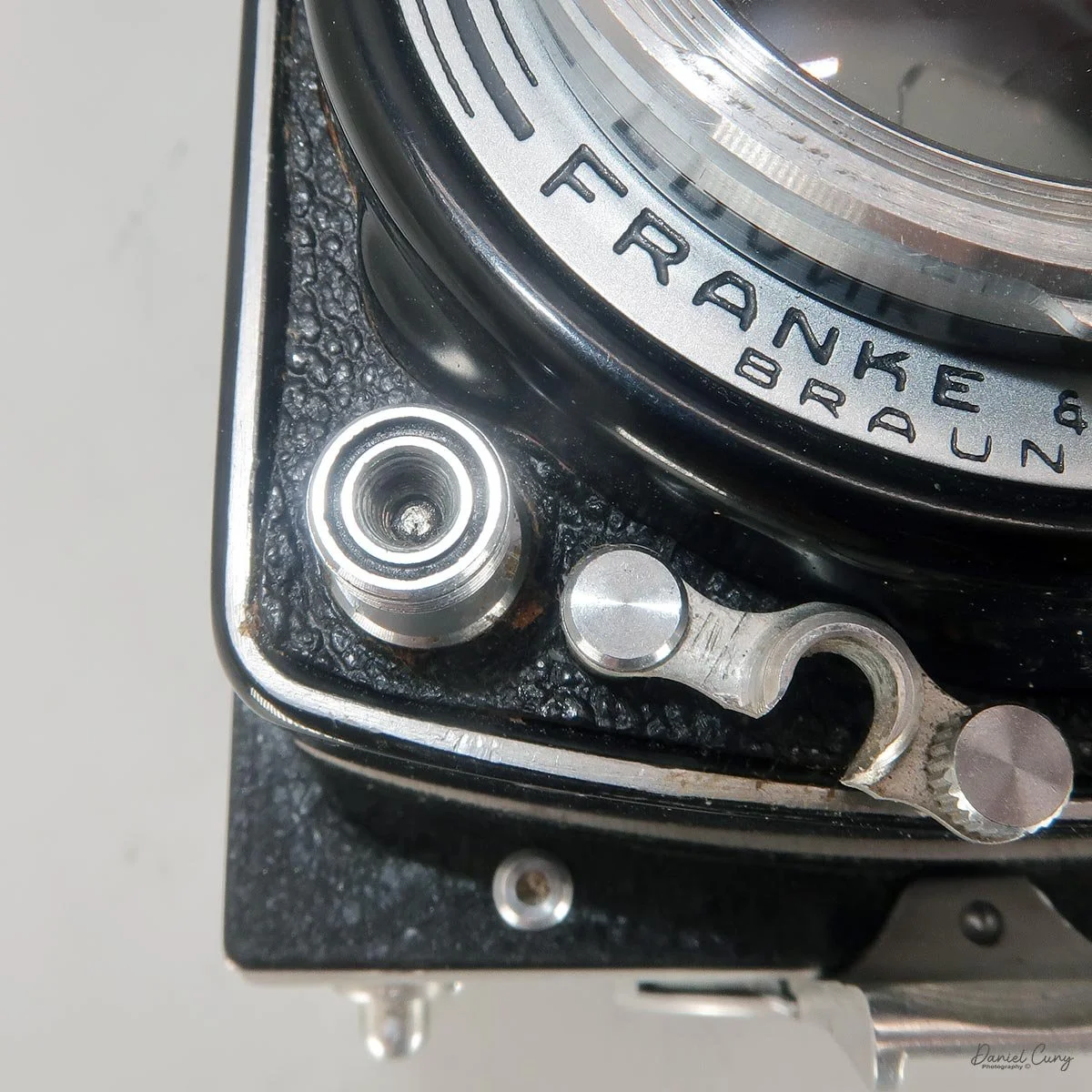
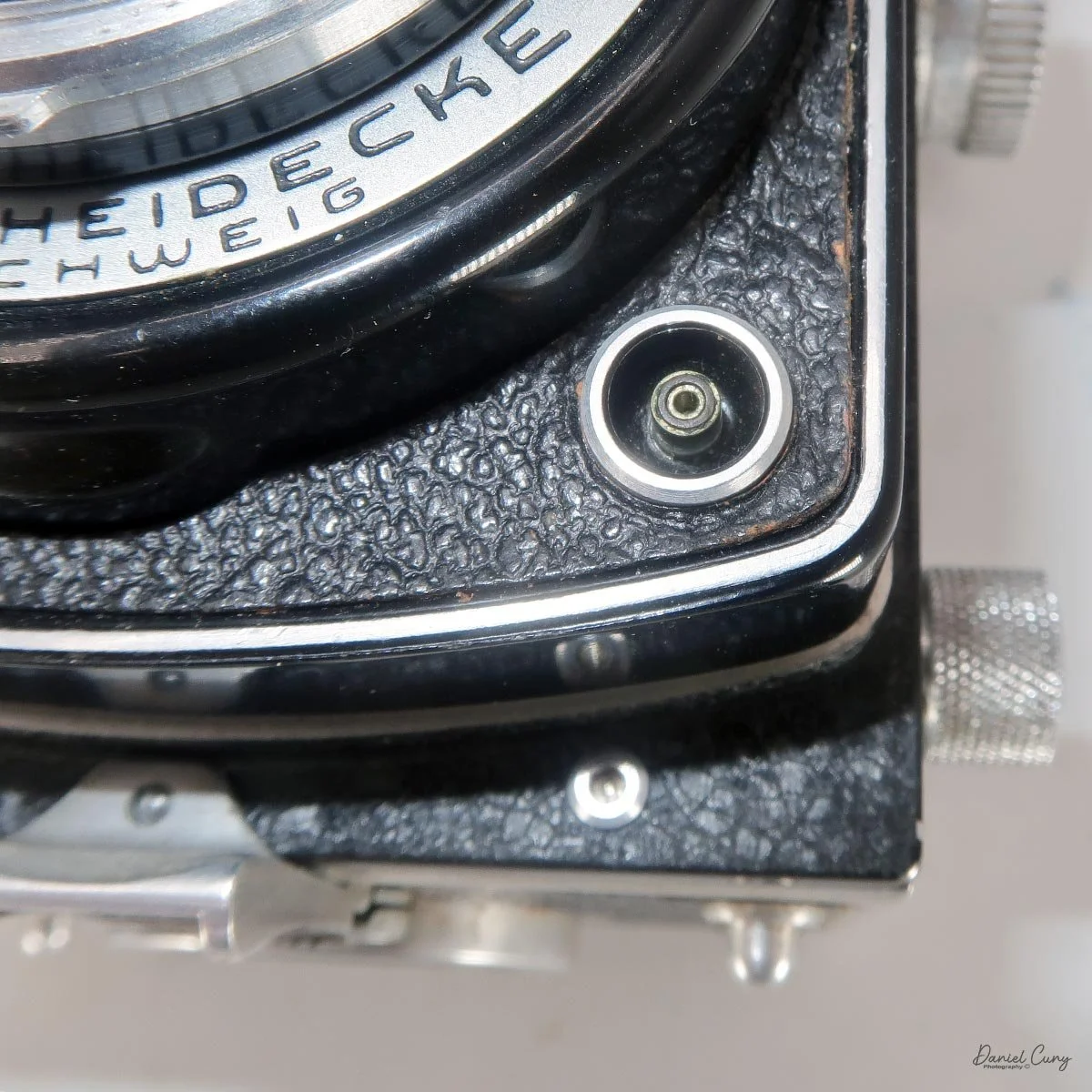
On the bottom left is the camera's shutter release button, along with a "locking" lever that needs to be pulled down to release the "lock" of the shutter release. The shutter release is also threaded for a cable release for timed exposures. The flash sync cable socket is on the bottom right of the Rolleiflex 2.8 B.
On the left side of the camera are three knobs. The knob in the middle is the focus control of the camera. The Rolleiflex 2.8B minimum focus is 3 feet to infinity. The outer ring of the focus knob has the depth-of-field scale for the selected focus distance.
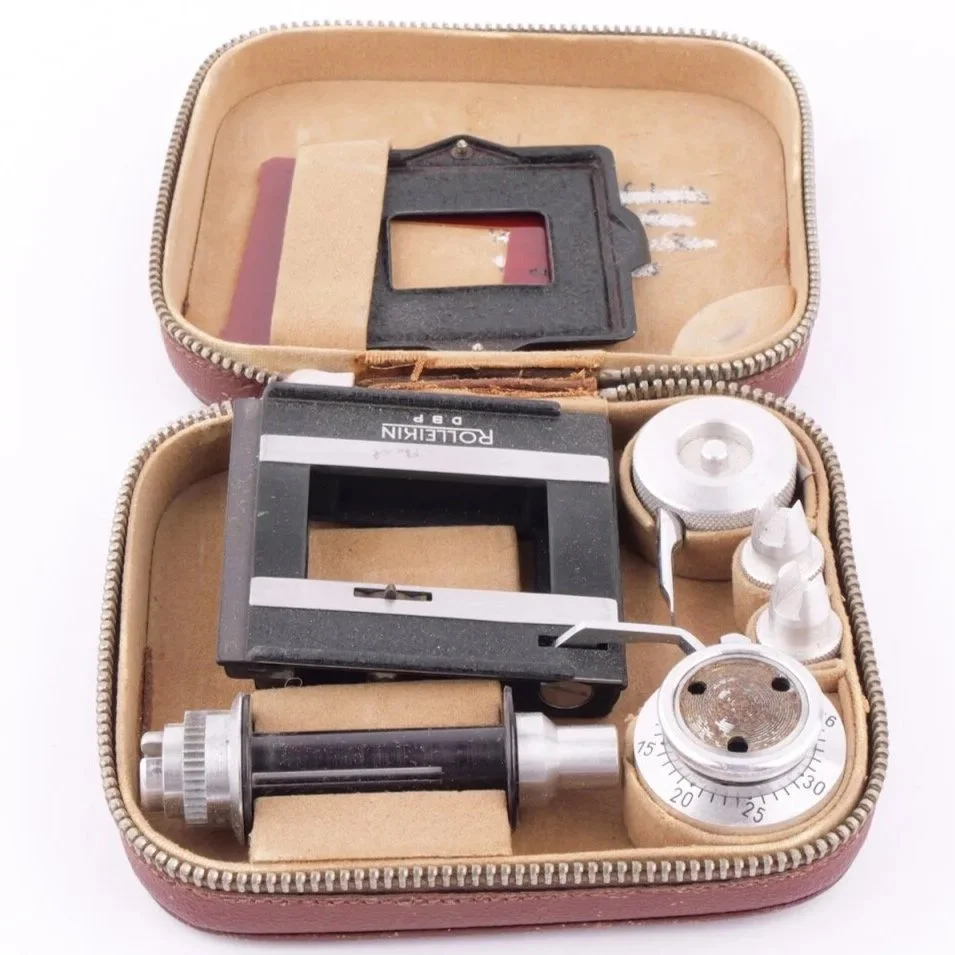
The other two knobs can be pulled out to load the camera with 120-size film used in Rolleiflex 6x6 cameras. The top knob can also count 35mm frames if you remove the camera's back and attach the Rolleiflex Rolleikin 1 adapter, which lets you shoot 35mm film in the Rolleiflex cameras.
To remove the film back, on both the left and right sides of the camera are clips that you lift up. When you unlock the film door with the switch on the bottom of the camera and lift the door as you would to load film, you can remove the back door and replace it with the Rolleikin door, along with the 35mm adapter. The Rolleikin 1 kit's own back has the pressure plate and sprocket wheel built into it, so the camera's back comes off entirely — it's the later Rolleikin 2 that keeps the camera's own back, on models with the adjustable pressure plate.
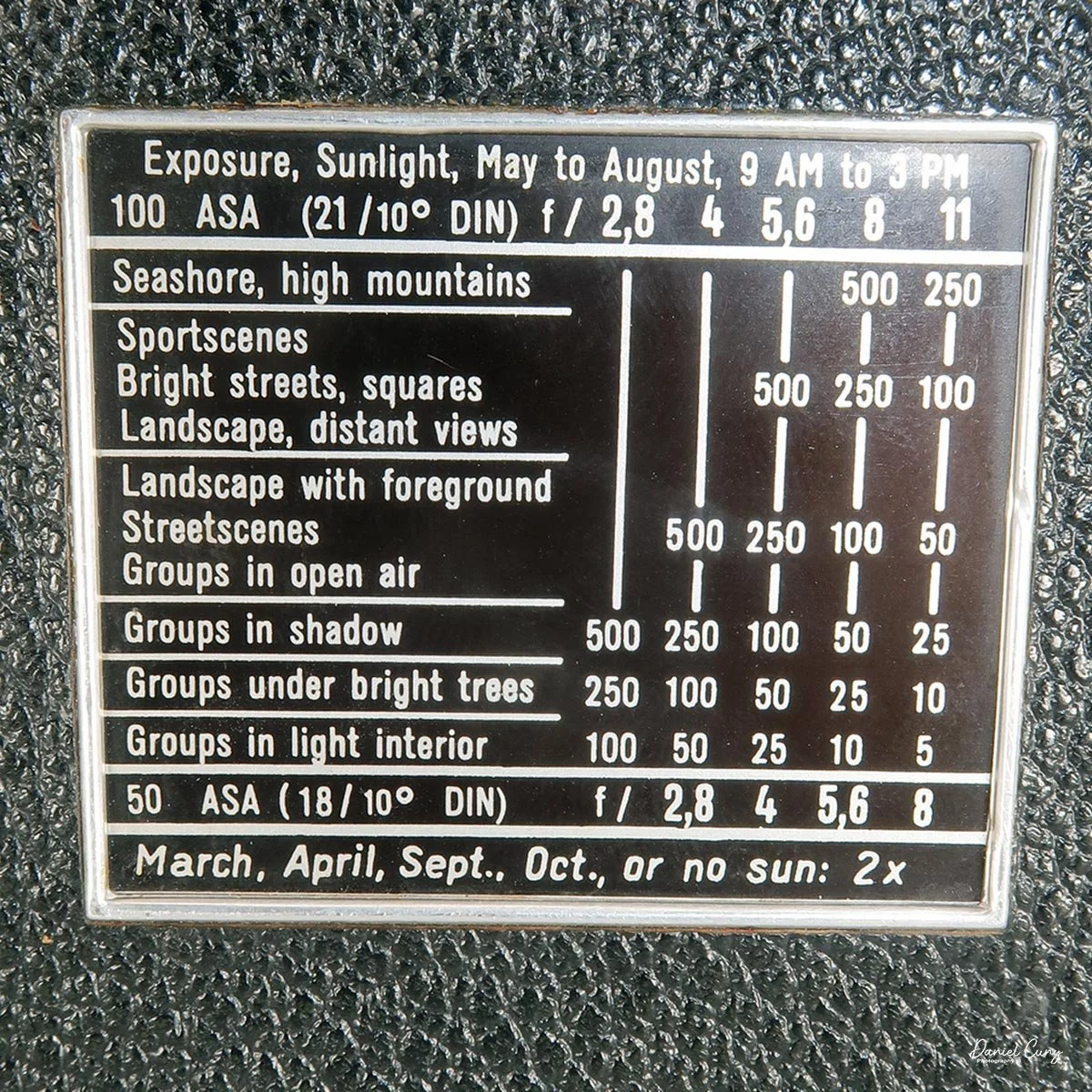
The camera back has an exposure index that shows approximate exposure settings for 100 ASA film.
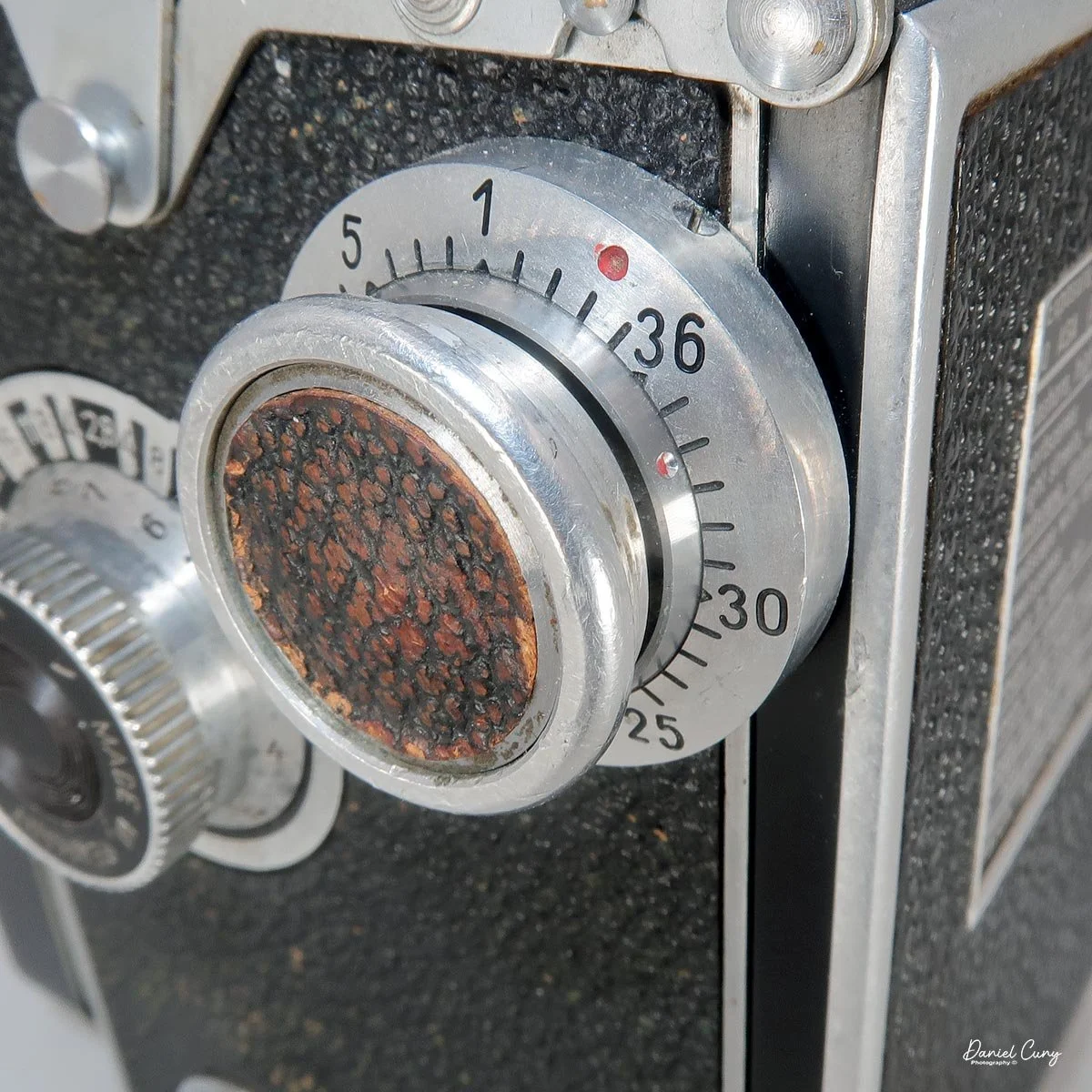
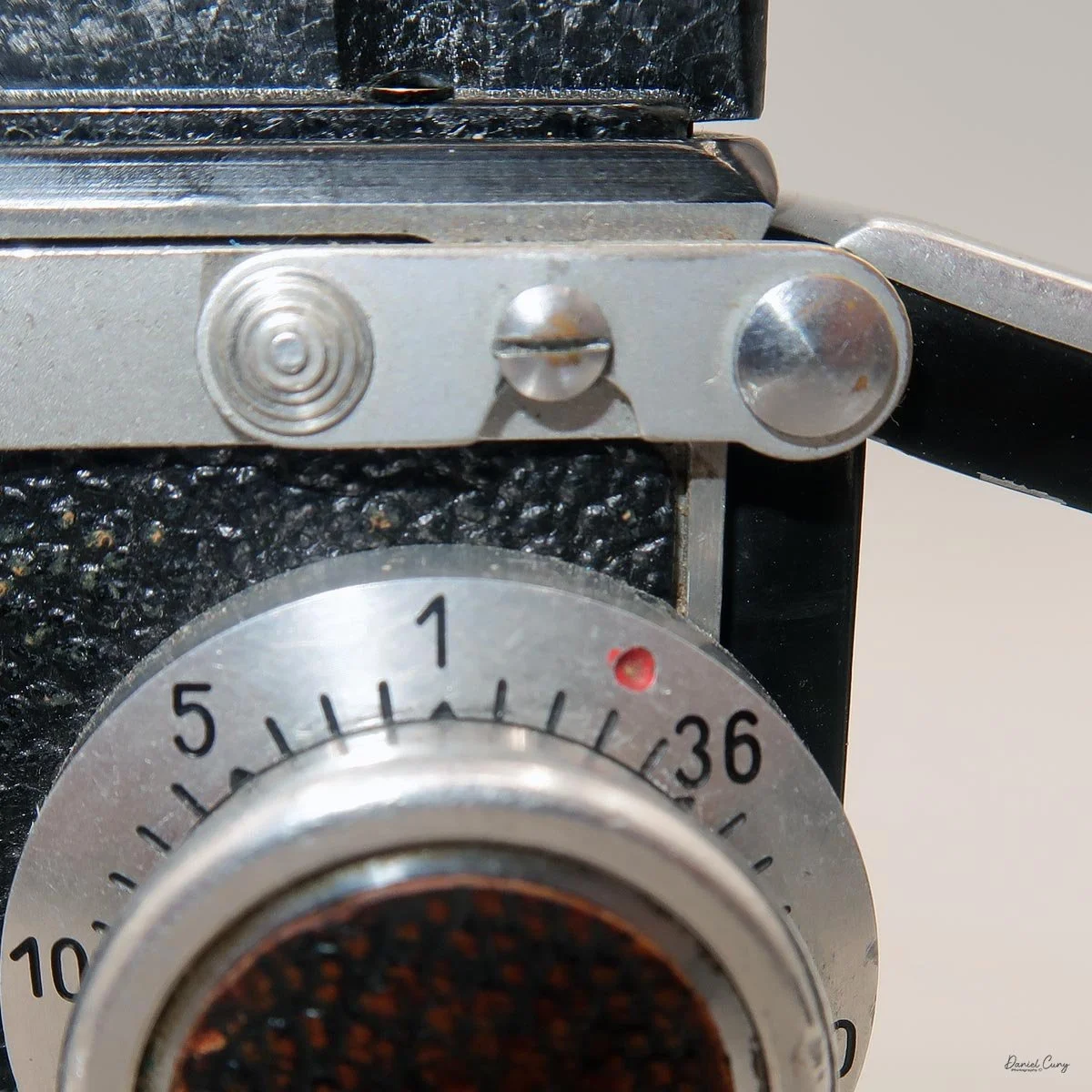
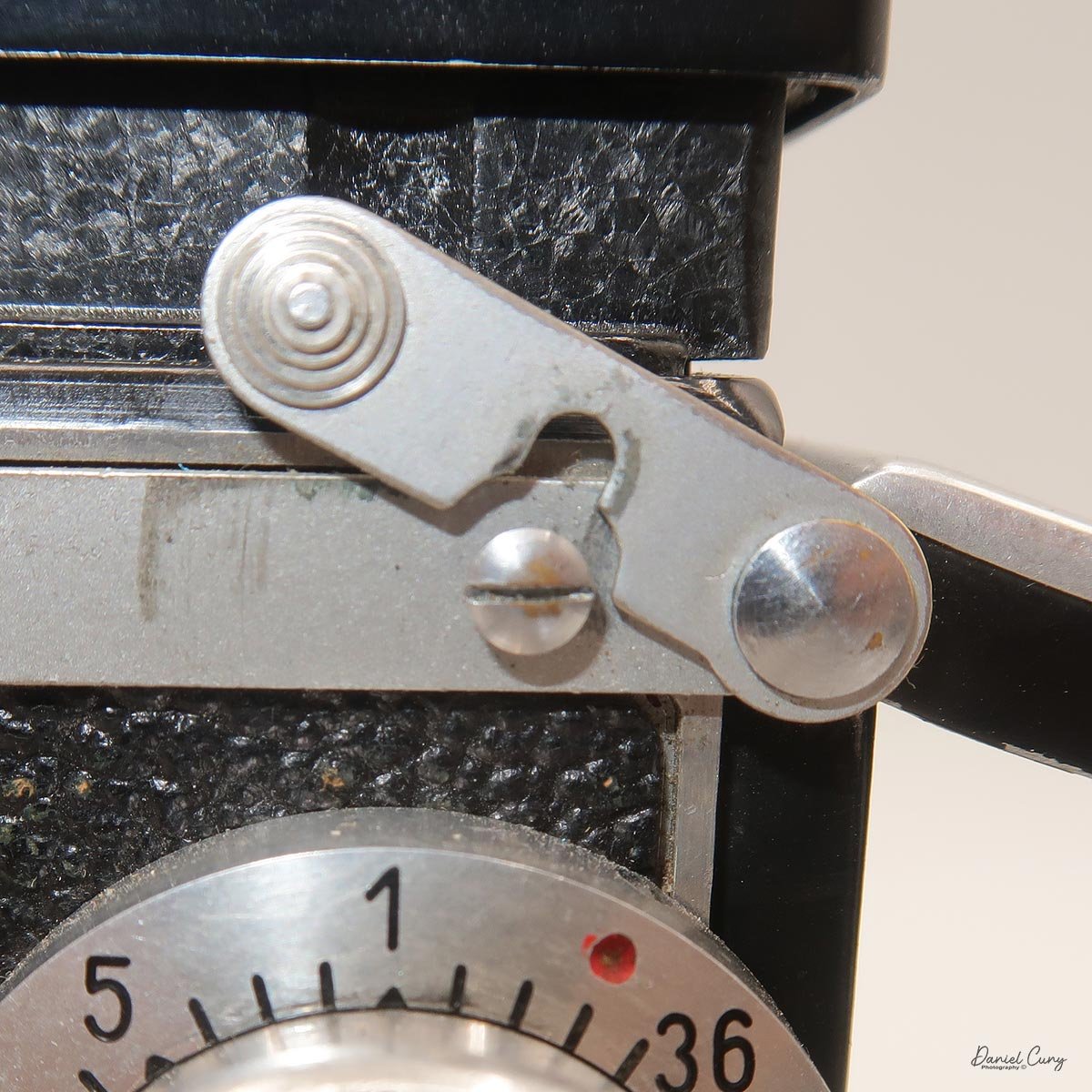
The right side of the camera has the film advance crank, which you turn clockwise to advance the film, then about half a turn counterclockwise to cock the shutter and prepare the camera for the next exposure. Just above the film advance crank is the camera's frame counter.
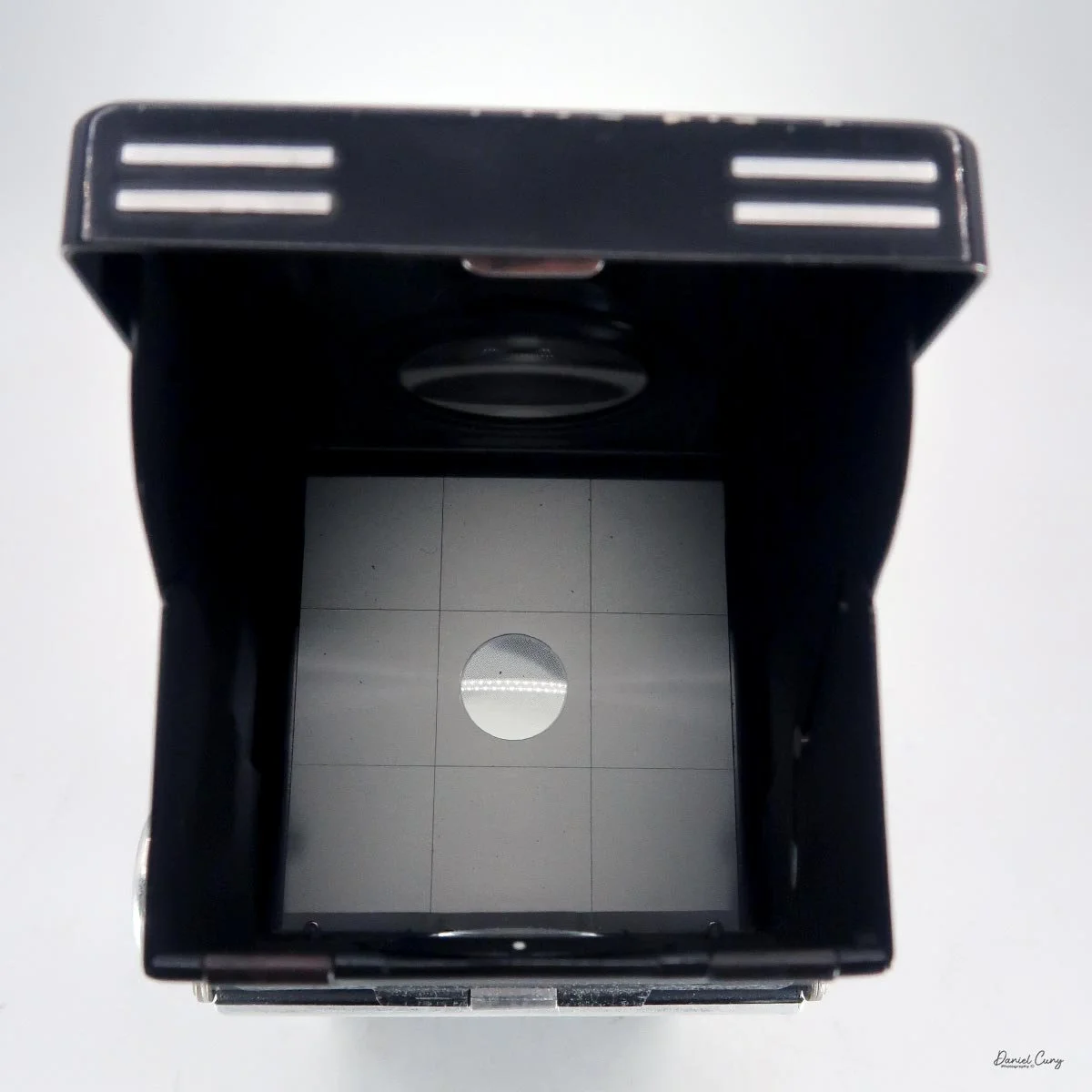
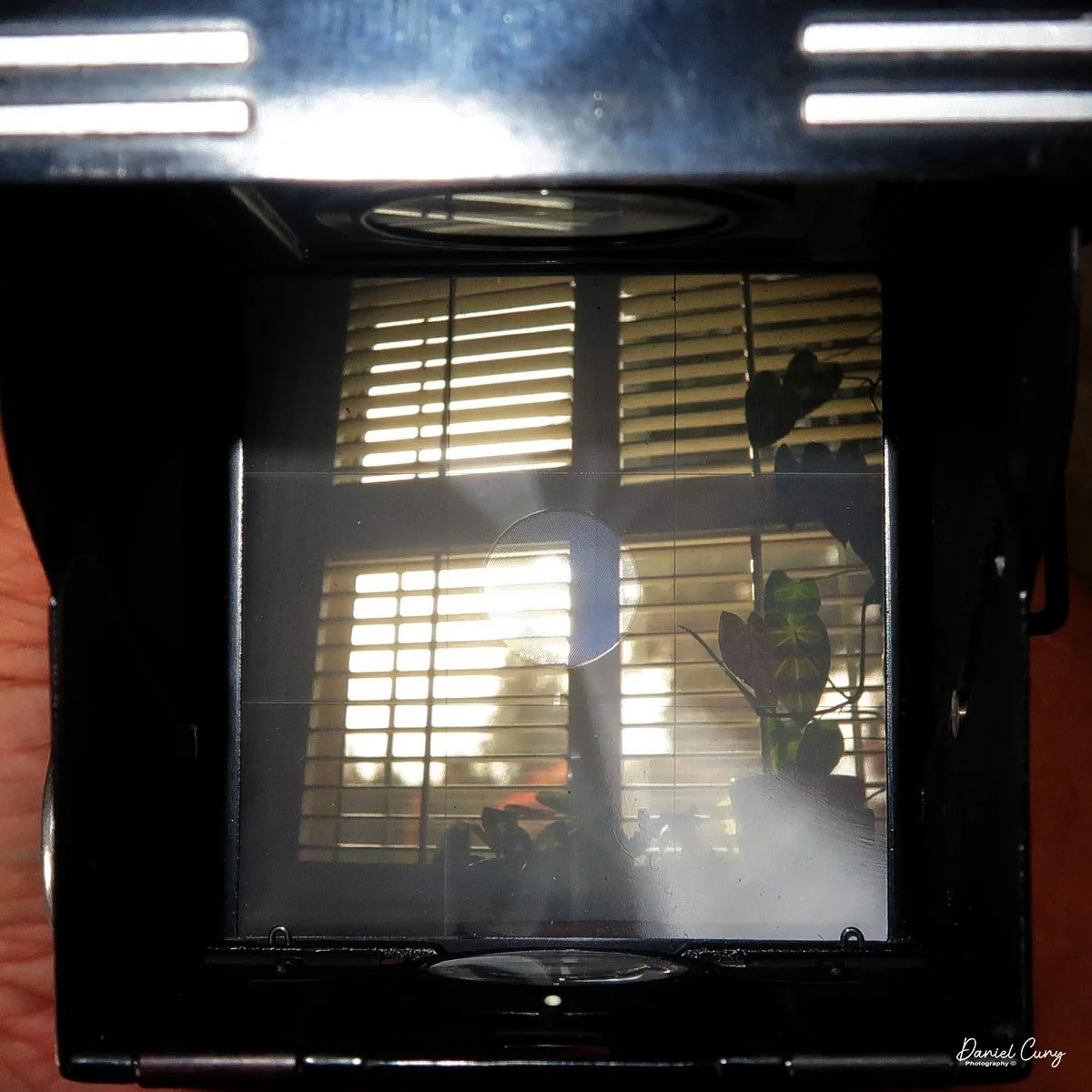
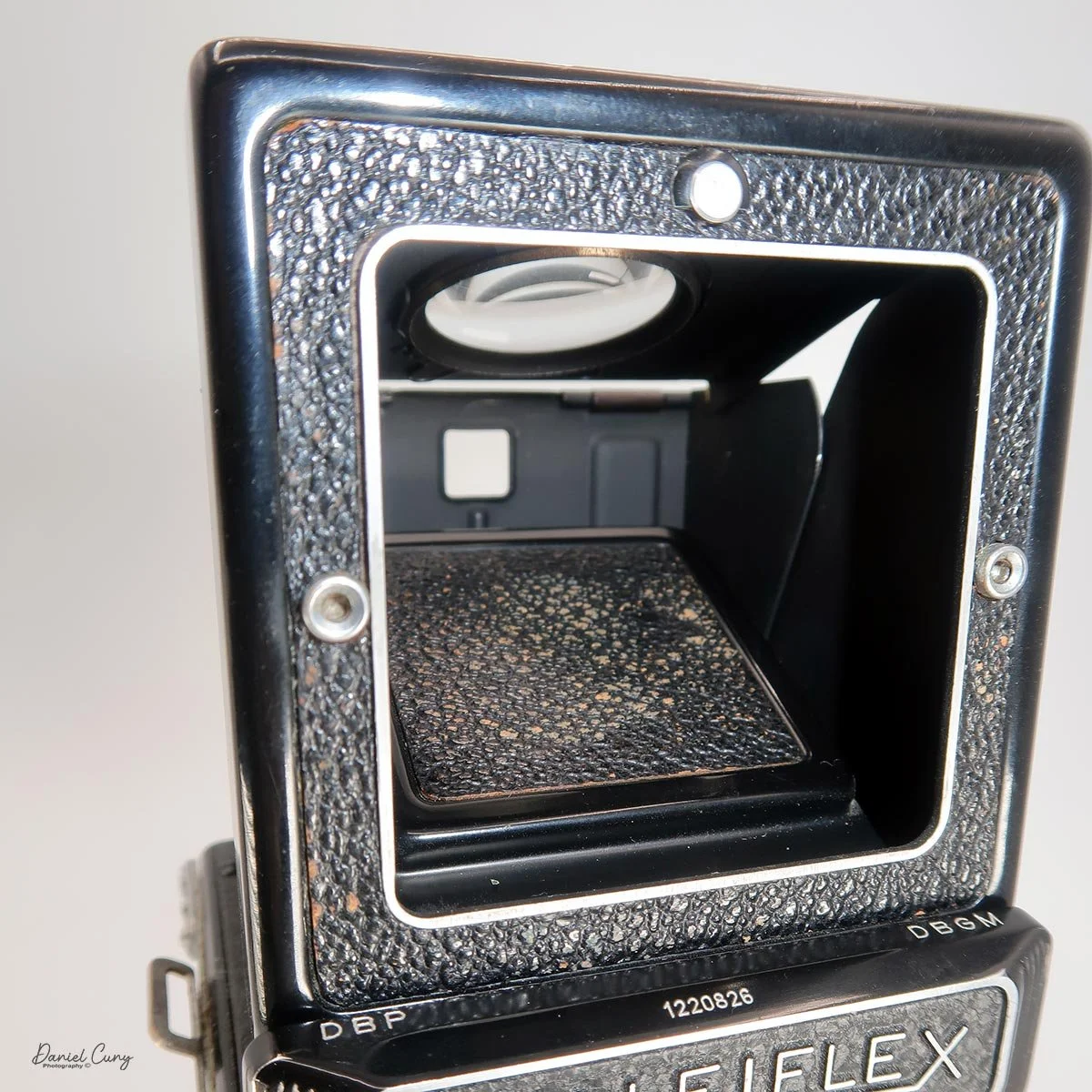
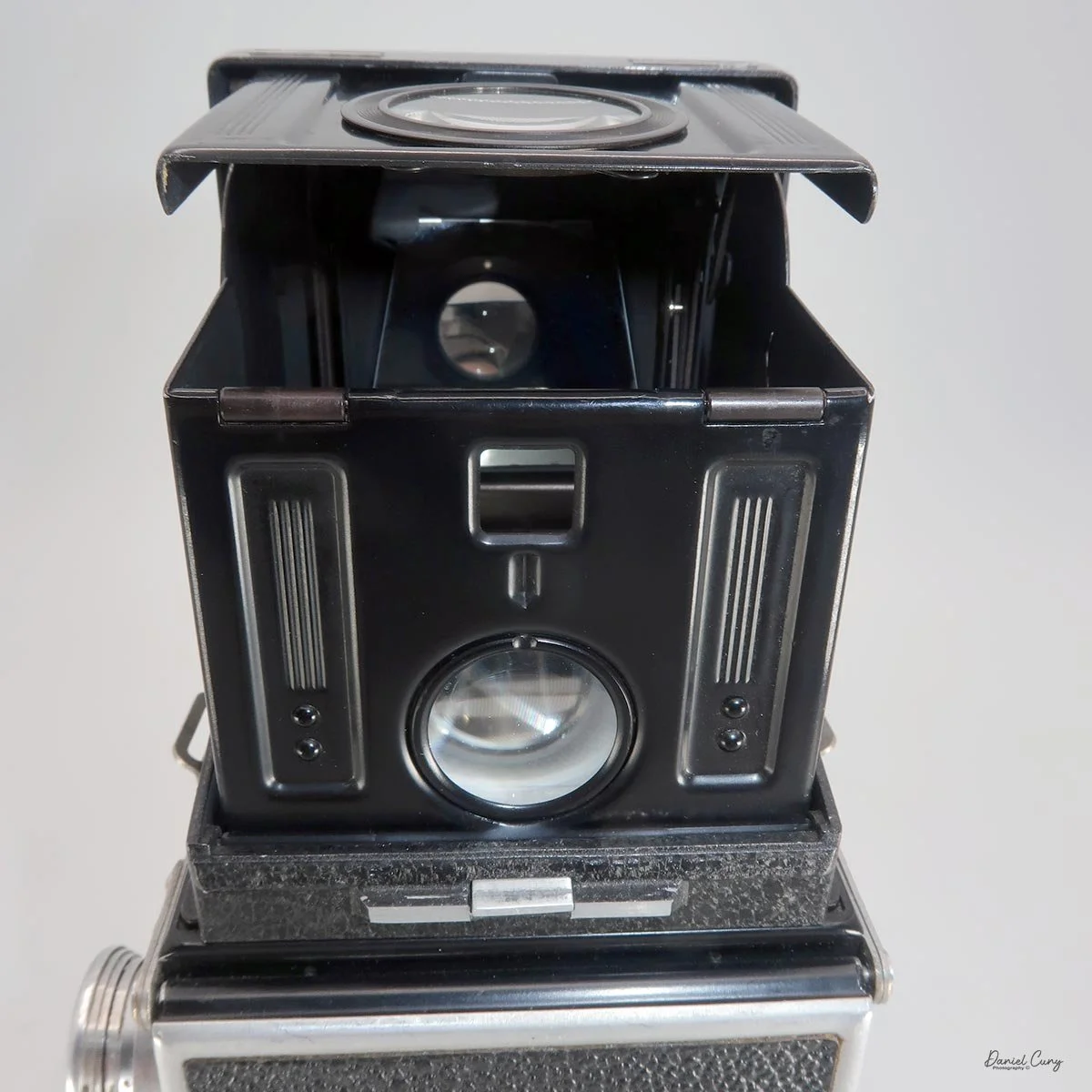
To view the image through the viewing lens, lift the back of the light chimney; it opens to let you look down into the camera. The finder on the Rolleiflex 2.8B has a few viewing options. There's the normal viewing when looking down into the camera, along with a flip-up magnifying glass, which can be flipped up via a chrome tab in the middle of the front portion of the light chimney. This is handy for fine focus.
Looking on the back of the light chimney, there is a square cut out, so when you press in the front portion of the chimney, you can use it as a "sport" finder for quick photos. Even better, just below the square cutout is an optical lens you can look through to focus, much like you would with a 35mm camera.
If looking down on your subject is difficult, open the light chimney, lift the magnifying glass, and press the front panel of the light chimney. Now look through the lens on the back of the finder, and you have an eye-level finder that you can focus. I really enjoy this feature of the camera. To close the light chimney, press the top back; the chimney closes for transport.
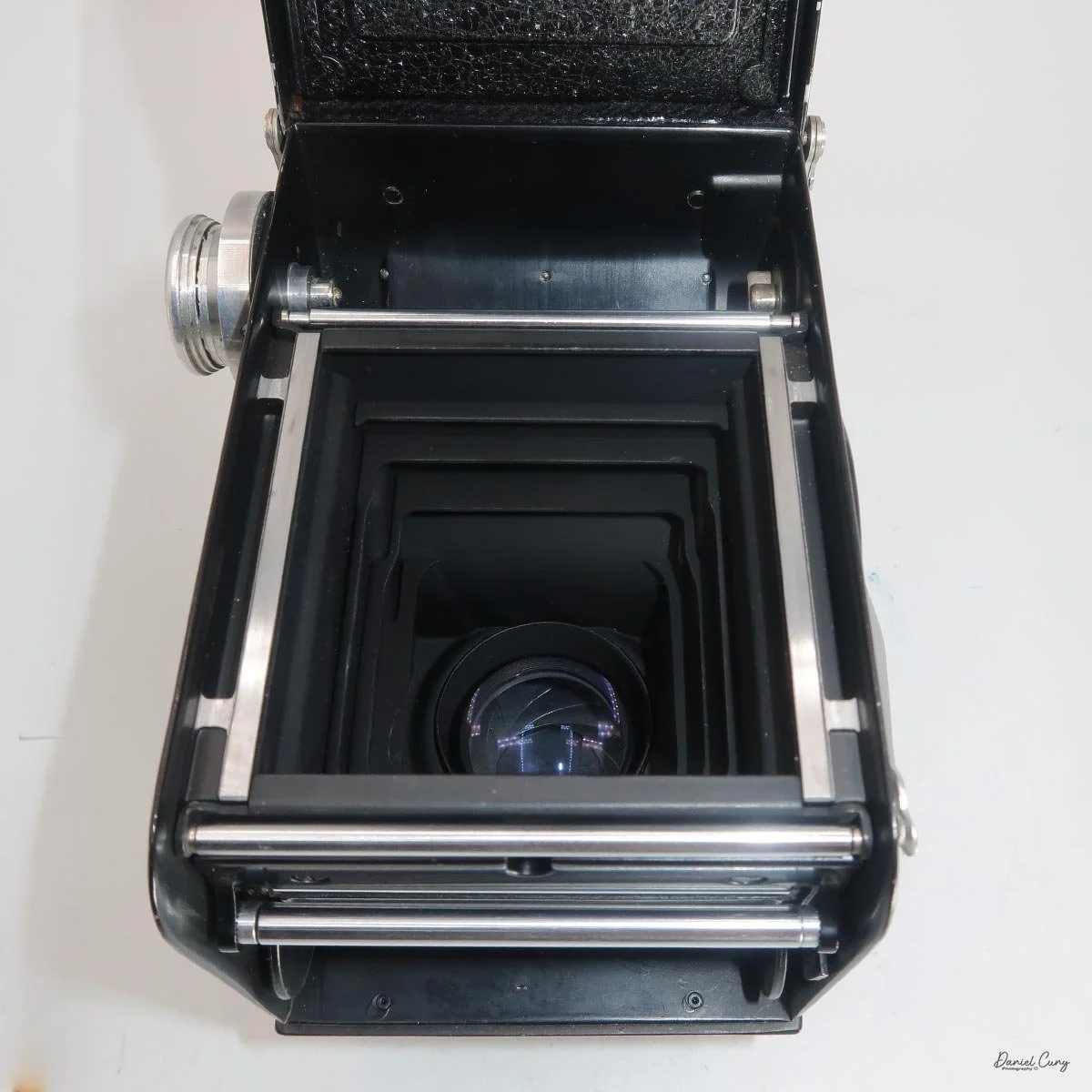
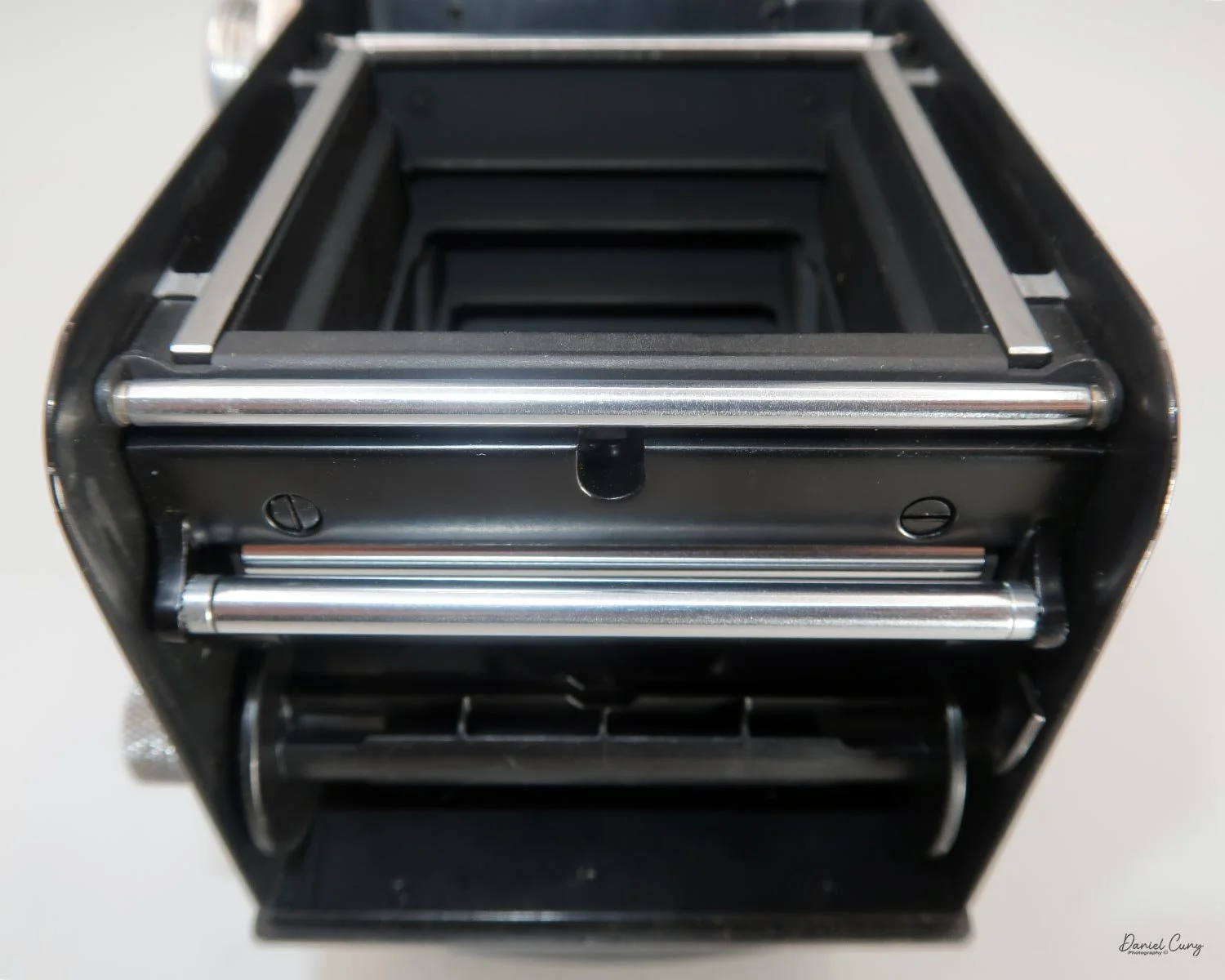
To open the back of the camera to load film, use the switch on the bottom of the camera around the tripod socket. Turn the lever in the direction of the arrow; the locking bar will lift, allowing you to lift the film door to load film into the camera.
When loading film into the Rolleiflex 2.8B, slide the paper leader under the first chrome wheel, then over the second wheel and across the film plane, before threading it into the take-up spool. Going under the first wheel sets the camera's transport and frame counter. Once you see the arrows pointing outward, you can close the back, lock the door, and turn the film-winding crank until it stops; then turn it back to set the shutter. You're now ready for your first photo, and the counter will be at number 1.
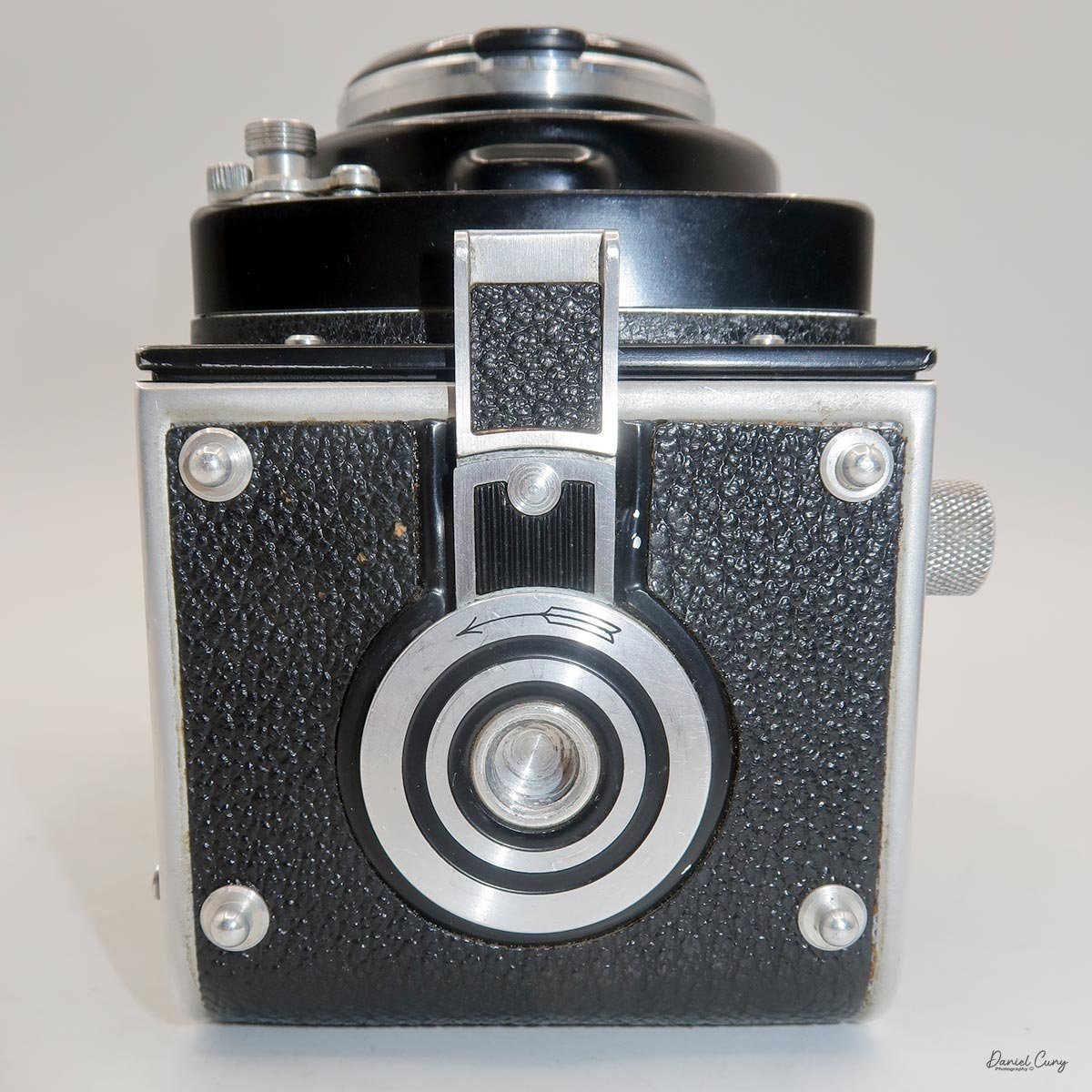
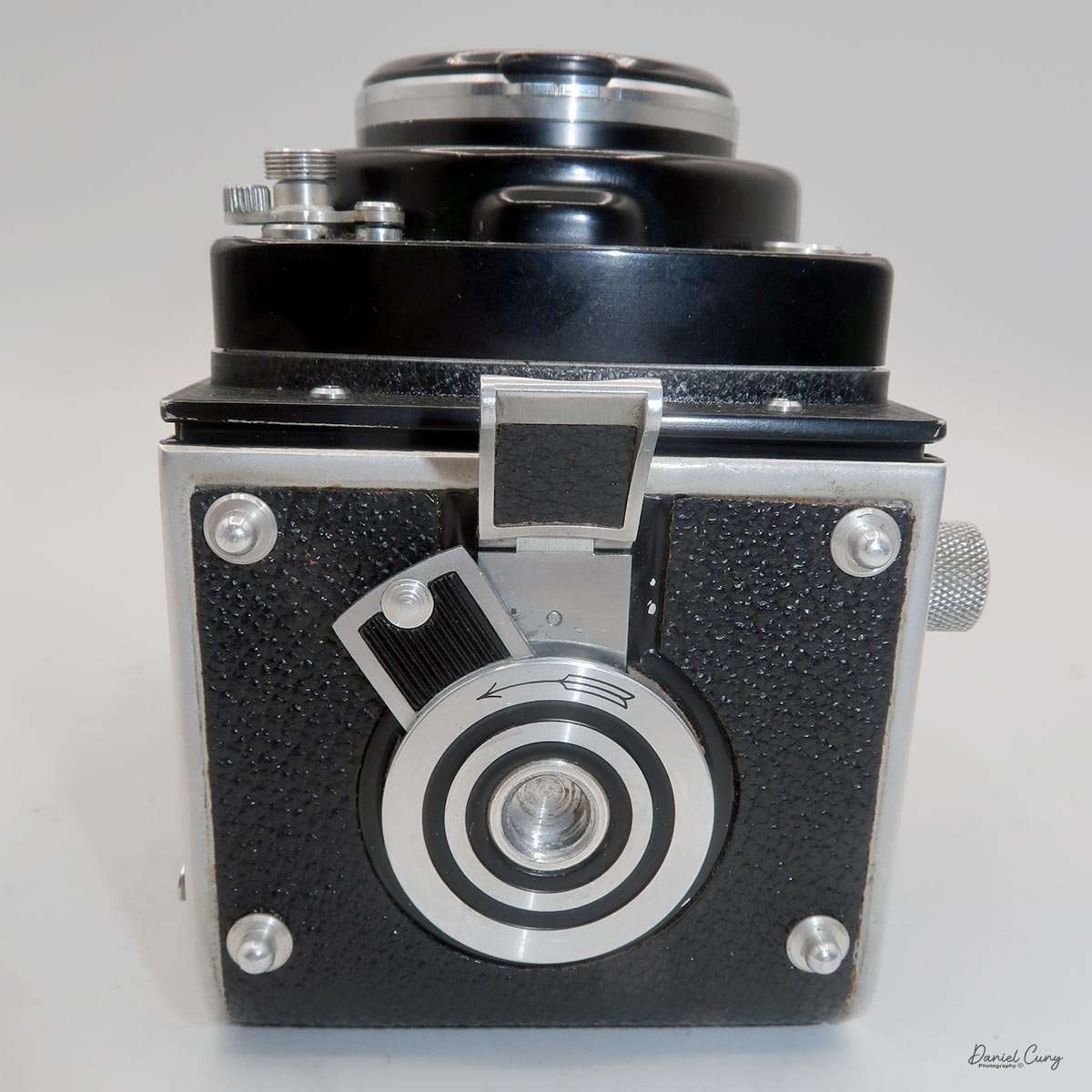
My camera also came with the original Rollei lens cap, which can be tricky to put on if you're not familiar with putting it on and taking it off. To remove the lens cap, lift the bottom lens portion (it's hinged) and turn the cap to the left if you're holding the camera, or to the right if you're facing the camera.
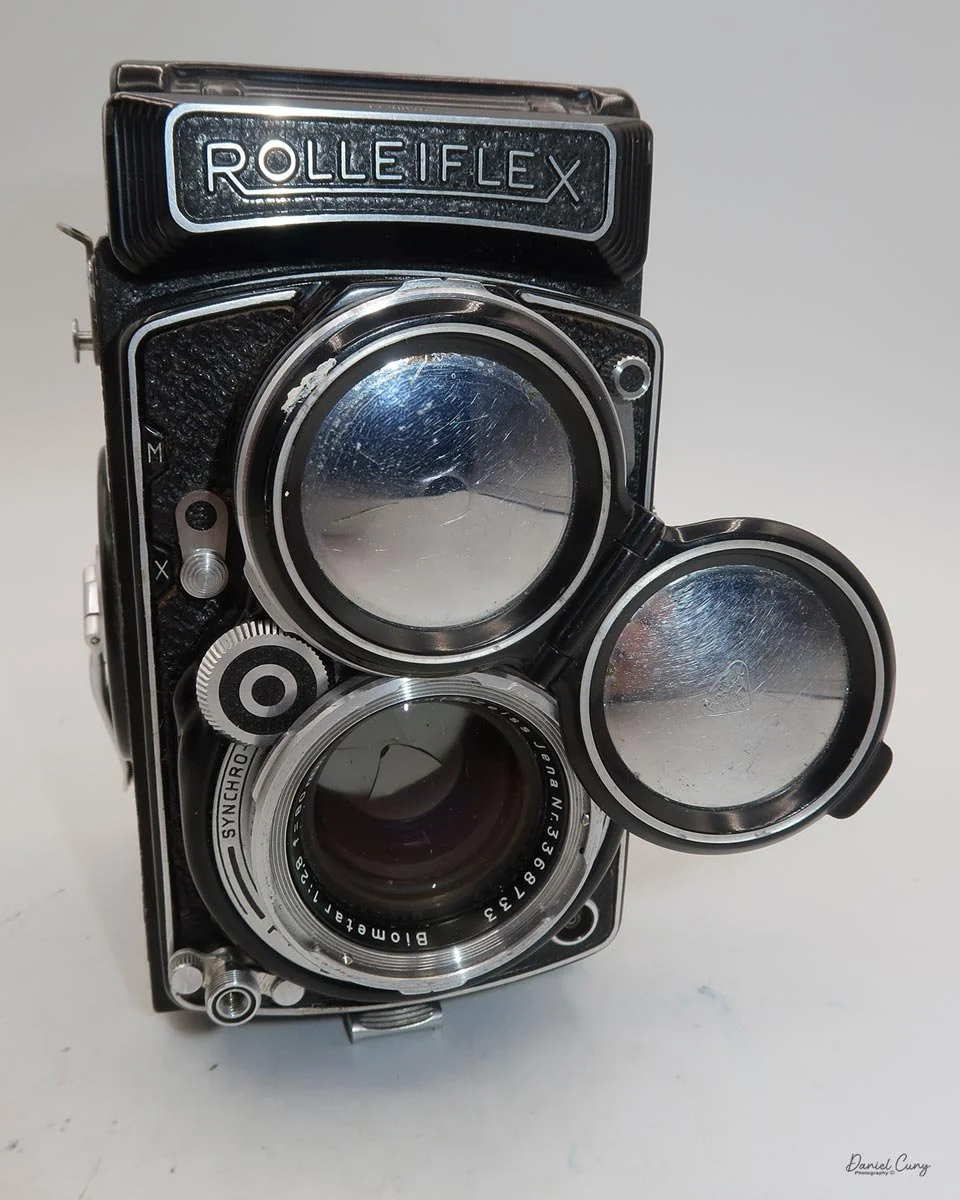
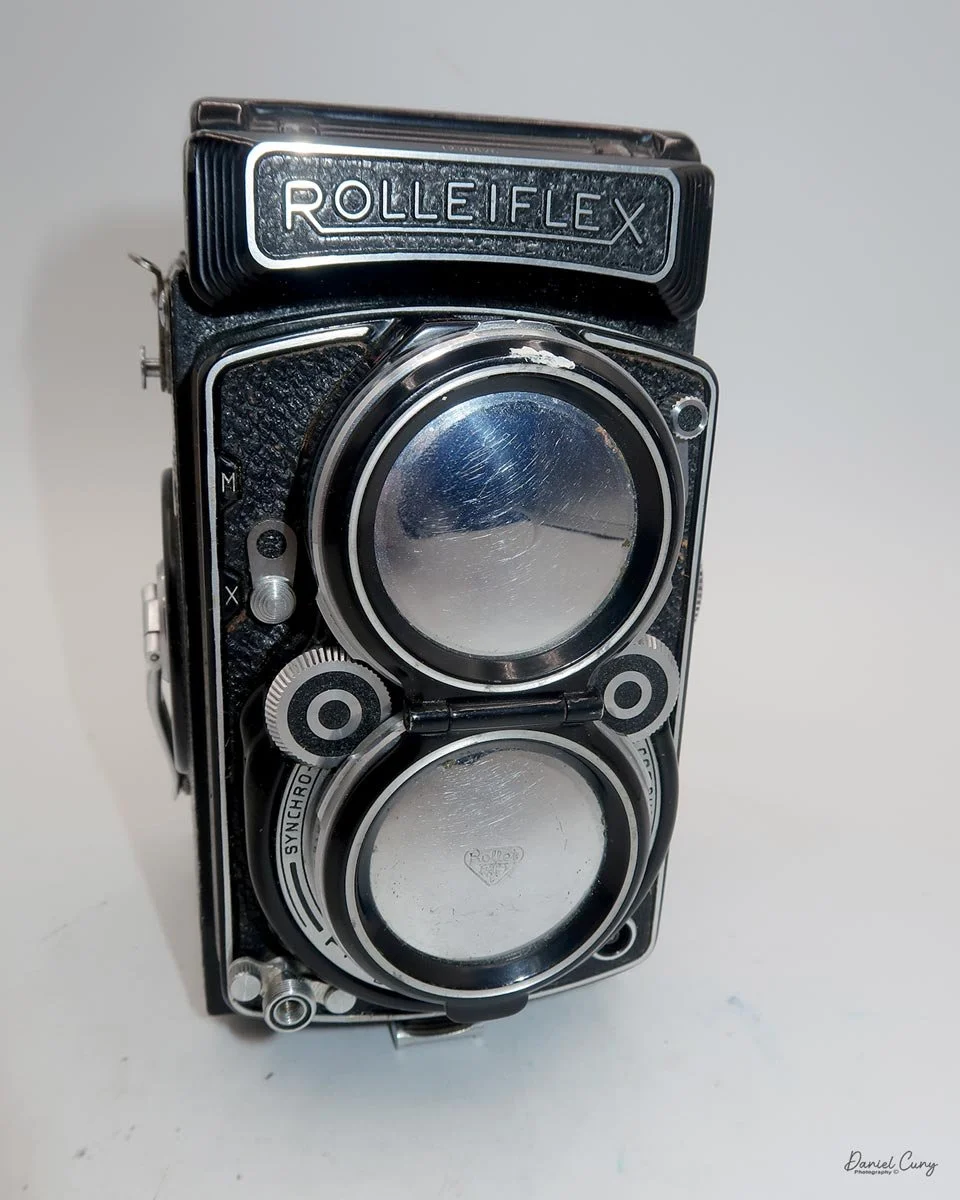
The lenses have a bayonet mount, which in Rollei language is Bay III because of its bayonet size. Turn the cap about a quarter turn, then release it from the top or viewing lens. To attach the lens cap, turn it about a quarter turn to the side, making sure it's engaged into the bayonet, then place it over the taking lens and press to click it into place.
My Results:
Now that we've loaded film in the camera and we walked through the neighborhood taking photos, let's see how the camera performed. Here are some of the photos taken with the Rolleiflex 2.8B.
Conclusion:
I should have gotten a Rolleiflex 2.8 sooner, as these are wonderful cameras to use. I remember many years ago, in the 1980s, shooting weddings for the camera shop I worked for with a Rolleiflex, which I really enjoyed. Even more than shooting weddings with Hasselblads. I must confess, the Rolleis they had were for the 2nd and 3rd shooters, so I mostly shot with the Rolleis, but I really liked their leaf shutters, and once you got used to the reverse viewing, they were tremendous cameras.
I really enjoyed the "eye-level" focusing and the brighter focusing screen, which made it extremely easy to focus. The camera handled like a champ. The images are extremely sharp, and now I need a wider strap and clips so I can take it out more often. Overall, my experience with the Rolleiflex 2.8B was very positive.
Thank you for taking the time to read about the Rolleiflex 2.8B I recently added to my collection.
Are you interested in other vintage gear? Here are some of my other Camera Reviews.
Check out my Cuny's Camera Collection YouTube channel, where I am putting together video overviews of the cameras I write about. Be sure to subscribe and like the channel, too!
Cuny's Cameras and Photos is my online eBay store, where you will find some of the cameras I have reviewed, along with a wide range of other cameras, lenses, and items from my collection that I am thinning out.
Until next week, please be safe.