GOMZ Malyutka Camera

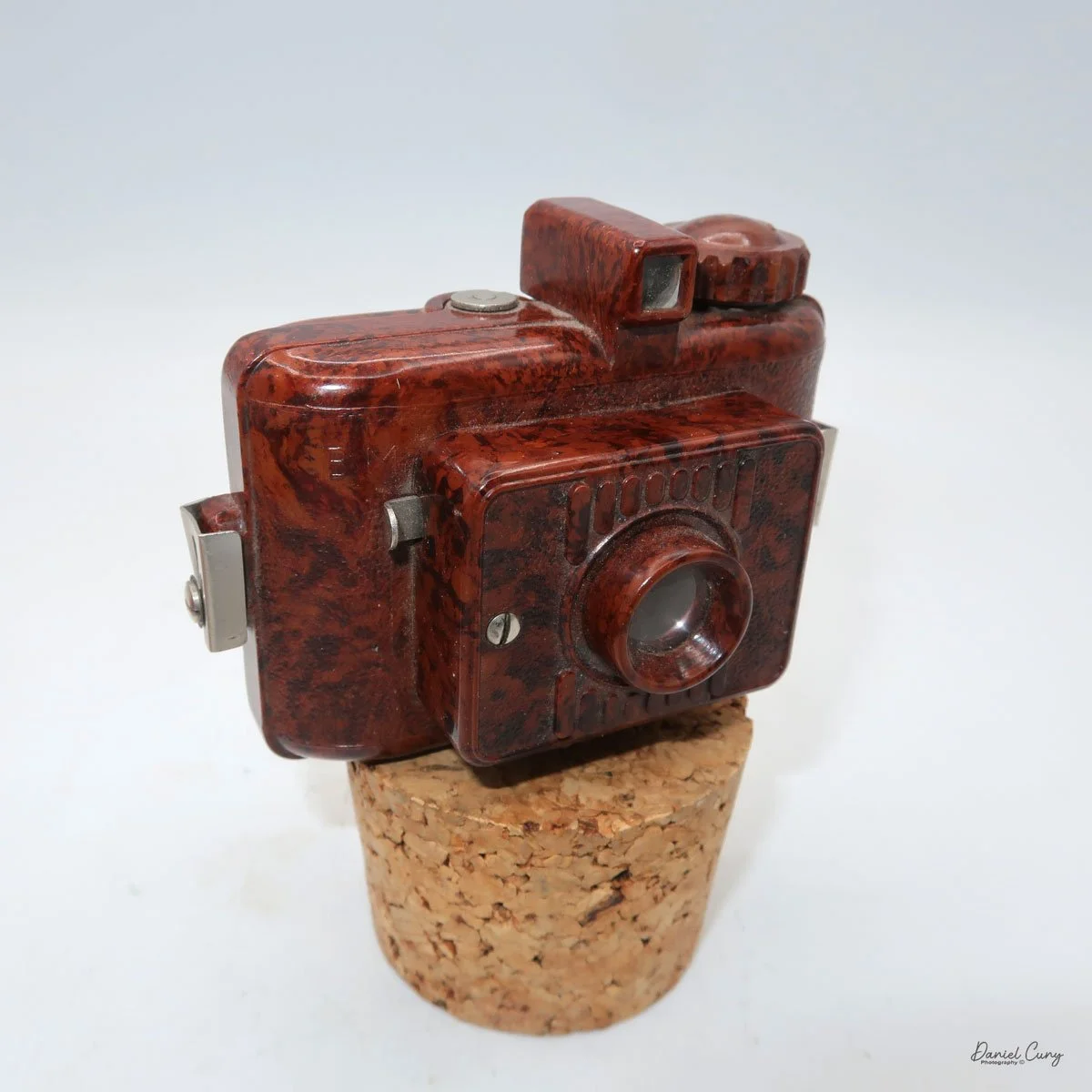
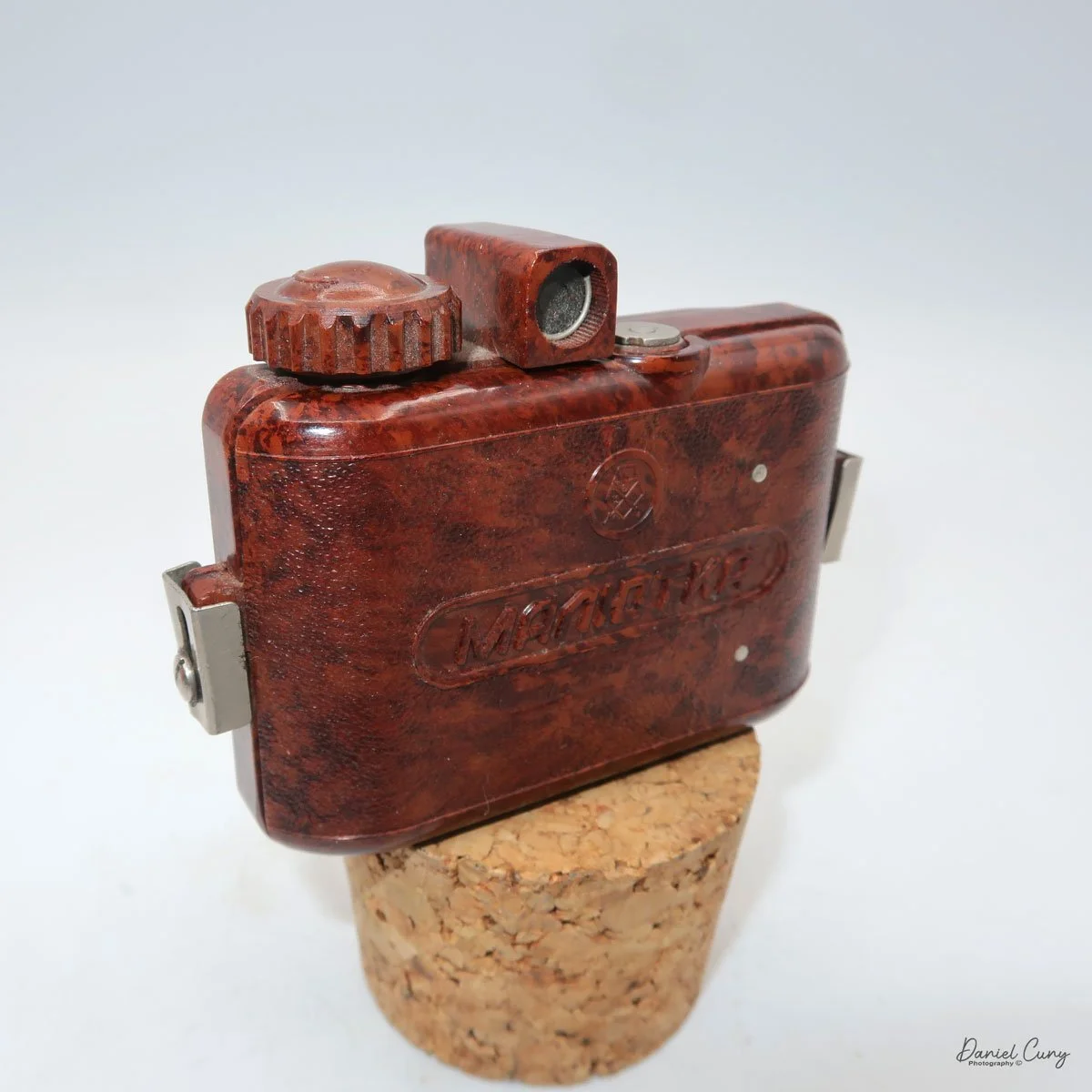
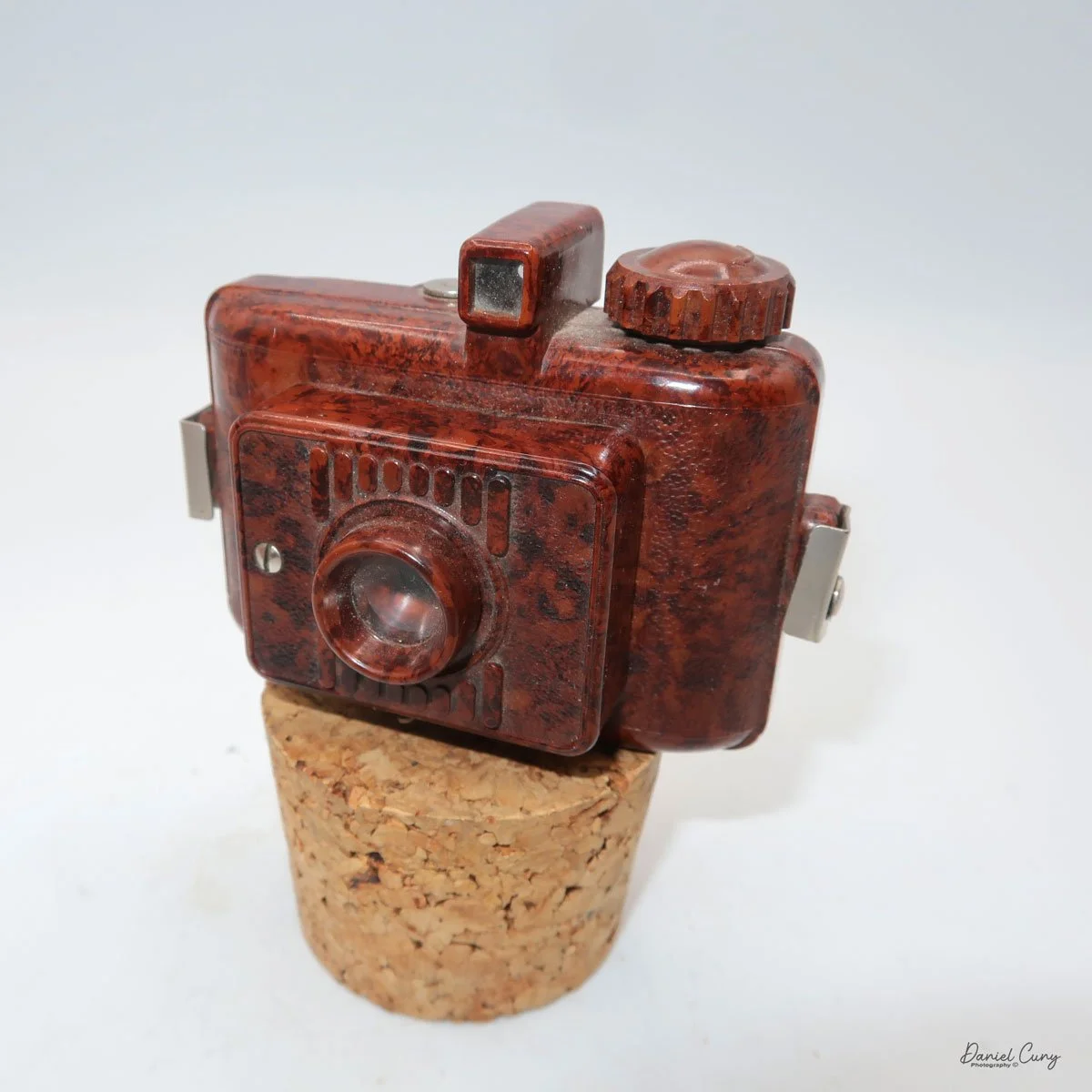
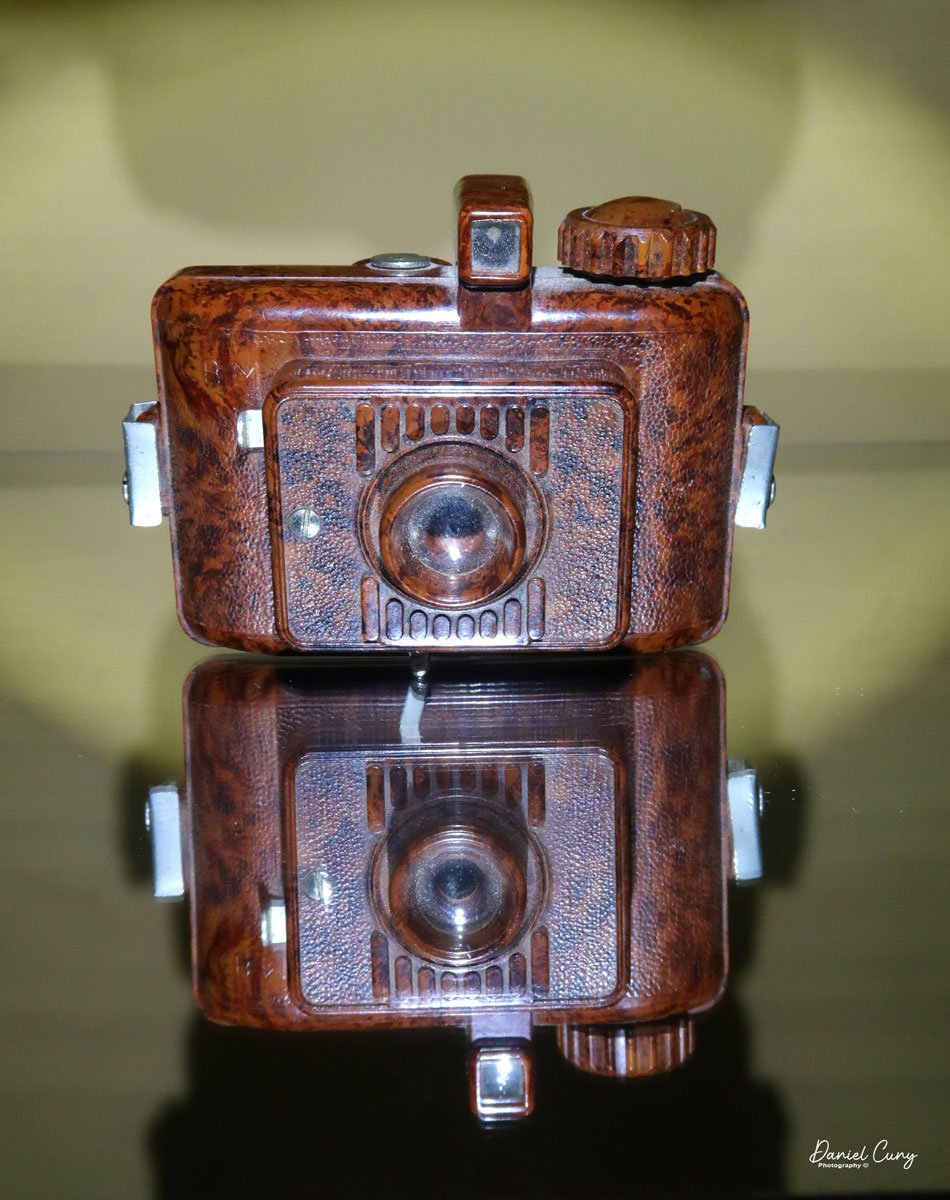
My GOMZ Malyutka camera

It wasn't until later in my camera-collecting career that I developed an interest in miniature and subminiature cameras. It was the more unusual or the odder looking camera items like the pen-shaped Stylophot,  or the round Petal camera, the Twin Lens style miniature cameras like the Gemflex camera, or the miniature cameras which resemble small rangefinder or SLR cameras like the Golden Ricoh 16, where I really enjoyed having them in my collection. They are very unique cameras and items that stand out because they are so different from the larger box, folding, or view cameras. A real advantage of having miniature and subminiature cameras in your collection is the amount of display space they save. You can display many more items and accessories in a much smaller area.

 The GOMZ Malyutka is a camera I purchased around 10 years ago, and I didn't start researching it until about a year ago, when I found out it was pretty rare. I didn't even have it in my display of miniature or subminiature cameras until that time.

 This is another camera I purchase in a group or "lot" of camera in a fairly unknown auction of camera. My real prize and the main item I was bidding on was an early Nikon F body, and tucked in the background was an early Nikon 5cm f2 tick mark lens, which, due to the angle of the lens and the low visibility of people looking, not many people bid on the "Lot", so luckily it was one that I won. There were also other items within the "lot" that I had minimal interest in, but the Tick Mark lens and early Nikon F body were the prize.
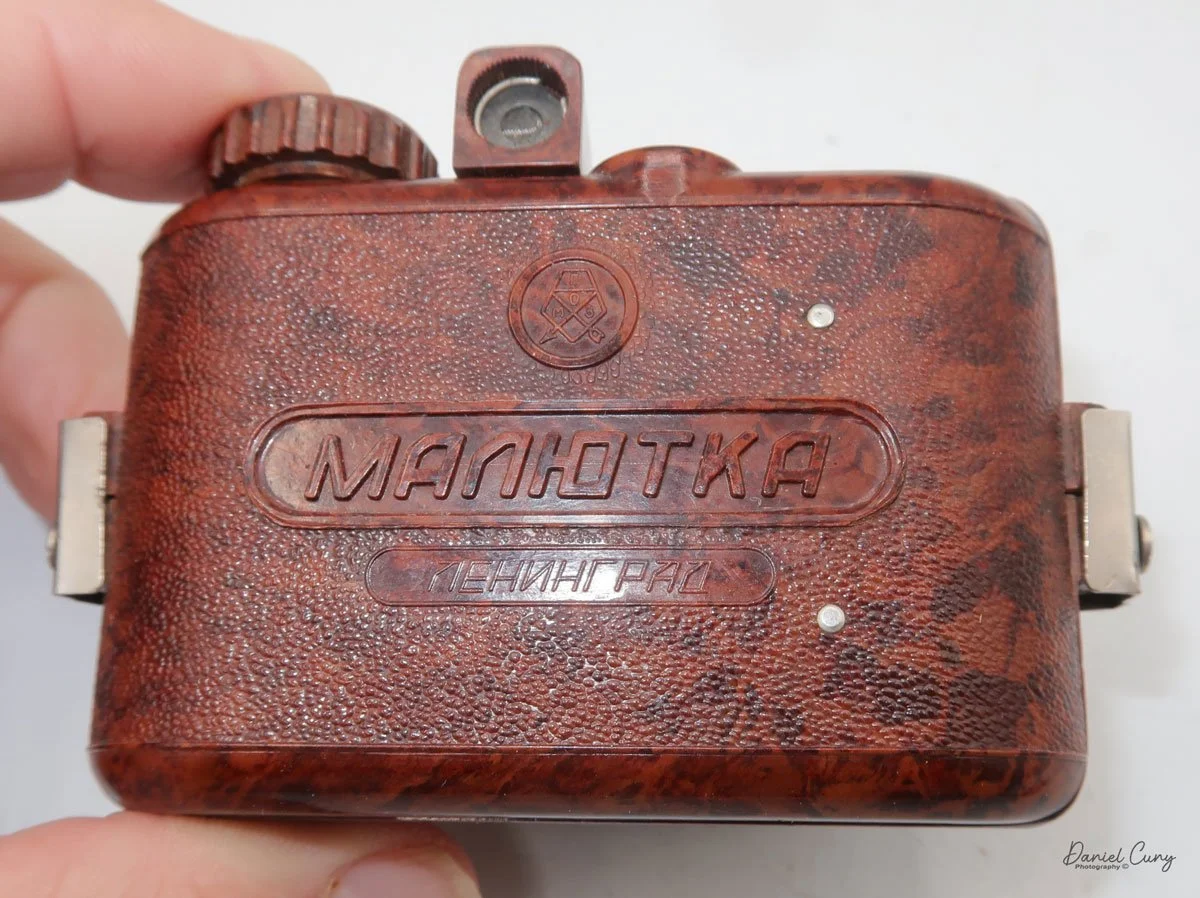
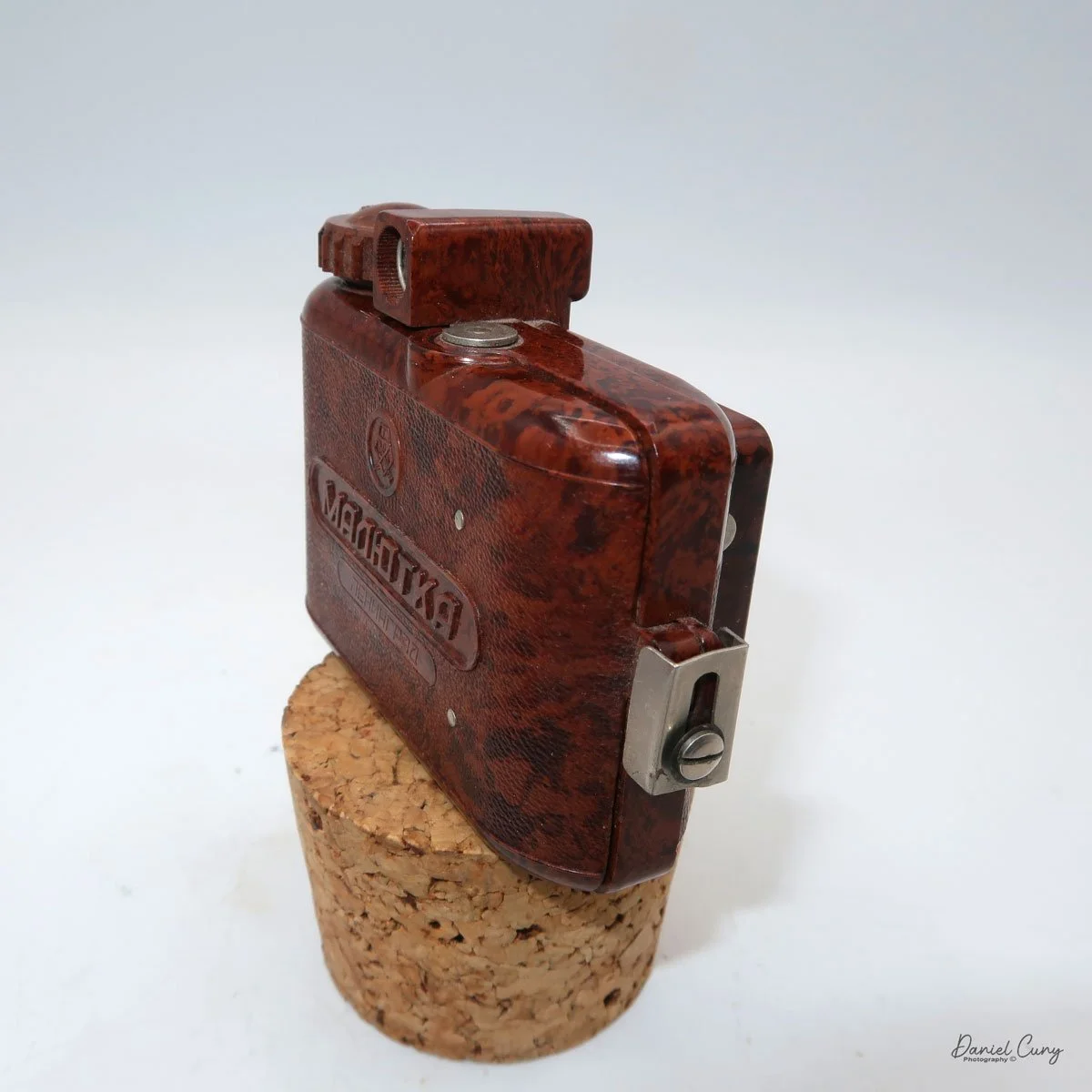
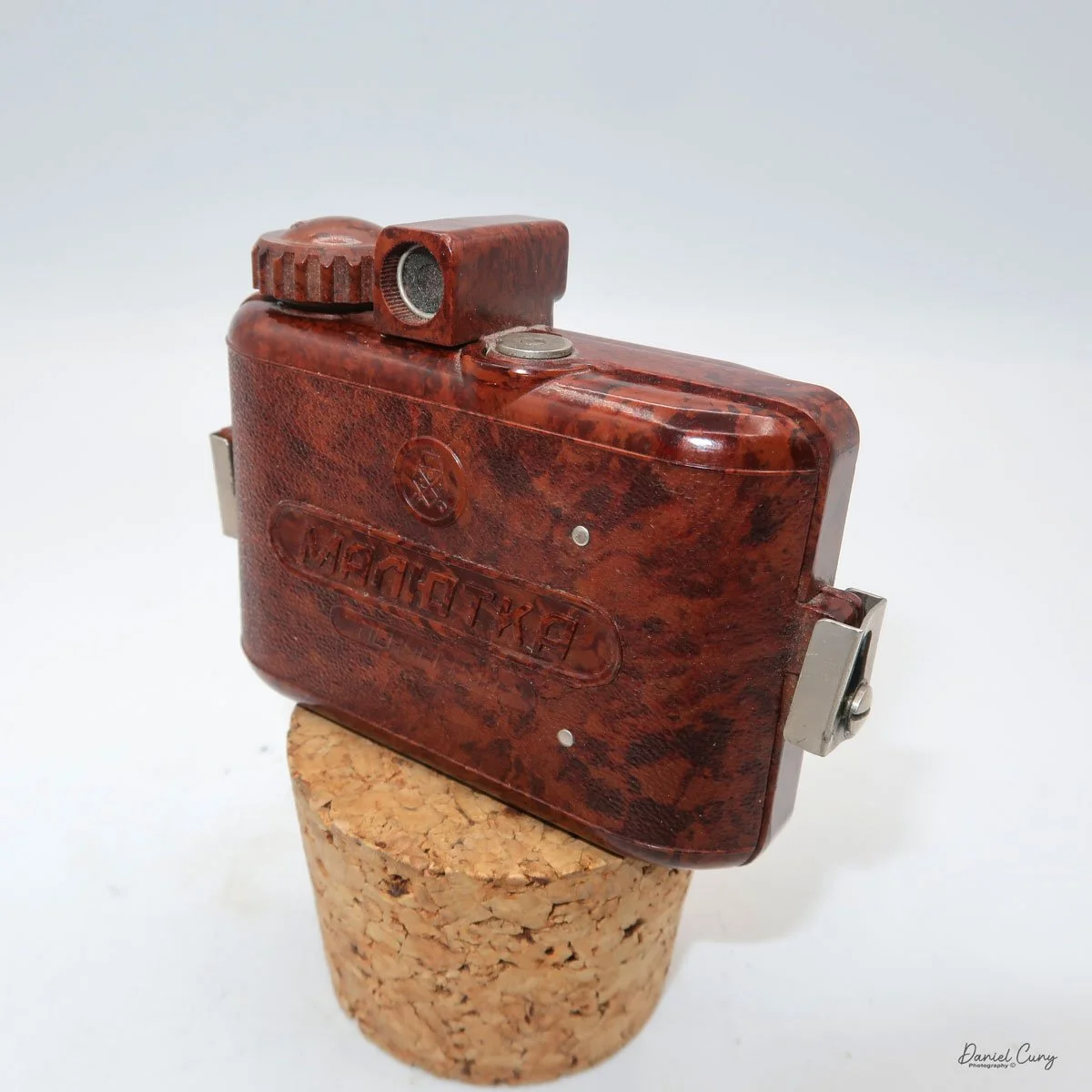
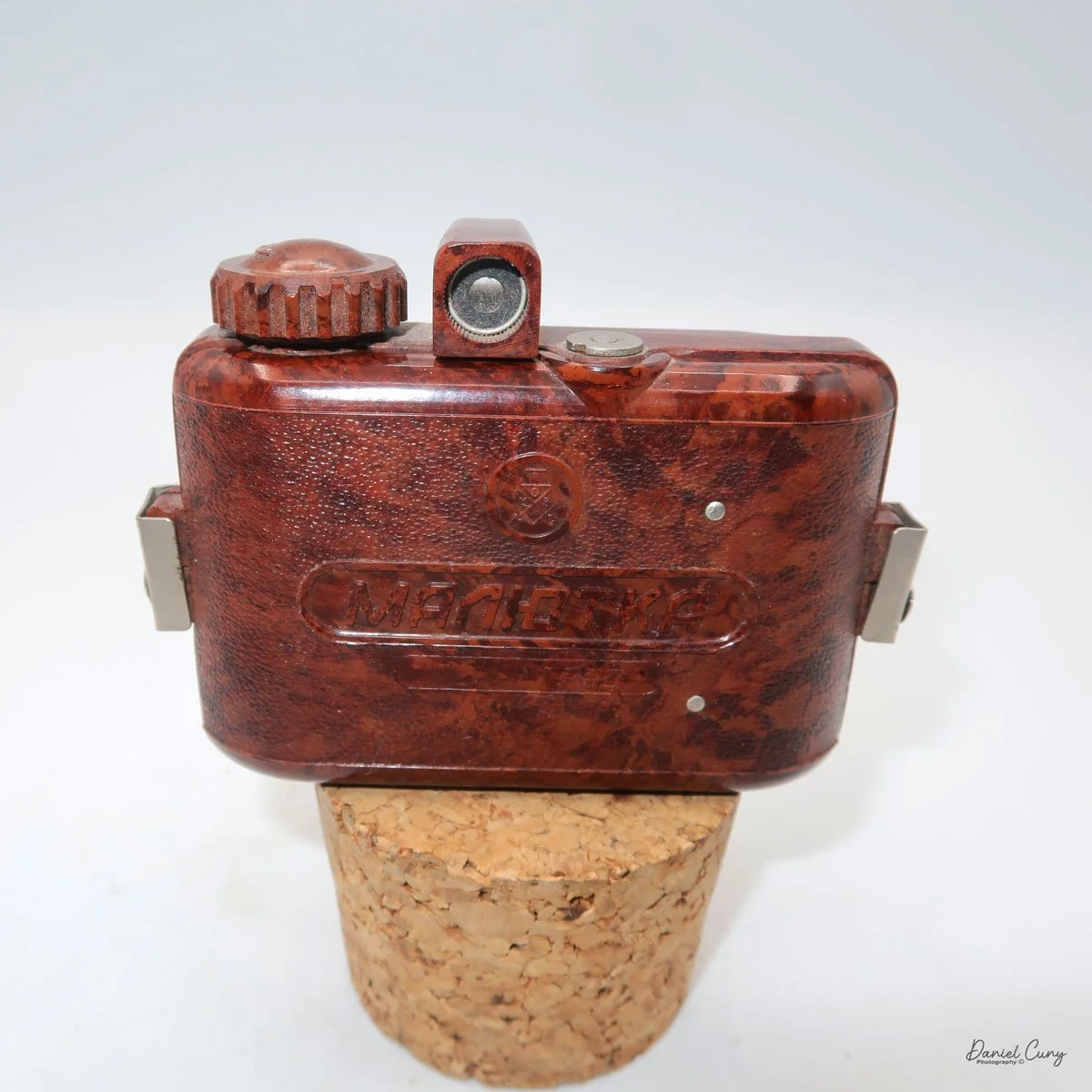
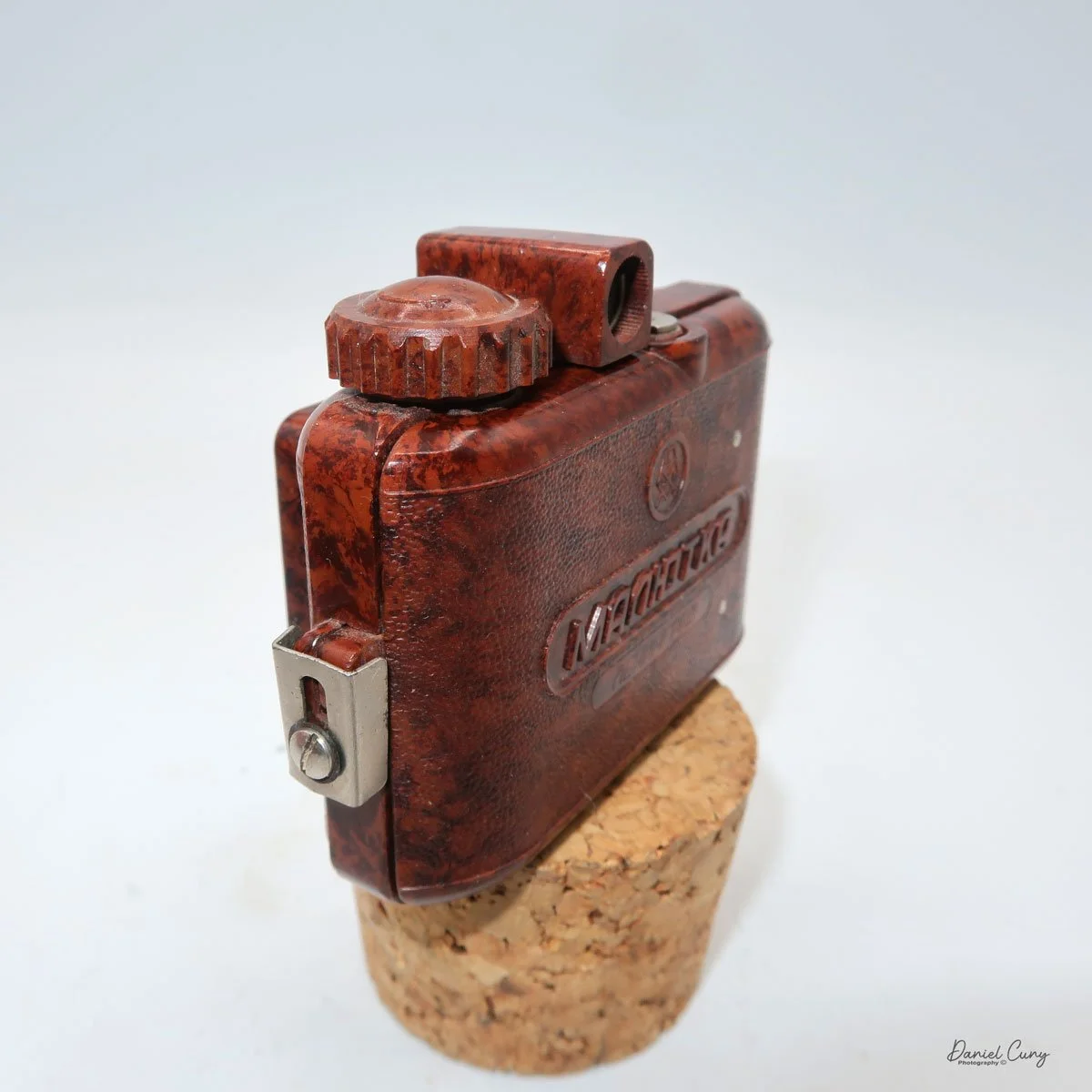
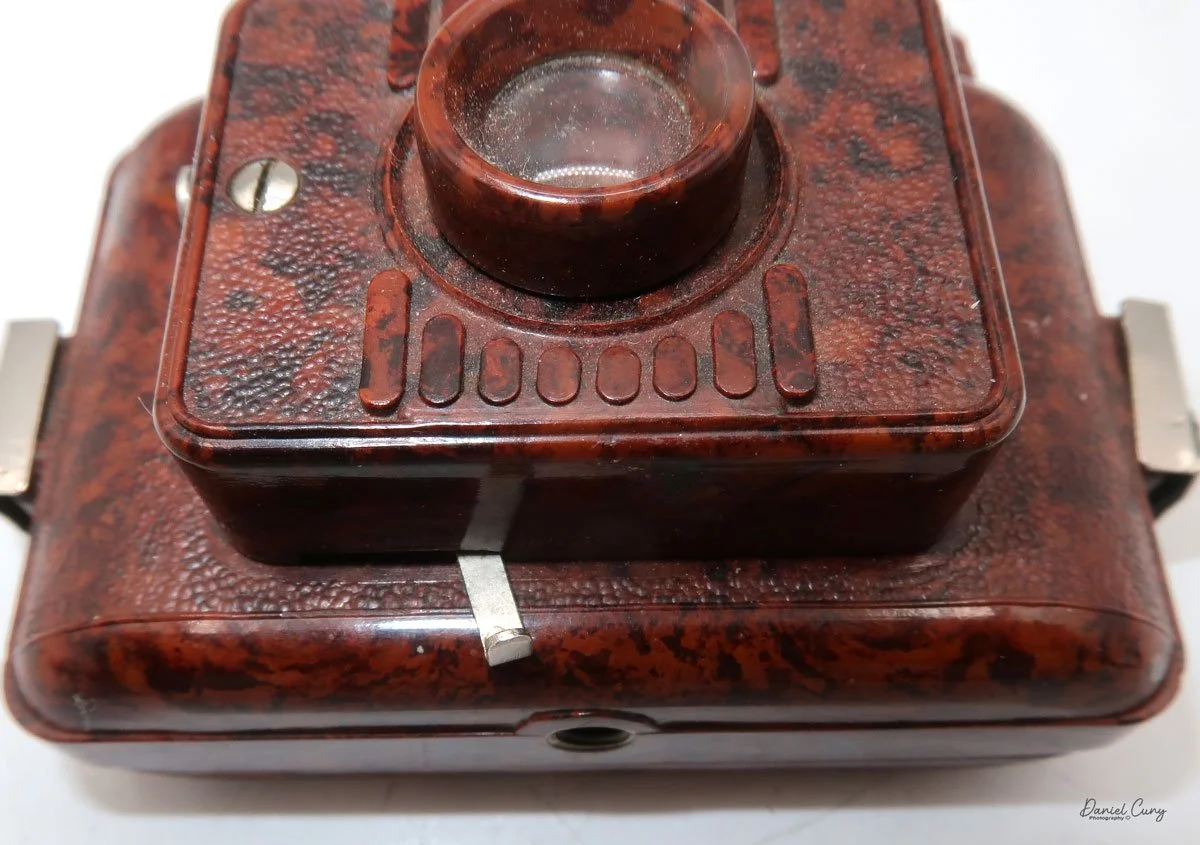
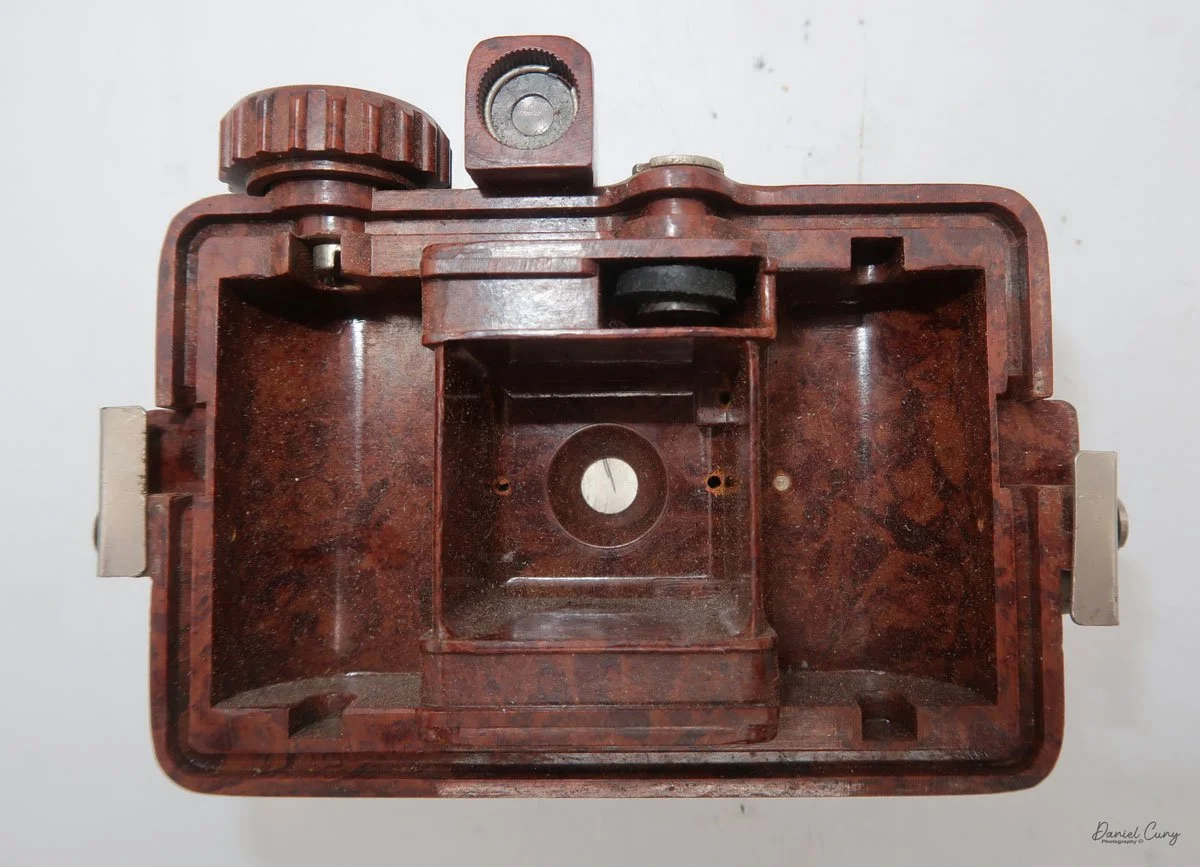
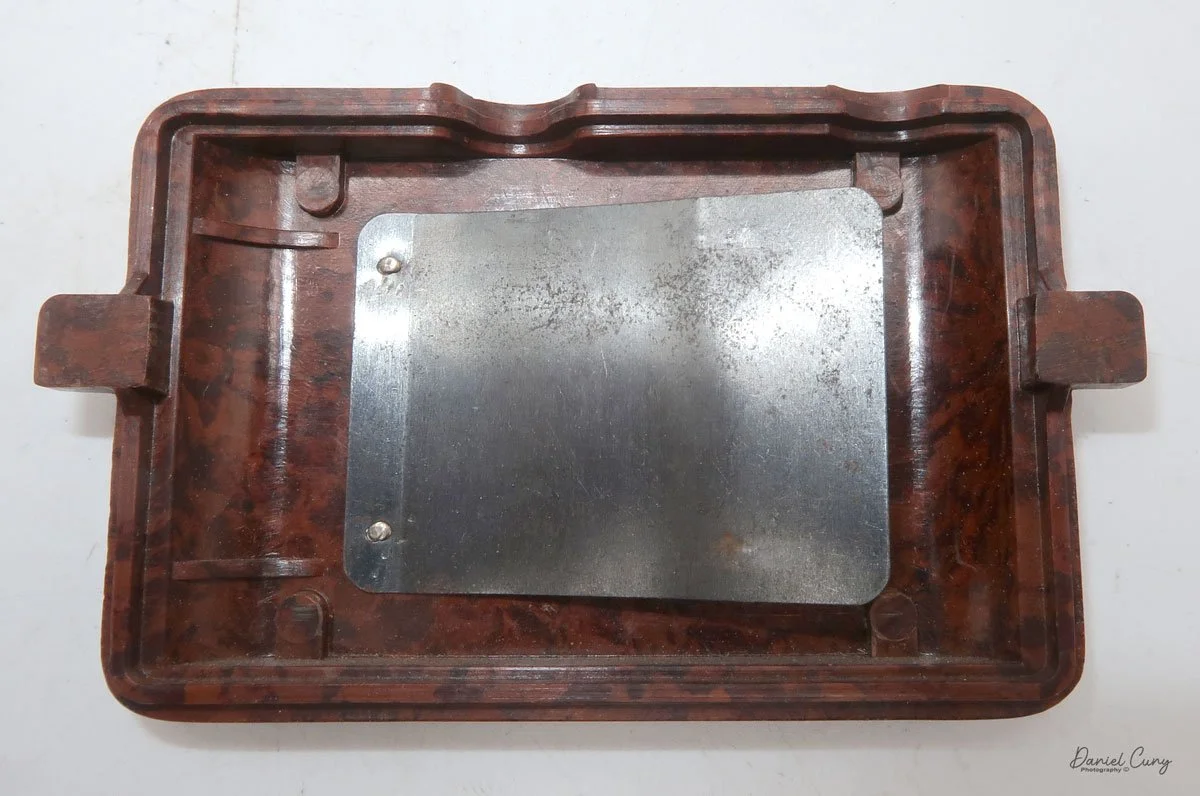
Back side of GOMZ Malyutka camera

 Once I received the items from the auction, I noticed this really nice brown bakelite camera with Russian Cyrillic writing on the back. As I've mentioned before, I have a love for colored cameras, so when I saw this Gomz Malutka, I thought it was a nice little camera. I put it away, not really giving the camera much thought until about a year ago when I was going through a box of photo items for a local camera show that was selling at. I pulled the Gomz Malutka from the box, and was ready to add it to the items for the sale. Then, as I was inspecting the camera again, I thought it might be a fun camera to write about sometime in the future. I set the camera aside.

 After the camera show, as I returned to my office, I noticed the Gomz Malutka on my desk and started making some basic inquiries about the camera. At this point, I began to see that the camera is indeed somewhat rare, so let's write about it for my blog.

History:

 The history of GOMZ (Gosudarstvennyi Optiko-Mekhanicheskii Zavod), the State Optical-Mechanical Plant, reflects Russia's tumultuous and innovative 20th-century history. Located in Leningrad (now St. Petersburg), the factory was the cradle of the Soviet optical industry, responsible for producing the nation's first mass-market cameras and pioneering designs that predated Western equivalents.
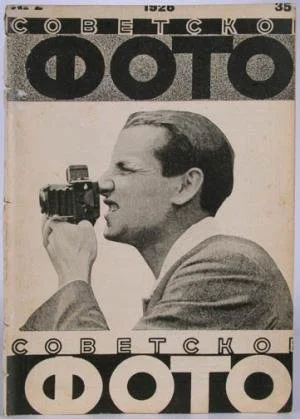
Cover of Sovetskoe Foto (Soviet Photo) Magazine

 The facility began life in 1914 as a French-Russian joint venture to produce optical sights for the military during World War I. Following the 1917 Revolution, the factory was nationalized and underwent several reorganizations before officially adopting the GOMZ acronym in 1932. While it continued to produce military optics, the Soviet leadership demanded a domestic photographic industry to reduce reliance on German imports, pushing GOMZ toward consumer cameras.

 The 1930s marked GOMZ's golden era of innovation. Its first major success was the Fotokor-1 (1930–1941), a 9x12cm folding plate camera. Based on German designs, the Fotokor-1 became the first mass-produced Soviet camera, with over one million units manufactured. It effectively democratized photography in the USSR, serving as the primary tool for documenting the Soviet state's industrialization.

Even more technically significant was the Sport (1937), a 35mm single-lens reflex (SLR) camera. Historians often debate whether the GOMZ Sport or the German Kine Exakta was the world's first proper 35mm SLR. Regardless of the title, the Sport was a marvel of engineering for its time, featuring a vertical metal shutter and a reflex viewfinder that allowed photographers to see exactly what the lens saw—a standard feature today, but revolutionary in the 1930s.
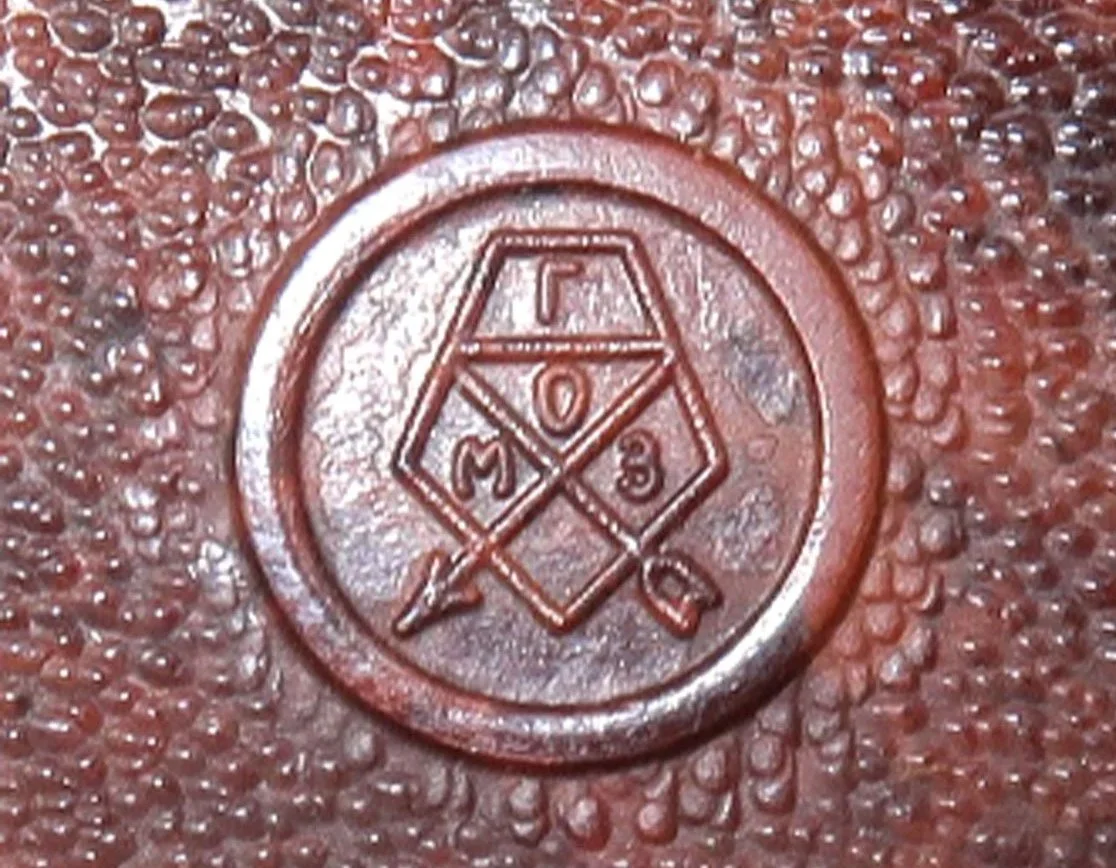
Logo of Gomz camera

 During World War II, the factory suffered heavily during the Siege of Leningrad. Production shifted entirely to military needs, such as sights for tanks and artillery. After the war, GOMZ pivoted back to consumer goods, focusing on affordable, simple cameras for the recovering population.

This post-war period gave rise to the legendary Lubitel series (starting in 1949). Based on the German Voigtländer Brilliant, the Lubitel was a twin-lens reflex (TLR) camera made of Bakelite and later plastic. It was cheap, durable, and capable of producing excellent medium-format images, introducing millions of amateurs to photography. Similarly, the Smena series provided a simple, viewfinder alternative that became a staple in Soviet households.

 In 1965, GOMZ underwent a final restructuring, becoming the Leningrad Optical-Mechanical Association (LOMO). Under this new name, the factory would later produce the LOMO LC-A, the camera that accidentally sparked the global "Lomography" art movement in the 1990s. However, the foundation of this success was laid during the GOMZ era, which transformed a military optics plant into a titan of Soviet creativity and engineering.

My Camera:

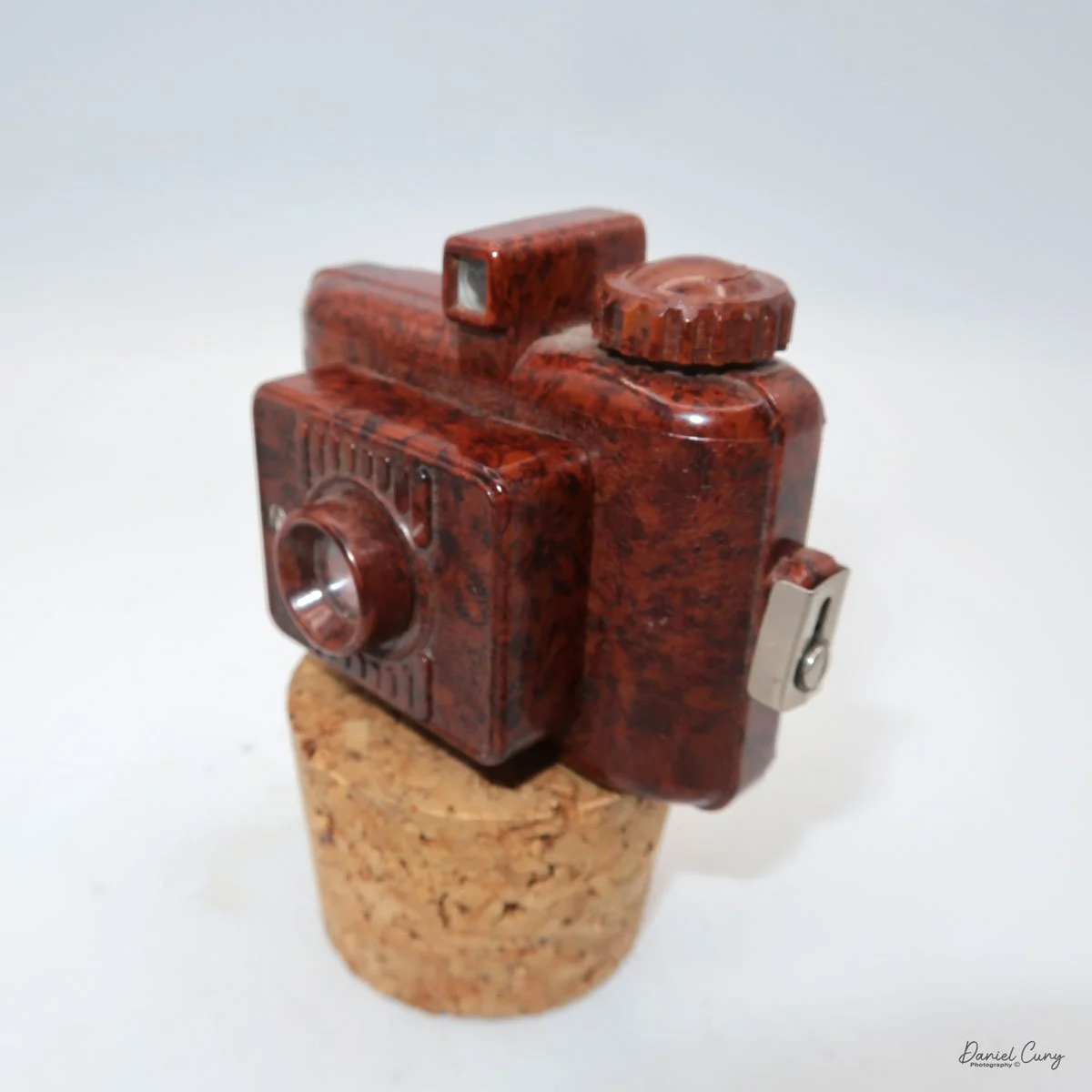
 My GOMZ Malyutka is small, measuring  2" wide, by 1.5" tall and 1.5" deep from the front of the lens to the rear of the camera, and it weighs only 2.3 ounces without film. The Gomz Malutka is based on the SIDA camera from Sida GmbH, Berlin, Germany, which was made in the mid-1930s and came in both metal and Bakelite. "Malyutka" (малютка) is a Russian word that means "baby," "little one," or "tiny thing". It is also very similar to a camera made by Gomz,  Liliput camera.
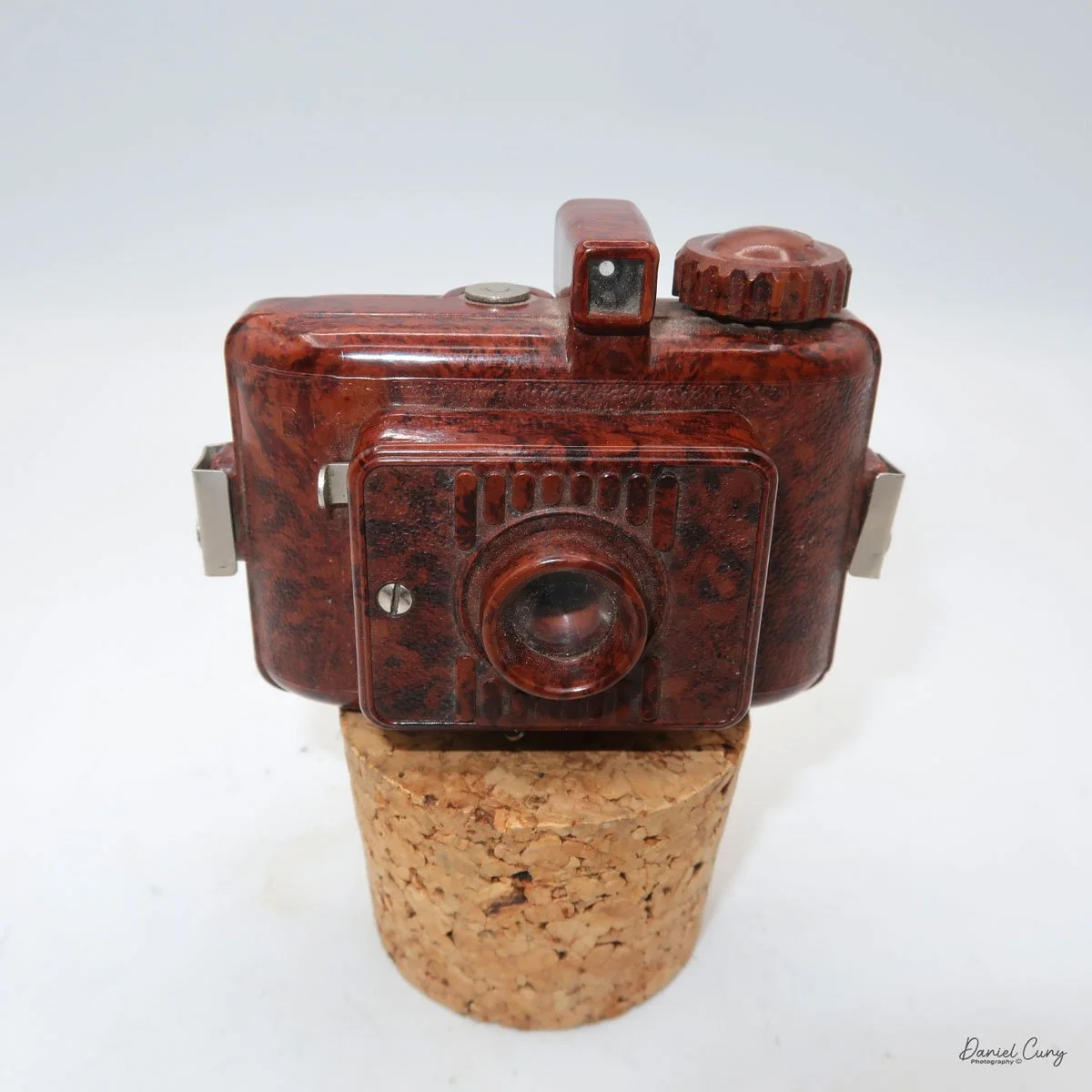
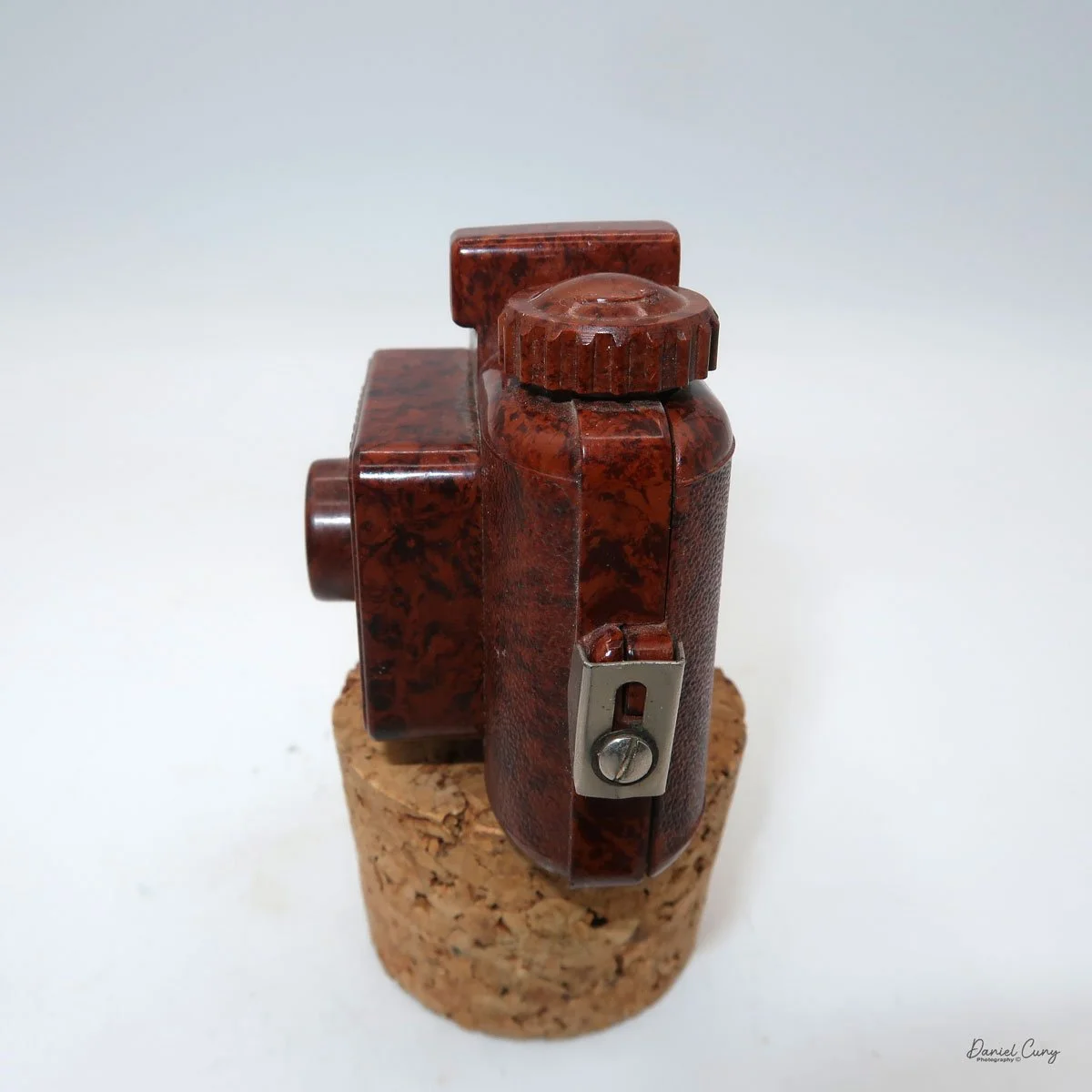
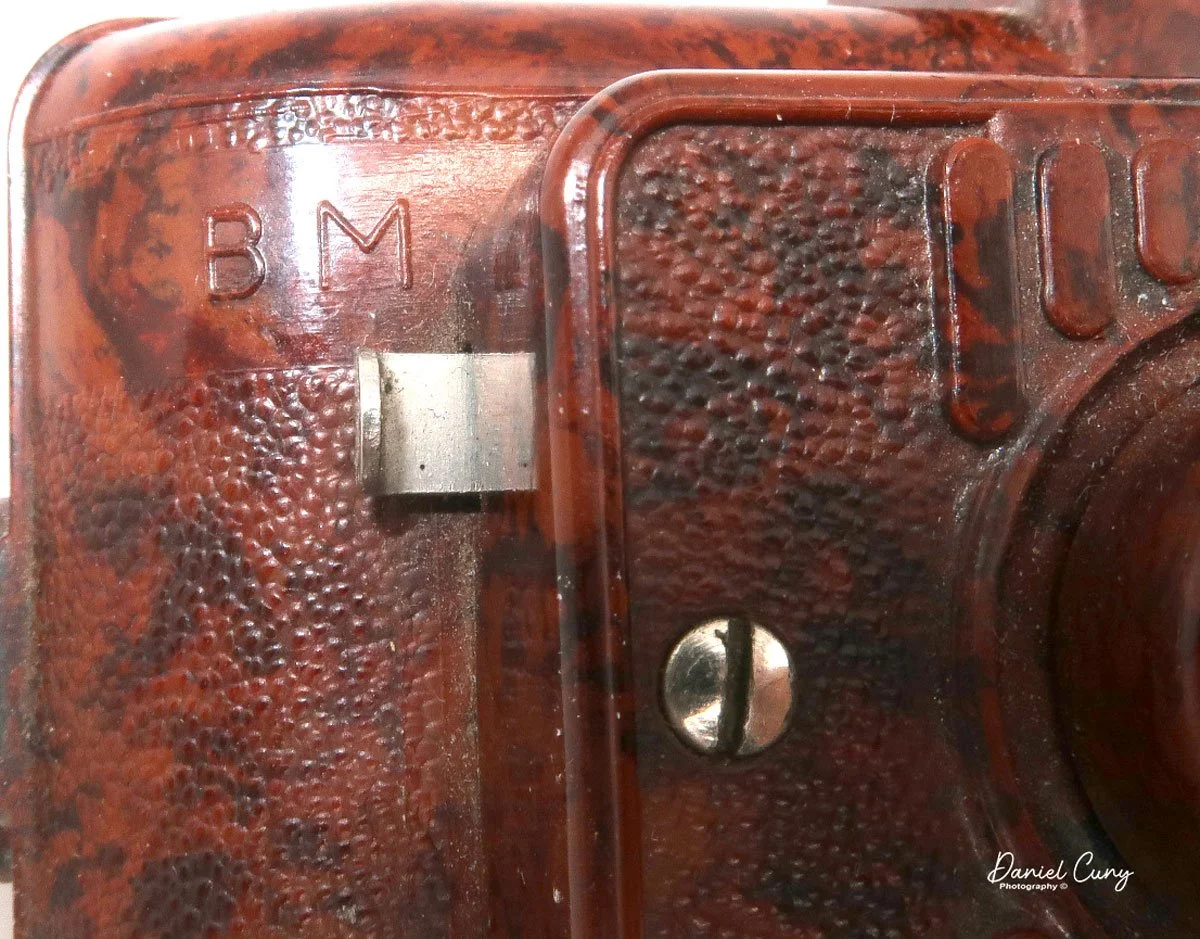
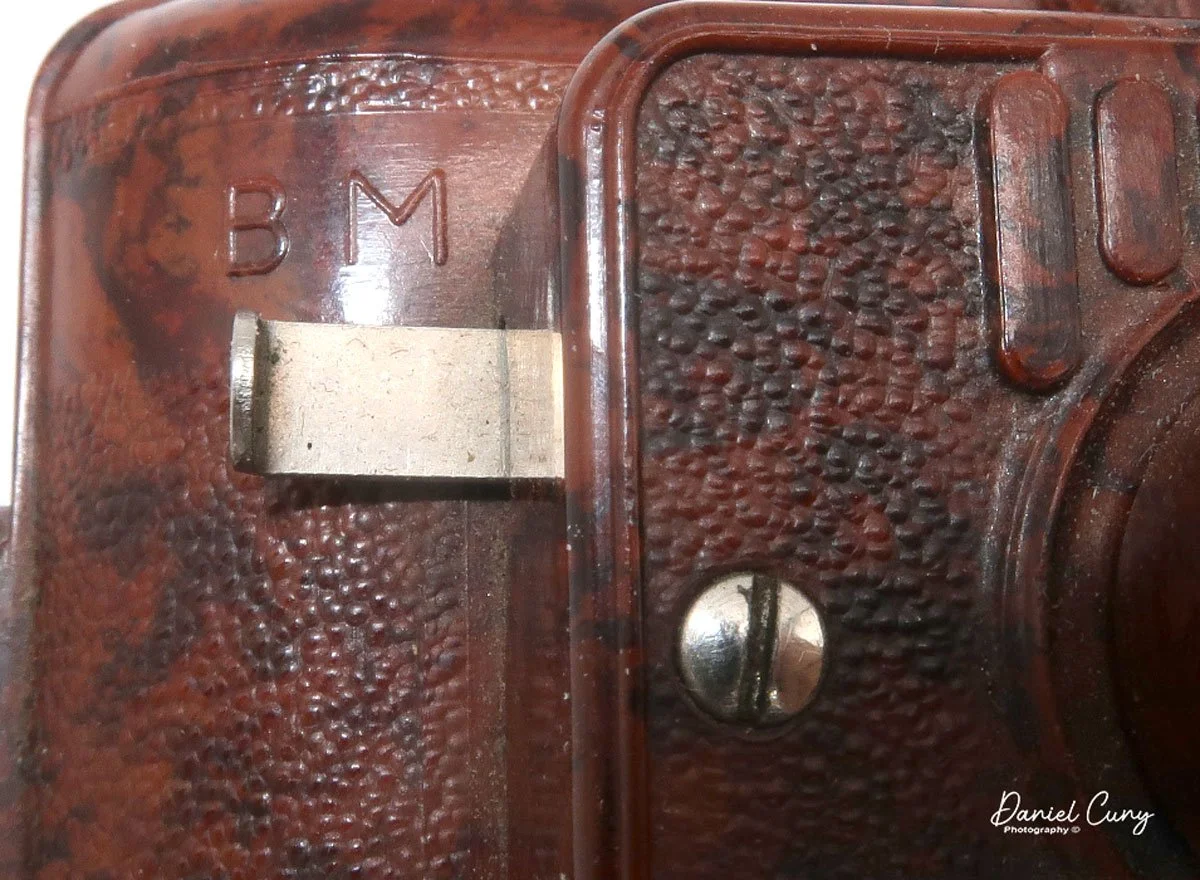
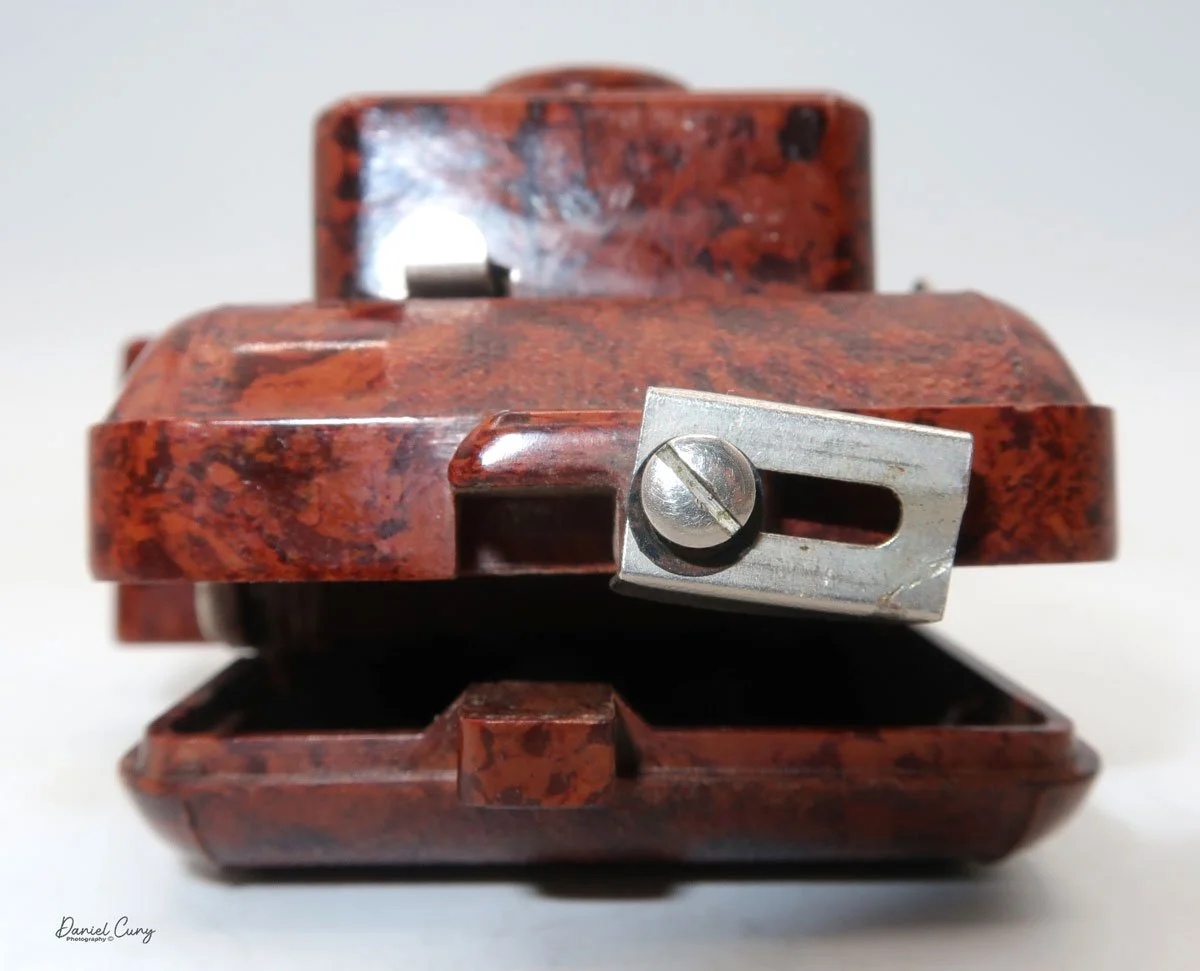
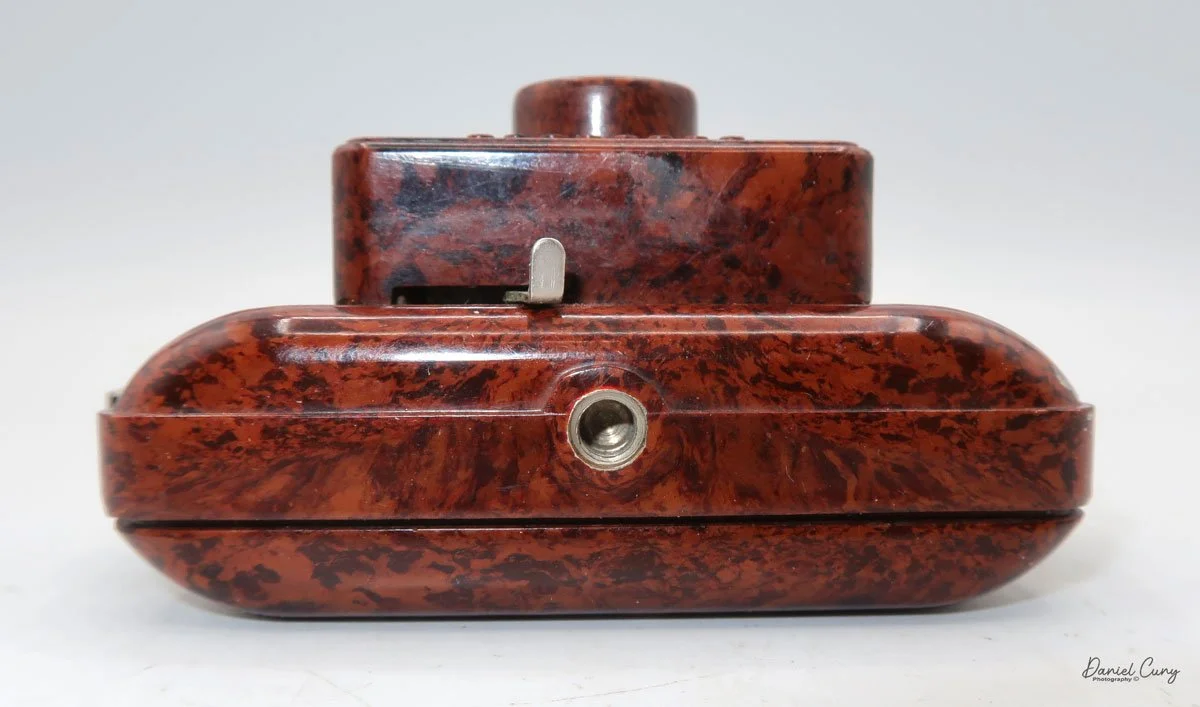
 The camera's controls are very straightforward. There is only the shutter release at the bottom of the camera, along with the shutter control on the right side next to the lens. The shutter control consists of two settings: "M" (moment) for normal shutter speed, generally around 1/50 sec, and "B" for time exposures. Sliding a bar out from the side of the camera makes these settings. Sliding the shutter release under the lens takes the photo. 
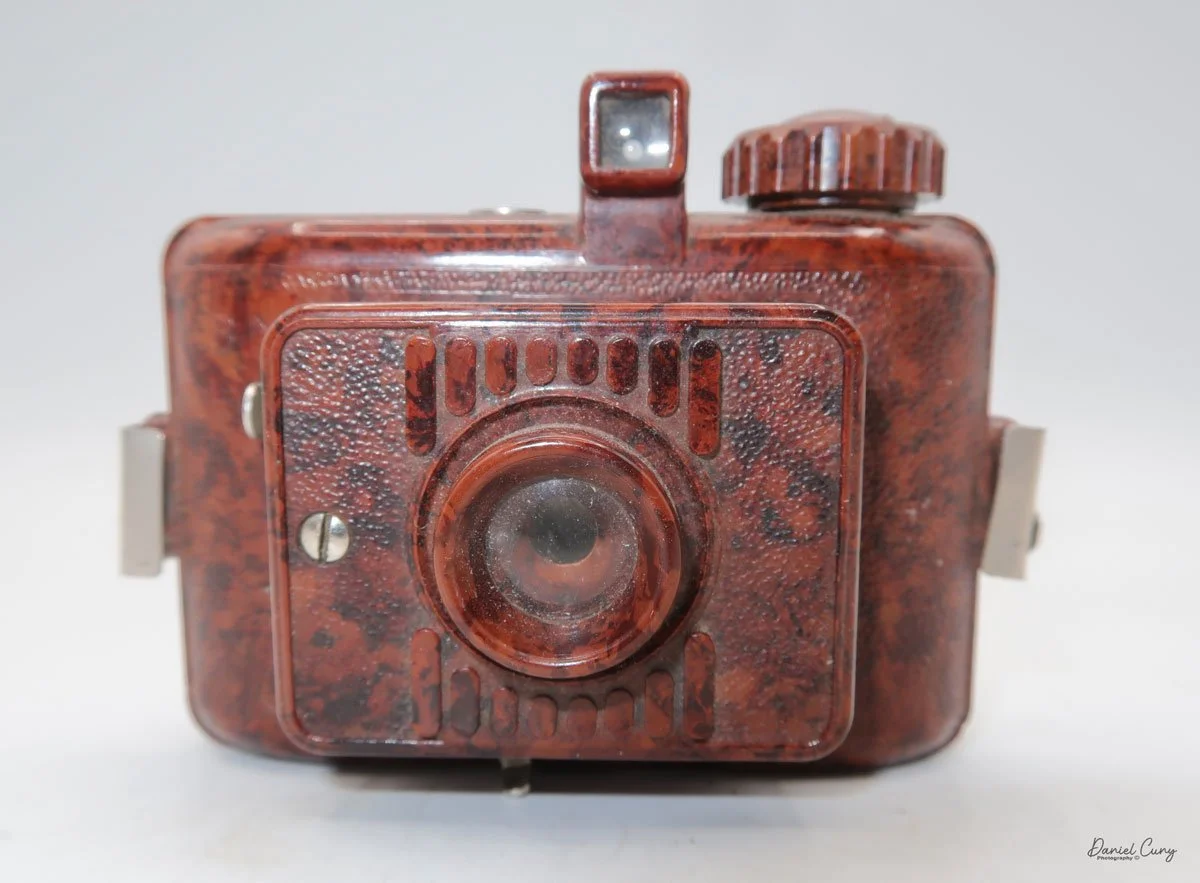
 To open the back of the camera to load film, there are clips on either side that you move to the down position to remove the back. The camera takes Boltax film, a special 35mm film that produces a 24 mm x 24 mm negative. You load the camera similarly to any roll film camera: put the empty spool on the take-up reel side and the fresh film on the opposite side. Bring the leader to the slot on the take-up spool and start winding. Put the back on the camera and slide up the clips to lock it in place. Wind the film and advance it to the first frame.

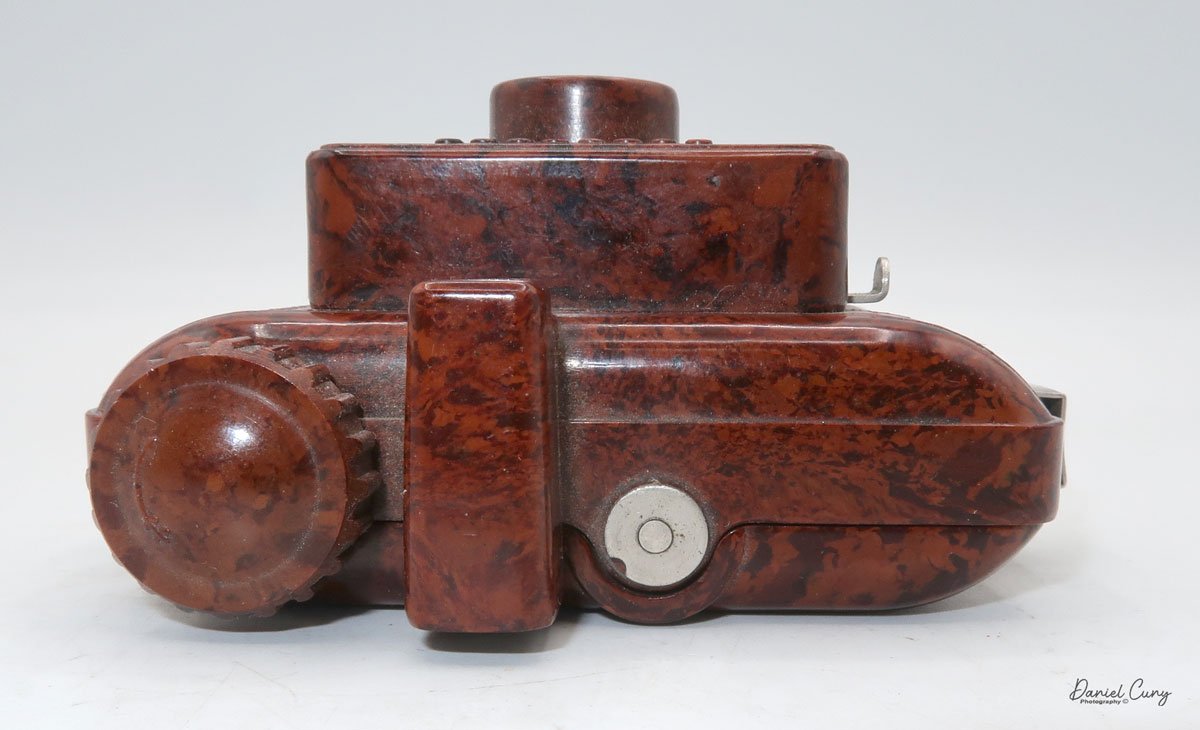
 There is a small viewfinder at the top of the camera to frame your photo, and a tripod socket at the bottom to steady the camera during long exposures. Also at the top is a small, round metal disk that rotates as the film moves within the camera. Since the camera doesn’t have a red window on the back of the film door, you need to watch the disk rotate a few times to make sure the film is moving inside the camera.
Results:

 Since I don't have any Boltax film, I wasn't able to take photos with the Malutka camera, but possibly in the future, I'll try and use some paper backing I have from a few rolls of 828 film and run some film through it using 35mm to see how the camera performs.


Conclusion:

 The Gomz Malyutka is an excellent small camera that I enjoy having in my collection. It's in fantastic condition and is another color camera that sits proudly amongst the other miniature and subminiature cameras on my shelf.

 Thank you for taking the time to learn about this small, odd Russian camera. 

 I'd love to hear from you. Please get in touch with me if you have questions, concerns, or comments.

 Here's a link to my other Camera Reviews.

 Cuny's Camera and Photo has many cameras I've reviewed for sale, along with other camera and photo oddities. If interested in any items, email me, and I'll offer a nice discount as a friend of the family.

 Until next week, please be safe.


Ensign Midget-Silver Jubilee Model

My Ensign Midget-Silver Jubilee camera

All of the Ensign Midget cameras have a fascinating look. With three models, the straightforward Model 22, to the more refined Models 33 & 55, featuring a diamond-shaped faceplate and a very Art Deco appearance. The one model that stood out to me with the most significant difference was the Ensign Midget-Silver Jubilee model, introduced in 1935 for the Silver Jubilee of King George V and Queen Mary. This model, in particular, holds a unique place in the history of Ensign cameras, being a rare and special edition.

 As I've mentioned several times, my love for the unusual, quirky, and vibrant cameras holds a very special place in my heart. The majority of my collection has something particularly peculiar about it. Whether the camera is a different color other than the drab black, ot it has a different film format, or an unusual faceplate, or some other oddity about it

 The Ensign Midget, Model 55, Silver Jubilee camera in my collection is a relatively recent purchase. I have memories of reading about it in McKeown's Camera Price Guide, and I've come across a few at camera shows and online, but I never pulled the trigger and purchased one. However, when I finally acquired this model, it felt like a significant addition to my collection, a piece of history that I could now share with fellow enthusiasts.

Ensign Midget with slip-in case & manual

 I found the Ensign Midget, Silver Jubilee model that I currently own online at a very reasonable price, which also included the protective cover and original manual, making it even more desirable. The only thing missing was the original box, which would have increased the price. 

 When the camera arrived, I was very pleased with its condition, as it was free of scrapes and dings, which are very common on a camera that is 90 years old. The camera's cover was clean, the faceplate still had a chrome shine, and the instruction manual was in superb condition. I was very pleased with the camera's condition, and it was in good working order, which was the icing on the cake, as they say.

 In the UK, Kodak also produced a "Silver Jubilee" box camera, which is covered in white leatherette. While I'd love to have one of the Kodaks in my collection among the other colored box cameras I have, it'll be some time down the road for me.

History:

 Ensign cameras represent a significant chapter in British photographic history. The company's roots date back to 1834, with the founding of Claudet & Houghton by George Houghton and Antoine Claudet, who initially dealt in optical glass. This enterprise evolved, eventually becoming George Houghton & Sons, which by the early 1900s was manufacturing cameras, such as the 'Ensign Simplex Auto'. By 1908, their Walthamstow factory was reportedly the largest camera manufacturing plant in the United Kingdom.

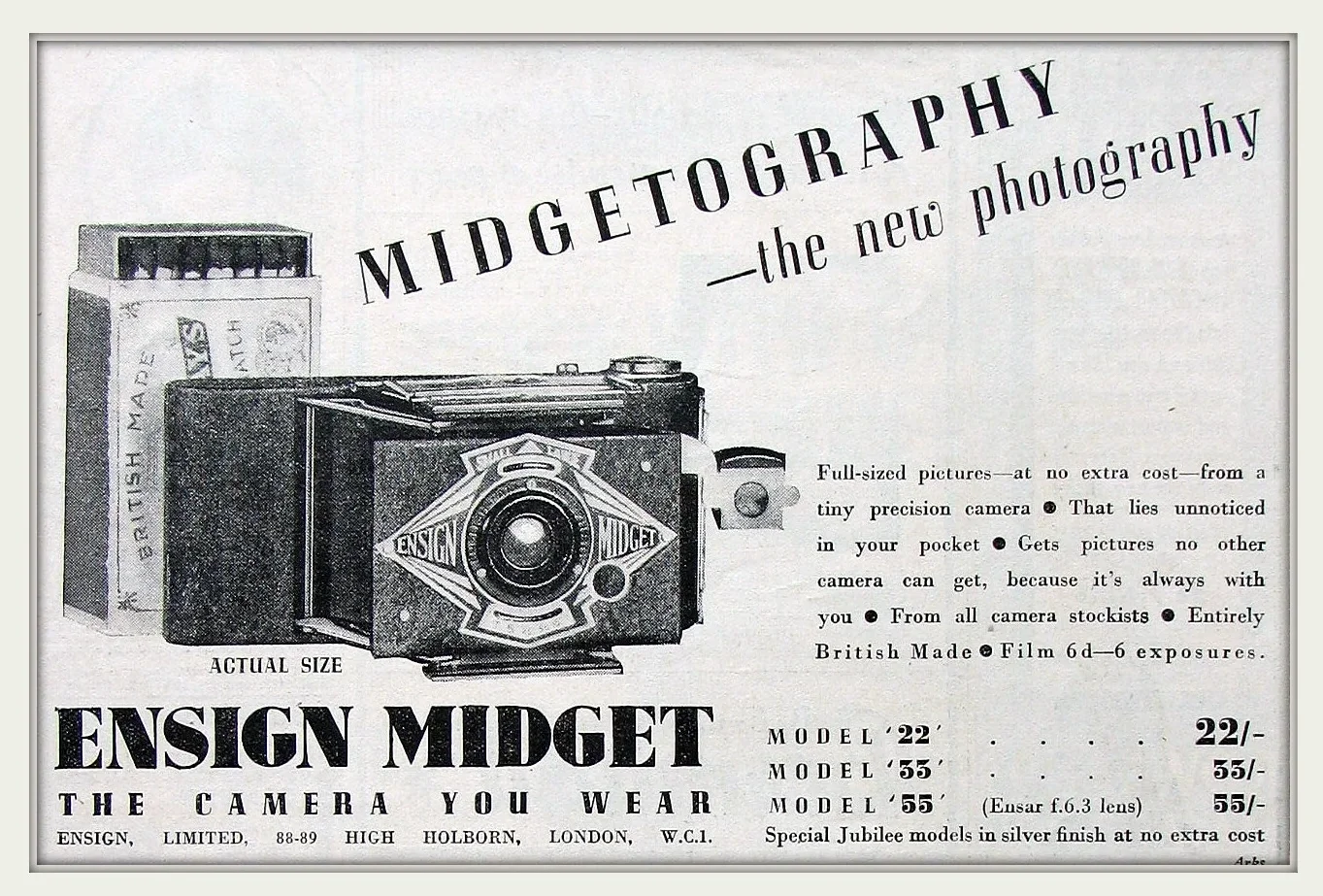
Ad for Ensign Midget camer

 A significant turning point came in 1915 when Houghton merged with W. Butcher and Sons Ltd. to form the Houghton-Butcher Manufacturing Company. Throughout this period, they produced popular models, such as the Sanderson folding camera and the highly successful, compact Ensignette roll-film camera, introduced in 1909. The Ensign brand name grew so synonymous with their products that in 1930, the parent company was formally renamed Ensign Ltd.

 Ensign became known for producing affordable, good-quality cameras that helped popularize photography among ordinary people in the 1920s and 1930s. They produced various formats, including folding roll-film cameras like the Popular Ensign and later models, such as the distinctively styled Ful-Vue, post-WWII.

 The company faced turmoil during World War II; their London headquarters, Ensign House, was destroyed by bombing in 1940, and the sales wing was soon after wound up. Post-war, Ensign continued through several mergers, joining with Elliott & Sons to become Barnet Ensign Ltd. in 1945, and then with lens-maker Ross Ltd. to become Barnet Ensign Ross Ltd. in 1948. It finally operated as Ross Ensign Ltd. by 1951. Despite producing quality 1950s roll-film cameras, the company ultimately failed to embrace the emerging 35mm format. Production of still cameras ceased, and the Ross Ensign name faded away, with the company being dissolved around 1961.

Key Features and Models

The Midget was marketed with the slogan "Wear it Always—Like your Watch," emphasizing its petite size, which measures approximately 90mm × 45mm × 18mm when collapsed.

 The camera came in three primary models, whose numbers originally corresponded to their price in shillings:

  • Model 22: The most basic version, typically featuring a fixed-focus meniscus lens and a simple two-speed shutter (Instantaneous/Time). It often lacked the top-folding frame finder found on higher models.

  • Model 33: An upgrade from the 22, this version typically featured a slightly better fixed-focus "All Distance" meniscus lens and a 3-speed shutter (e.g., 1/25, 1/50, 1/100 sec, plus T/B).

  • Model 55: The premium model featured a focusing Ensar f/6.3 Anastigmat lens with iris diaphragm control, enabling focus down to approximately 3 feet. Its shutter offered speeds up to 1/100 sec.

 All models used the dedicated Ensign E10 roll film to produce six negatives measuring 35 mm × 45 mm—a format slightly larger than the standard 35 mm (Leica format). The cameras were constructed with a pressed steel body and leather bellows, featuring an Art Deco design with chrome accents on the struts.

 The Midget family was very popular, but its production was ultimately halted in 1940/1941 as the company shifted its focus to wartime manufacturing. It was not returned to the product line after the war, as Ensign focused on the 120 film format instead of competing in the burgeoning 35mm market.

My Camera:

 My Ensign Midget camera is 3.5" wide by 1.75" tall by 0.75" deep with the front lens collapsed, and 2.75" with the front lens extended and the black bellows of the camera exposed in its normal "picture-taking" position. My camera weighs in at a measly 5.9 ounces. As you can see, the slogan Ensign used, "Wear it Always—Like your Watch," was very informative. I'm thinking that if I had had one of these cameras back in 1935 and carried it in my pocket, it would have been so small that it might have been challenging to locate.

The camera has two struts on either side of the lens, which extend when the lens plate is pulled out for taking photos. Once you're finished taking the pictures and ready to close the camera, start by pulling the end of the struts closest to the lens out, away from the lens plate, to unlock them. Then,  the lens plate can collapse back into the body when not in use.

 Once you have the lens extended and ready to take photos, the front viewfinder unfolds upwards to make the front of the "Direct Vision Viewfinder as noted in the manual. Once the front is extended, the back of the camera houses a "flip up" eyepiece that completes the camera's Direct Vision Viewfinder which is to be used if you want eye-level viewing.

There is a "Brilliant View Finder, tucked into the side of the camera's body, which can be used for taking vertical images, then flipped out when taking a horizontal image. For vertical images, the Brilliant View Finder lens is tucked into the camera body with a small opening just below the word "Midget" on the right side of the camera's faceplate, as viewed from the front. It's evident once the Brilliant View Finder is flipped to use in the horizontal position.

On the right side of the camera, as you're holding it to take a photo, tucked behind the faceplate is the camera's shutter release. Also on the right side of the camera is a slide-out leg that props up the camera for taking vertical images. On the flip-up leg is the camera's serial number, which mine happens to be "H15871."

On the front of the camera are the settings for shutter speed, aperture, and focus distance. The Aperture settings are located along the top of the faceplate and range from f/6.3 to f/22, selected by moving a small slider just below the aperture numbers. 

 Around the F/6.3 "ENSAR" anastigmat lens are focusing distances for you to set. The distance lines up with a small bar that protrudes from the lens, with focus distances of 3" at the 12 o'clock position, 5' at the 3 o'clock position, 8' at the 6 o'clock position, 12' at the 9 o'clock position, and infinity, backing up towards the 12 o'clock position.

 The shutter speeds of 1/100, 1/50, 1/25, "B", and "T" are set on the bottom of the faceplate, similarly to how the aperture settings are made, by sliding a small bar to the desired shutter speed.

Shutter, aperture and focus area on Ensign Midget camera

To open the back of the camera to load film, a locking mechanism on the left side must be pulled down. This slides a small bar that fits into a tiny opening, allowing the back of the camera to swing open and be removed from the camera.

 You load the Ensign Midget just like any roll film camera, but unfortunately, this camera and the other Midget camera takes an odd-size film that is no longer available. Once the film was loaded, engage the feet into the hinges on the right side of the camera and close it up. Just be sure that when you lock the back of the camera, the small rod fits into the tiny hole, which holds it in place. If not engaged, the back will open.

My Results:

 Unfortunately, I don't have film to use in this camera, due to its unique size and limited availability. Therefore, until I learn to cut and process film to use in the camera, this will remain a showpiece in my collection.


Conclusion:

 The Ensign Midget, Silver Jubilee edition camera is a camera I've long desired to own and will be cherished in my collection. The silver crinkle finish on the camera is a lovely touch to an already beautifully designed and built camera—a real gem crafted during a heyday period in pre-World War II England.

 Thank you for taking a few minutes to read about this fantastic, small, yet extremely well-built camera. One, I'm happy to give a prominent spot in my collection.

 Click the link to read my other Camera Reviews.

 If you're looking for a photo item, I have a wide selection of cameras, lenses, and camera parts available in my eBay store, Cuny's Cameras and Photo.

 Until next week, please be safe.