GOMZ Malyutka Camera

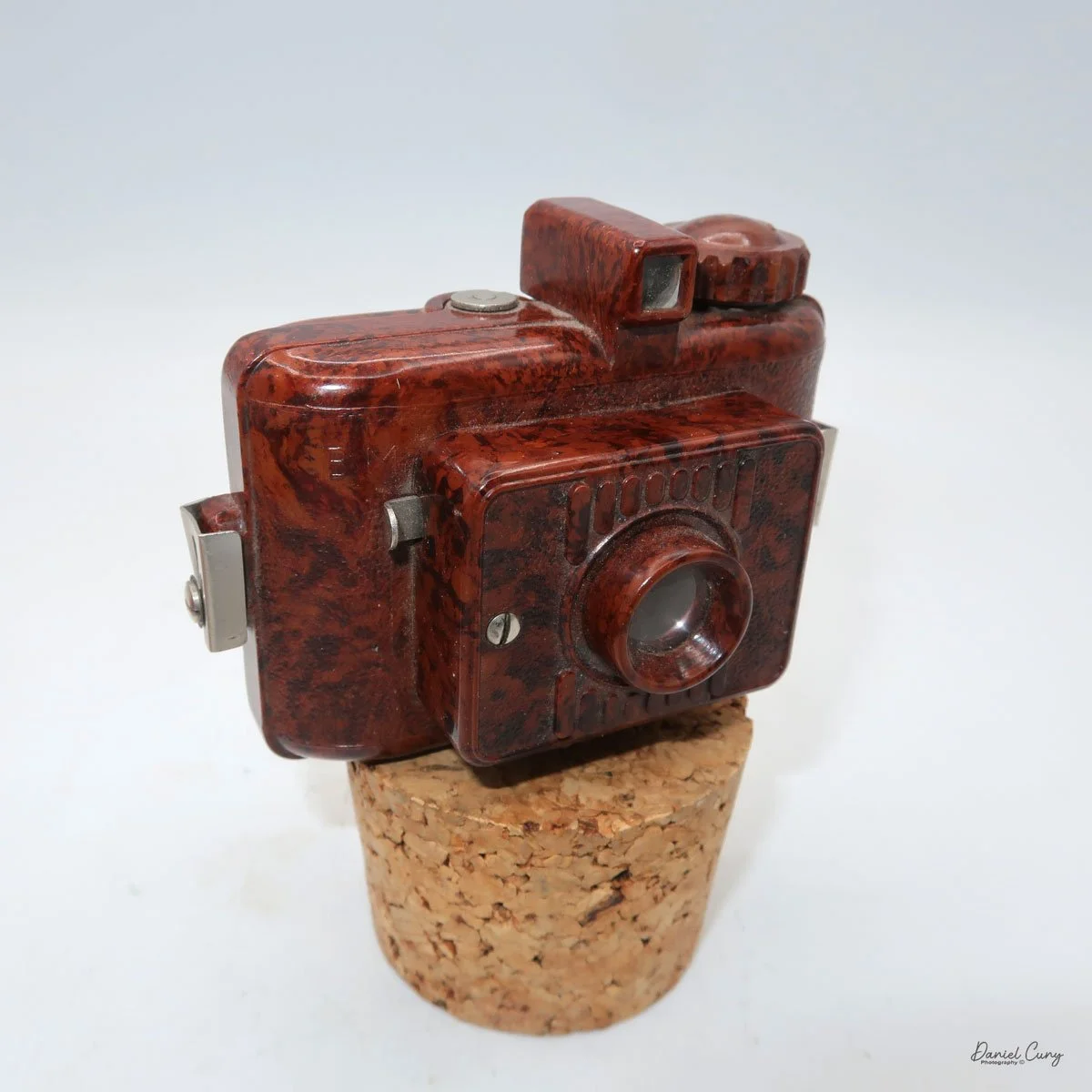
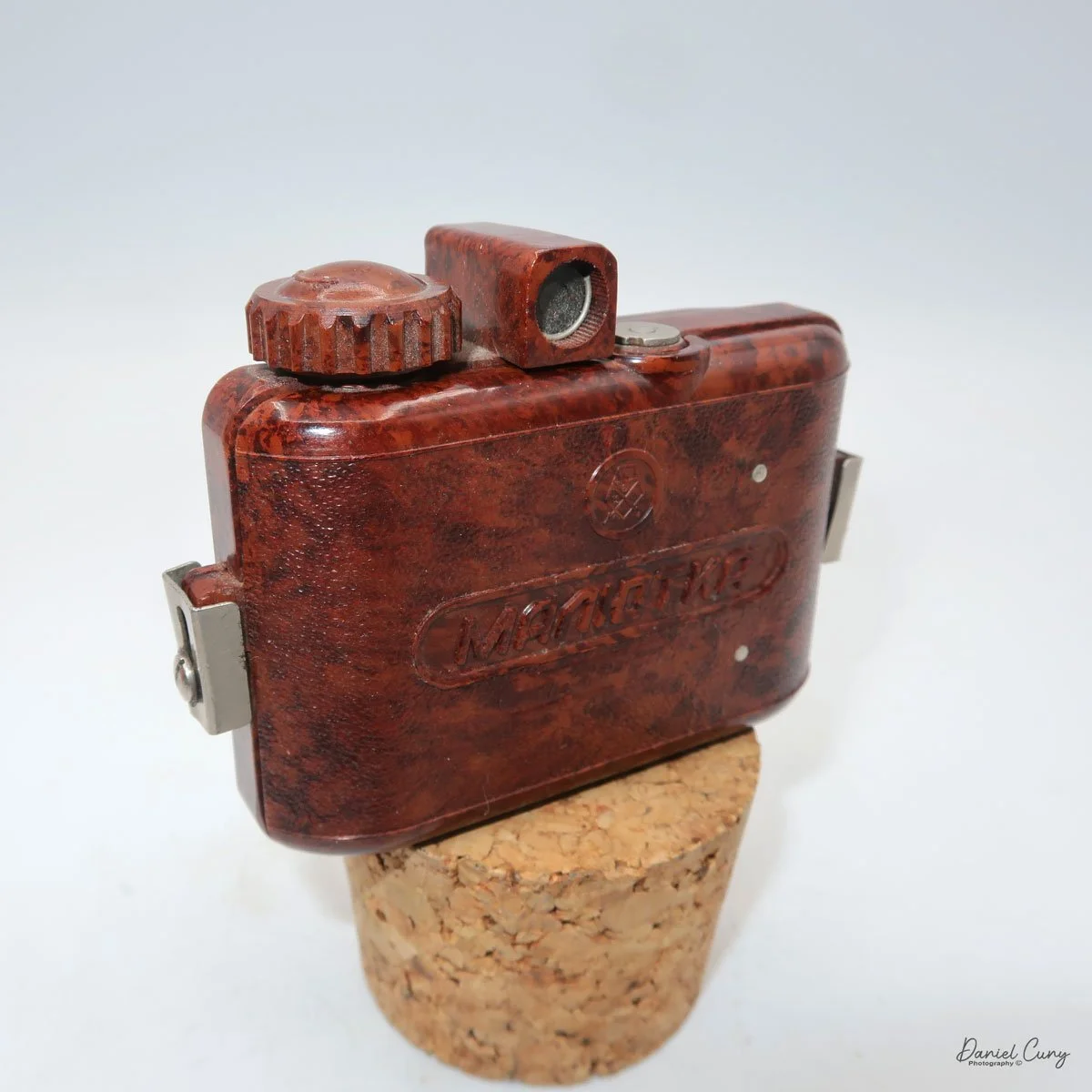
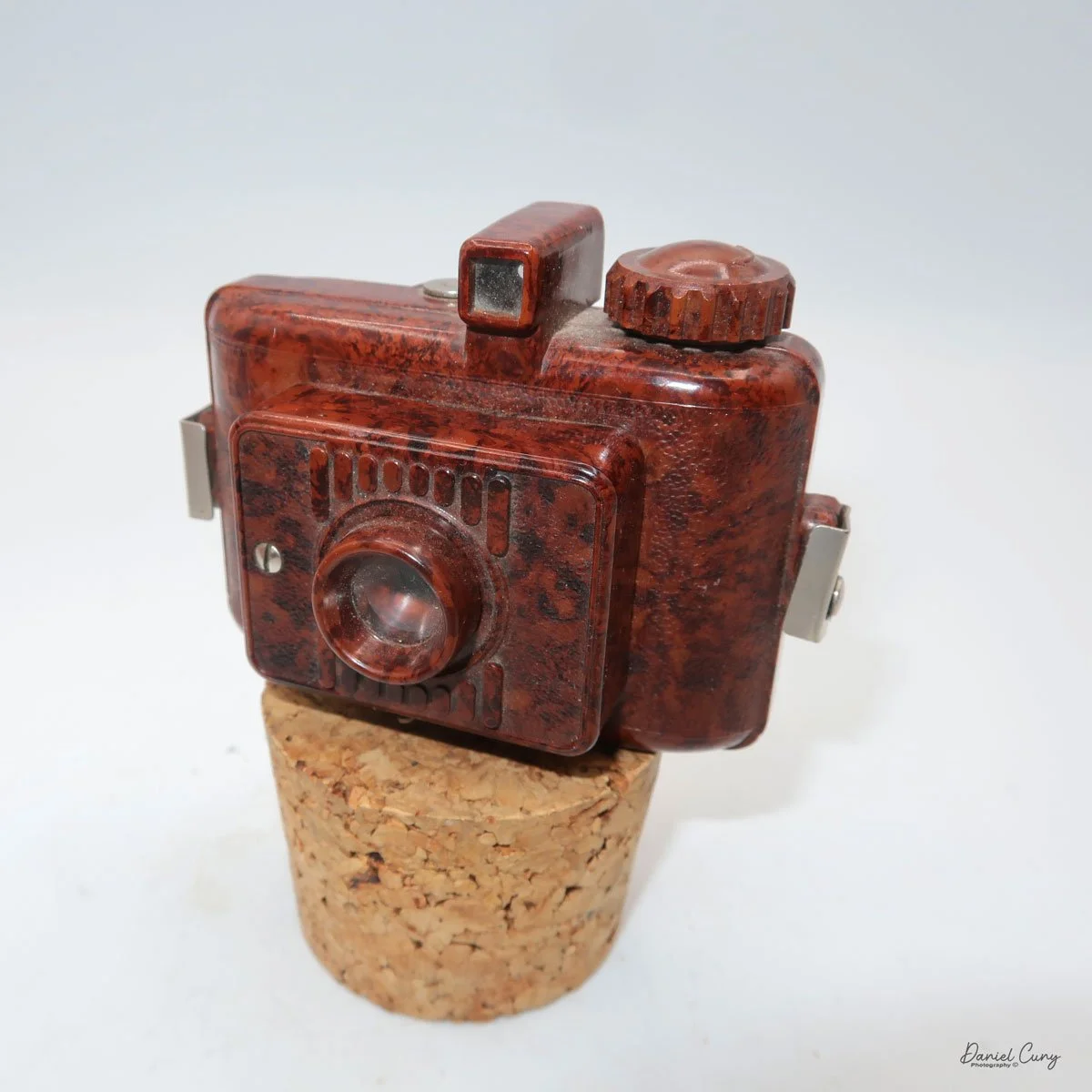
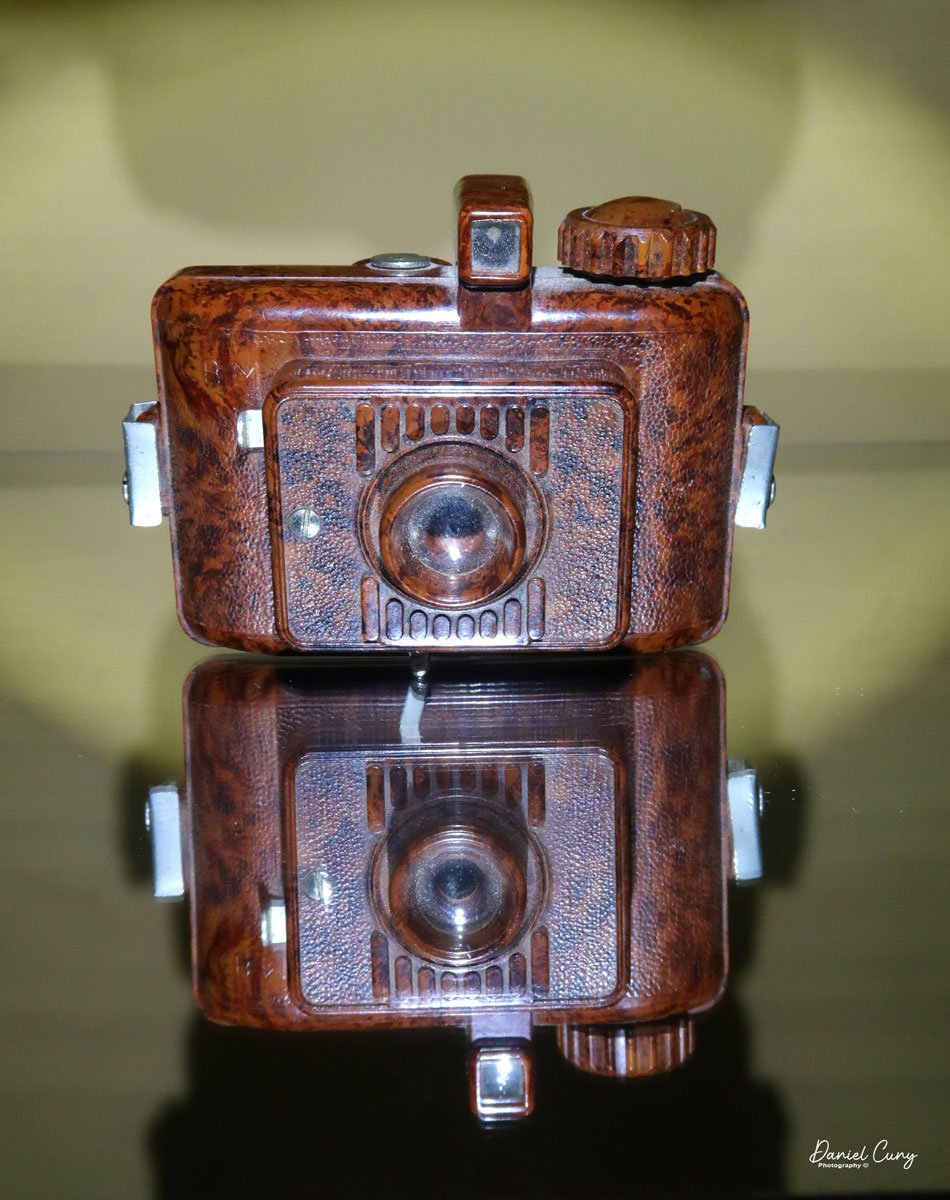
My GOMZ Malyutka camera

It wasn't until later in my camera-collecting career that I developed an interest in miniature and subminiature cameras. It was the more unusual or the odder looking camera items like the pen-shaped Stylophot,  or the round Petal camera, the Twin Lens style miniature cameras like the Gemflex camera, or the miniature cameras which resemble small rangefinder or SLR cameras like the Golden Ricoh 16, where I really enjoyed having them in my collection. They are very unique cameras and items that stand out because they are so different from the larger box, folding, or view cameras. A real advantage of having miniature and subminiature cameras in your collection is the amount of display space they save. You can display many more items and accessories in a much smaller area.

 The GOMZ Malyutka is a camera I purchased around 10 years ago, and I didn't start researching it until about a year ago, when I found out it was pretty rare. I didn't even have it in my display of miniature or subminiature cameras until that time.

 This is another camera I purchase in a group or "lot" of camera in a fairly unknown auction of camera. My real prize and the main item I was bidding on was an early Nikon F body, and tucked in the background was an early Nikon 5cm f2 tick mark lens, which, due to the angle of the lens and the low visibility of people looking, not many people bid on the "Lot", so luckily it was one that I won. There were also other items within the "lot" that I had minimal interest in, but the Tick Mark lens and early Nikon F body were the prize.
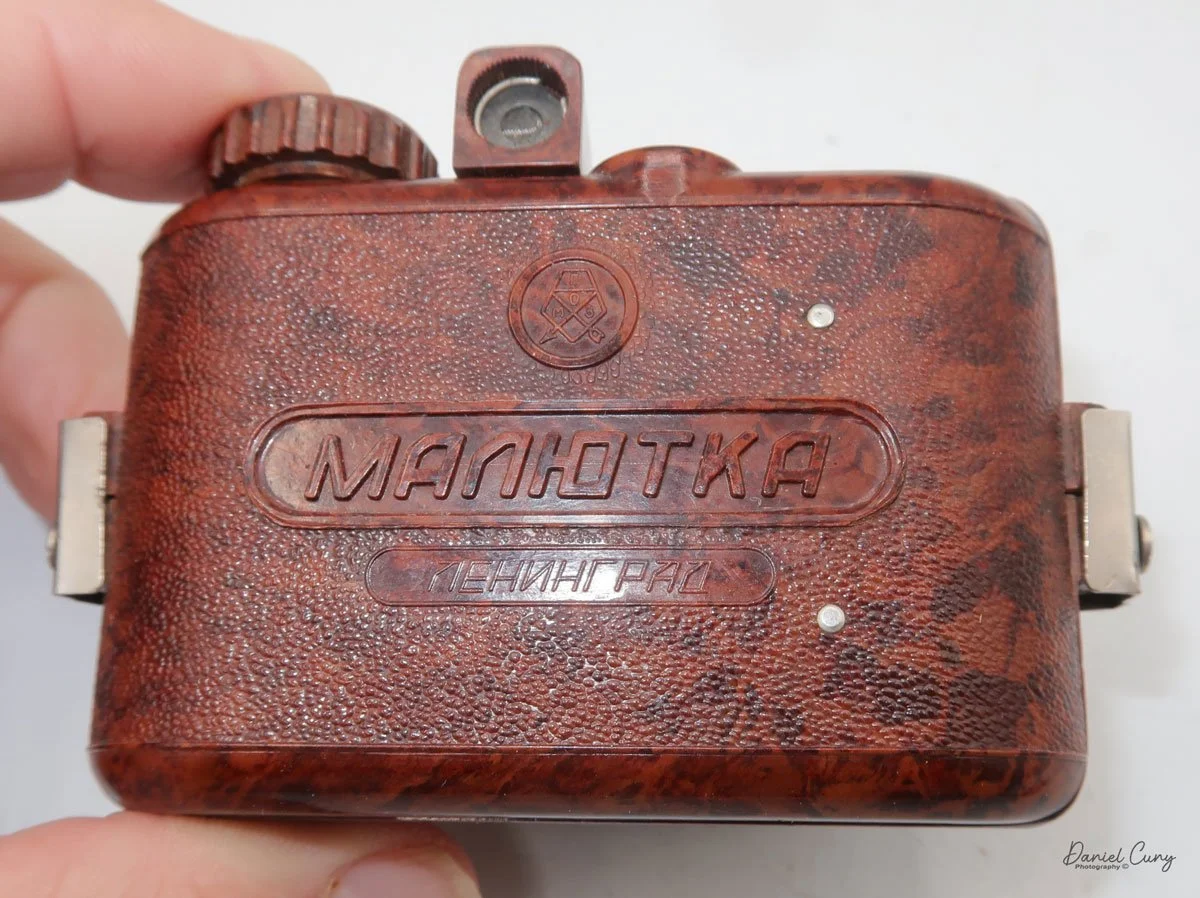
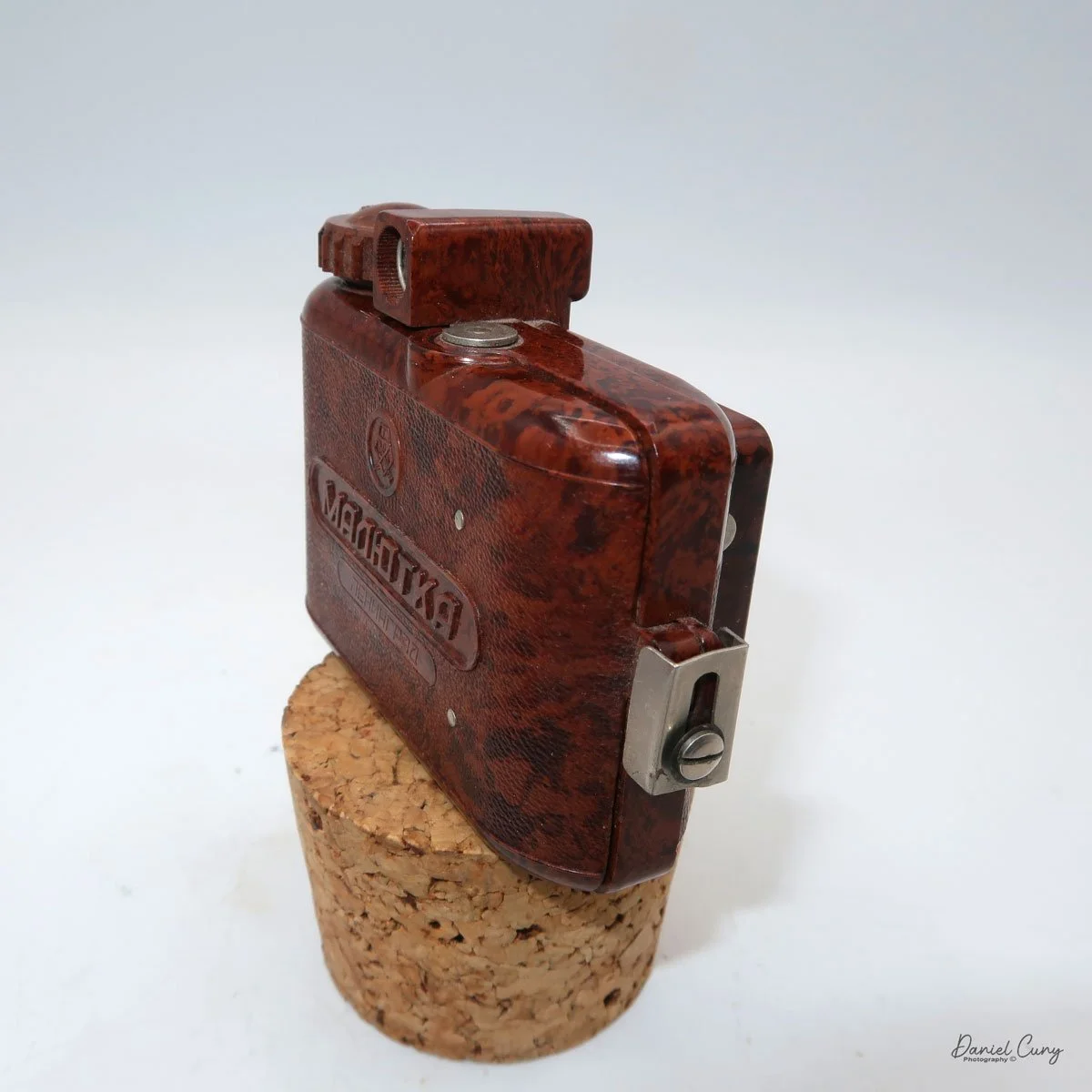
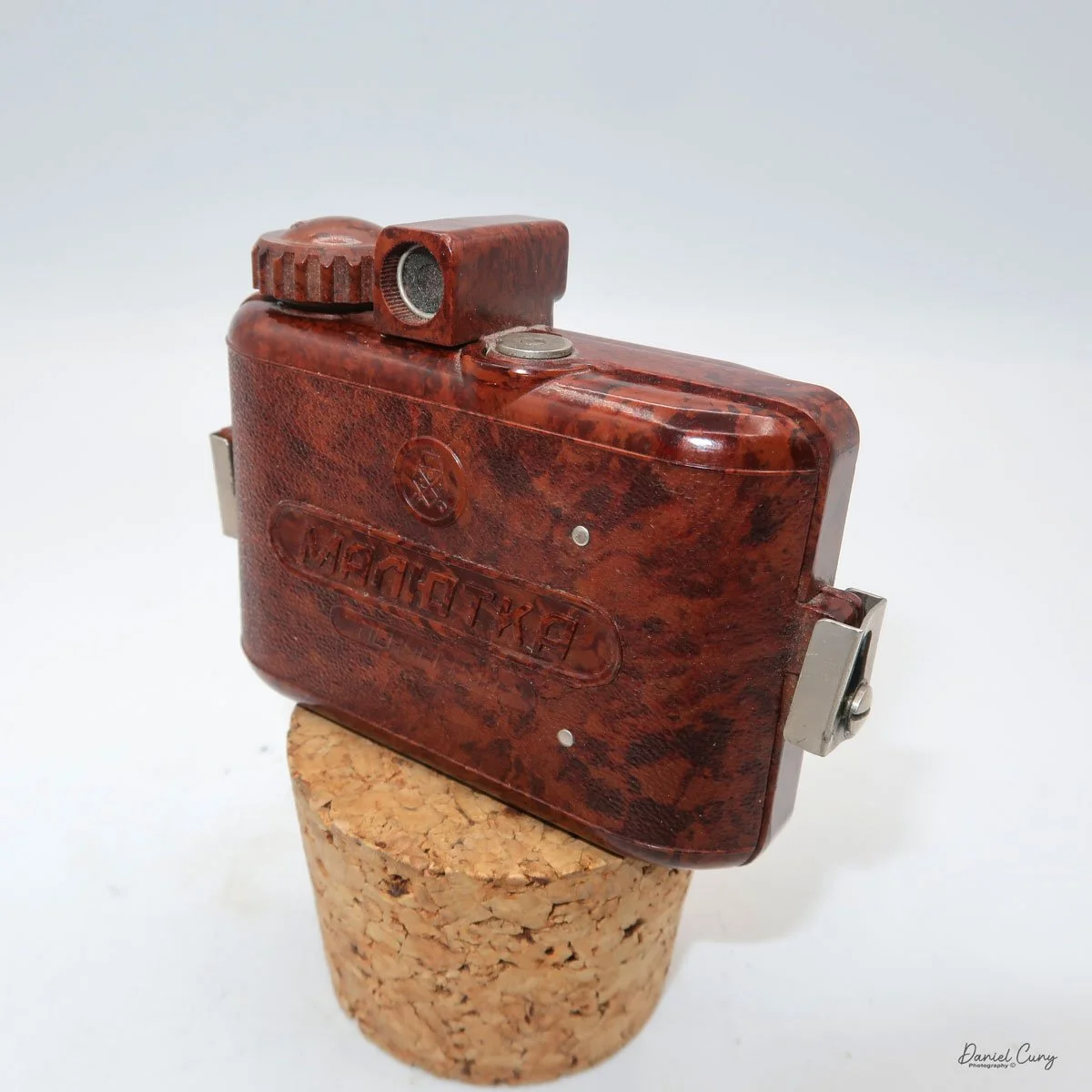
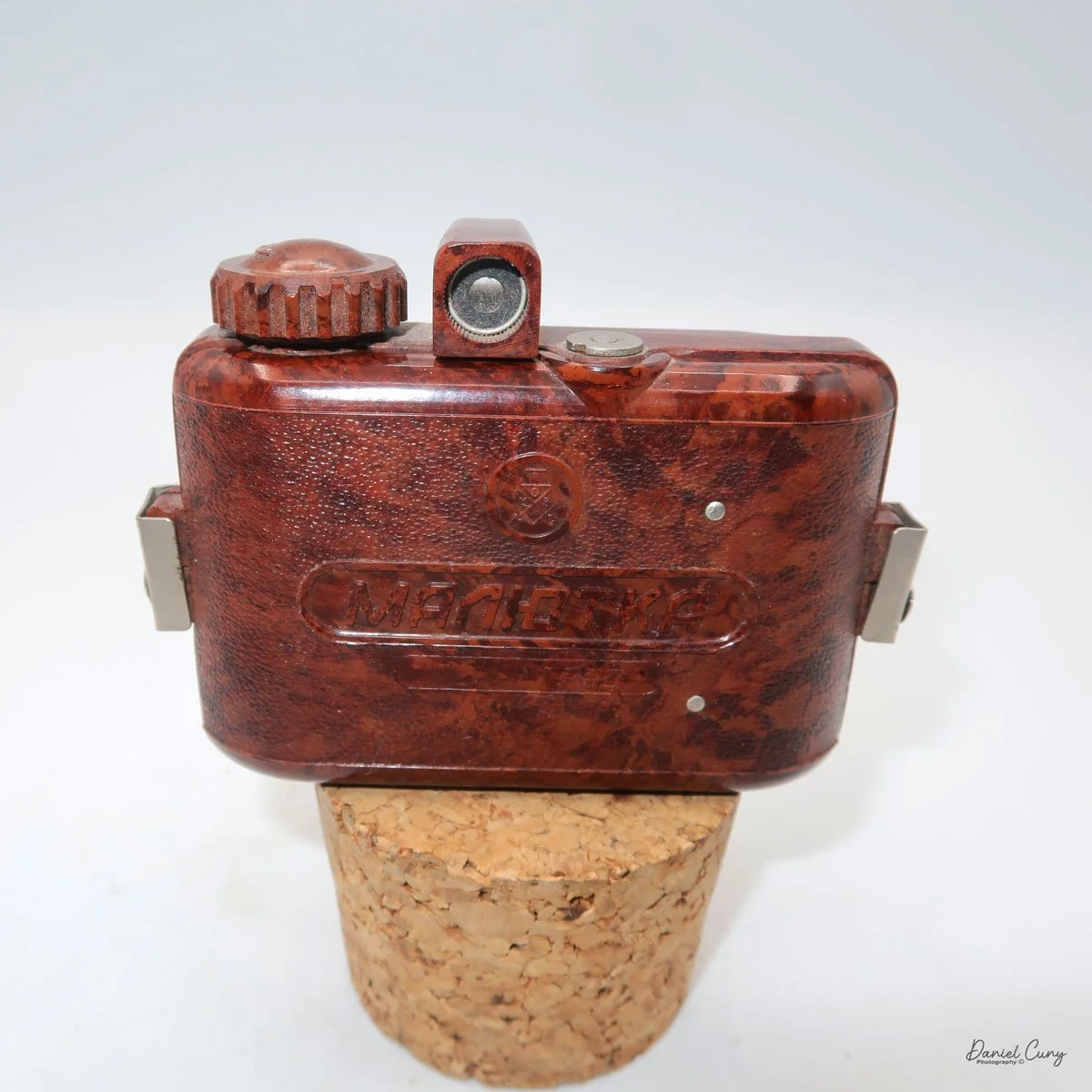
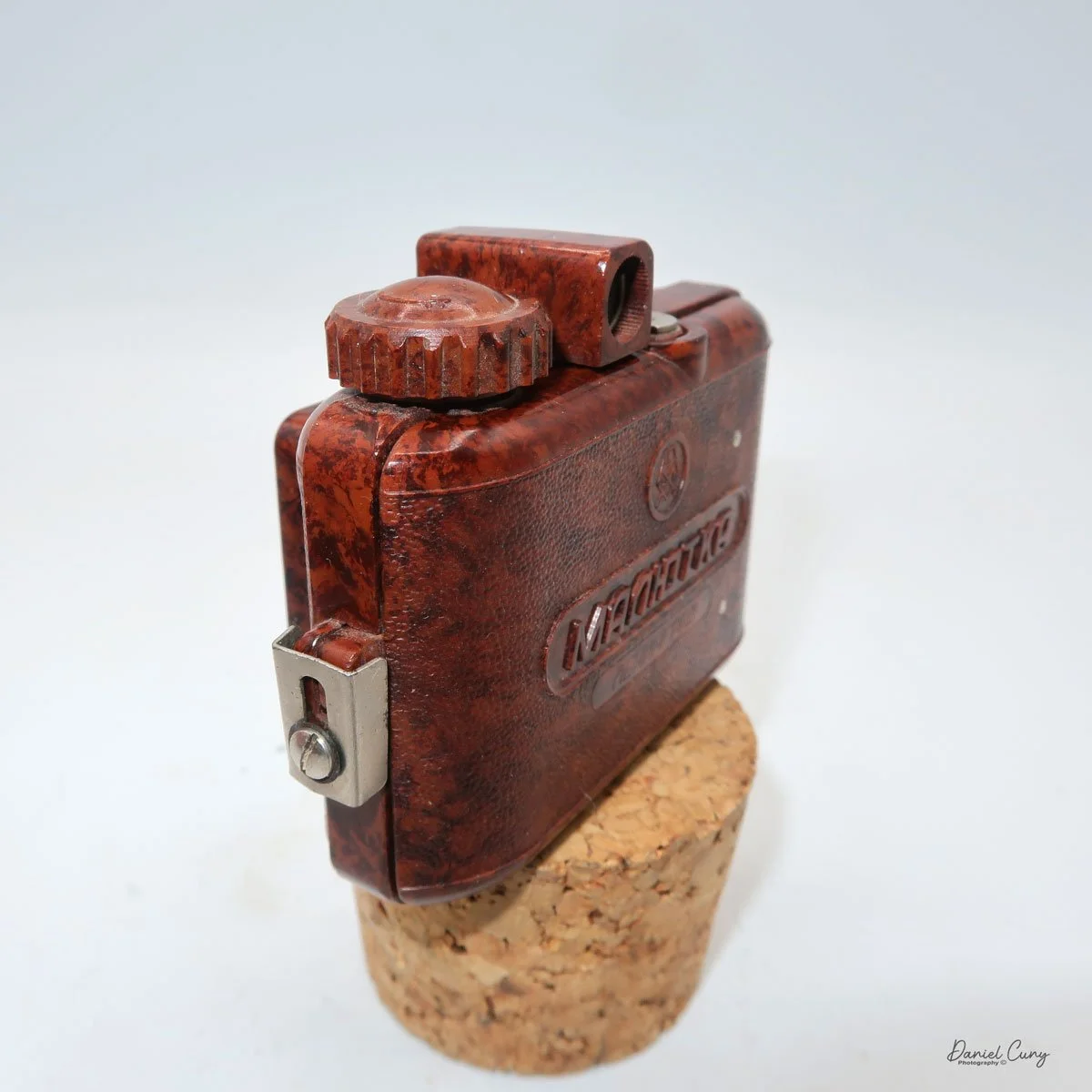
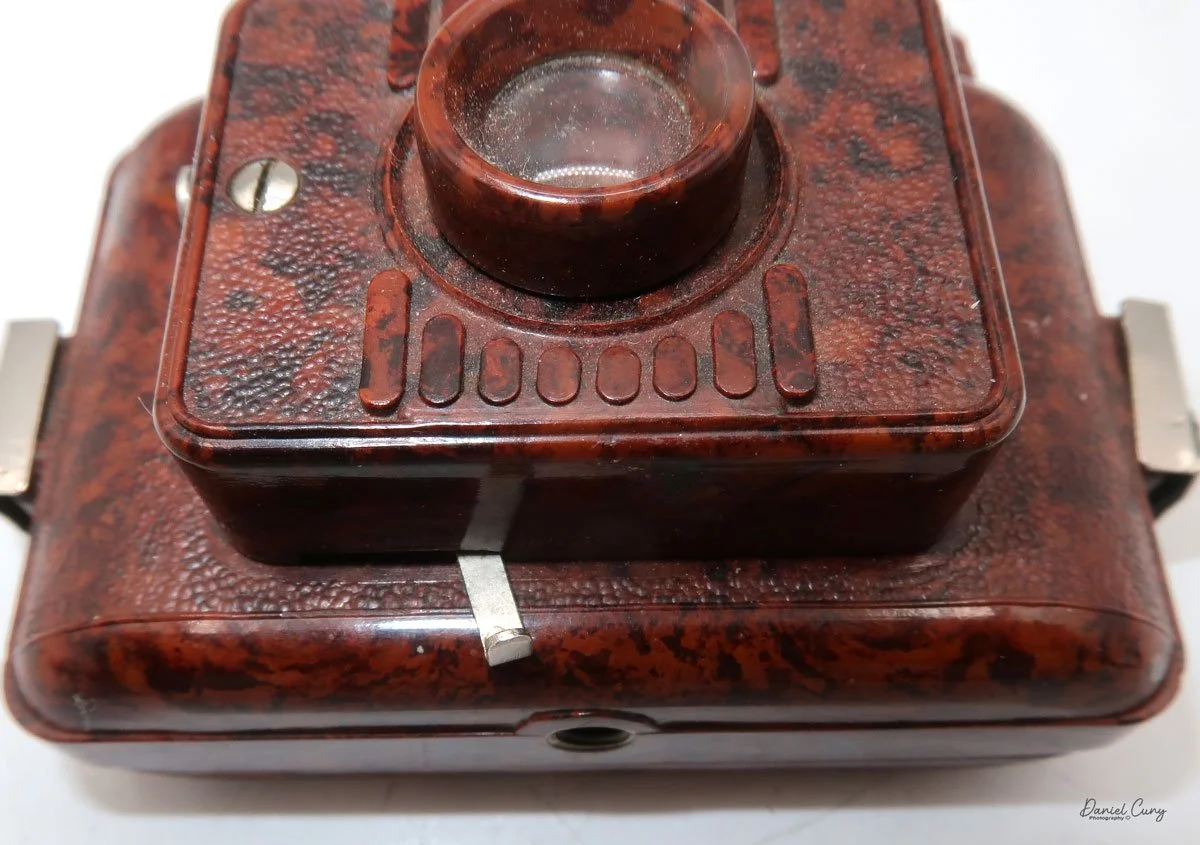
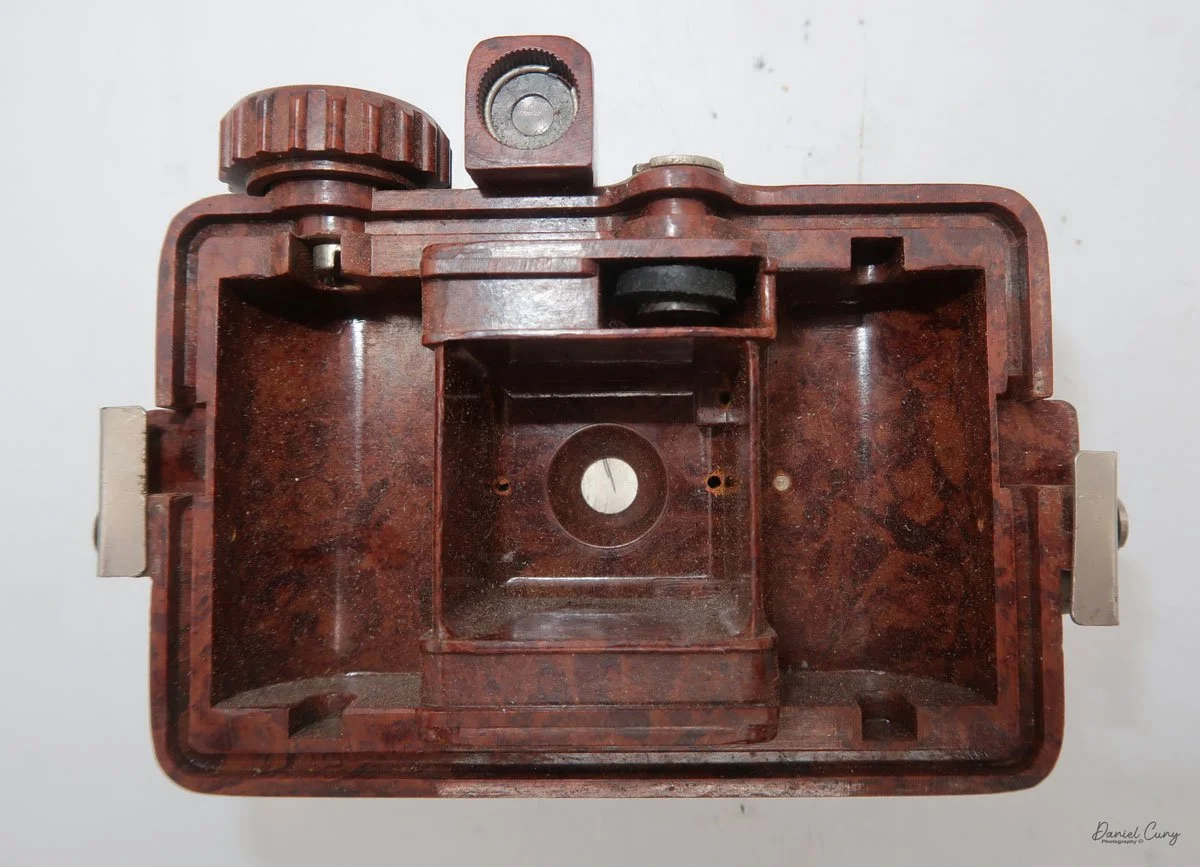
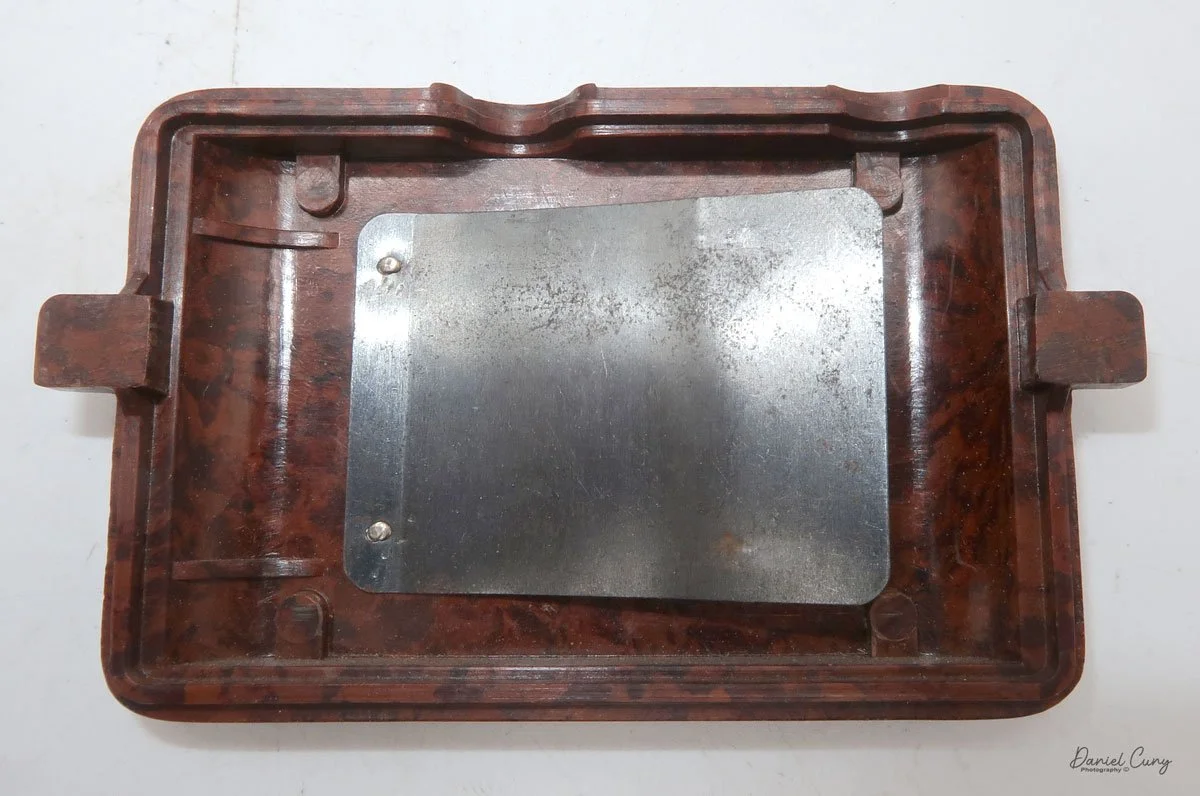
Back side of GOMZ Malyutka camera

 Once I received the items from the auction, I noticed this really nice brown bakelite camera with Russian Cyrillic writing on the back. As I've mentioned before, I have a love for colored cameras, so when I saw this Gomz Malutka, I thought it was a nice little camera. I put it away, not really giving the camera much thought until about a year ago when I was going through a box of photo items for a local camera show that was selling at. I pulled the Gomz Malutka from the box, and was ready to add it to the items for the sale. Then, as I was inspecting the camera again, I thought it might be a fun camera to write about sometime in the future. I set the camera aside.

 After the camera show, as I returned to my office, I noticed the Gomz Malutka on my desk and started making some basic inquiries about the camera. At this point, I began to see that the camera is indeed somewhat rare, so let's write about it for my blog.

History:

 The history of GOMZ (Gosudarstvennyi Optiko-Mekhanicheskii Zavod), the State Optical-Mechanical Plant, reflects Russia's tumultuous and innovative 20th-century history. Located in Leningrad (now St. Petersburg), the factory was the cradle of the Soviet optical industry, responsible for producing the nation's first mass-market cameras and pioneering designs that predated Western equivalents.
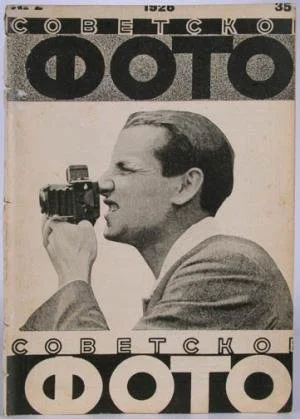
Cover of Sovetskoe Foto (Soviet Photo) Magazine

 The facility began life in 1914 as a French-Russian joint venture to produce optical sights for the military during World War I. Following the 1917 Revolution, the factory was nationalized and underwent several reorganizations before officially adopting the GOMZ acronym in 1932. While it continued to produce military optics, the Soviet leadership demanded a domestic photographic industry to reduce reliance on German imports, pushing GOMZ toward consumer cameras.

 The 1930s marked GOMZ's golden era of innovation. Its first major success was the Fotokor-1 (1930–1941), a 9x12cm folding plate camera. Based on German designs, the Fotokor-1 became the first mass-produced Soviet camera, with over one million units manufactured. It effectively democratized photography in the USSR, serving as the primary tool for documenting the Soviet state's industrialization.

Even more technically significant was the Sport (1937), a 35mm single-lens reflex (SLR) camera. Historians often debate whether the GOMZ Sport or the German Kine Exakta was the world's first proper 35mm SLR. Regardless of the title, the Sport was a marvel of engineering for its time, featuring a vertical metal shutter and a reflex viewfinder that allowed photographers to see exactly what the lens saw—a standard feature today, but revolutionary in the 1930s.
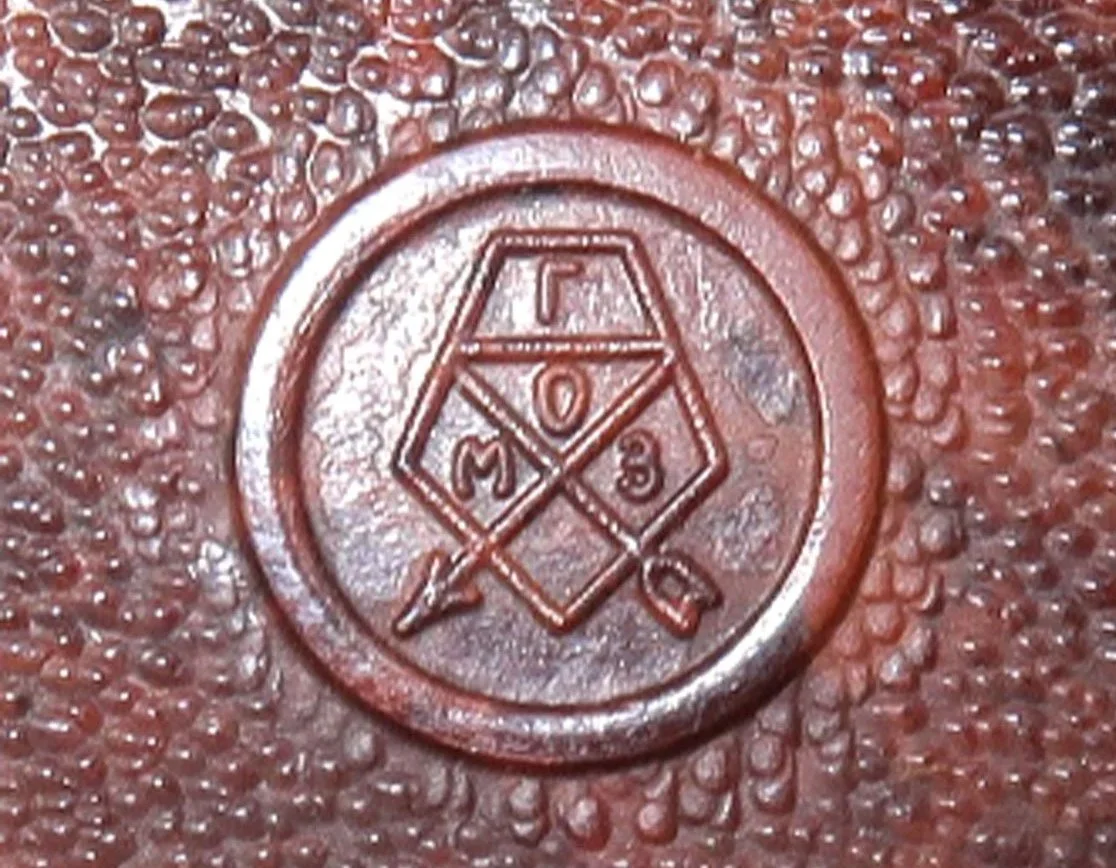
Logo of Gomz camera

 During World War II, the factory suffered heavily during the Siege of Leningrad. Production shifted entirely to military needs, such as sights for tanks and artillery. After the war, GOMZ pivoted back to consumer goods, focusing on affordable, simple cameras for the recovering population.

This post-war period gave rise to the legendary Lubitel series (starting in 1949). Based on the German Voigtländer Brilliant, the Lubitel was a twin-lens reflex (TLR) camera made of Bakelite and later plastic. It was cheap, durable, and capable of producing excellent medium-format images, introducing millions of amateurs to photography. Similarly, the Smena series provided a simple, viewfinder alternative that became a staple in Soviet households.

 In 1965, GOMZ underwent a final restructuring, becoming the Leningrad Optical-Mechanical Association (LOMO). Under this new name, the factory would later produce the LOMO LC-A, the camera that accidentally sparked the global "Lomography" art movement in the 1990s. However, the foundation of this success was laid during the GOMZ era, which transformed a military optics plant into a titan of Soviet creativity and engineering.

My Camera:

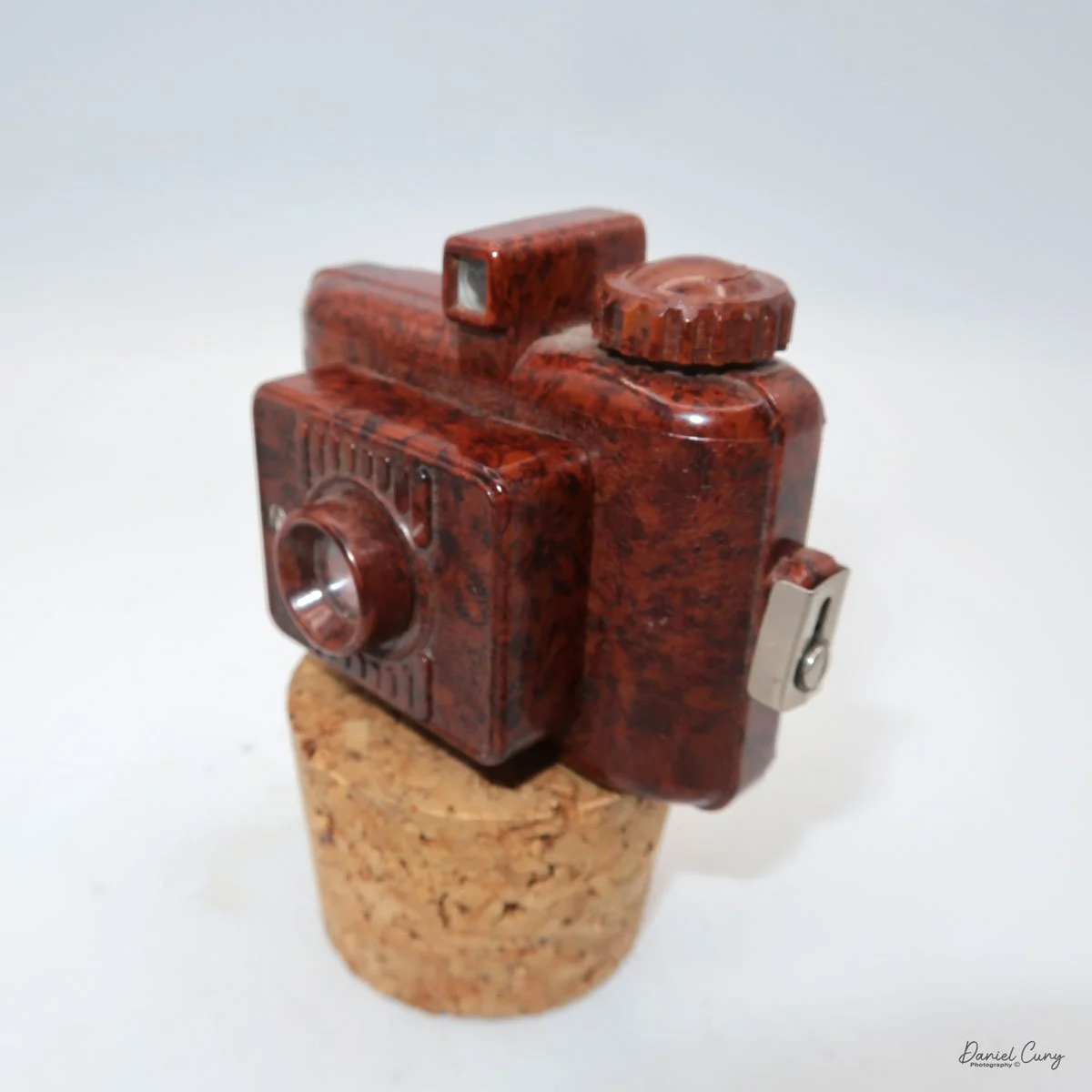
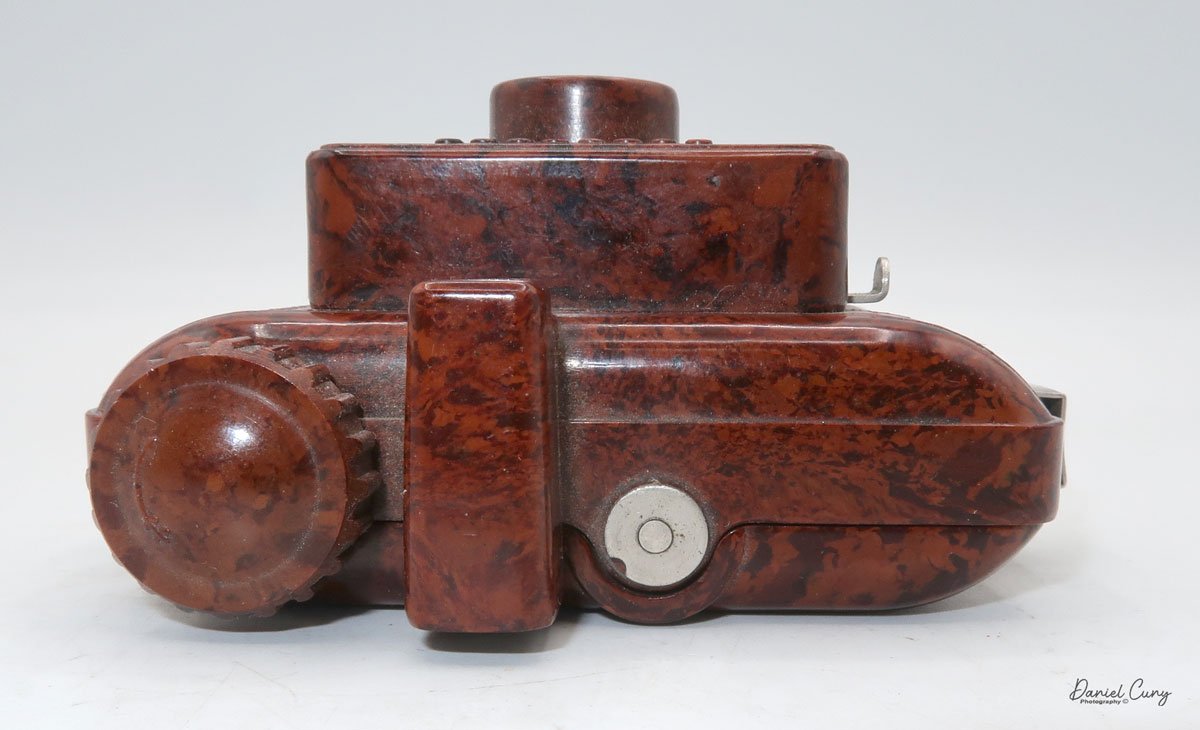
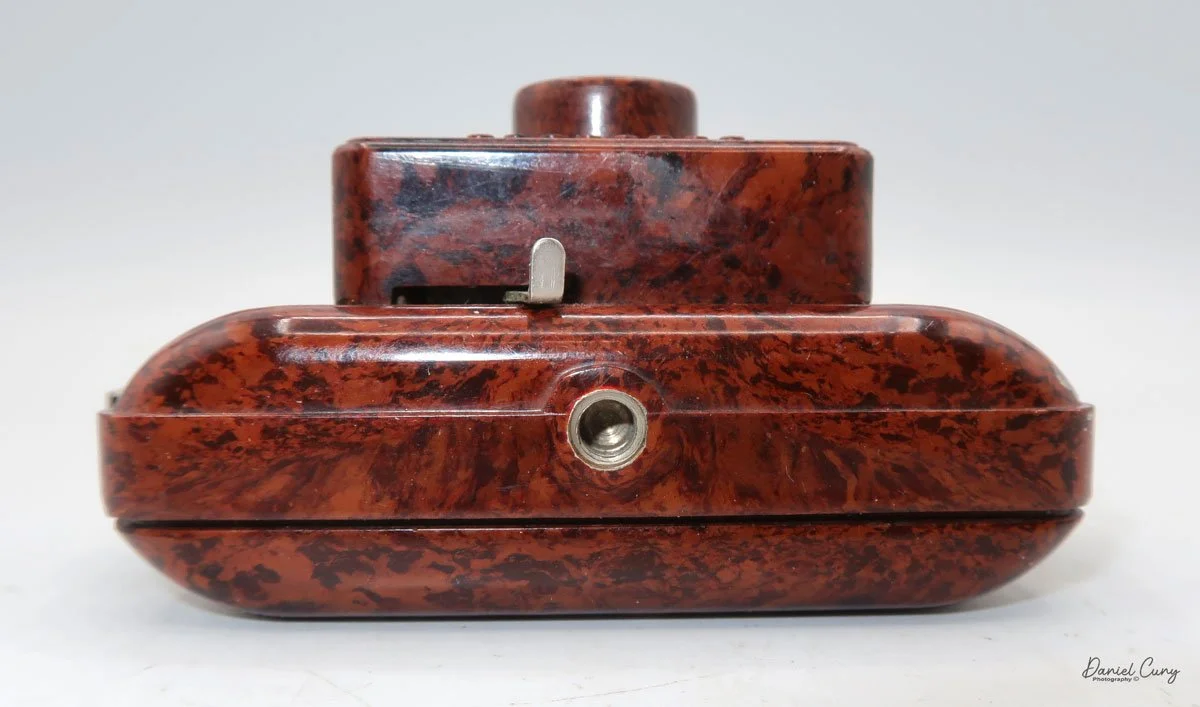
 My GOMZ Malyutka is small, measuring  2" wide, by 1.5" tall and 1.5" deep from the front of the lens to the rear of the camera, and it weighs only 2.3 ounces without film. The Gomz Malutka is based on the SIDA camera from Sida GmbH, Berlin, Germany, which was made in the mid-1930s and came in both metal and Bakelite. "Malyutka" (малютка) is a Russian word that means "baby," "little one," or "tiny thing". It is also very similar to a camera made by Gomz,  Liliput camera.
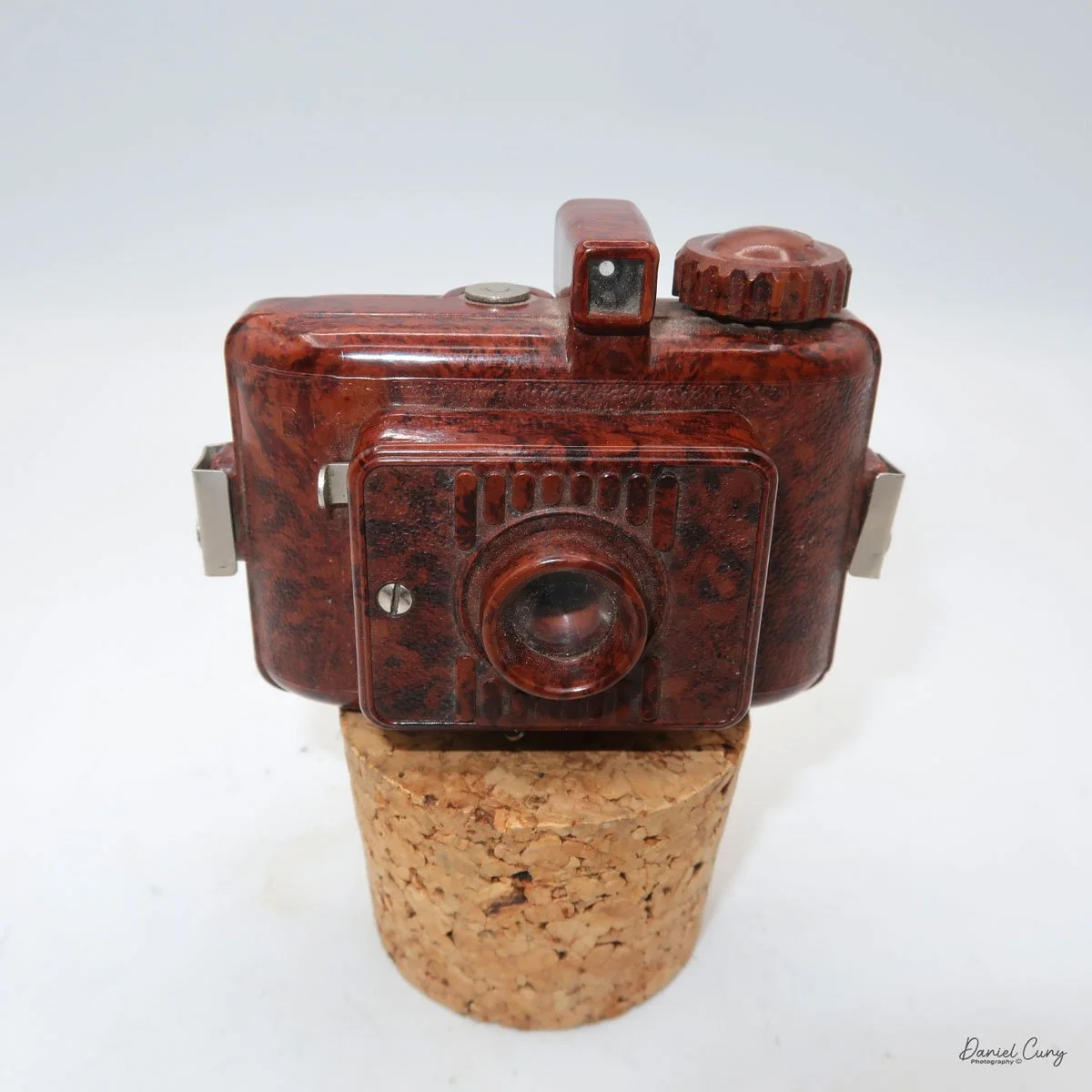
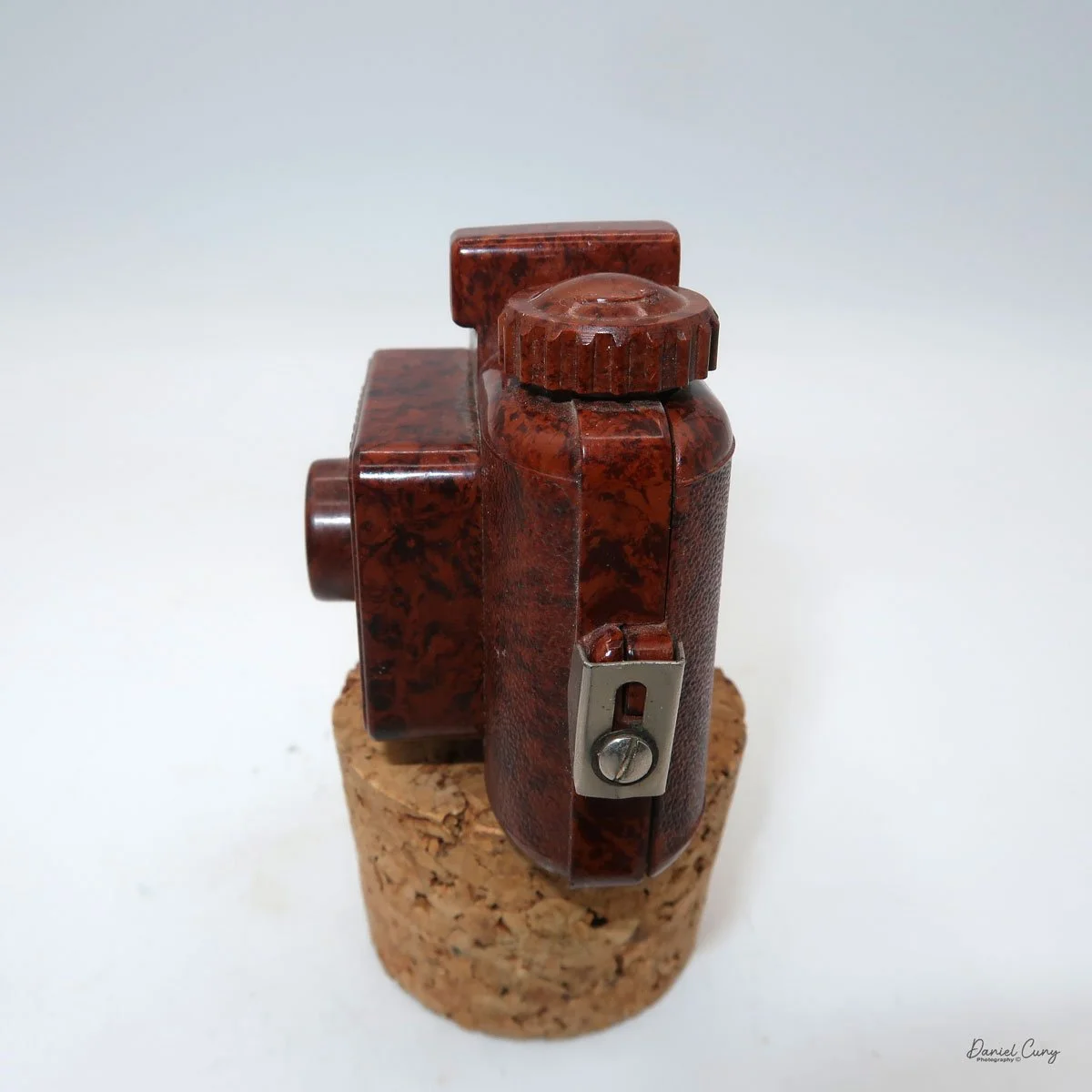
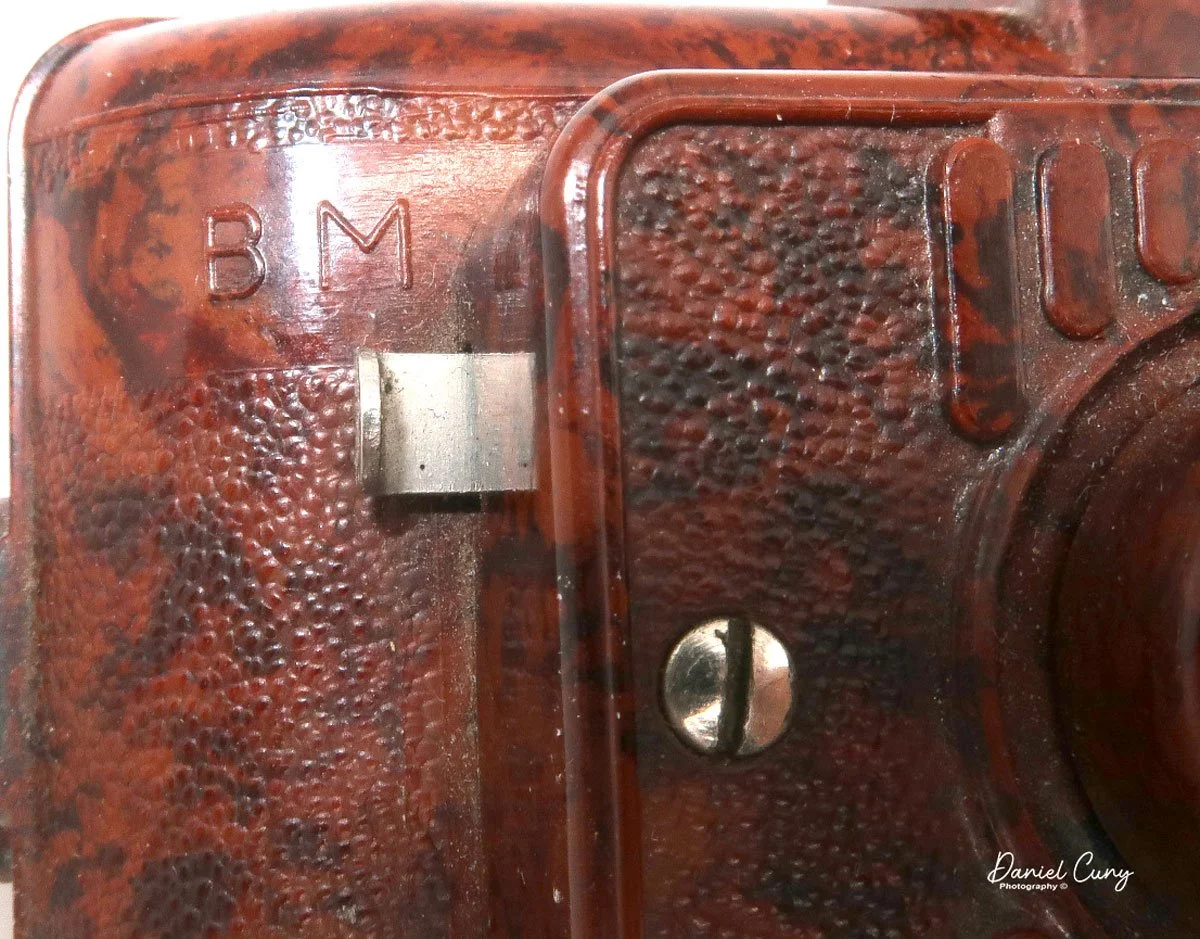
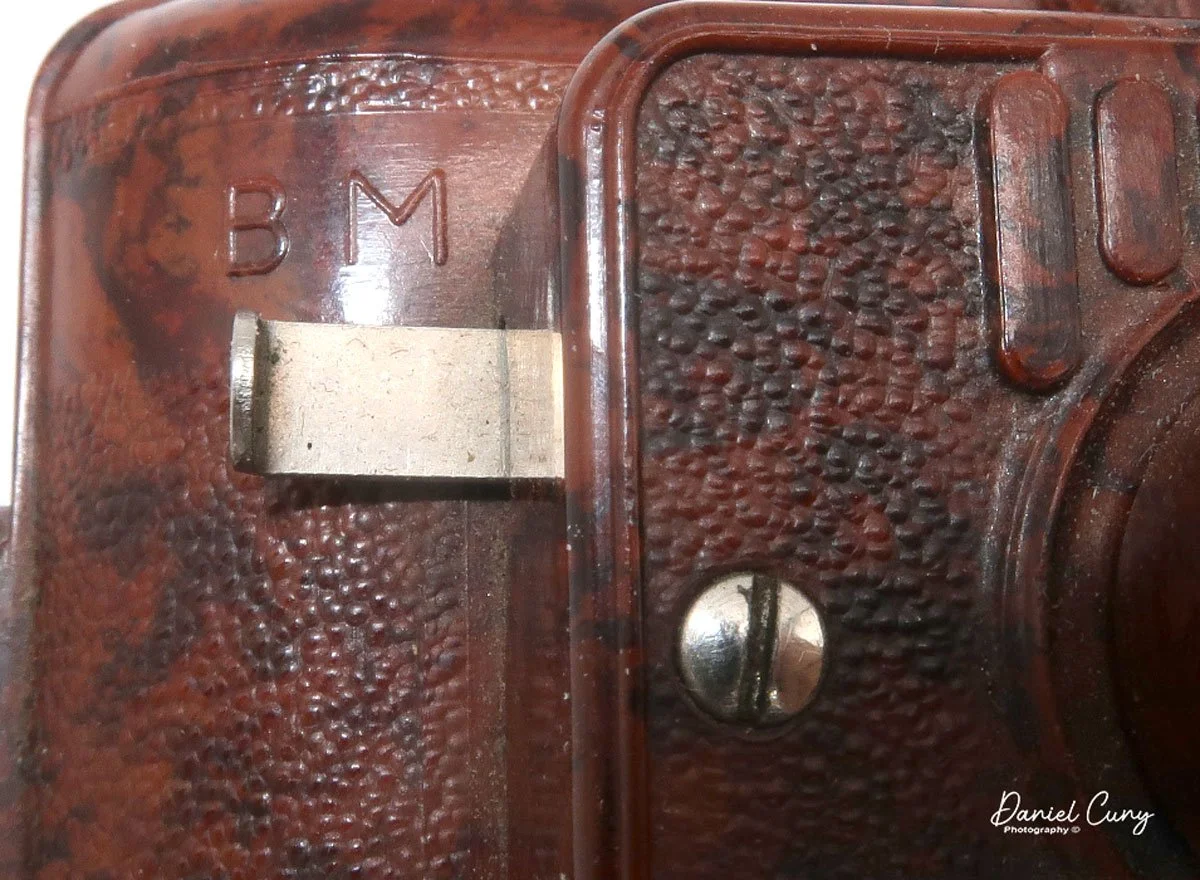
 The camera's controls are very straightforward. There is only the shutter release at the bottom of the camera, along with the shutter control on the right side next to the lens. The shutter control consists of two settings: "M" (moment) for normal shutter speed, generally around 1/50 sec, and "B" for time exposures. Sliding a bar out from the side of the camera makes these settings. Sliding the shutter release under the lens takes the photo. 
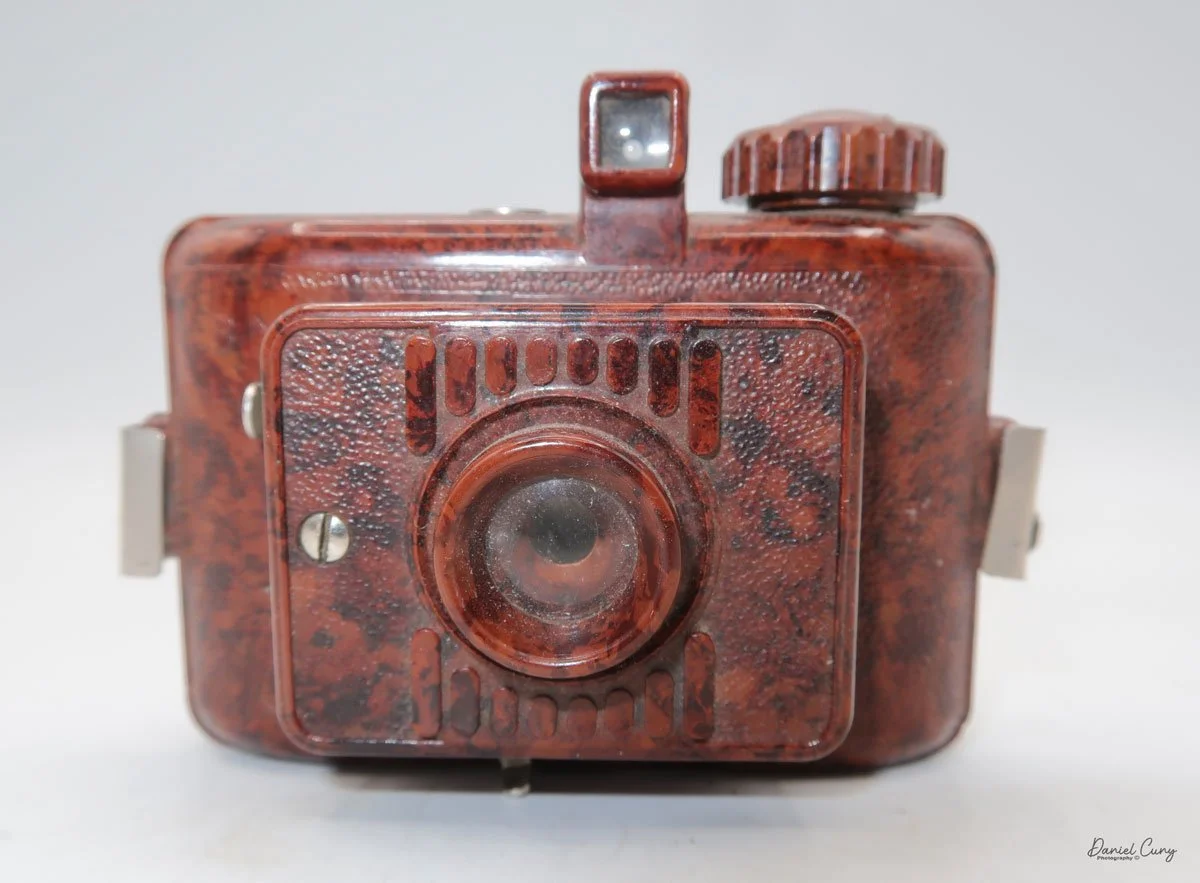
 To open the back of the camera to load film, there are clips on either side that you move to the down position to remove the back. The camera takes Boltax film, a special 35mm film that produces a 24 mm x 24 mm negative. You load the camera similarly to any roll film camera: put the empty spool on the take-up reel side and the fresh film on the opposite side. Bring the leader to the slot on the take-up spool and start winding. Put the back on the camera and slide up the clips to lock it in place. Wind the film and advance it to the first frame.

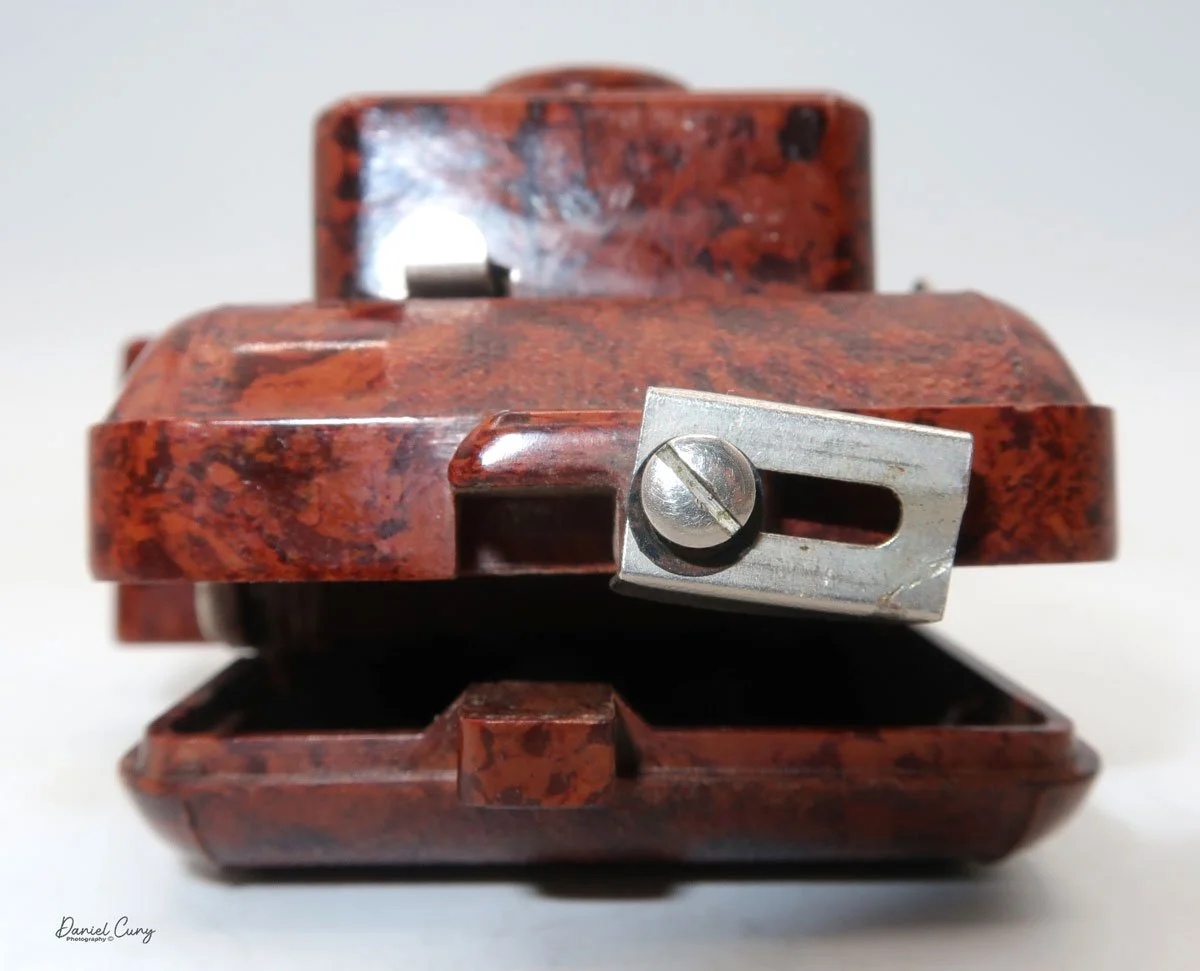
 There is a small viewfinder at the top of the camera to frame your photo, and a tripod socket at the bottom to steady the camera during long exposures. Also at the top is a small, round metal disk that rotates as the film moves within the camera. Since the camera doesn’t have a red window on the back of the film door, you need to watch the disk rotate a few times to make sure the film is moving inside the camera.
Results:

 Since I don't have any Boltax film, I wasn't able to take photos with the Malutka camera, but possibly in the future, I'll try and use some paper backing I have from a few rolls of 828 film and run some film through it using 35mm to see how the camera performs.


Conclusion:

 The Gomz Malyutka is an excellent small camera that I enjoy having in my collection. It's in fantastic condition and is another color camera that sits proudly amongst the other miniature and subminiature cameras on my shelf.

 Thank you for taking the time to learn about this small, odd Russian camera. 

 I'd love to hear from you. Please get in touch with me if you have questions, concerns, or comments.

 Here's a link to my other Camera Reviews.

 Cuny's Camera and Photo has many cameras I've reviewed for sale, along with other camera and photo oddities. If interested in any items, email me, and I'll offer a nice discount as a friend of the family.

 Until next week, please be safe.


Bolsey 8 Camera

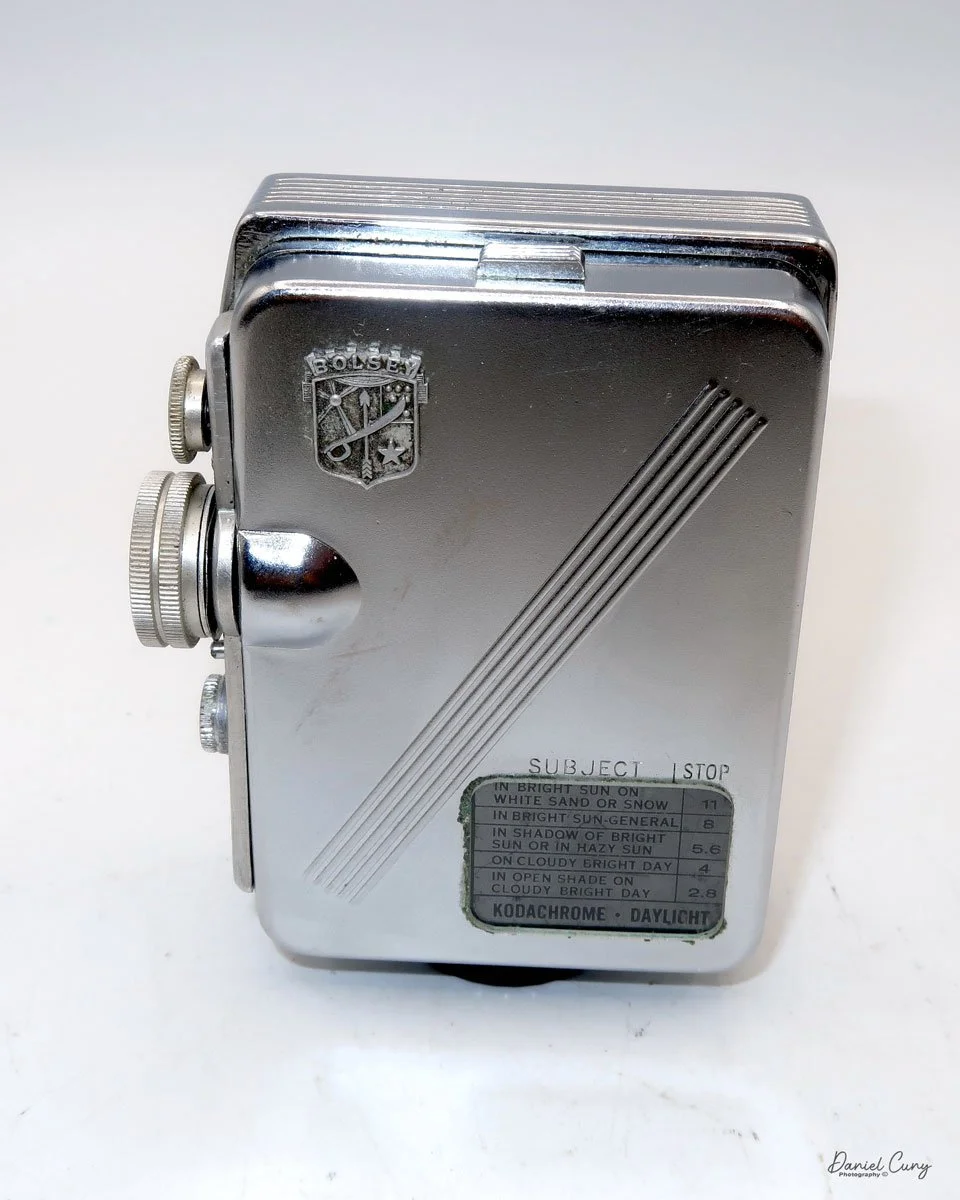
My Bolsey 8 camera

Being a big fan of Bolsey cameras, I was thrilled when a Bolsey 8 camera showed up unexpectedly with a "lot" of cameras purchased online. It was buried in the photo, and all you could see was part of the case, so to my surprise, I picked up the camera and unzipped the case to find a somewhat rare Bolsey 8.

 I've owned several different Bolsey cameras and even written about a couple in my weekly camera blogs. One is the Bolsey Flex-Trio, which I had in the original box with the flash. Just a year or so ago, I wrote about the unusual Boley Model C twin-lens camera. Both cameras are very well made, and I've always enjoyed shooting with them and having them in my collection.

 In 1956, the Bolsey 8 camera was marketed and sold as the only miniature 8mm movie and still camera made. There was even a "Lady Bolsey 8" camera sold in the United Kingdom, which I'll need to keep my eye out for a possible future purchase.

 There are many movie cameras that have single-frame capability, which is used in animation. Still, none of them that I'm aware of can change to different shutter speeds when using the camera in the single frame mode. The Bolsey 8 has just that capability and is extremely small and compact. There's an excellent website for subminiature cameras at www.submini.com, and if interested, they have a copy of the Bolsey Manual.

History:

The Bolsey Camera Company was established in 1947 in the United States by Jacques Bolsey, born Yakov Bogopolsky in Kyiv, Ukraine, in 1895. Bolsey's journey into camera design began in Switzerland, where he initially studied medicine but soon shifted to mechanical engineering and photography. 

 In the 1920s, he designed the Cinegraphe Bol, a 35mm cine camera, and later developed the renowned Bolex line of movie cameras, which became highly regarded for their precision and durability. After selling the rights to Bolex to Paillard in Switzerland, Bolsey contributed to developing the Alpa camera before immigrating to the United States in 1939.

 In America, Bolsey worked for the government during World War II, designing aerial and ground photography cameras. He then founded the Bolsey Camera Company to produce user-friendly, affordable, and durable cameras for the consumer market. The company's most iconic products were compact 35mm rangefinder cameras, such as the Bolsey B series (B, B2, B22, Jubilee), which featured cast aluminum bodies, coupled rangefinders, and built-in flash synchronization—a rare feature at the time. 

 The Bolsey C series combined twin-lens reflex (TLR) and rangefinder designs. The company also produced subminiature cameras using 8mm film and pseudo-TLR models like the Bolsey-Flex.

 Bolsey cameras gained popularity in postwar America for their accessibility and portability, appealing to amateur photographers and families. However, by the late 1950s, the company struggled to compete with the influx of advanced, competitively priced cameras from Japanese manufacturers. 

 Although the Bolsey Camera Company ceased operations in the early 1960s, its innovative designs and commitment to democratizing photography left a lasting legacy. Today, Bolsey cameras are prized by collectors for their unique blend of engineering, aesthetics, and historical significance.

My Camera

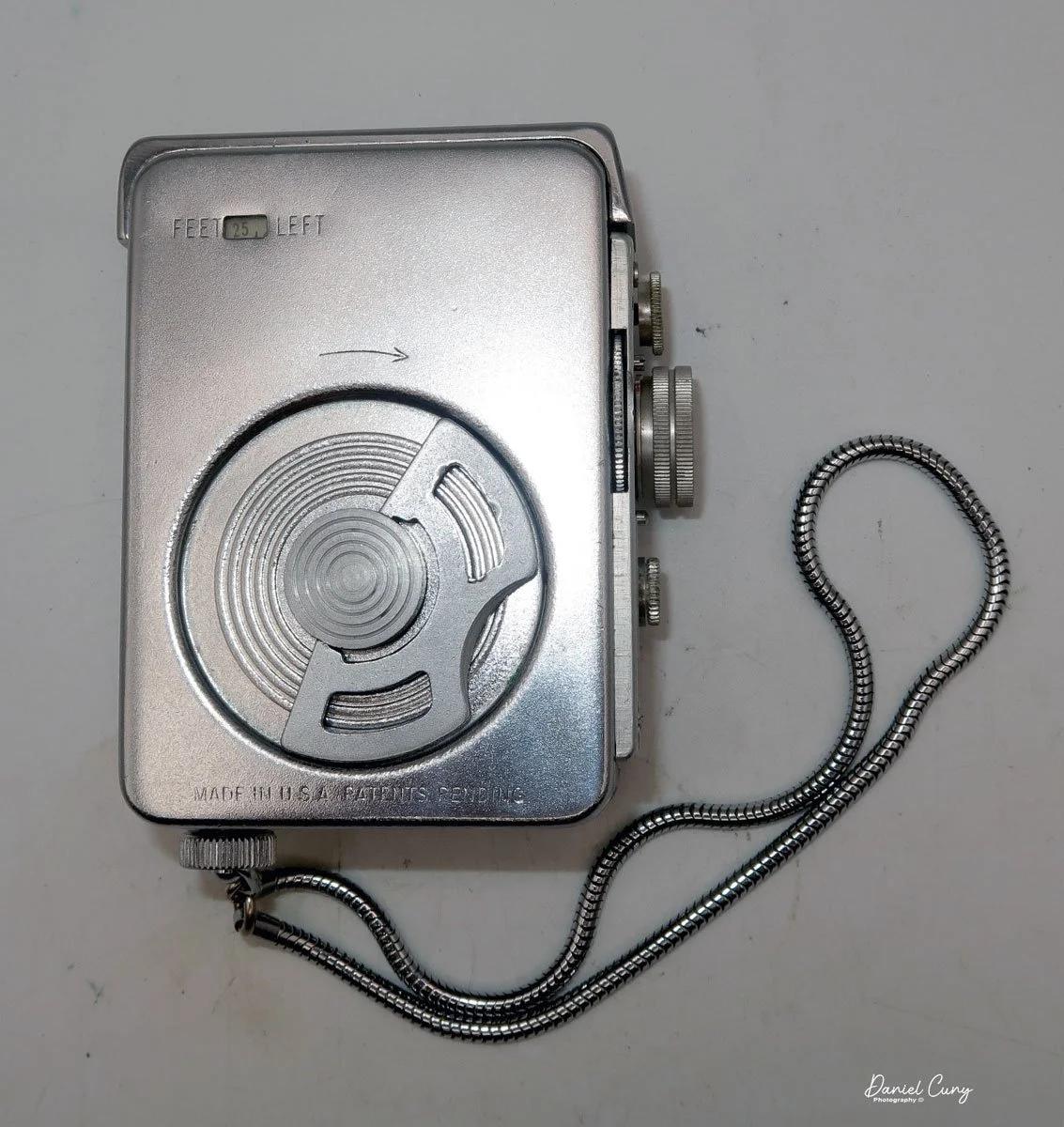
My Bolsey 8 camera is 3.25" tall by 2.5" deep by 1.25" wide and weighs 12.3oz. The camera is tiny yet easy to hold and extremely well-built. The Bolsey 8 has a clock drive spring motor that advances the film cartridge in the camera. My Bolsey 8 camera has a Bolsey Elgeet Navitar 10mm f1.8 lens. A wide-angle lens (6.5mm) and a telephoto lens (20mm) were also available for the camera. The serial number on my camera is 08823, stamped on the back of the camera just under the viewfinder.

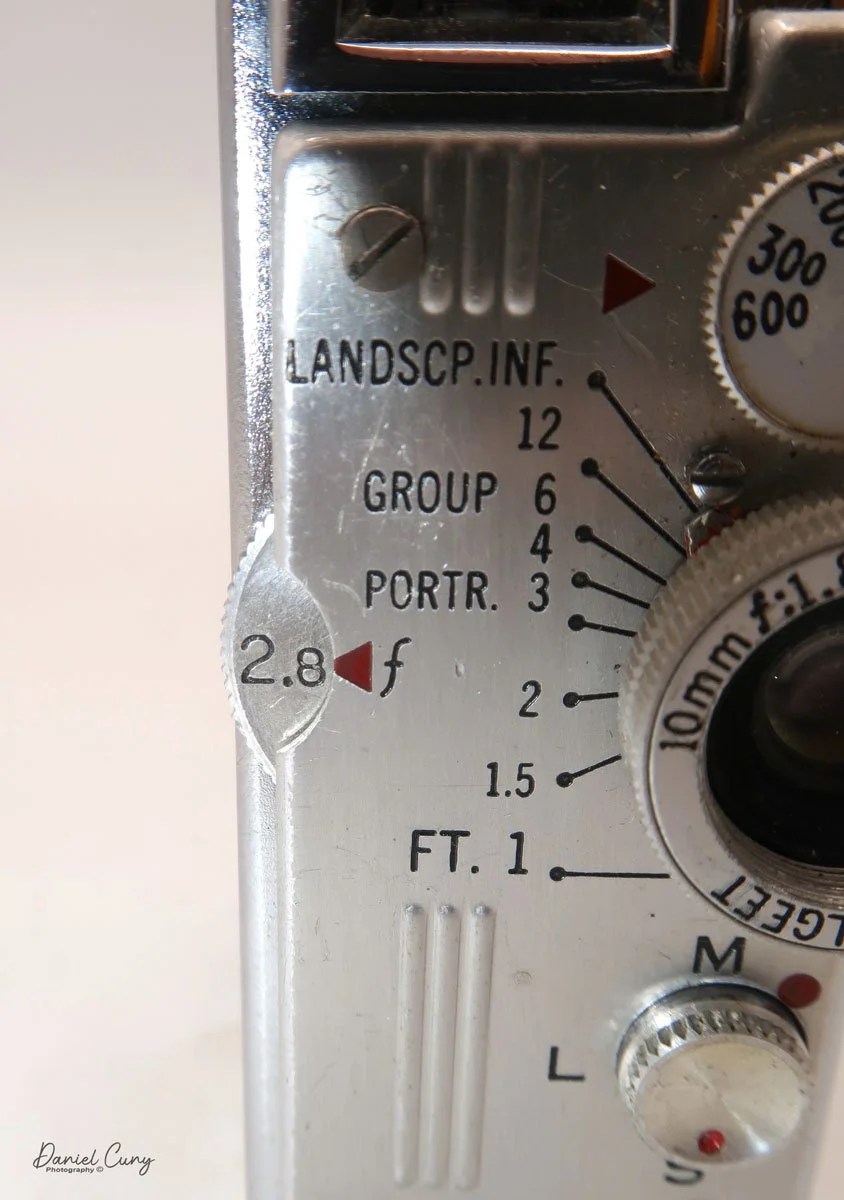
The Bolsey 8 camera has variable shutter speeds, which include 1/600, 1/300, 1/200, 1/100 & 1/50. These are set on a small dial just above the lens. The Bolsey 8 also has an aperture range from F1.8 to F22. A large wheel sets the aperture on the side of the camera body, showing what aperture the user has the camera's lens set to. In between the lens and the aperture settings are the focus marks for the distance you are from your subject. The focus on the lens needs to be set from one foot to infinity, with another setting in between, for landscape, group, or portrait. You cannot miss this in front of the camera. 

Also, on the front of the camera, below the lens, is a wheel that turns with "M" on the top, "L" in the middle, and "S" on the bottom. To use the camera as a movie camera, turn the wheel to "M," and for still photography, turn the wheel to "S." Press the button to activate the shutter on the camera in either the "M" or "S" modes. "L" locks the camera's shutter so you can't accidentally run the camera while the camera is in your pocket or fitted camera case.

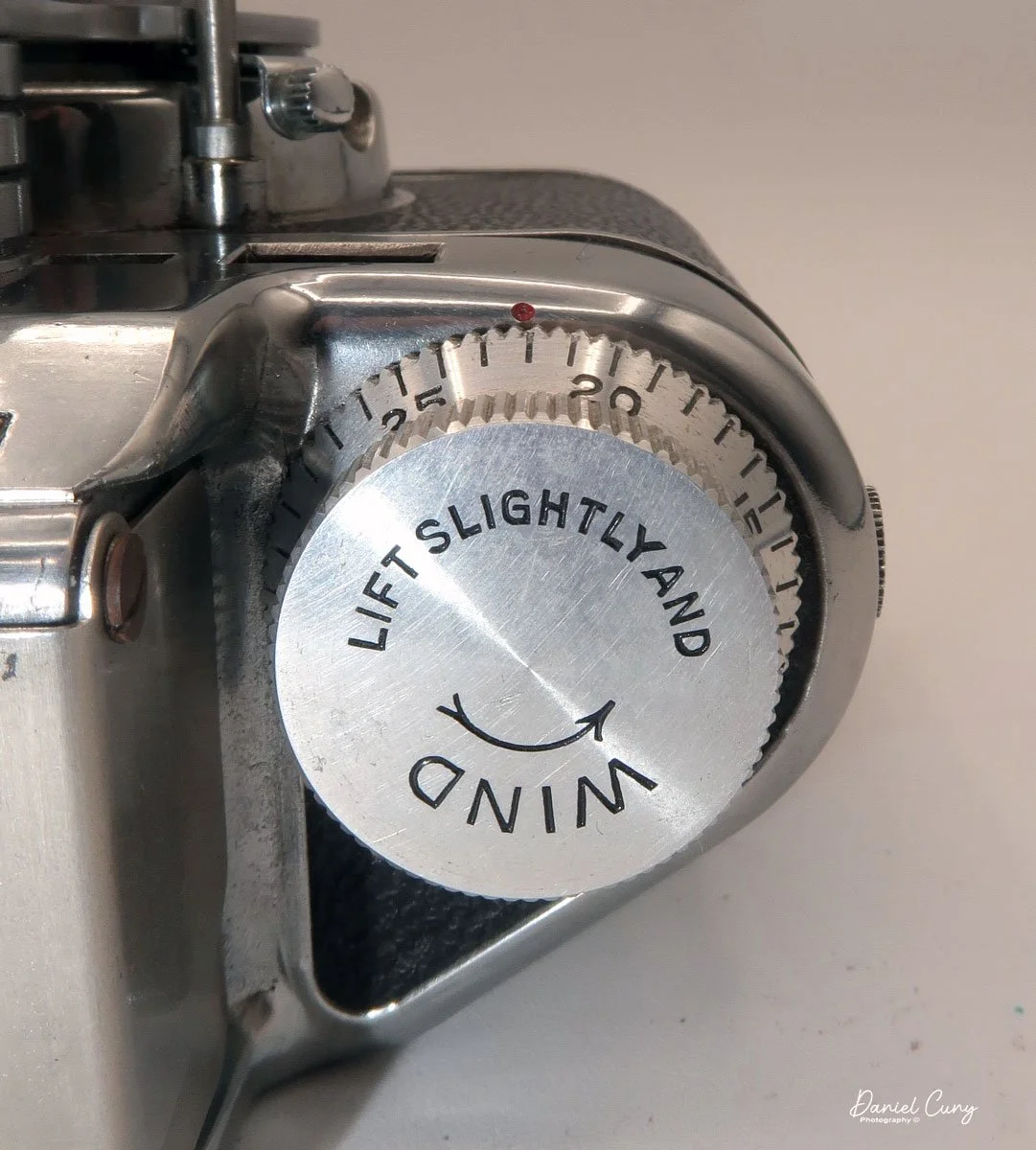
 On the right side of the camera is the large winding key, which you turn clockwise to wind the motor. In the back, in the top corner, is the footage counter, which tells you how many feet of film are still available to use on the roll.

On the left side of the camera is nothing more than the Bolsey logo on a metal label on the top left front of the camera, and on the bottom right back of the camera is a window that allows you to see the recommended exposure settings information imprinted on the special Bolsey 8 film cartridge. To take the side of the camera to load the film, you pull the side off the camera by pulling from the small knob on the top of the camera. The back will come off, and you can insert the film magazine into the camera body. Then, just snap back on the side of the camera for shooting.

 The film used in the Bolsey 8 camera is a single 8mm magazine of 25 feet. The roll of film that was still in my camera was Kodachrome 25, which is a fantastic still film and one used extensively in the late 1950s and early 1960s. I can remember it's a film my dad used in our family movie cameras.

Results:

The camera wasn't used because the film in it is very old and Kodachrome, a type of film for which processing is no longer available, is not available. 


Conclusion:

I can tell you the camera was in good working condition. All the shutter speeds worked, and the lens was clean, so it would have been fun to try it out and see what results you could expect.

 Thank you for taking a few minutes from your day to read about this two-in-one camera. It is an excellent still and movie camera built into one small, dynamic package.

 I'd love to hear from you about this or any other cameras I've written about. Click on the link to read other camera reviews I've done.

 I also have an online store called Cuny's Camera, where I sell old, vintage cameras, lenses, and other knickknacks.

 Until next week, please be safe.

Bolsey Model C-Twin Lens Reflex

My Bolsey C camera

Very early in my camera collecting career, the Bolsey cameras have been a steady companion in my collection. I believe this goes back to when, in my 20s, I'd go to local Flea markets, which were usually held in older Drive-in theatres due to their expensive areas, and find Bolsey cameras. Usually, they were the B2 models and generally in fair to poor condition.

 Every once in a while, I'd find one in working condition, which was a rarity. The thing that drew me to these cameras was the odd shape they have. They are generally smaller than the standard 35mm camera. Still, they have an odd shape where the front of the camera is much broader than the rear. The corners of the cameras are rounded off, giving them a sleek and modern look for their time. I compare them to the shape of automobiles of the time, which generally had rounded curves and were comfortable to use.

 The Bolsey C was a camera that I've always had my eye on to add to my collection for many years. I can remember looking through the Bible of all camera collectors, McKeown's camera guide, and seeing the Model C and the other Model B and Jubilee models, with thoughts that someday I'll have one in my collection. That day was about 4 years ago when I purchased another "lot" of cameras with the Model C within that lot. To my surprise, the camera was almost mint and had a working shutter. Even the fitted case was in excellent condition. The camera appeared almost unused for 70-75 years since the camera was initially introduced in 1950.

History:

Bolsey Camera Company can be traced back to Yakov Bogopolsky, a trailblazing figure in the early 20th-century photographic industry, who played a pivotal role in the evolution of compact cameras. Born in 1895 in Ukraine, Bogopolsky left for Switzerland in 1913-14, where he studied medicine in Geneva. Due to the Russian Revolution and WWI outbreak, he could not return to Russia. While studying medicine, he worked as a portrait photographer to earn money. During his time in Switzerland, he changed his name to Jacques Bolskey. While in Switzerland, his passion for photography grew. He even invented a camera that photographed the beating heart of a dog, which was used in surgery.

 One of Bolskey's earliest successes was the Bolex line of cameras he designed while working for Paillard, a Swiss company. These cameras, primarily for motion pictures, became highly regarded for their precision and durability. While in Switzerland, he also worked as a designer at Swiss watchmaker Pignons S.A., which produced the first Alpa camera.

 After 22 years in Switzerland and being denied citizenship there, he eventually immigrated to the United States in 1939, changing his name to Jacques Bolsey. Bogopolsky's most significant contributions were realized through the Bolsey Camera Company, which he founded in the 1940s in New York. 

Bolsey's hallmark was producing user-friendly, affordable cameras that maintained quality. His most iconic designs were the Bolsey B series of cameras, which debuted in the mid-1940s. These cameras, such as the Bolsey B, B2, and Jubilee, were compact and housed in durable cast aluminum bodies. They featured a coupled rangefinder and a fixed-focus lens, making them accessible to amateur photographers. The Bolsey cameras were marketed as an ideal solution for everyday photography, emphasizing ease of use and portability.

 One of Bolsey's key innovations was incorporating a built-in flash synchronization system, a feature uncommon in consumer-grade cameras at the time. This innovation further solidified the company's reputation for blending functionality with convenience. The cameras became popular in the United States, particularly among families looking to capture moments during the post-war era.

 Despite its early success, the Bolsey Camera Company struggled to compete with emerging Japanese camera manufacturers in the 1950s and 1960s. Companies like Nikon and Canon began producing more advanced and competitively priced cameras, dominating the global market. Bolsey's commitment to simplicity and compact design became less appealing as photographers demanded more advanced features.

 By the mid-1960s, the Bolsey Camera Company ceased operations. While short-lived, Bolsey left a lasting impact on camera design, particularly democratizing photography. The company's cameras remain collectors' items today, valued for their unique blend of aesthetics, engineering, and historical significance. Jacques Bolsey's vision and ingenuity continue to be celebrated in the world of vintage photography.

My Camera:

My Bolsey Model C is two cameras in one. It's a twin-lens 35mm camera that incorporates both a waist-level finder and rangefinder into the same camera body. The camera is 3.75" tall with the chimney down and 4.75" tall in the up position, 4.25" wide by 2.5" deep, and weighs 1 lb 2.6oz. The camera is made from aluminum and has a gleaming finish. The camera has a Wollensak Anastigmat 44mm f3.2 lens in a Wollensak shutter. My Bolsey C also still has the red round Bolsey emblem intact on the viewing chimney. So many Bolsey cameras are missing this, as they are easily lost.

 The camera has a waist-level finder with ground glass at the top for focusing and is parallax corrected to 2', which is also the minimum focusing distance. According to the Instruction manual, the waist-level finder is "exactly as you will shoot it. "The waist-level lens is also the same as the taking lens.

 The camera also has a coupled rangefinder with split image capability built into it. It has the best of both worlds for focusing. Both the waist level and the rangefinder on my camera are bright and accurate. The separate viewfinder is offset on the right side of the camera for framing purposes. Also, on the back of the camera, there are two sockets on the left side made for the flash unit that snaps into them. A flash with a normal PC cord won't work on this camera.

To load the camera, the back is removed from the camera body by switching a lever on the bottom of the camera to the "open" position. The back slides off, exposing the standard 35mm camera film chamber. You slide in a 35mm film cartridge into the open area on the left, bringing the leader over the roller and the drive gear with the sprockets, and slide the leader into the take-up spool. IMPORTANT: wind the camera; you need to pull the winding lever up slightly before the camera will allow the camera to advance to the next frame. If you don't do this step, you'll tear the sprocket holes from the film because the drive gear is locked until you pull the winding lever up before winding. Put the back onto the camera and lock it. At this point, lift the winding lever and advance two times to get it to the first frame. On the back of the camera is a depth-of-field scale.

One other function of the winding lever is cocking the shutter. The Bolsey Model C uses a bar to prevent users from taking double exposures. The shutter release is a lever on the right side of the camera. Behind the shutter release is a bar with a red dot on the end. After you take a photo, the bar with the red dot springs forward, preventing the shutter release from returning to the normal "taking" position. After you take the photo, lift the winding knob, and advance to the next frame, the bar with the red dot is pulled back into the camera, allowing the shutter release to move back to the "taking" position and cocking the shutter. If you try to take a photo with the red dot showing, the shutter doesn't trip, and no exposure is made. Not all Bolsey cameras have the red dot bar to prevent double exposure. I have several other Bolsey cameras (B2 Special in red and a grey B3) that don't incorporate this feature.

The camera only has 5 shutter speeds, 1/200, 1/100, 1/50, 1/25, and 1/10, along with "B" and "T" for timed exposures. The 1/25 and 1/20 are in red, warning of slow speed to use a tripod or some way to keep the camera steady. The control of the shutter speed is a slider bar above the speed indicating which speed will be used. The aperture settings go from f3.2 to f22. These are controlled by a separate sliding bar under the lens with a pointer pointing at the set aperture.

Close up of shutter spped and aperture controls on Bolsey C camera

My results:

Where I live, it's usually overcast and raining, but I had a few hours where the sun almost poked its head out, so I loaded a roll of film into the camera and drove to two different places close to my home to take photos. The first was a local park with a playground, and the second was a home with a massive Christmas display. The display mainly consists of plastic figures on the front of the house. I figured I get a few good photos here. Here are the results of the photo journey.

Conclusion:

I need to admit, I wasn't sure how this camera would perform or if I would like to use this somewhat oddball camera. I have to admit, the camera worked great, and it was really fun to shoot with. I really enjoyed the waist-level finder and thought it was bright and accurate in its ability to focus sharply. I also tried the rangefinder, which performed just as well. On a scale of 1-10, I'd give this an 8, maybe even an 8.5, in its usability, a joy to use, and results.

 You can get good results using either the rangefinder or waist-level finder. It's the best of two worlds built into one camera. If you don't have one, you should add this to your collection. Try to find a good working example to take out and use. I don't think you'll be disappointed.

 Thank you for taking a few minutes to read about this fantastic camera.

 Until next week, please be safe.