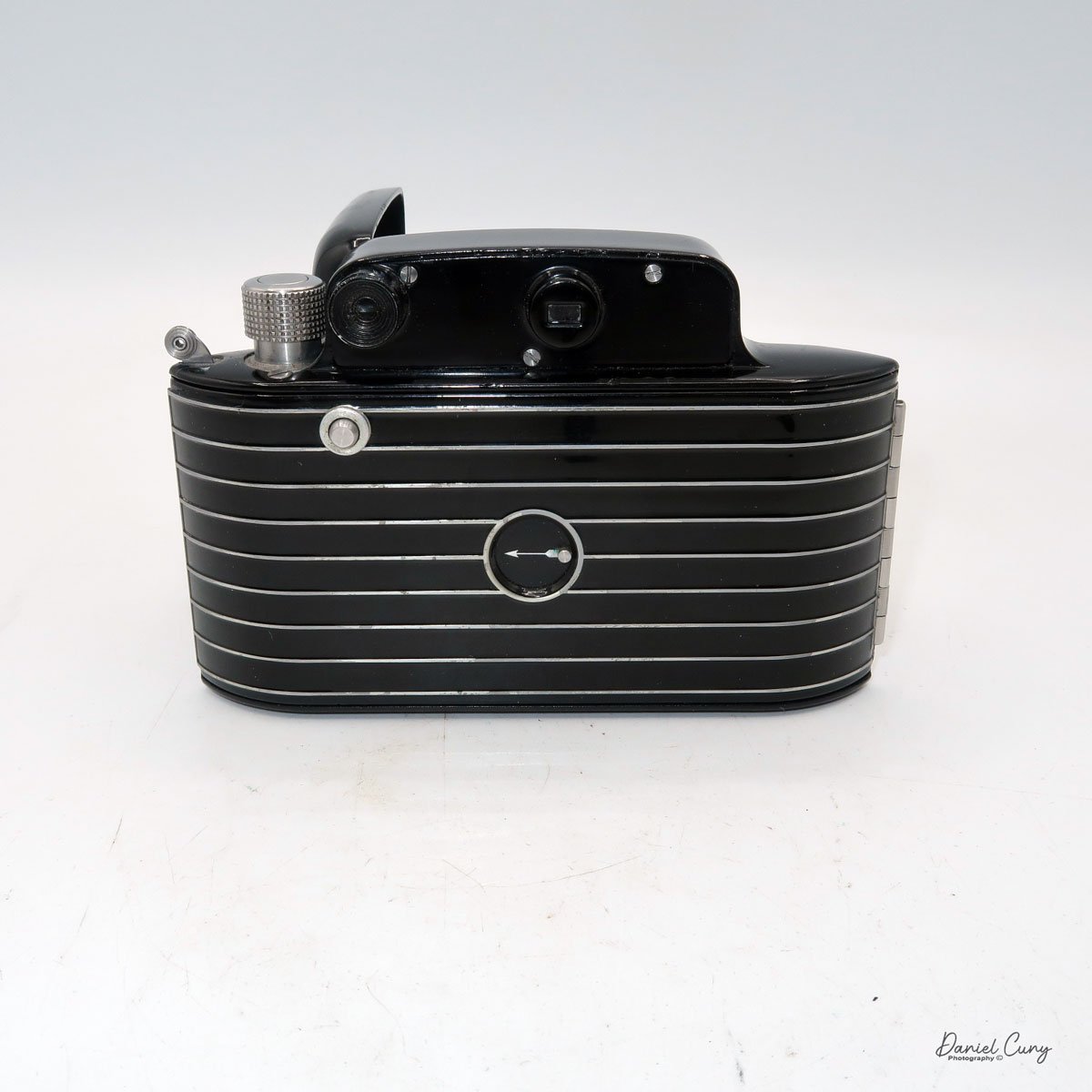
Kodak Bantam Special

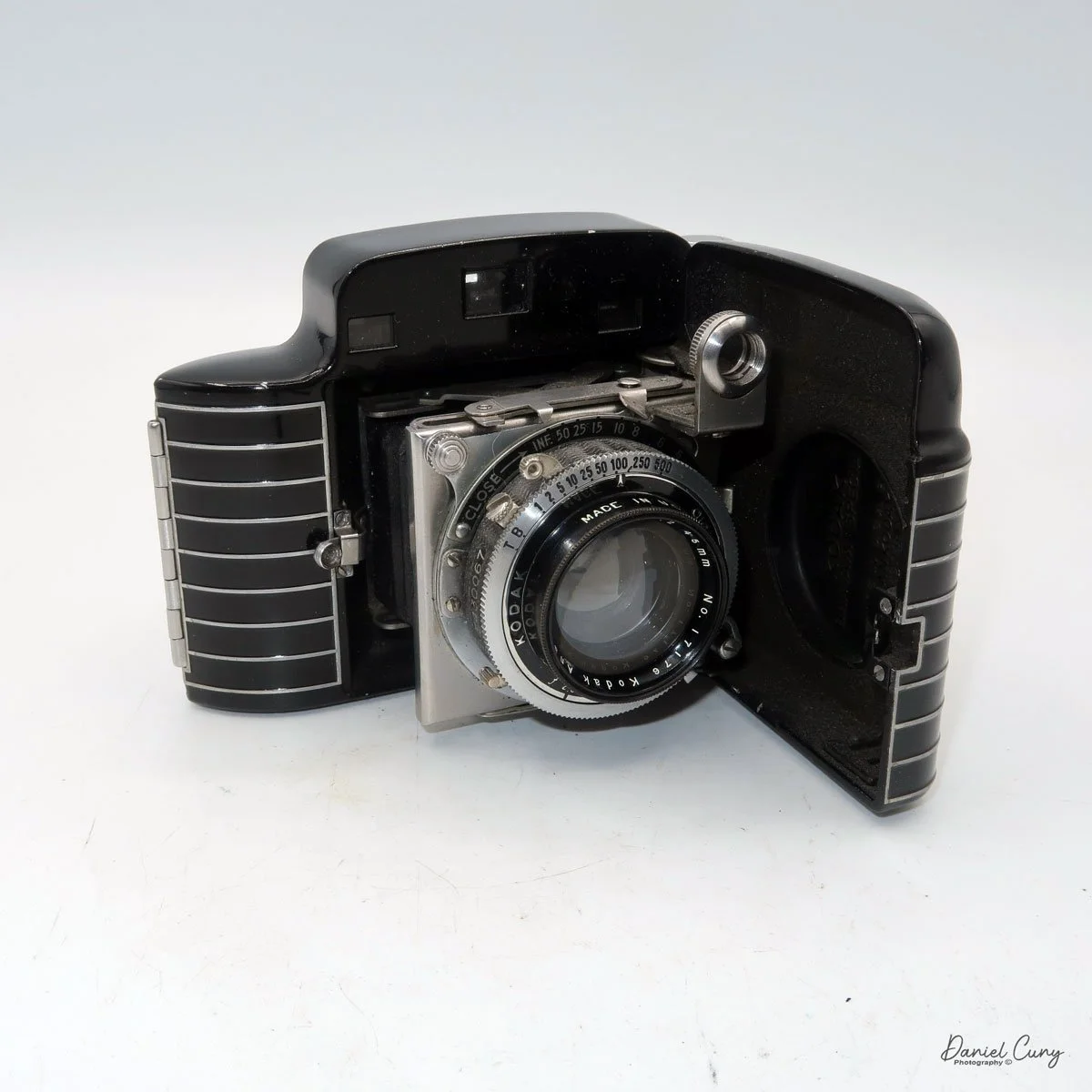
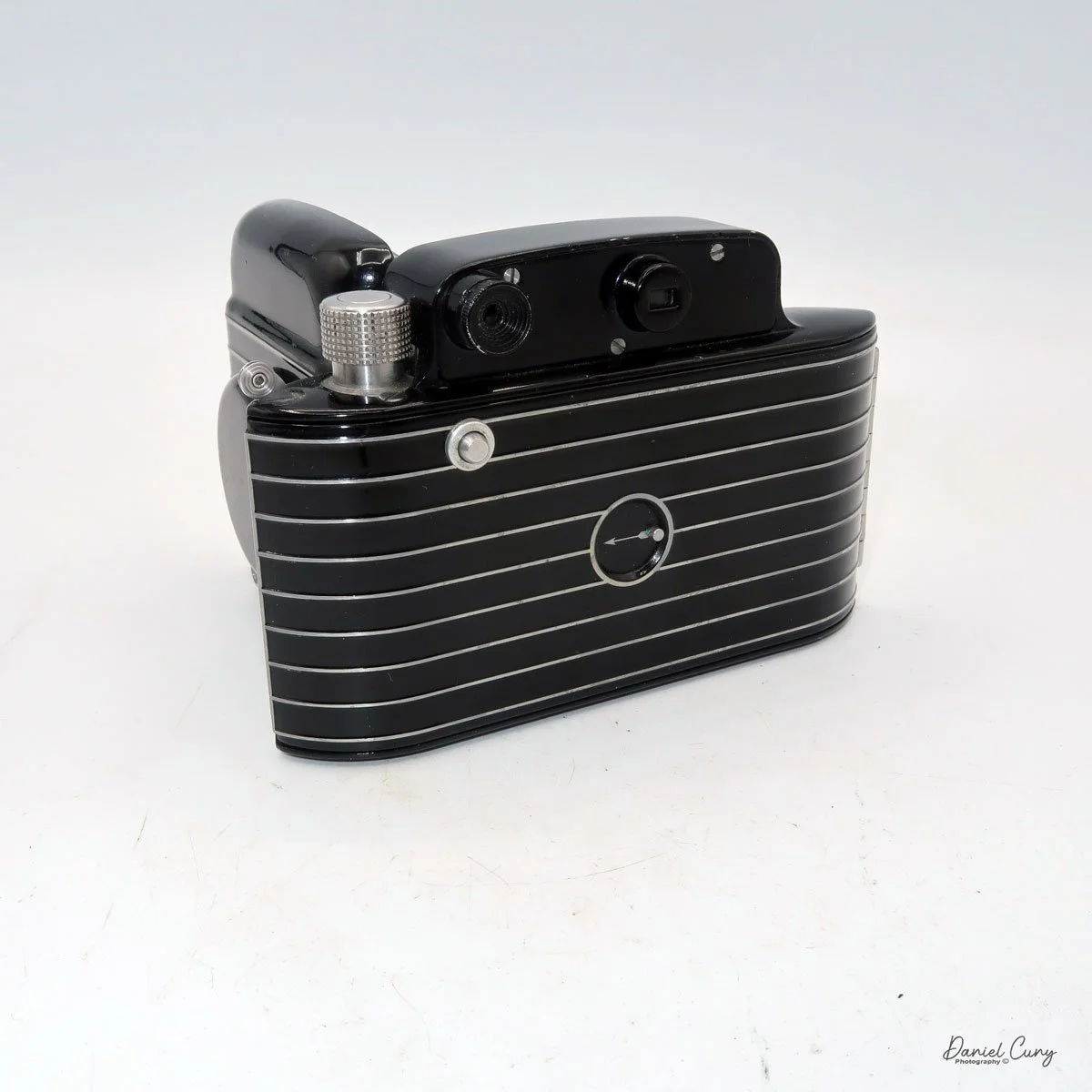
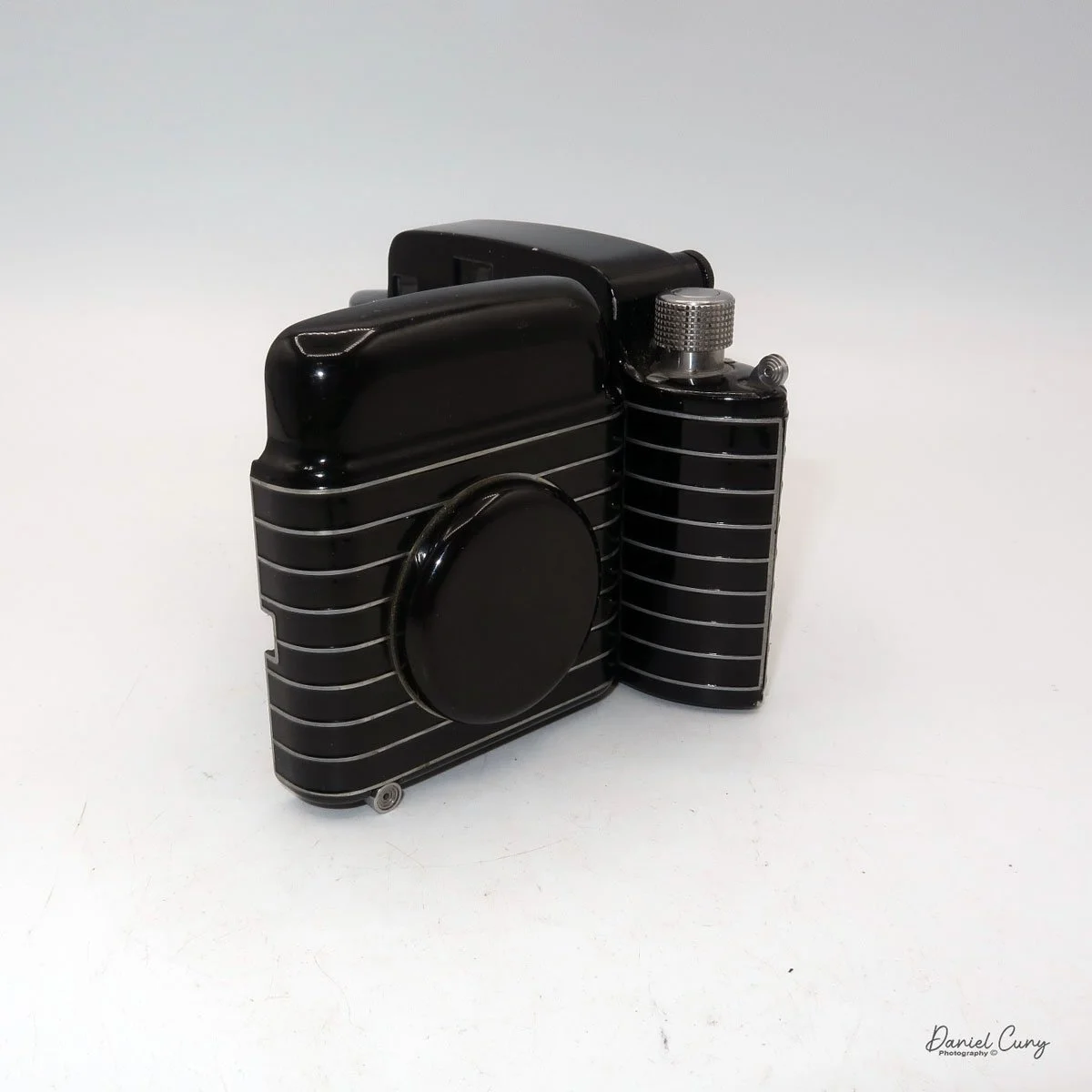
My Kodak Bantam Special camera.

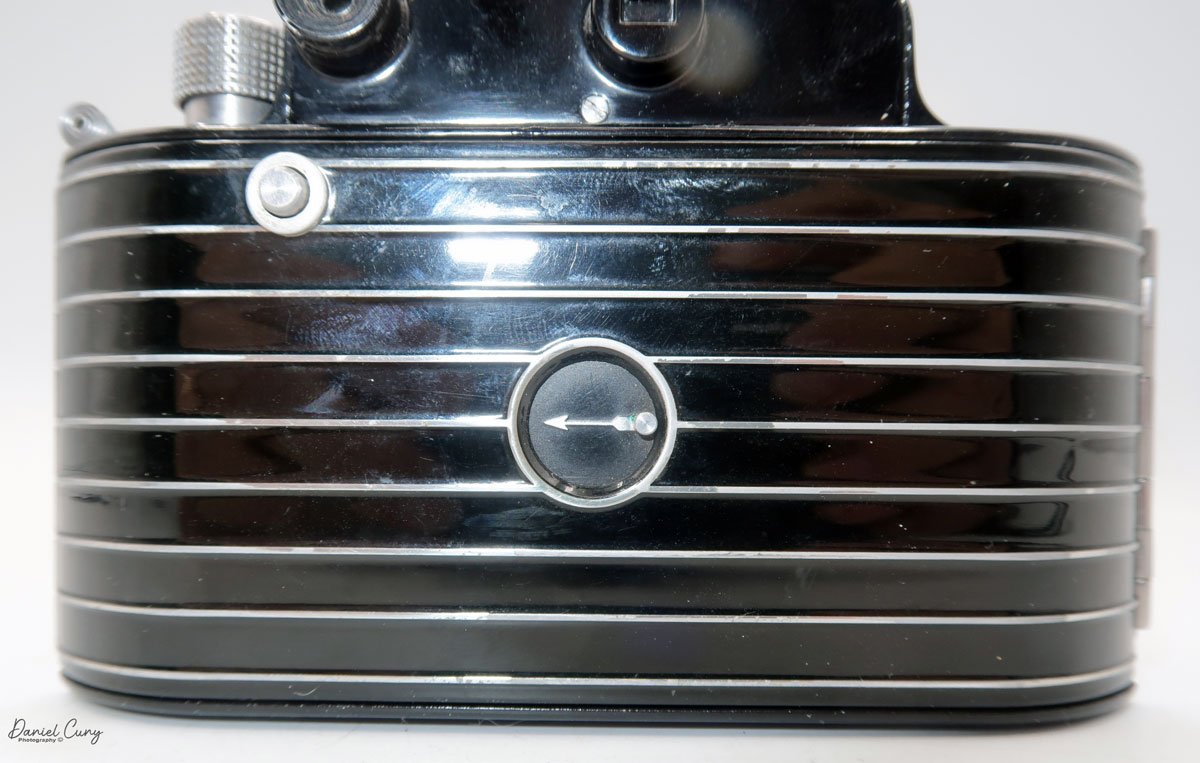
There are a few cameras that, just due to their sheer design, stand out in any person's collection. Cameras like the Kodak Super Six-20, Polaroid SX-70, Welta Reflekta, and the Kodak Brownie Beau all have a very striking design, whether on the faceplate or the camera's overall design. In my opinion, the one camera that is the most striking and beautifully made is the subject of this week's camera collecting blog, the Kodak Bantam Special.

 The Kodak Bantam Special is a camera made between 1936 and 1948, during the heyday of camera innovation and manufacturing not only in the United States but worldwide. If you think about the cameras produced in this era, there were the Zeiss Ikon Contax I, II, and III. Leica had the IIIC, Ihagee had the Kine Exakta, Kodak produced the Retina, Medalist, Rolleiflex continued to improve their models, and companies like Argus, Voigtlander, Agfa, and in Japan, Canon produced the Hansa in 1936.
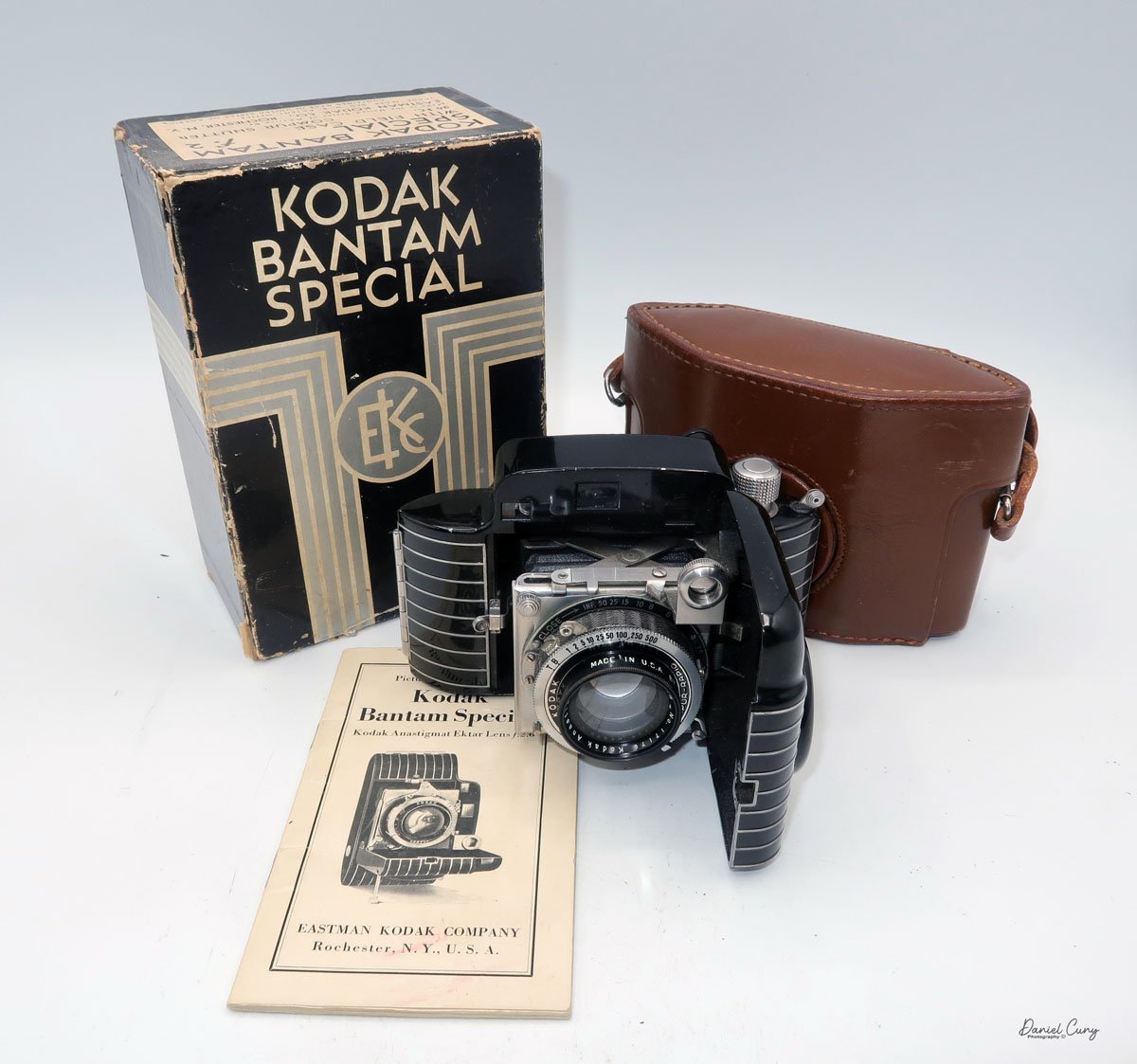
Kodak bantam Special with case, manual and original box.

 I've had my Kodak Bantam Special for 20 years or longer at this point, and one of the things I like about my Bantam Special is it's a very clean camera, with a working shutter, very bright viewfinder, a very nice case, the original box and instruction manual(s) too. When I opened the box to retrieve the case, I found two manuals inside. Something I have forgotten about.

 I've owned several different Kodak Bantam cameras, which are relatively common and easy to find, but the Bantam Special truly is a "special" camera. I've owned a couple before the one I have now, but they were in relatively poor condition, with either chips in the paint or a shutter that wasn't working. But when I found this camera online, not only was the price reasonable, but it was complete. The only thing it didn't have was the camera's hang tag, which is extremely difficult to find.

 As I was looking over the cameras above my desk, thinking about the camera I wanted to write about this week, my eyes skimmed over the Bantam Special, thinking I must have written about it in the past. Still, when I looked at my camera reviews, it was one I'd overlooked. 

 The reason it's been looked over was the lack of 828 film I have in my refrigerator, which I use to review cameras. I have many of the other film formats,  35mm, 120, 620, 116, and 127, but no 828. So, a couple of weeks ago, I went to the local vintage camera store in town, which carries several of the film sizes I shoot with, and bought a couple of rolls.

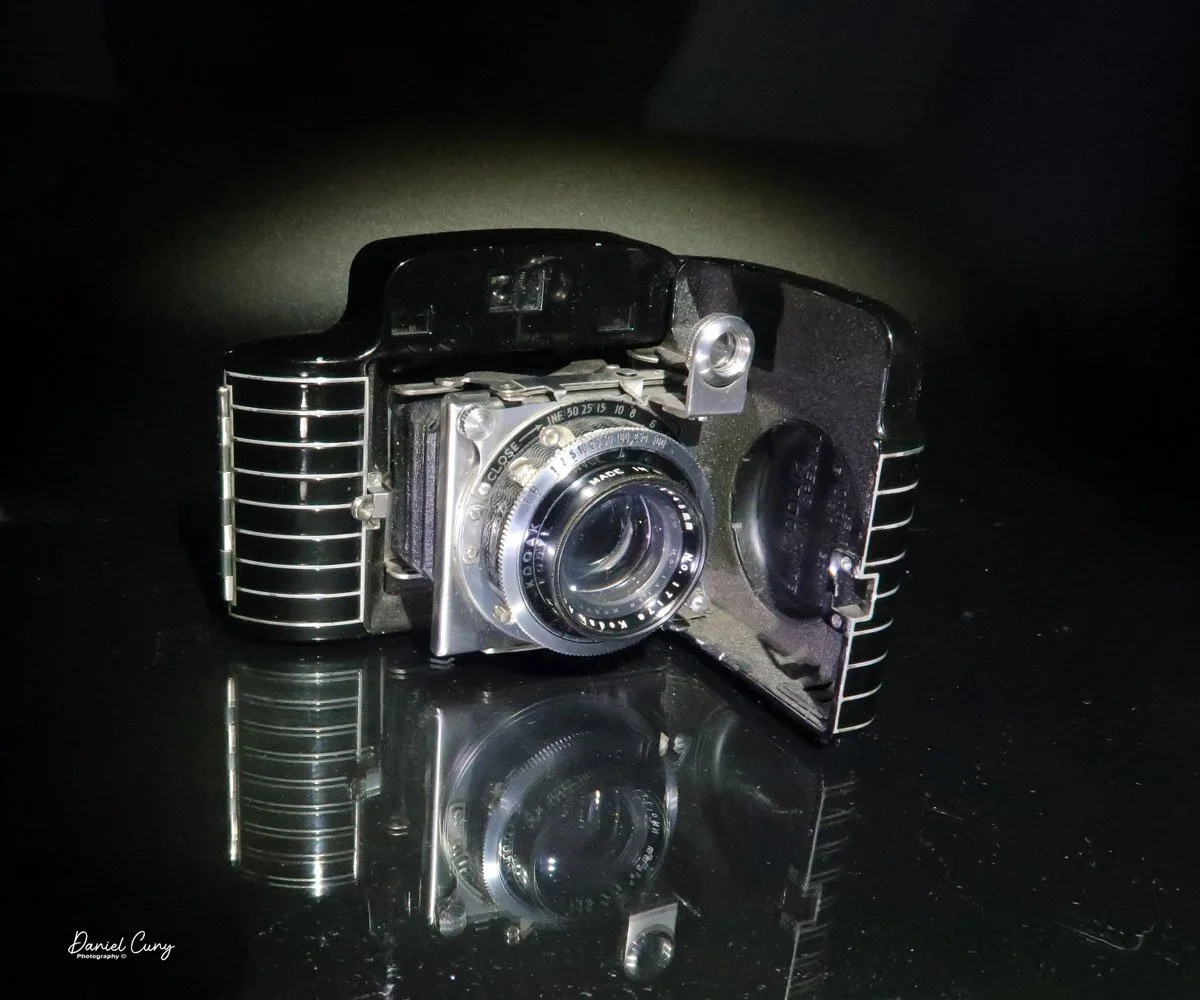
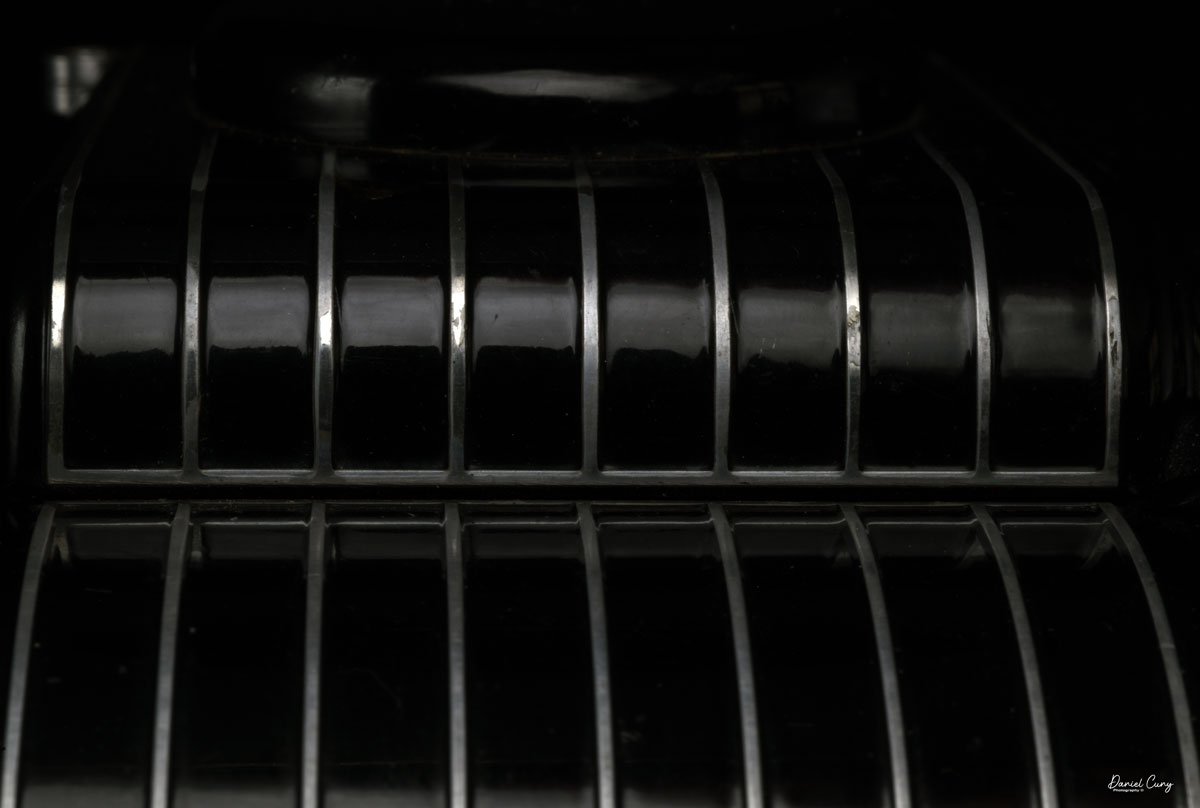
An artistic view of Kodak Bantam Special camera

 For the history section, I've already written about the history of George Eastman, Eastman Kodak, and Walter Dorwin Teague, my favorite camera designer, so I thought I'd talk a bit about the not-too-popular film size that went away almost 40 years ago, 828 film.

History:

 828 film is a niche but significant chapter in the evolution of roll-film photography. Introduced by Eastman Kodak in 1935, 828 was designed as an alternative to 35mm film for compact consumer cameras. Kodak developed it alongside the launch of the original Kodak Bantam, a stylish, pocket-sized camera meant to bring high-quality photography to a broader audience. The goal was to offer the image quality of 35mm negatives without the mechanical complexity and cost associated with perforated 35mm film cassettes.
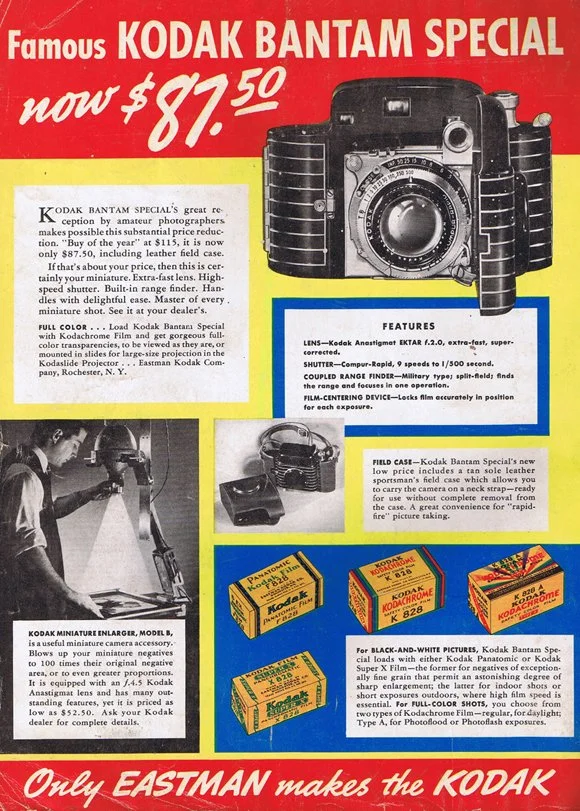
Kodak Bantam Special ad with 828 film

 Physically, 828 film is 35mm wide, identical to standard 35mm film in width, but it is paper-backed like 120 film. Instead of the multiple perforations found in 35mm stock, 828 features a single registration hole per frame, which helped position each exposure. This simplified both camera design and film advancement mechanisms. The standard frame size—28×40 mm—is actually slightly larger than the 24×36 mm frame on typical 35mm film, giving it a modest image-quality advantage despite its amateur-market positioning.

 Throughout the late 1930s and 1940s, Kodak produced a variety of Bantam models that used 828 film, including several Art Deco designs, such as the Bantam Special, known for its high-quality lenses and elegant styling. Other camera manufacturers occasionally experimented with the format as well, but 828 remained overwhelmingly associated with Kodak.

 The format reached its peak popularity in the 1940s and early 1950s, especially in the United States. However, its momentum began to fade as 35mm film gained dominance, propelled by the rise of precision German and later Japanese cameras, reusable metal cassettes, and the convenience of automated processing. By the 1960s, 828 had become a minor format, kept alive mainly by Kodak's continued film production and the long lifespan of Bantam cameras already in circulation.

 Kodak manufactured 828 film until the mid-1980s, after which demand dwindled, and the film was discontinued. Today, 828 is considered an obsolete format, though it retains a small following among camera collectors and experimental photographers. Enthusiasts occasionally reload old 828 spools with cut-down 35mm film, keeping the distinctive format alive in a niche, hands-on way.

My Camera:

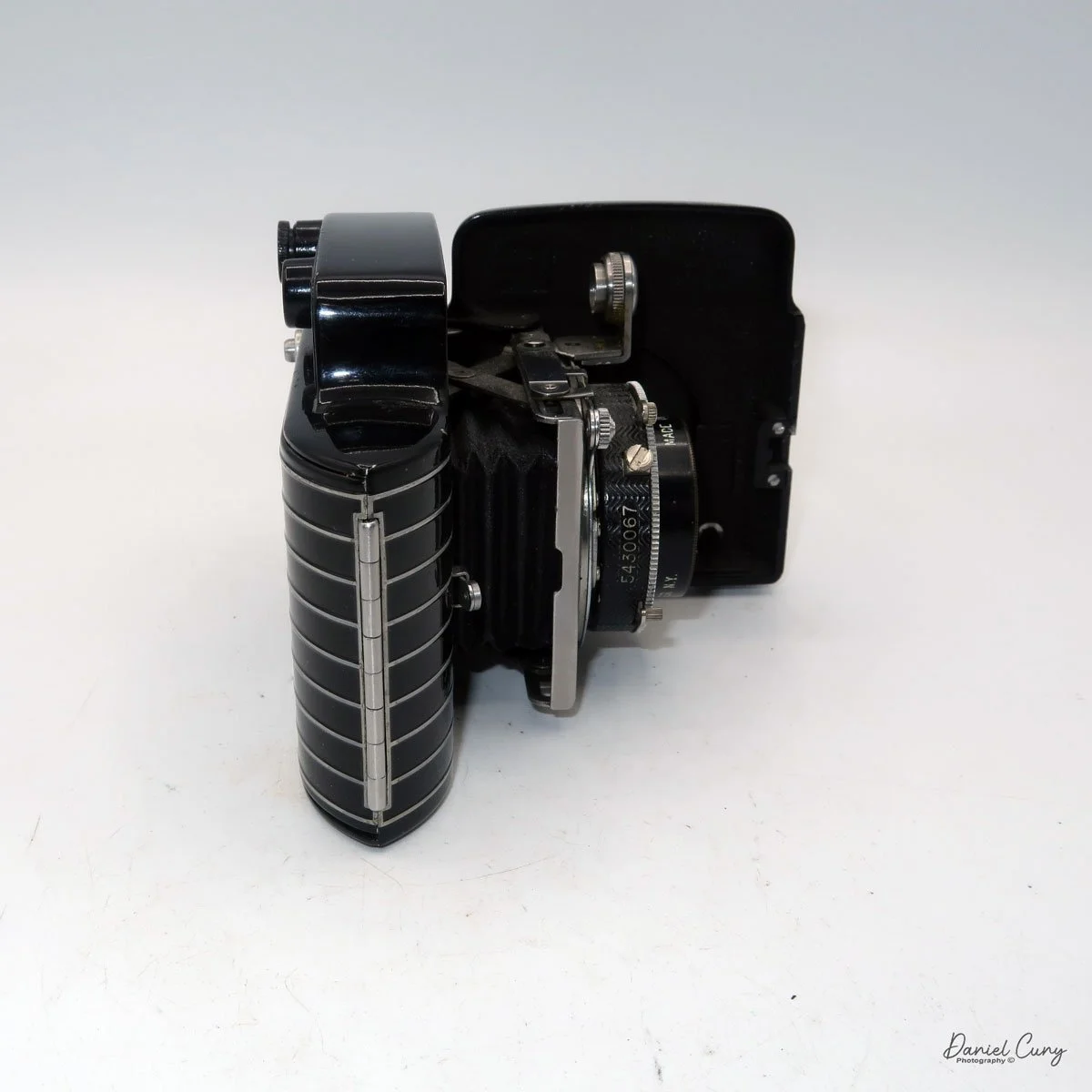
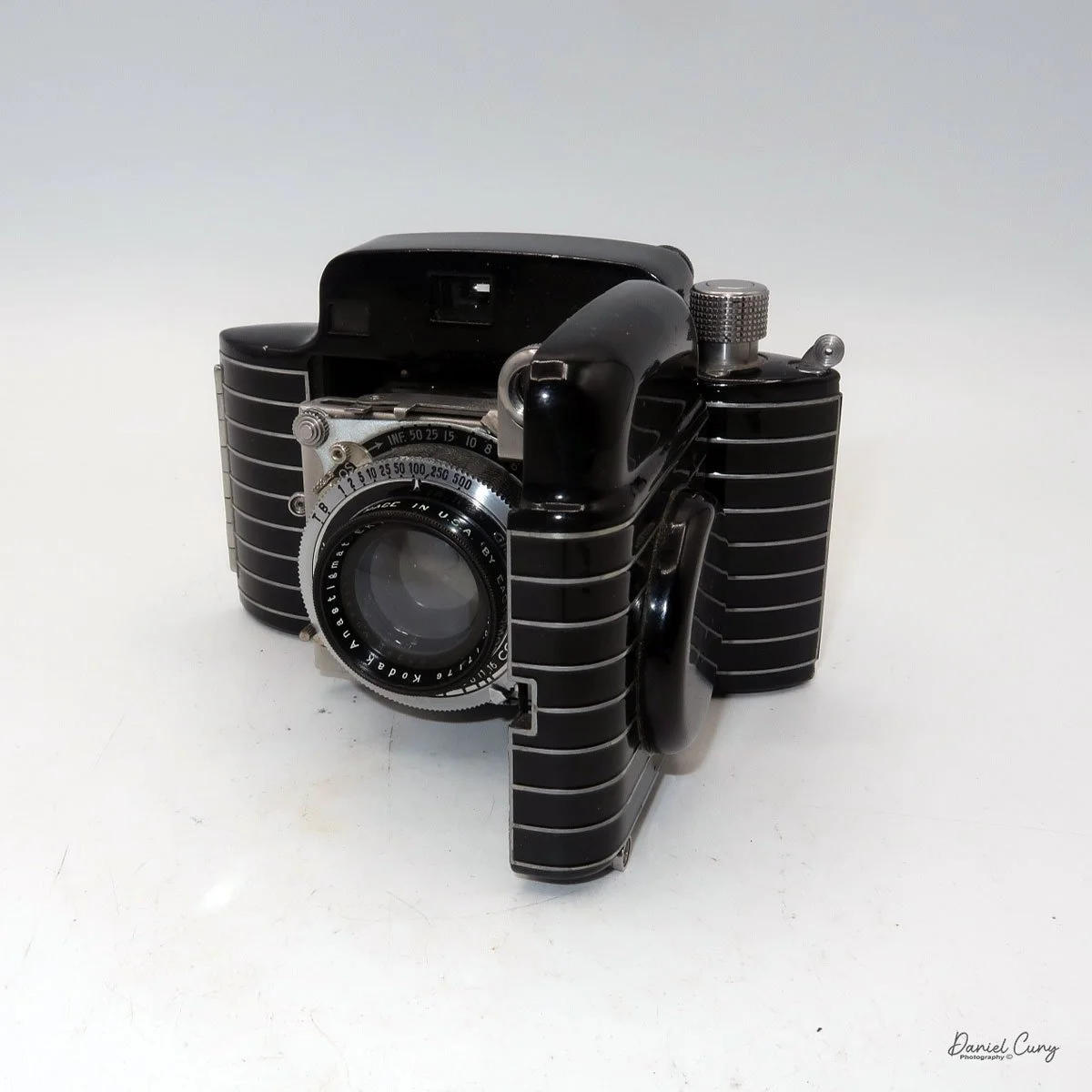
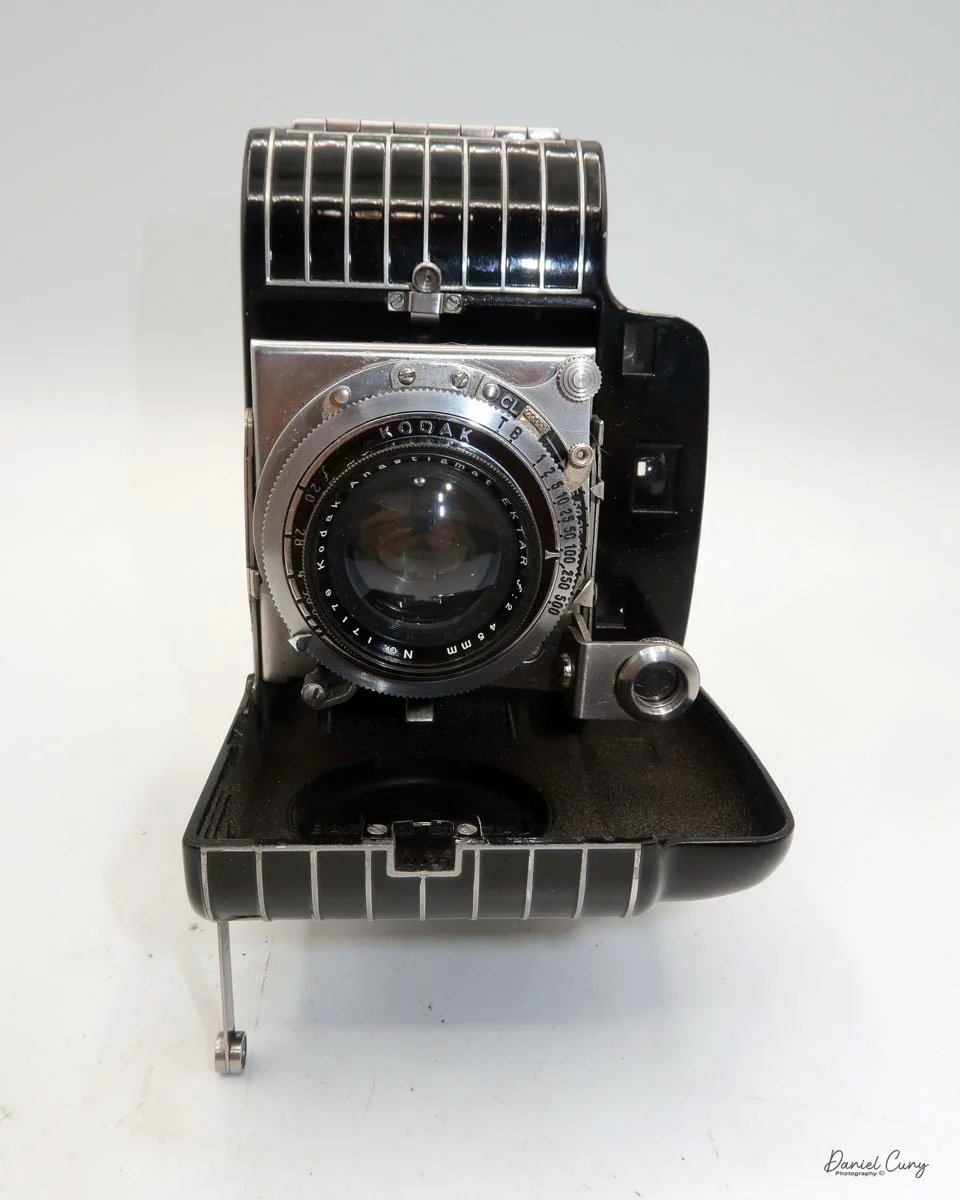
 My Kodak Bantam Special camera is 5" wide by 3" tall by 2" deep with the lens closed, and 4" deep when the lens is extended. It weighs 1 pound, 0.5 ounces with a roll of film loaded. The camera is very sleek and stylish, with a Kodak Anastigmat Ektar 45mm f/2.0 lens and a Compur Rapid shutter. The camera was distributed between 1936 and 1940 with the Compur Rapid shutter made in Germany; after the war, Kodak distributed the camera with a Supermatic shutter between 1941 and 1948. 
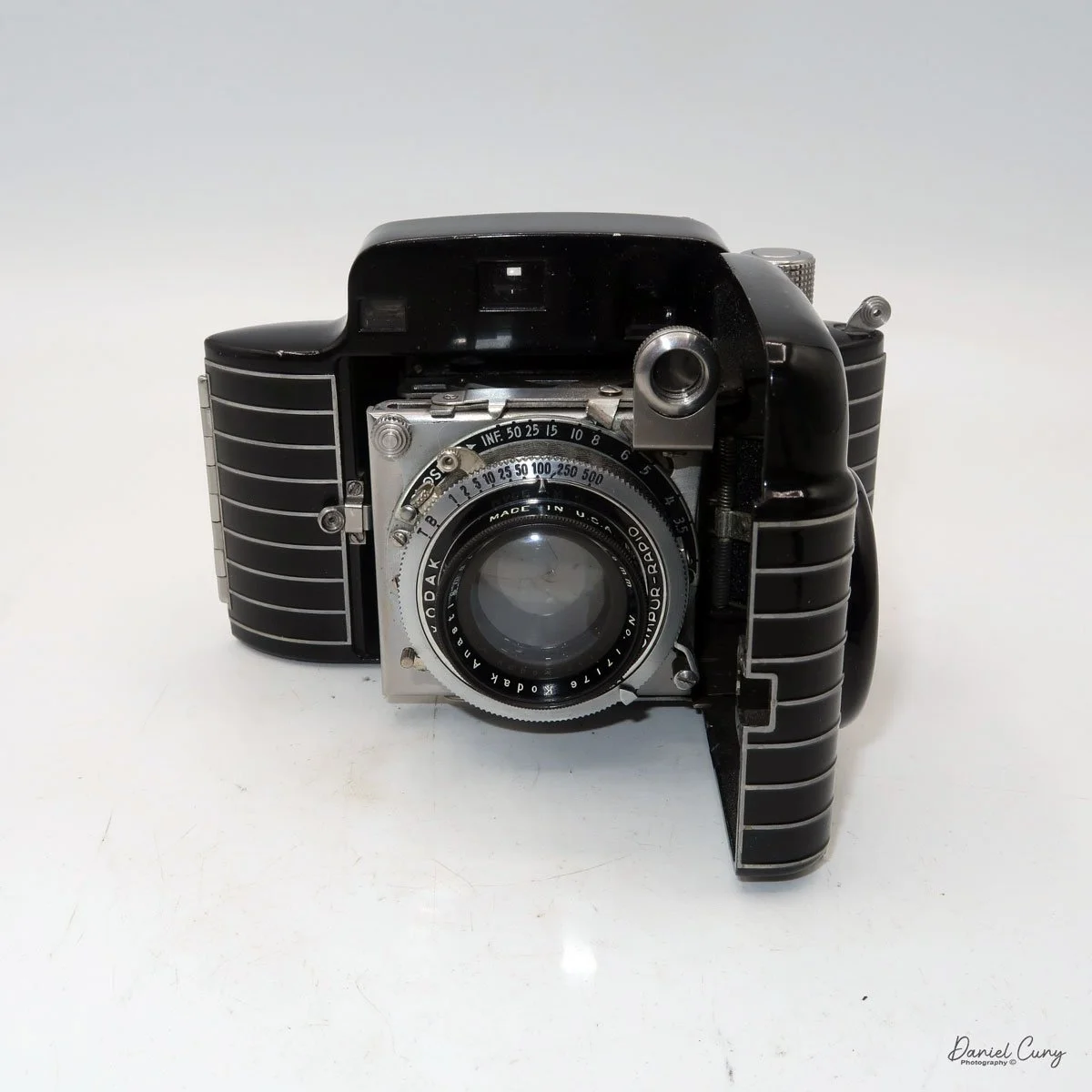
To open the camera to take a photo, press the button on the right side, right in the middle, adjacent to the lens door. The door swings open to the left as you hold the camera, which is the opposite of how the popular Kodak Retina line of cameras opens to take a photo. 

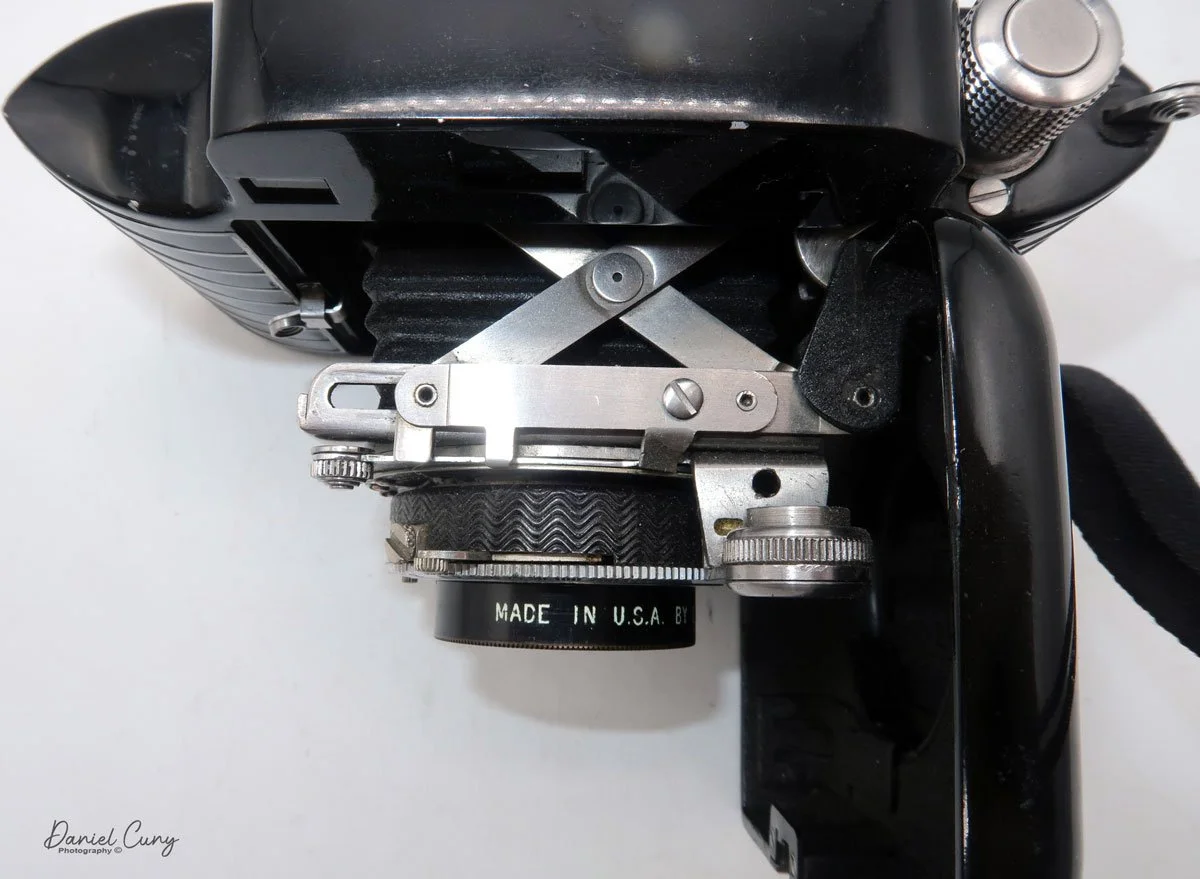
 Similar to the Kodak Retina, the Bantam Special's lens is on a lens board, which is attached to a short black bellows that extends as the lens extends, with a scissor-style truss connecting the lens board to the camera body.

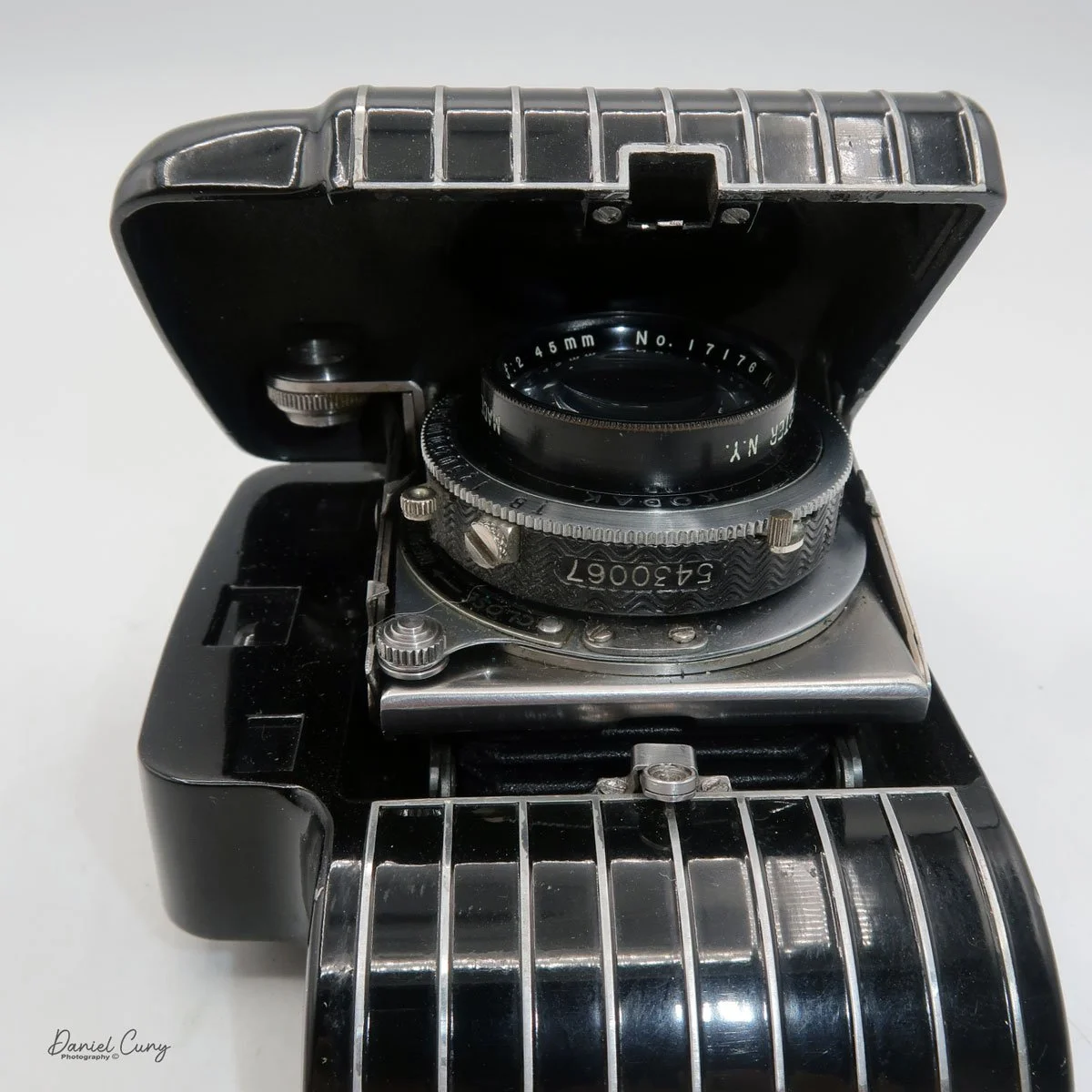
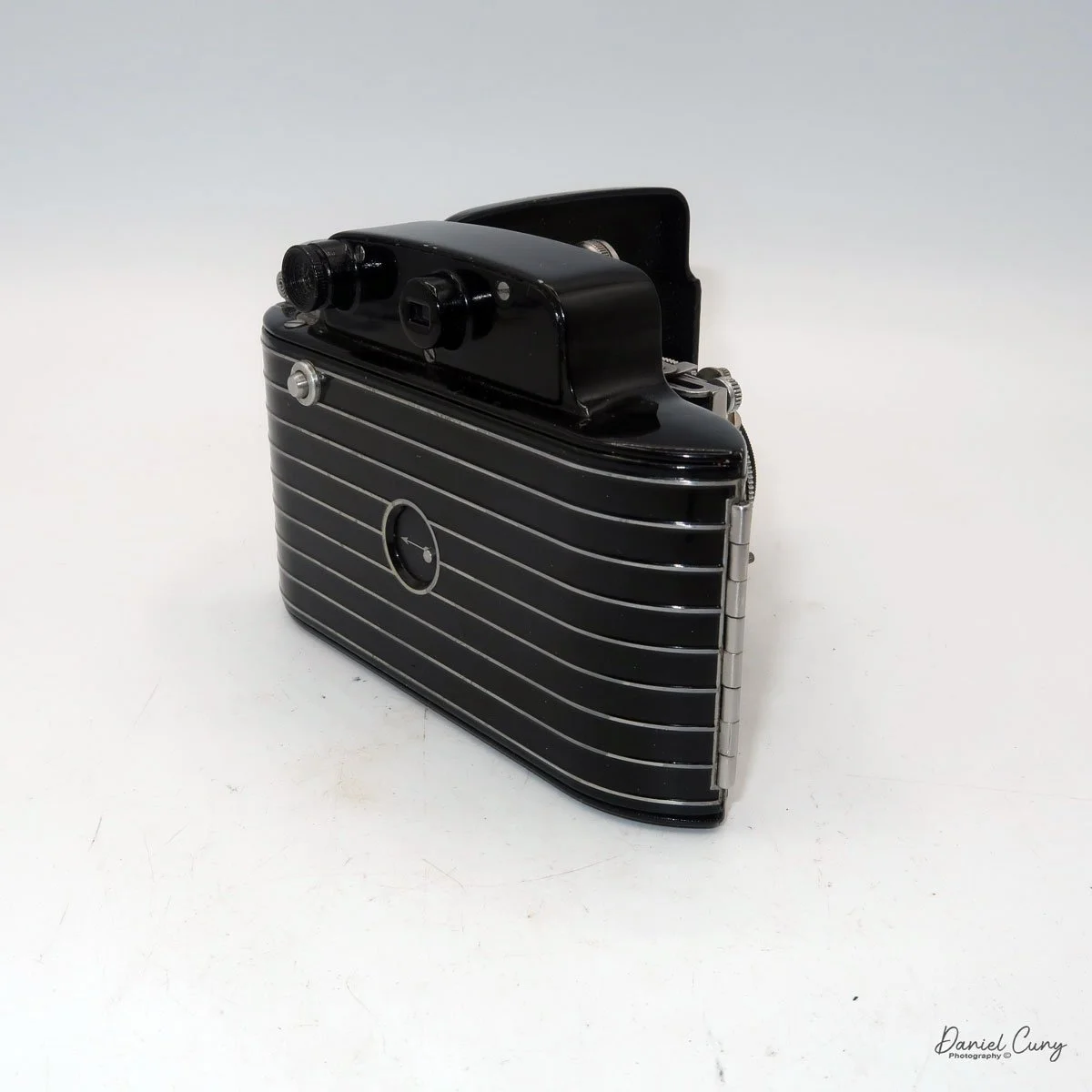
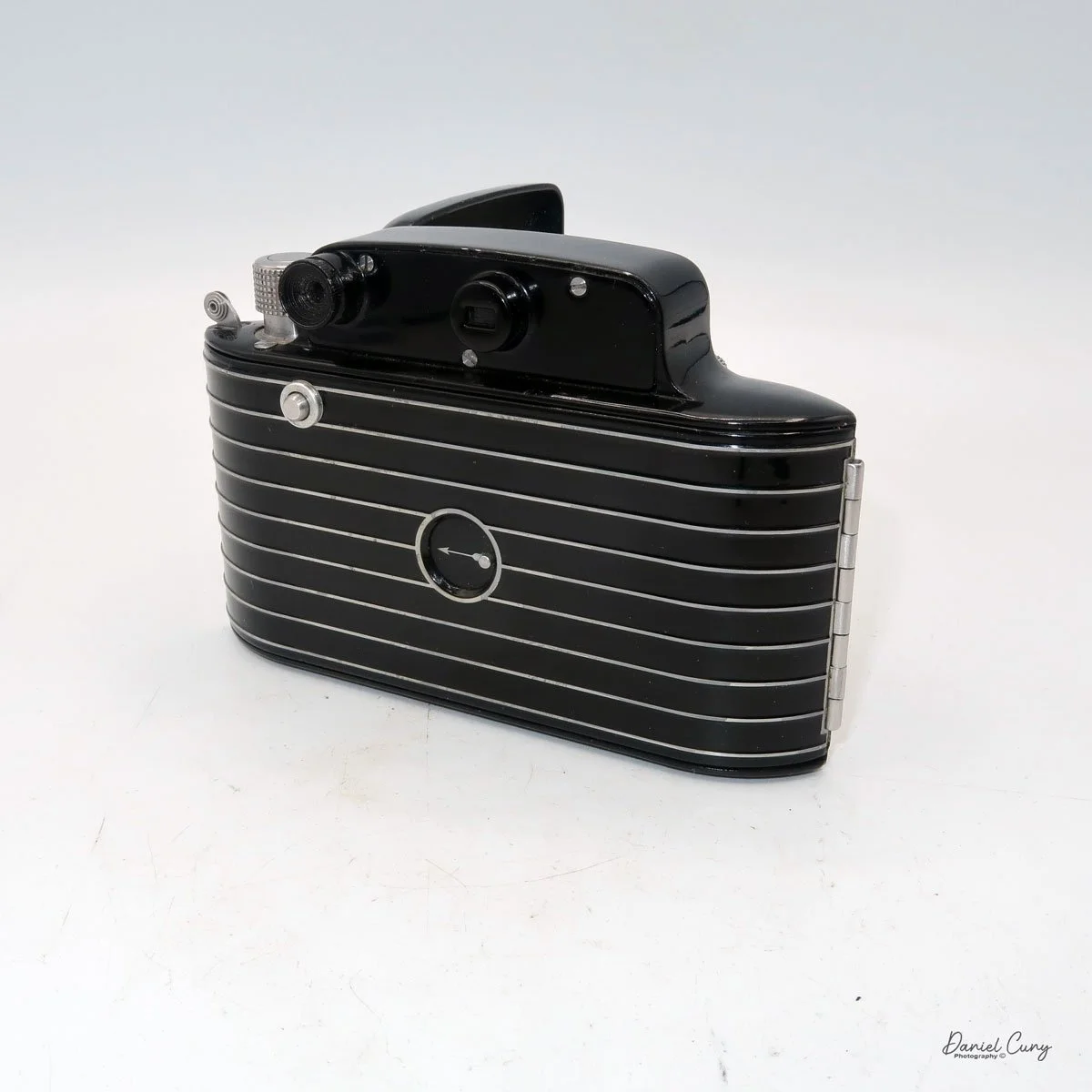
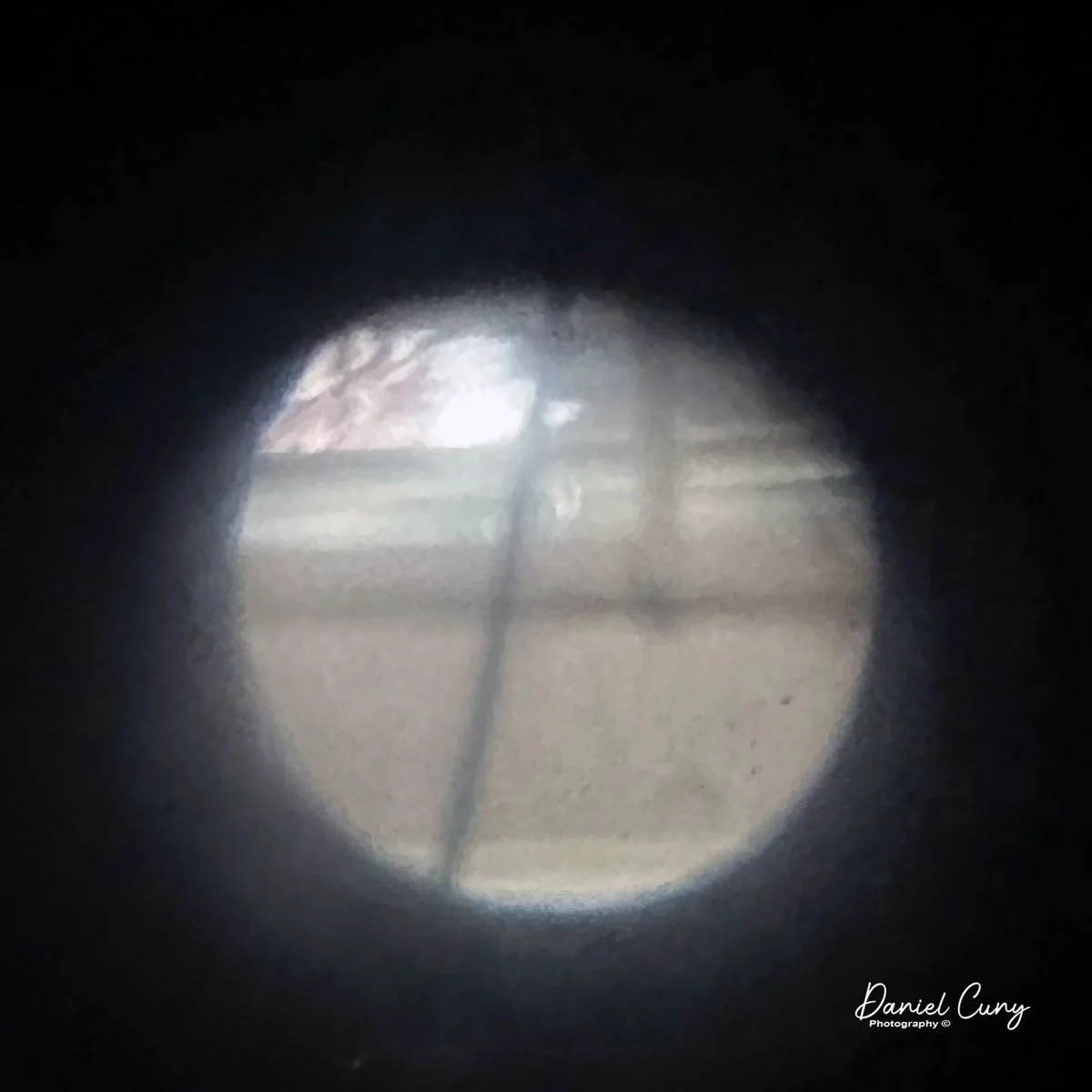
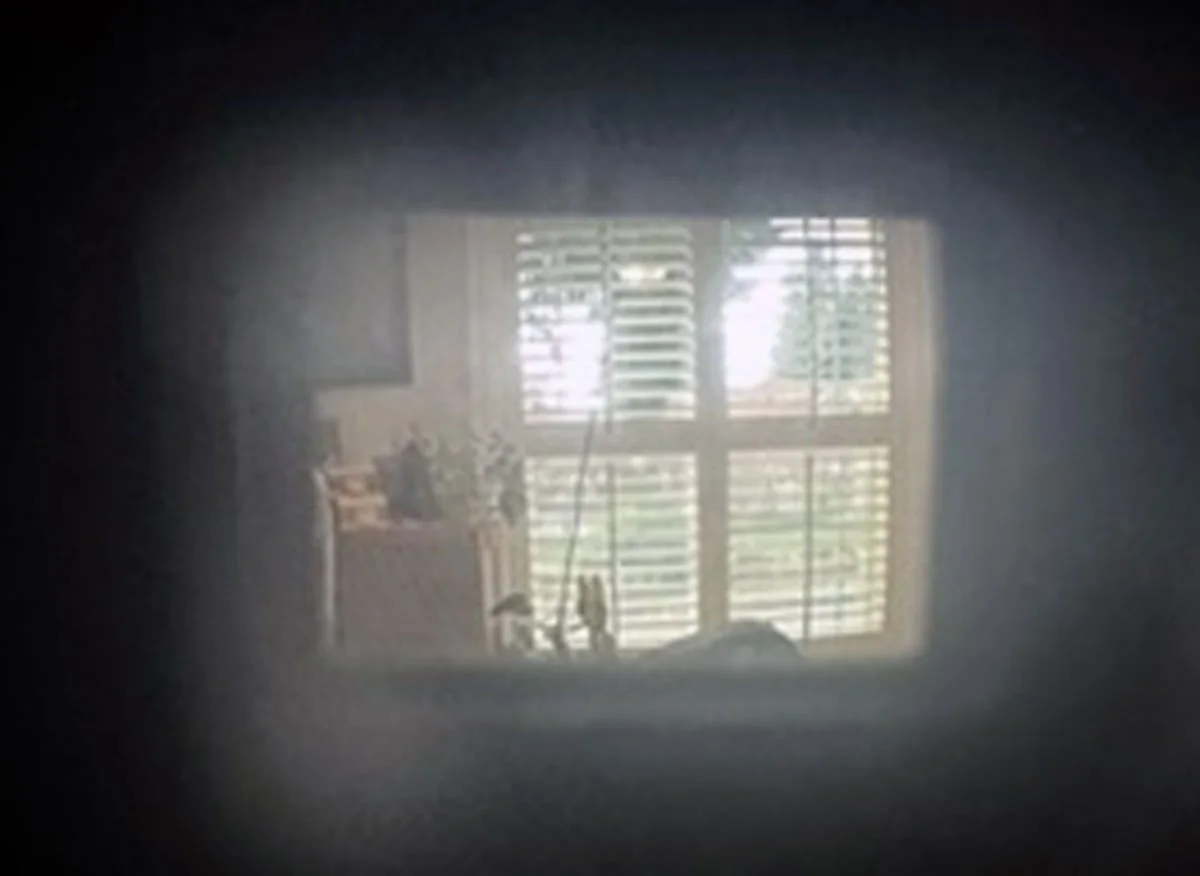
To focus the lens, the camera incorporates a "military style" rangefinder system. The focus adjustment is in the upper-right corner of the lens board when you hold the camera. Sliding the lever down focuses the lens. The rangefinder is viewed through the left-hand window on the back and provides a magnified view of the subject you're focusing on. The rangefinder in my camera is very bright and easy to focus with. Just slide the focus lever until a vertical line becomes a single, straight line, which indicates the camera is focused. The viewfinder is the window on the right-hand side that allows the photographer to frame their subject. 
The focus ring is also used to close the lens back into the camera body. Slide the ring up past the infinity marker in the direction of the "close" arrow. The lens's door will unlock, allowing you to retract the lens back into the camera and shut the front door for transportation.

 The shutter speeds and aperture settings are done on two separate settings on the Compur Rapid shutter. The shutter speed range is from 1/500 to 1 sec, along with "B" and "T" settings. The Aperture range is from f/2.0 to f/16 and is set via a sliding lever on the bottom of the shutter.
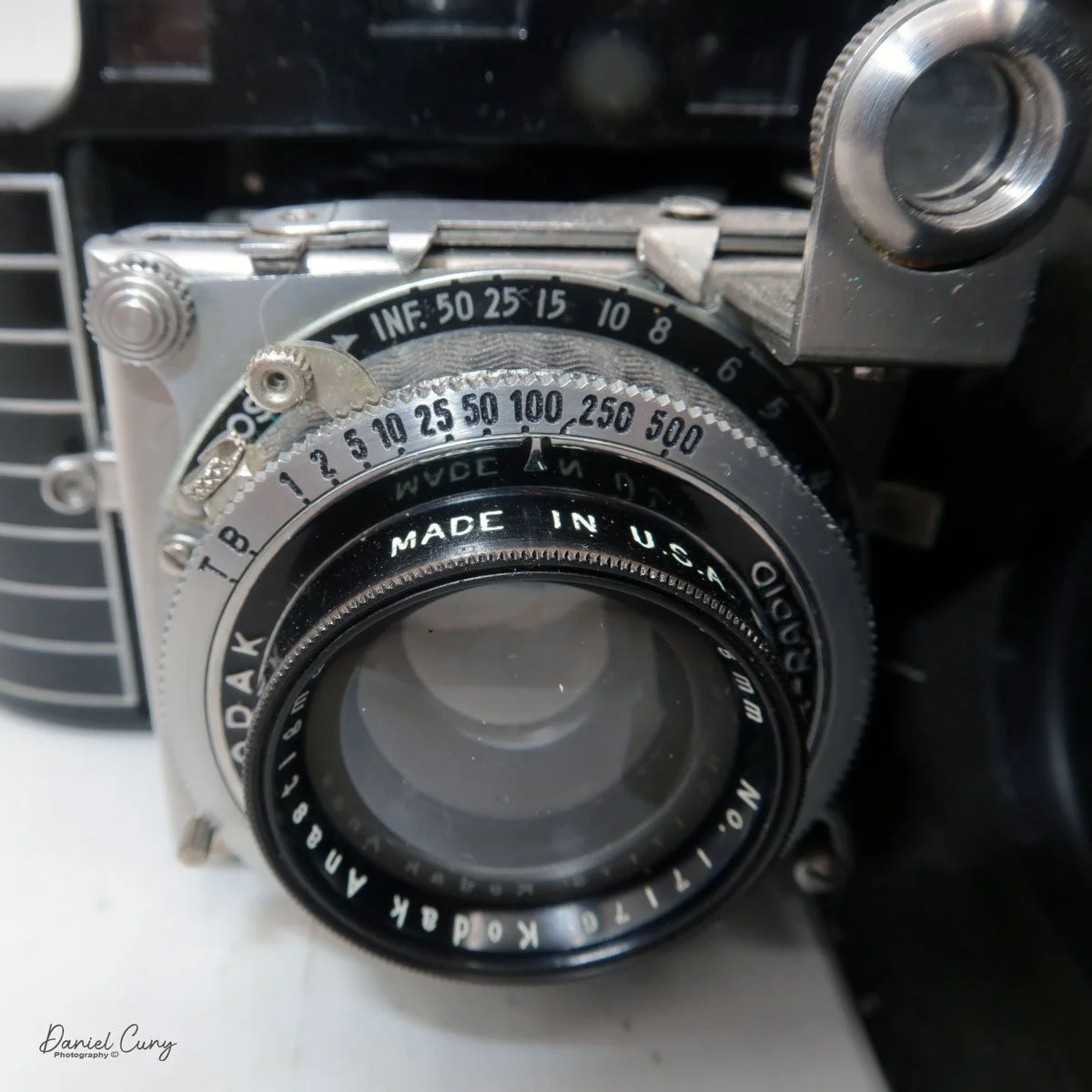
The shutter's cocking lever is on top of the shutter system, and the shutter release button is in the lower right of the camera's shutter. The placement and size of the shutter release were the most challenging aspects of using the Kodak Bantam Special camera. I'd get the camera focused, set the exposure, set the shutter speed and aperture, frame, cock the shutter, and I kept missing the shutter release. It's relatively small, and while not hidden, it's not in a very convenient place. If there were a shutter release on the top of the camera similar to the Retina's, that would make the camera much easier to use.
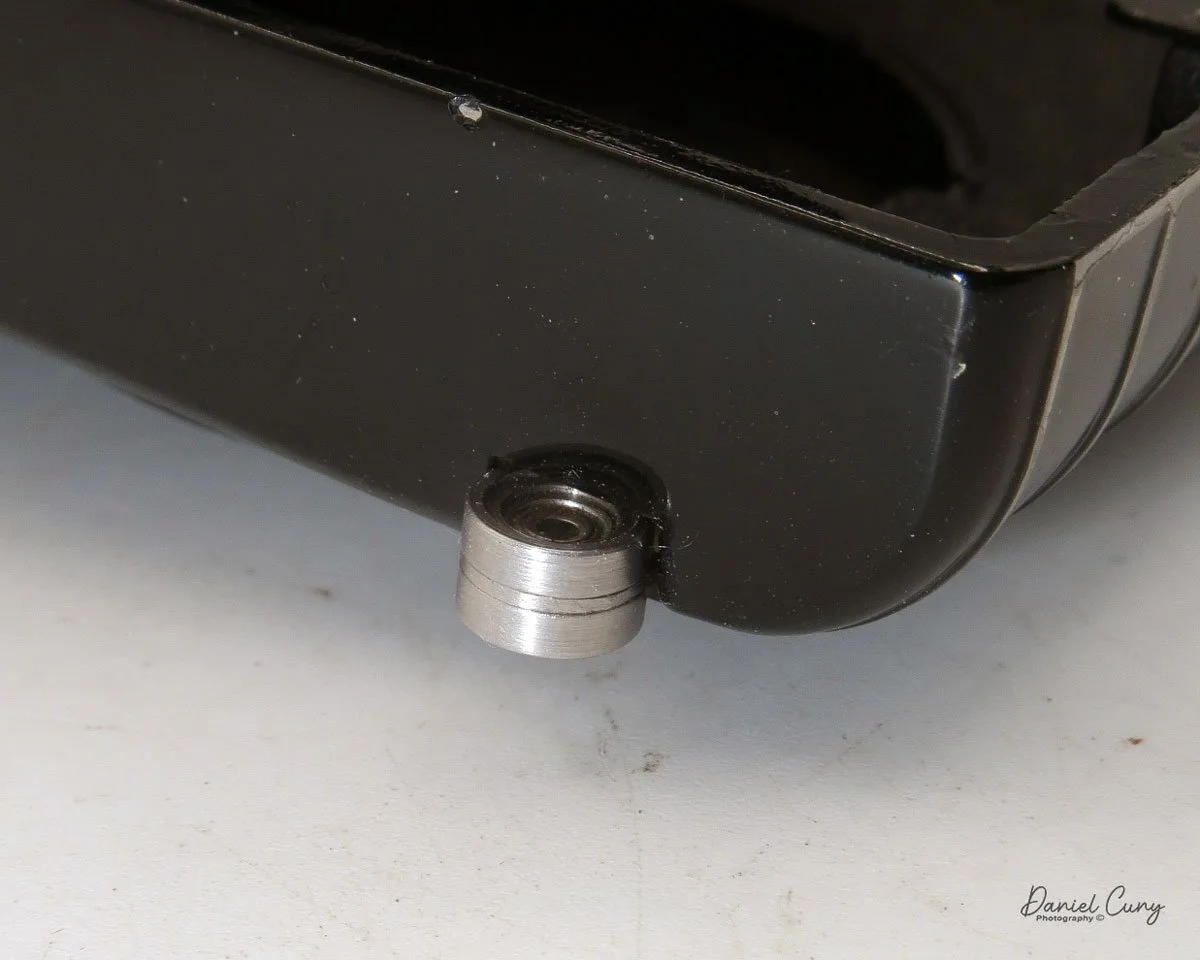
To open the back to load the film, on the top left of the camera, as you're holding it, is a protruding clip you pull up to release the lock for the back door. Once open, the camera is like many roll film cameras, with the empty spool going under the winding lever and the new roll of film on the right side of the camera body. Pull the film's leader out, and across the shutter area, and slide the tab into the slot of the empty film spool. Wind the leader until you see the "start" sign on the film's paper backing and close the film door. Open the camera's green window on the back door to see the frame numbers appear, indicating when to stop and take your next photo.

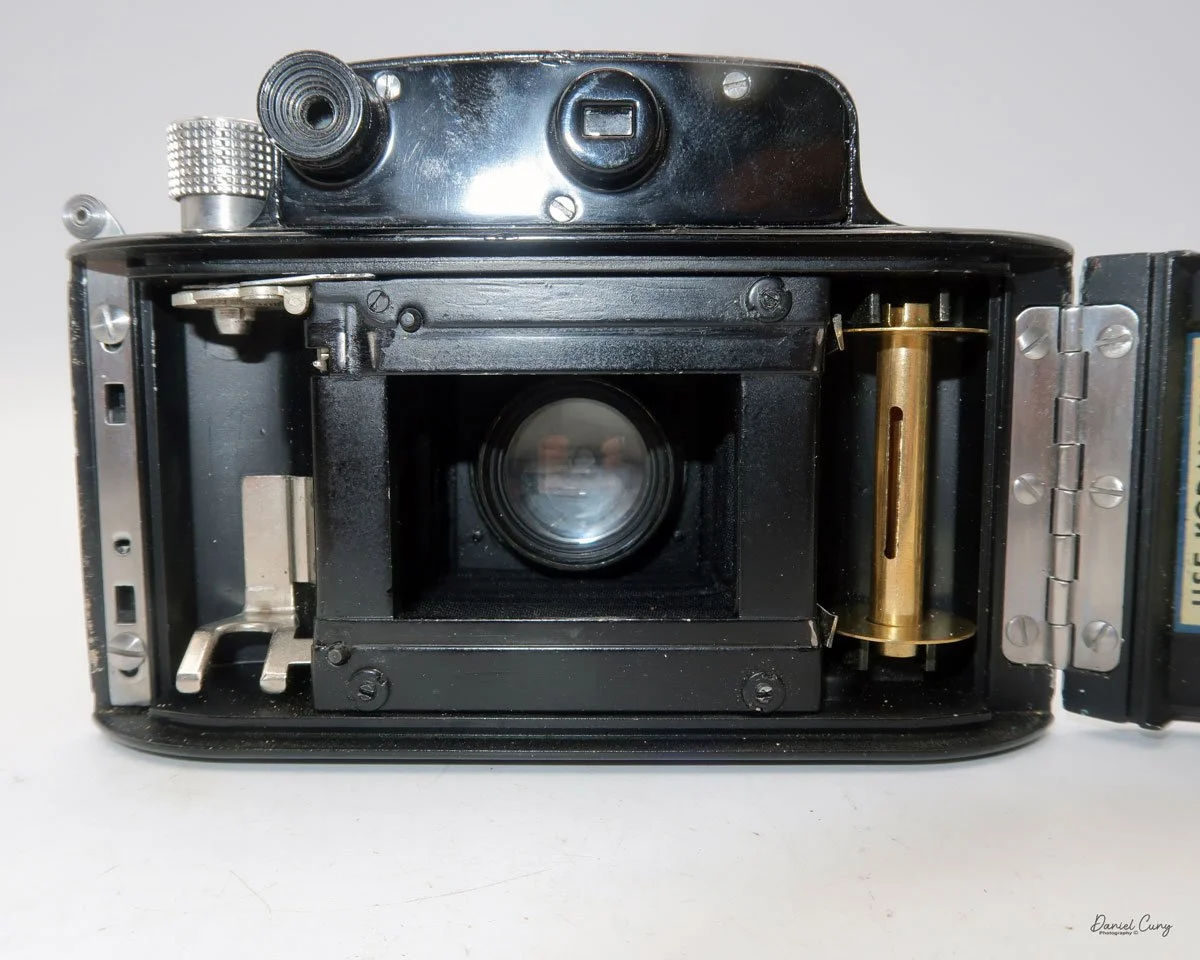
According to the manual, there is a button on the back of the camera that unlocks the frame advance knob, allowing you to advance the film to the next frame. Either the "film for classics" film used to take photos didn't have an automatic frame stop, or the item on my camera wasn't working because I didn't need to press the button to advance the film, and the film didn't stop automatically at the next frame. Either way, it wasn't a significant hindrance, and I just stopped advancing the film when I saw the following number on the roll.
My results:

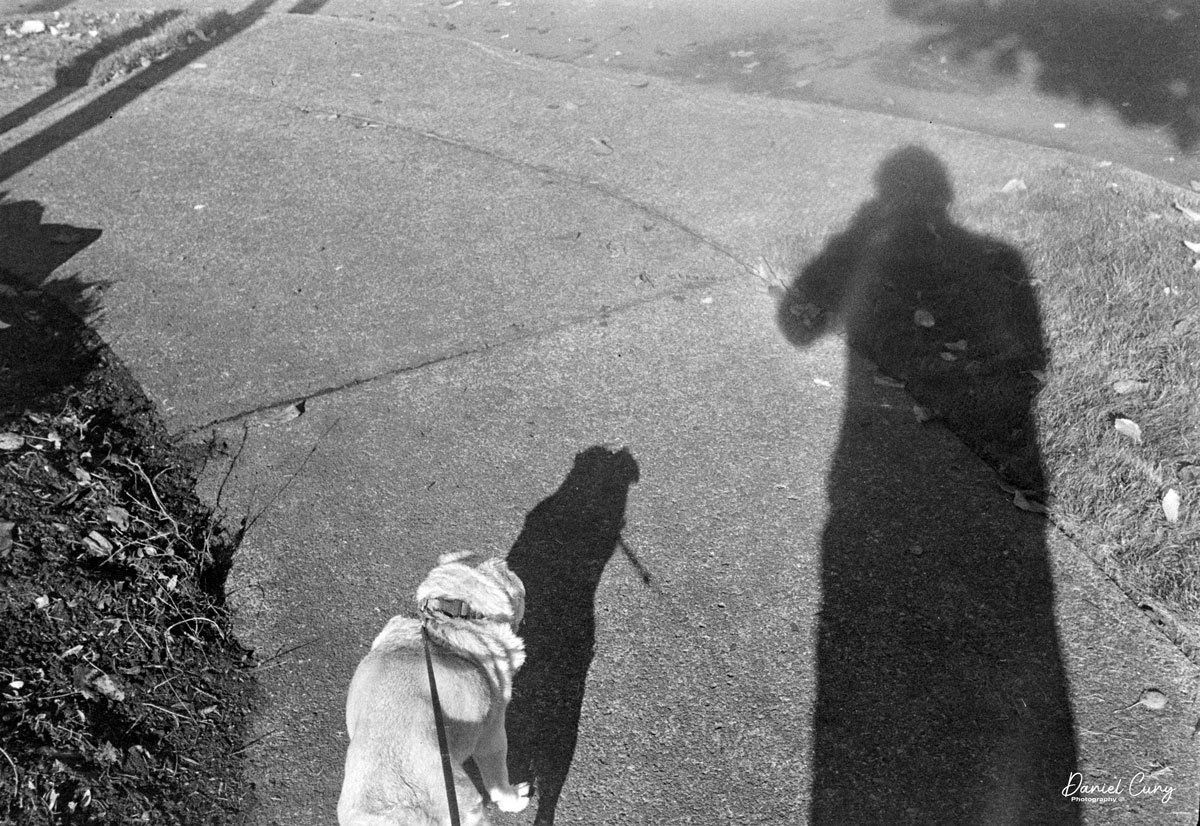
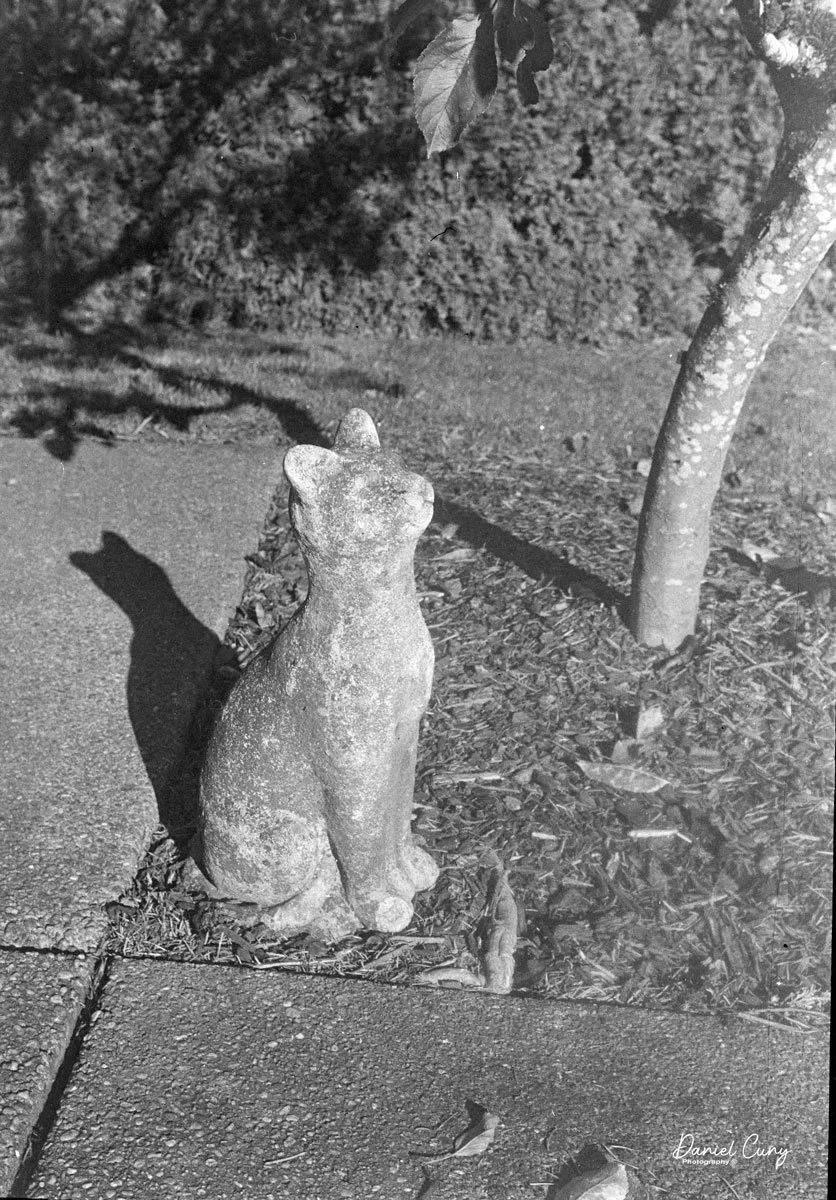
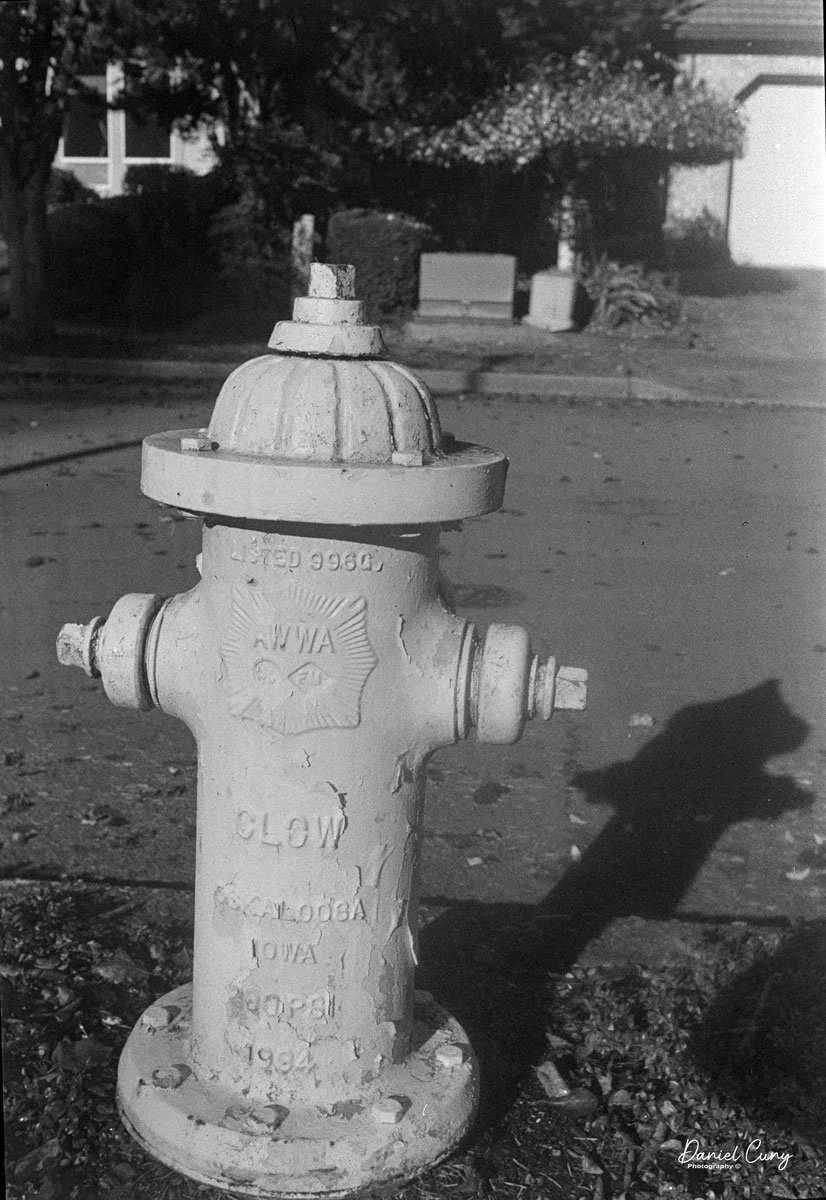
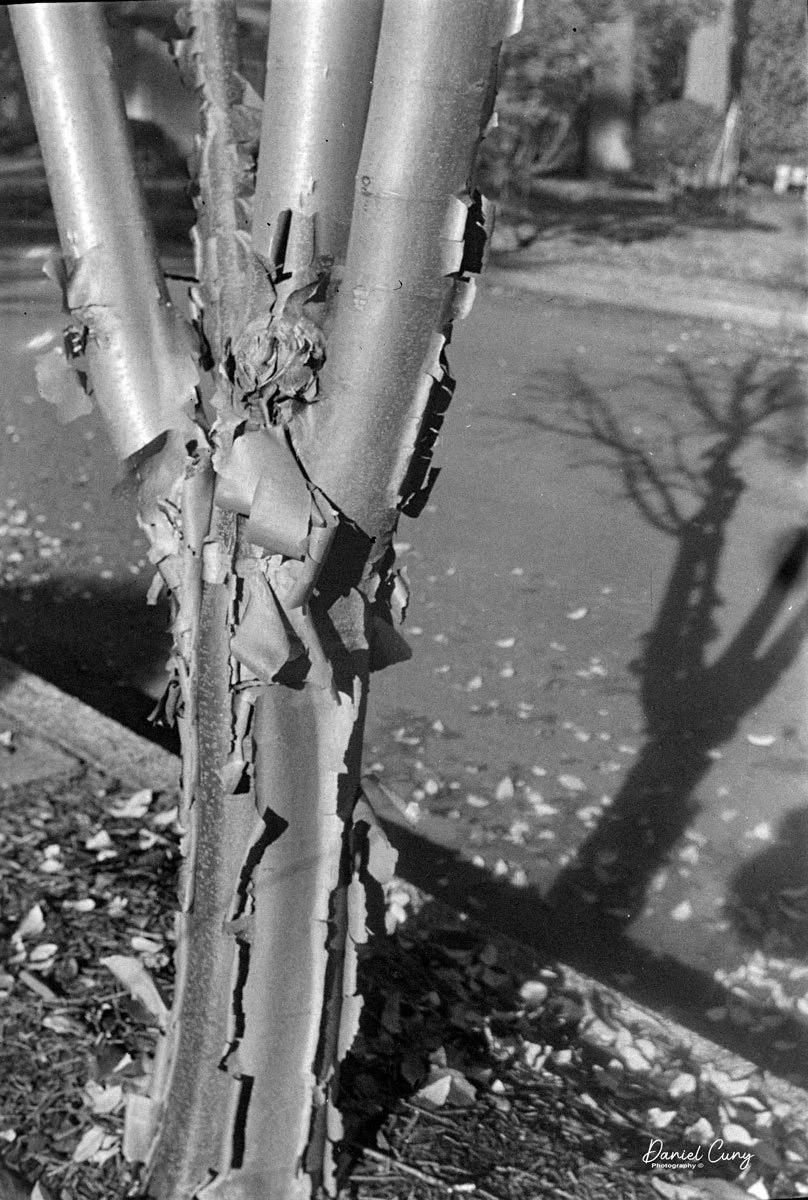
 Other than the difficulty I had finding the shutter release to take the photo, the camera was enjoyable to use. It's slim and fits nicely into my pocket when I walk around the neighborhood taking pictures. The shutter started to lag after the second shot on the roll, and the rest of the roll didn't turn out because of it. I exercised the shutter for an hour or so, running through all the shutter speeds, and that helped. Luckily, I purchased two rolls of film, and the following day, I loaded the camera and tried again, with much better results, as you can see from the examples below.

 The rangefinder was bright and extremely easy to use. The regular viewfinder was a bit small, but that's probably more to do with me getting older and having an eye issue with my "taking" eye, so I needed to swap over and shoot "left-eyed," which is something I'll need to get used to.

 I loaded a roll of Classics 828 film into the camera and walked the neighborhood for photos. With only eight frames per roll on 828 film, I can see why 35mm became more popular. That's not that many photos before having to change to the next roll of film.

 Anyway, here are the results from my walk around the neighborhood with my Kodak Bantam Special.
Conclusion:

 On a scale of 1 to 10 for camera usability, I'd give it a 7, but for overall appearance, artistry, and appeal, it's a solid 10 in my books. There aren't many other cameras with this one's overall beauty.

 The photos turned out terrific, and it was great fun to use. Other than the price of black-and-white film at over $20.00 per roll, I'd use the camera more often. Still, for special occasions, it is a great camera to use, and one I'm pleased to have in my collection, especially with the case, manual, and box.

 Here's a link to my other Camera Reviews.

 I have some of the reviewed cameras along with other interesting cameras and photo items in my eBay store, Cuny's Cameras and Photos. Please stop by, and if you mention the blog, I'll be happy to offer a discount.

 Thank you for taking the time to read about this fabulous camera from the late 1930s. The Kodak Bantam Special is just that, Special.

 Until next week, please be safe.

Ensign Midget-Silver Jubilee Model

My Ensign Midget-Silver Jubilee camera

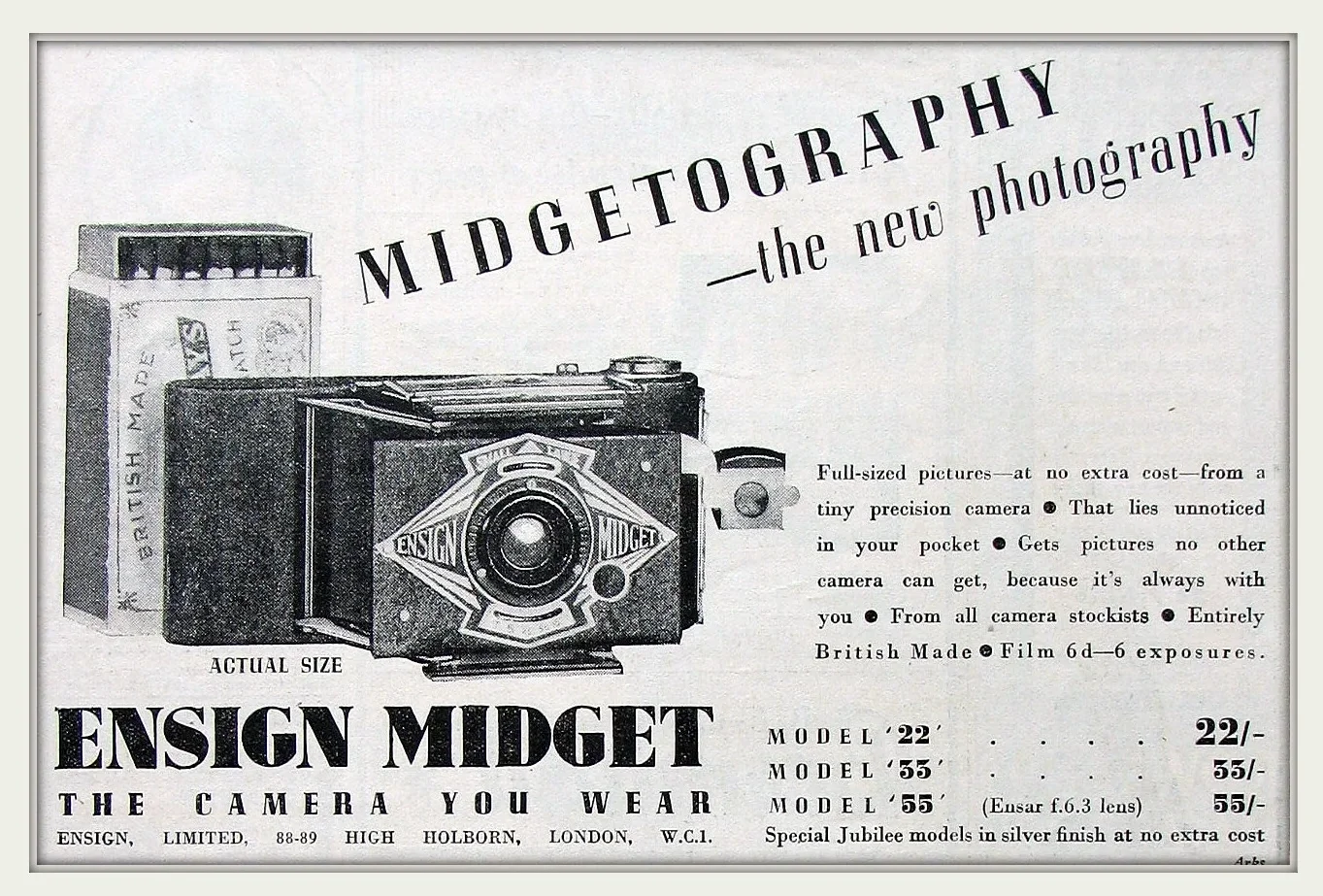
All of the Ensign Midget cameras have a fascinating look. With three models, the straightforward Model 22, to the more refined Models 33 & 55, featuring a diamond-shaped faceplate and a very Art Deco appearance. The one model that stood out to me with the most significant difference was the Ensign Midget-Silver Jubilee model, introduced in 1935 for the Silver Jubilee of King George V and Queen Mary. This model, in particular, holds a unique place in the history of Ensign cameras, being a rare and special edition.

 As I've mentioned several times, my love for the unusual, quirky, and vibrant cameras holds a very special place in my heart. The majority of my collection has something particularly peculiar about it. Whether the camera is a different color other than the drab black, ot it has a different film format, or an unusual faceplate, or some other oddity about it

 The Ensign Midget, Model 55, Silver Jubilee camera in my collection is a relatively recent purchase. I have memories of reading about it in McKeown's Camera Price Guide, and I've come across a few at camera shows and online, but I never pulled the trigger and purchased one. However, when I finally acquired this model, it felt like a significant addition to my collection, a piece of history that I could now share with fellow enthusiasts.

Ensign Midget with slip-in case & manual

 I found the Ensign Midget, Silver Jubilee model that I currently own online at a very reasonable price, which also included the protective cover and original manual, making it even more desirable. The only thing missing was the original box, which would have increased the price. 

 When the camera arrived, I was very pleased with its condition, as it was free of scrapes and dings, which are very common on a camera that is 90 years old. The camera's cover was clean, the faceplate still had a chrome shine, and the instruction manual was in superb condition. I was very pleased with the camera's condition, and it was in good working order, which was the icing on the cake, as they say.

 In the UK, Kodak also produced a "Silver Jubilee" box camera, which is covered in white leatherette. While I'd love to have one of the Kodaks in my collection among the other colored box cameras I have, it'll be some time down the road for me.

History:

 Ensign cameras represent a significant chapter in British photographic history. The company's roots date back to 1834, with the founding of Claudet & Houghton by George Houghton and Antoine Claudet, who initially dealt in optical glass. This enterprise evolved, eventually becoming George Houghton & Sons, which by the early 1900s was manufacturing cameras, such as the 'Ensign Simplex Auto'. By 1908, their Walthamstow factory was reportedly the largest camera manufacturing plant in the United Kingdom.

Ad for Ensign Midget camer

 A significant turning point came in 1915 when Houghton merged with W. Butcher and Sons Ltd. to form the Houghton-Butcher Manufacturing Company. Throughout this period, they produced popular models, such as the Sanderson folding camera and the highly successful, compact Ensignette roll-film camera, introduced in 1909. The Ensign brand name grew so synonymous with their products that in 1930, the parent company was formally renamed Ensign Ltd.

 Ensign became known for producing affordable, good-quality cameras that helped popularize photography among ordinary people in the 1920s and 1930s. They produced various formats, including folding roll-film cameras like the Popular Ensign and later models, such as the distinctively styled Ful-Vue, post-WWII.

 The company faced turmoil during World War II; their London headquarters, Ensign House, was destroyed by bombing in 1940, and the sales wing was soon after wound up. Post-war, Ensign continued through several mergers, joining with Elliott & Sons to become Barnet Ensign Ltd. in 1945, and then with lens-maker Ross Ltd. to become Barnet Ensign Ross Ltd. in 1948. It finally operated as Ross Ensign Ltd. by 1951. Despite producing quality 1950s roll-film cameras, the company ultimately failed to embrace the emerging 35mm format. Production of still cameras ceased, and the Ross Ensign name faded away, with the company being dissolved around 1961.

Key Features and Models

The Midget was marketed with the slogan "Wear it Always—Like your Watch," emphasizing its petite size, which measures approximately 90mm × 45mm × 18mm when collapsed.

 The camera came in three primary models, whose numbers originally corresponded to their price in shillings:

  • Model 22: The most basic version, typically featuring a fixed-focus meniscus lens and a simple two-speed shutter (Instantaneous/Time). It often lacked the top-folding frame finder found on higher models.

  • Model 33: An upgrade from the 22, this version typically featured a slightly better fixed-focus "All Distance" meniscus lens and a 3-speed shutter (e.g., 1/25, 1/50, 1/100 sec, plus T/B).

  • Model 55: The premium model featured a focusing Ensar f/6.3 Anastigmat lens with iris diaphragm control, enabling focus down to approximately 3 feet. Its shutter offered speeds up to 1/100 sec.

 All models used the dedicated Ensign E10 roll film to produce six negatives measuring 35 mm × 45 mm—a format slightly larger than the standard 35 mm (Leica format). The cameras were constructed with a pressed steel body and leather bellows, featuring an Art Deco design with chrome accents on the struts.

 The Midget family was very popular, but its production was ultimately halted in 1940/1941 as the company shifted its focus to wartime manufacturing. It was not returned to the product line after the war, as Ensign focused on the 120 film format instead of competing in the burgeoning 35mm market.

My Camera:

 My Ensign Midget camera is 3.5" wide by 1.75" tall by 0.75" deep with the front lens collapsed, and 2.75" with the front lens extended and the black bellows of the camera exposed in its normal "picture-taking" position. My camera weighs in at a measly 5.9 ounces. As you can see, the slogan Ensign used, "Wear it Always—Like your Watch," was very informative. I'm thinking that if I had had one of these cameras back in 1935 and carried it in my pocket, it would have been so small that it might have been challenging to locate.

The camera has two struts on either side of the lens, which extend when the lens plate is pulled out for taking photos. Once you're finished taking the pictures and ready to close the camera, start by pulling the end of the struts closest to the lens out, away from the lens plate, to unlock them. Then,  the lens plate can collapse back into the body when not in use.

 Once you have the lens extended and ready to take photos, the front viewfinder unfolds upwards to make the front of the "Direct Vision Viewfinder as noted in the manual. Once the front is extended, the back of the camera houses a "flip up" eyepiece that completes the camera's Direct Vision Viewfinder which is to be used if you want eye-level viewing.

There is a "Brilliant View Finder, tucked into the side of the camera's body, which can be used for taking vertical images, then flipped out when taking a horizontal image. For vertical images, the Brilliant View Finder lens is tucked into the camera body with a small opening just below the word "Midget" on the right side of the camera's faceplate, as viewed from the front. It's evident once the Brilliant View Finder is flipped to use in the horizontal position.

On the right side of the camera, as you're holding it to take a photo, tucked behind the faceplate is the camera's shutter release. Also on the right side of the camera is a slide-out leg that props up the camera for taking vertical images. On the flip-up leg is the camera's serial number, which mine happens to be "H15871."

On the front of the camera are the settings for shutter speed, aperture, and focus distance. The Aperture settings are located along the top of the faceplate and range from f/6.3 to f/22, selected by moving a small slider just below the aperture numbers. 

 Around the F/6.3 "ENSAR" anastigmat lens are focusing distances for you to set. The distance lines up with a small bar that protrudes from the lens, with focus distances of 3" at the 12 o'clock position, 5' at the 3 o'clock position, 8' at the 6 o'clock position, 12' at the 9 o'clock position, and infinity, backing up towards the 12 o'clock position.

 The shutter speeds of 1/100, 1/50, 1/25, "B", and "T" are set on the bottom of the faceplate, similarly to how the aperture settings are made, by sliding a small bar to the desired shutter speed.

Shutter, aperture and focus area on Ensign Midget camera

To open the back of the camera to load film, a locking mechanism on the left side must be pulled down. This slides a small bar that fits into a tiny opening, allowing the back of the camera to swing open and be removed from the camera.

 You load the Ensign Midget just like any roll film camera, but unfortunately, this camera and the other Midget camera takes an odd-size film that is no longer available. Once the film was loaded, engage the feet into the hinges on the right side of the camera and close it up. Just be sure that when you lock the back of the camera, the small rod fits into the tiny hole, which holds it in place. If not engaged, the back will open.

My Results:

 Unfortunately, I don't have film to use in this camera, due to its unique size and limited availability. Therefore, until I learn to cut and process film to use in the camera, this will remain a showpiece in my collection.


Conclusion:

 The Ensign Midget, Silver Jubilee edition camera is a camera I've long desired to own and will be cherished in my collection. The silver crinkle finish on the camera is a lovely touch to an already beautifully designed and built camera—a real gem crafted during a heyday period in pre-World War II England.

 Thank you for taking a few minutes to read about this fantastic, small, yet extremely well-built camera. One, I'm happy to give a prominent spot in my collection.

 Click the link to read my other Camera Reviews.

 If you're looking for a photo item, I have a wide selection of cameras, lenses, and camera parts available in my eBay store, Cuny's Cameras and Photo.

 Until next week, please be safe. 


Photo-See Camera Outfit

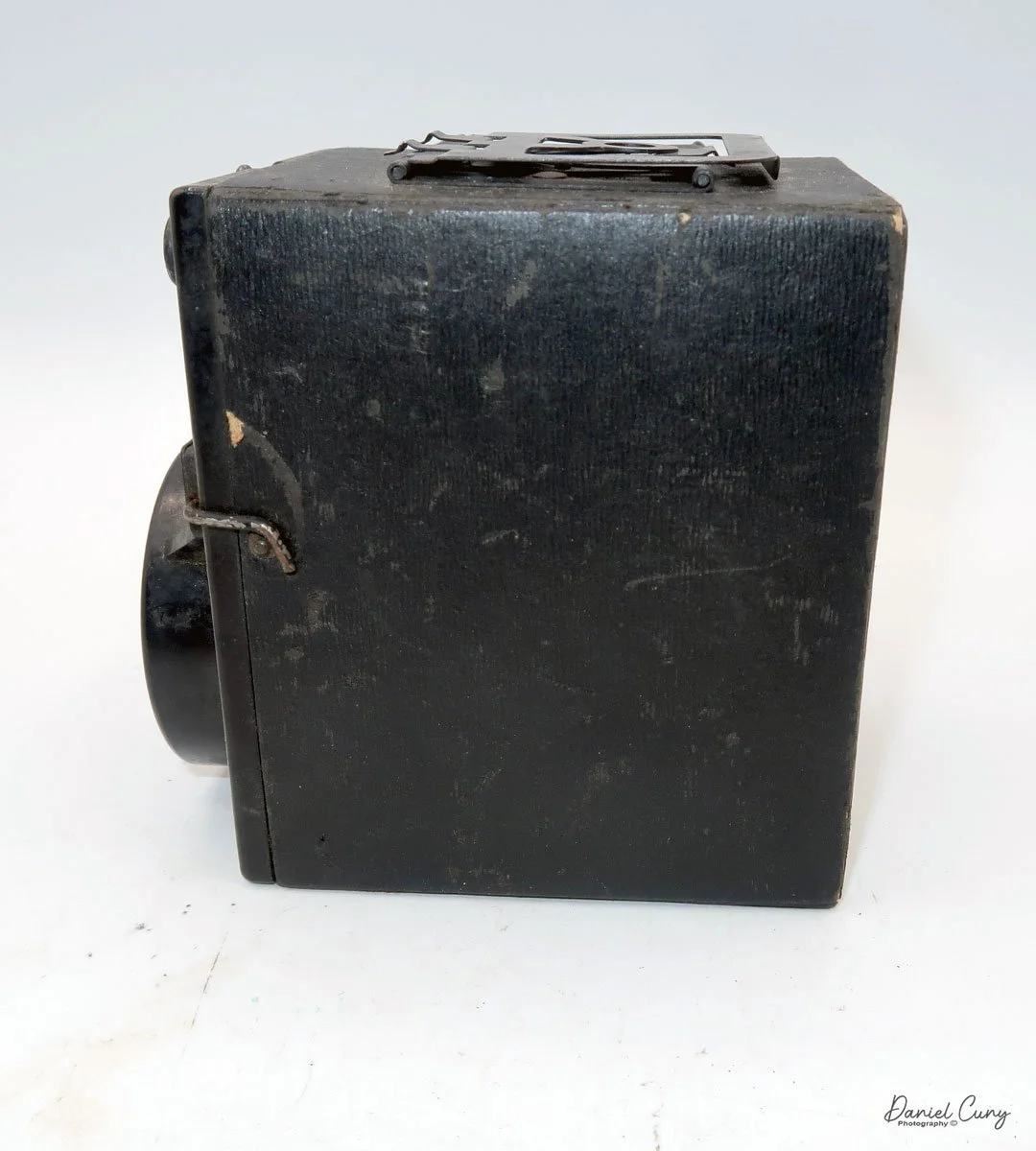
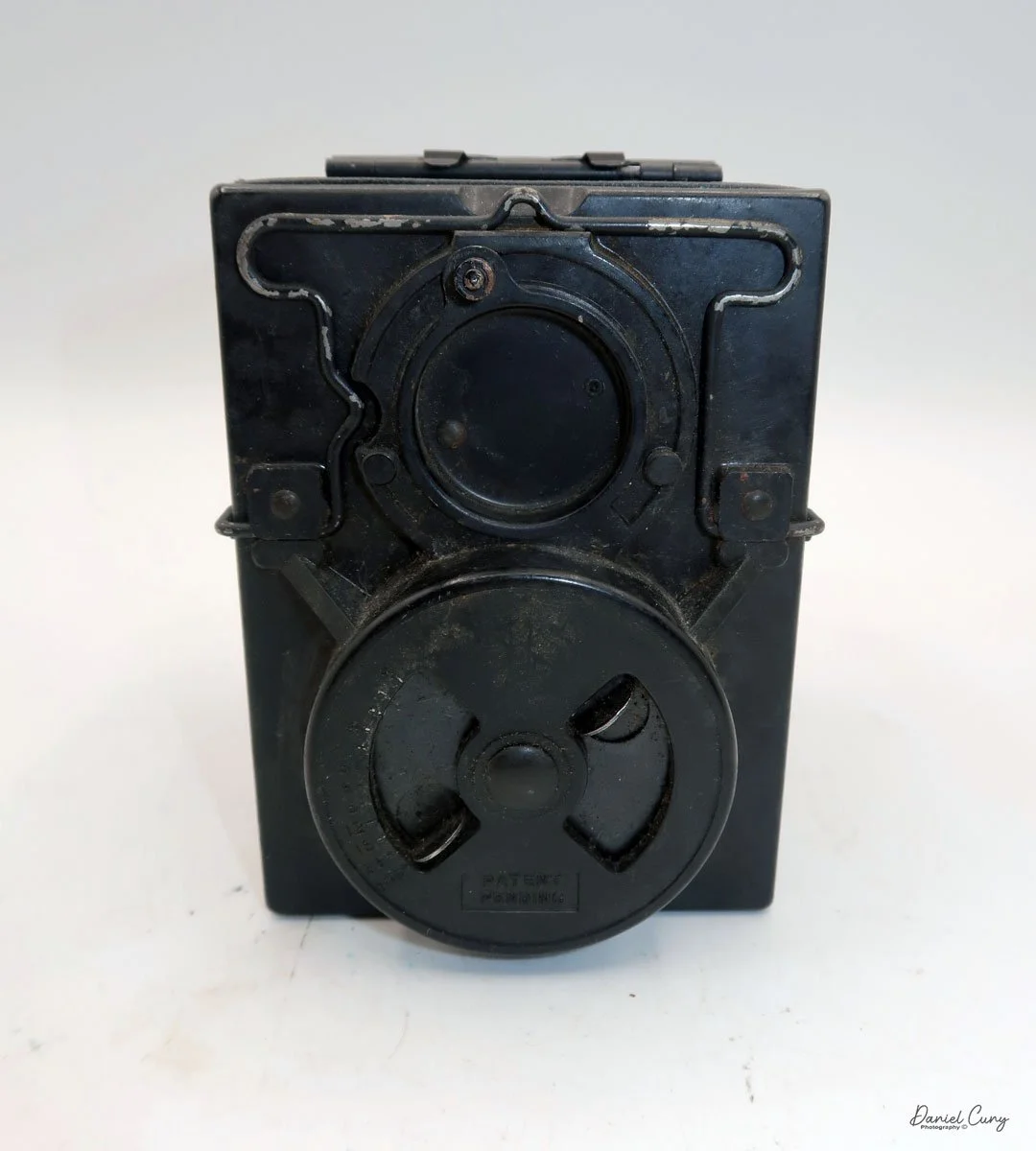
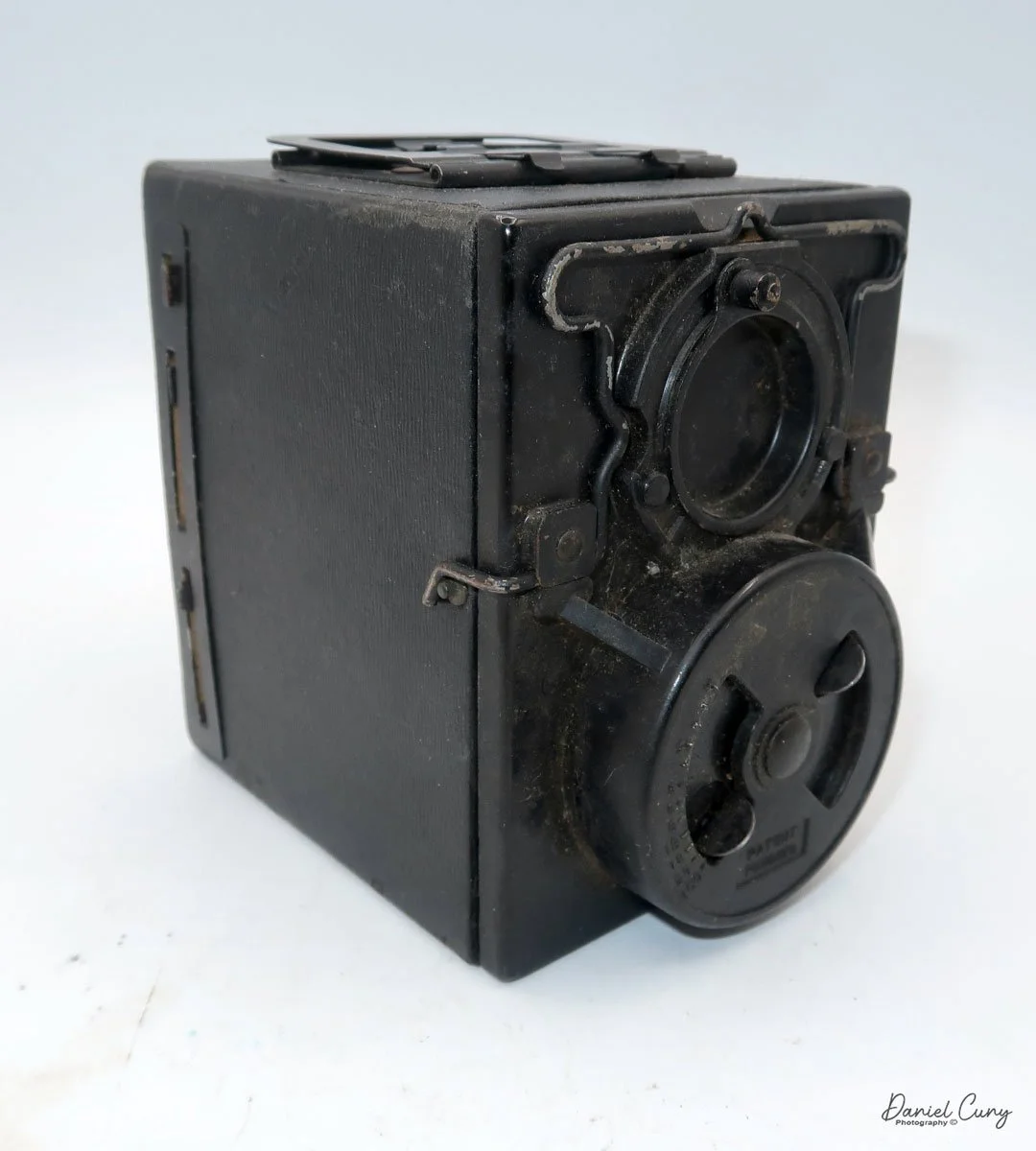
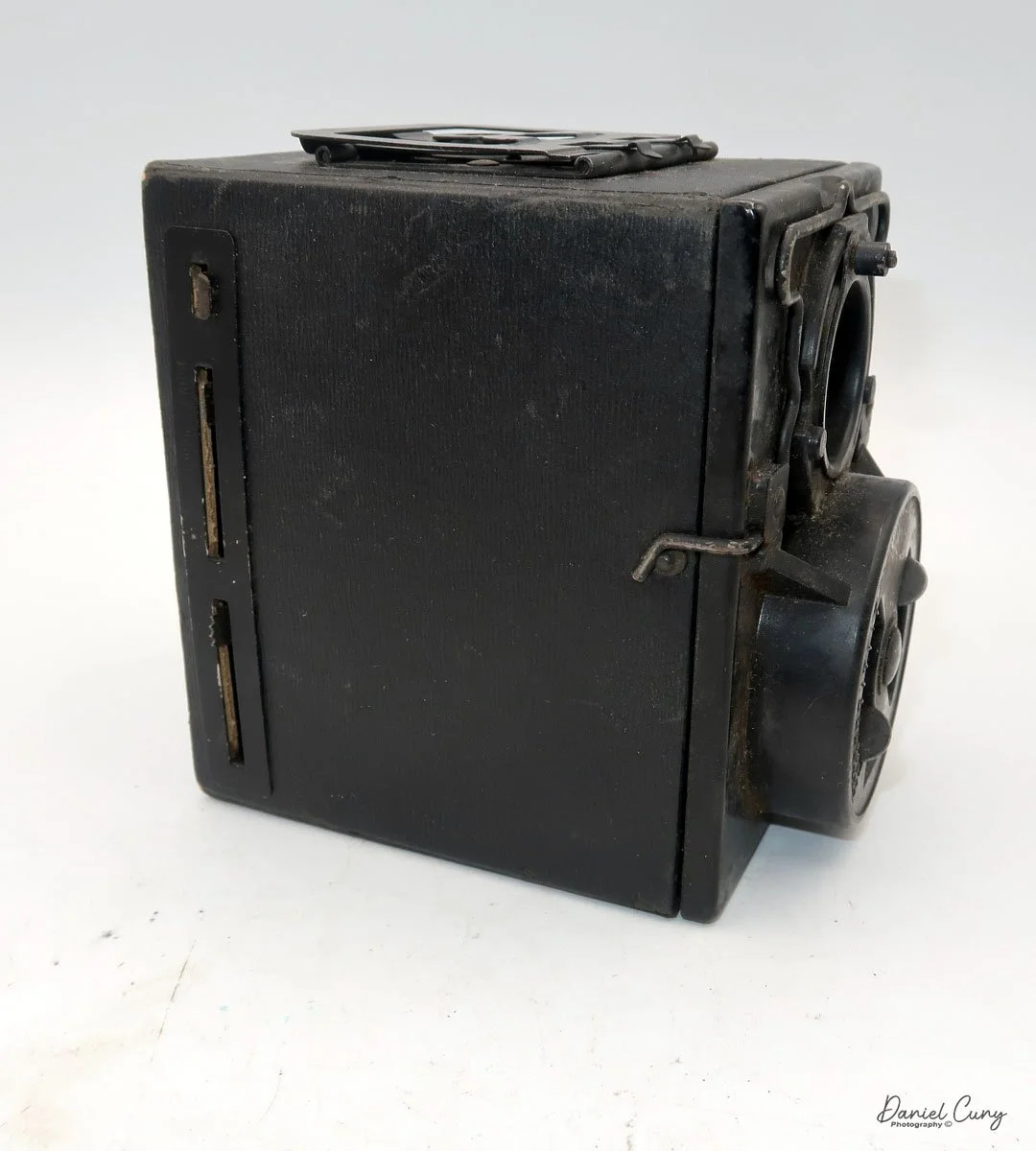
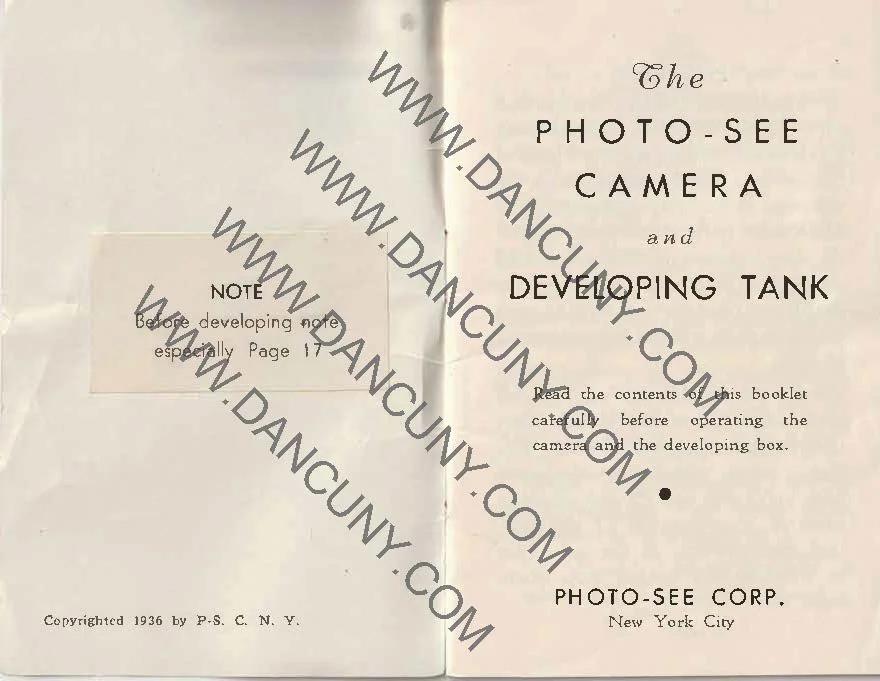
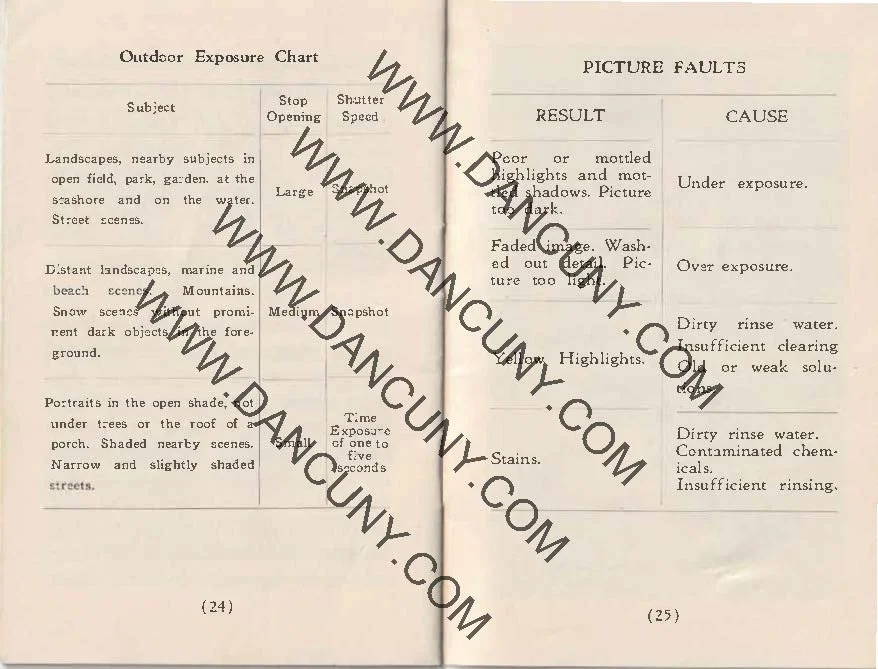
My Photo-See camera, developing tank and instruction manual.

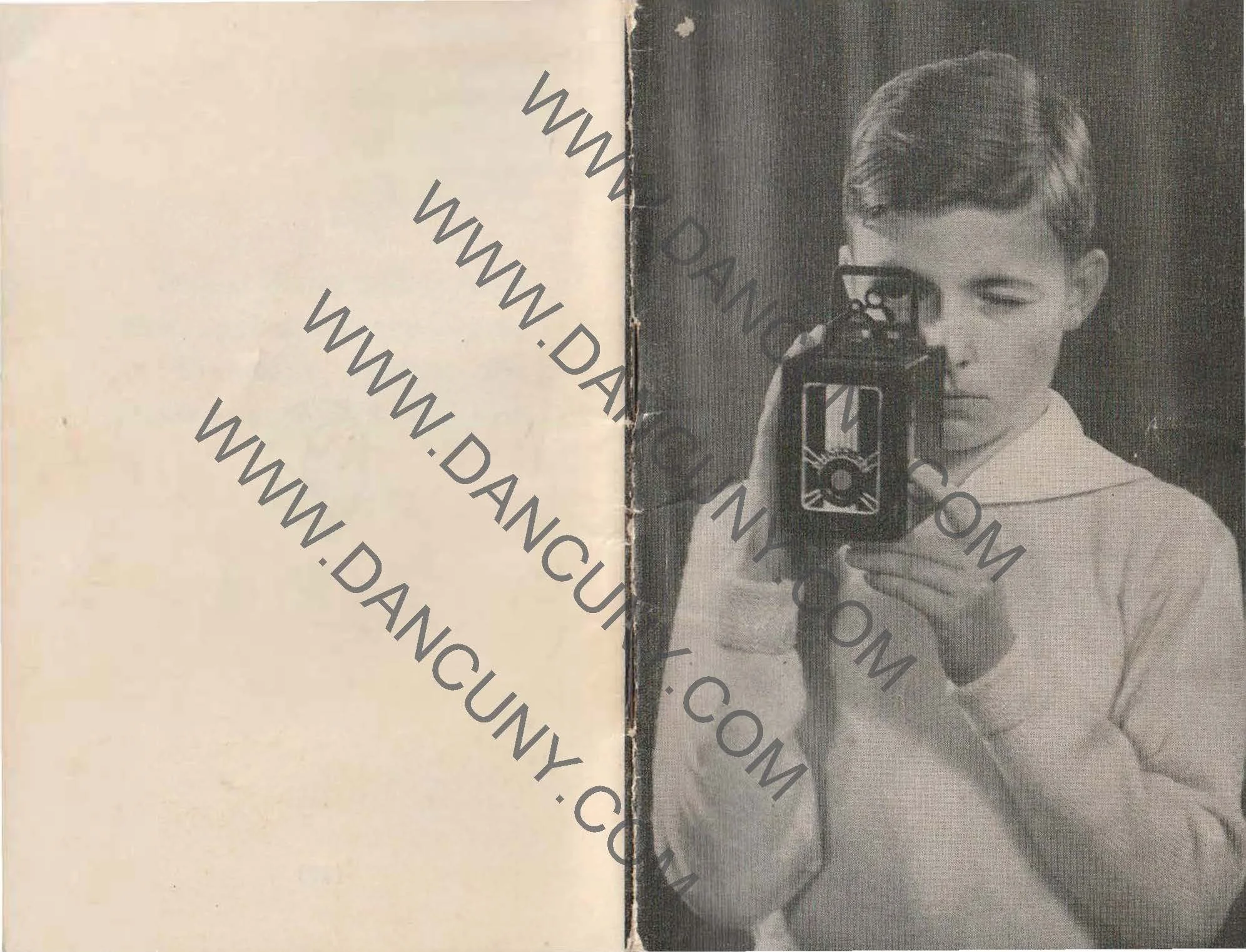
Almost 20 years before Dr. Land and Polaroid made instant photography world famous, a camera called the Photo-See was introduced in 1936. This company brought a very short-lived and straightforward box camera, along with a pocket-sized developing tank, to the market. These two items enable the photographer to take a photo and develop it without needing to send the film to be processed and printed.

 I don't remember when I purchased the Photo-See camera. I know it was well over 20 years ago. When I bought the photo see cameras, there were at least two, possibly three, of the same camera purchased in a lot of cameras purchased. 

 Several years ago, I recall selling one or two of the cameras on eBay. It wasn't until recently that I understood that there are two parts to this camera. The camera itself, and the developing tank in which the film for the camera was placed and processed.

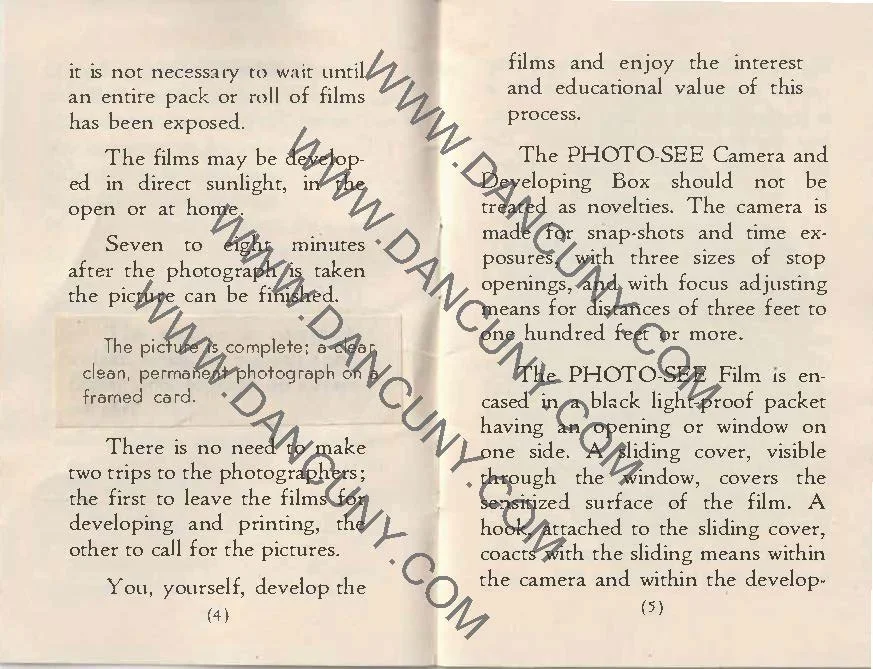
 Initially, I thought the developing tank fit onto the back of the camera, but I was wrong. The developing tank is actually a separate part that the film from the photo camera fits into, allowing the photographer to process the film at any time they want to. The idea was that the photographer could take the photo, then have the print ready within a few minutes.


The History:

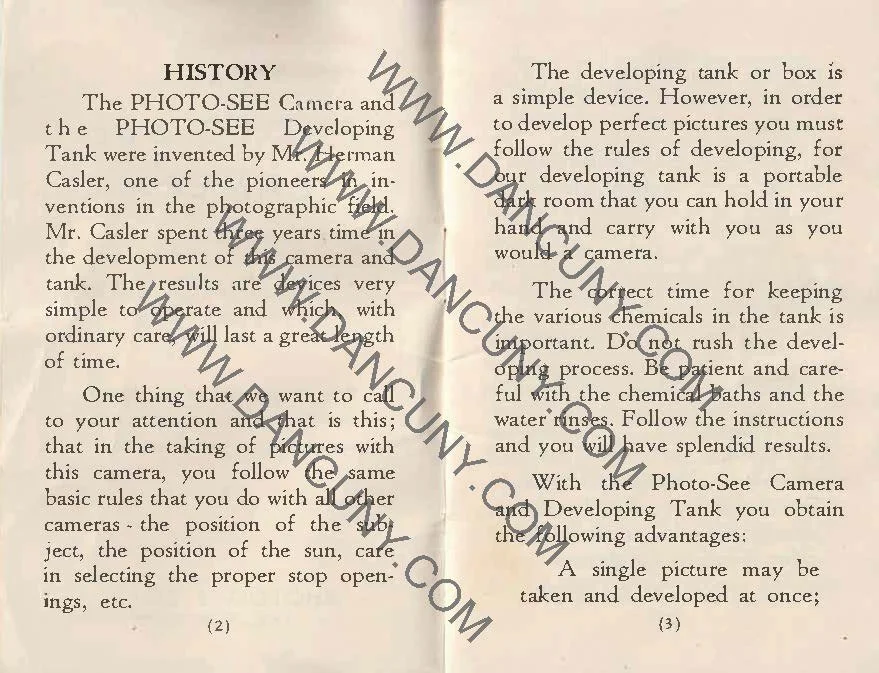
The Photo-See camera was the brainchild of Herman Casler, who was born in 1867 in Sandwich, IL, and raised in Fort Plain, NY. Over his lifetime, Casler invented and patented several different products and was also a partner in K.M.C.D. Syndicate, this was along with W.K.-L. Dickson, Elias Koopman, and Henry N. "Harry" Marvin. 

American Mutoscope and Biograph Founders, 1895. Casler upper right.

 Casler, Dickson, and Marvin collaborated in 1893 on a detective camera, the size of a watch, called the Photoret. The Photoret was a watch based on a pocket watch, similar to the Expo camera.

 Casler started his career as a Draftsman for General Electric Co., designing electric rock drills. He became the superintendent of Marvin Drill Company in 1895, which Harry Marvin owned.

 Casler, following Dickson's proposal, invented the Mutoscope, which displayed short films through flip-cards rotated by a hand crank that could be slowed down or sped up at the operator's will by turning the crank faster or slower. The prototype of the Mutograph camera was completed in November 1894, first tested with film in June 1895, and the first official Mutoscope films were made in August 1895.

Patent for Photo-See camera

 Marvin & Casler Co. was formed in 1896, where they manufactured the Mutoscope, which was very popular in nickelodeons during this time. The Mutoscope and Thomas Edison's Kinetoscope are the beginning of the motion picture business as we know it.
 His work in inventing motion picture cameras, projectors, and other motion picture equipment extended well beyond the 1920s, where he helped develop a more miniature hand-cranked motion picture camera and a three-pronged shutter that helped reduce flicker during projection.

 Herman Casler is also the inventor of the Photo-See camera, which was patented in 1937. The company was short-lived, as Casler passed away in 1939, and I don't see production of the camera continuing much after his death.

The Camera & Developing Tank:

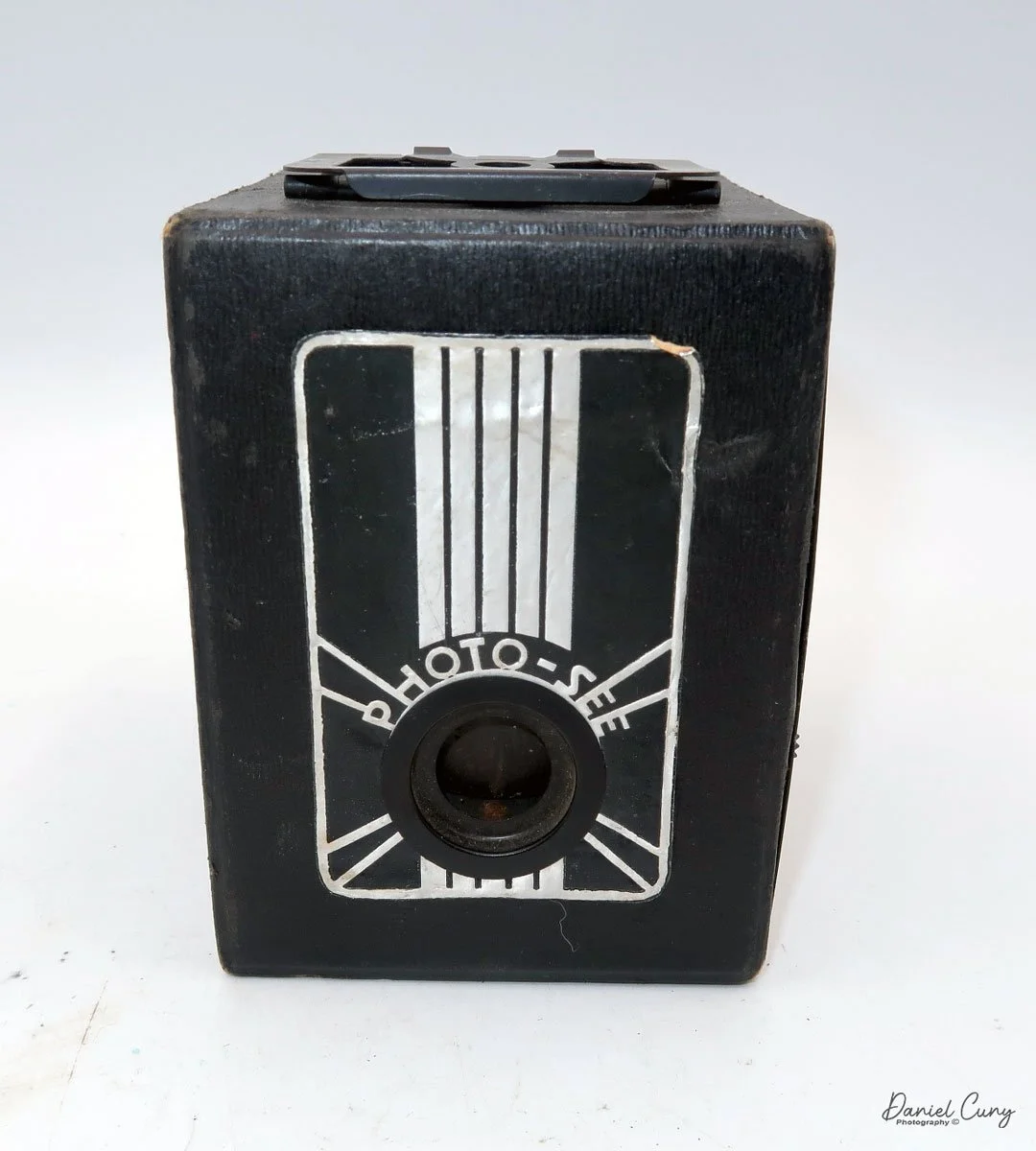
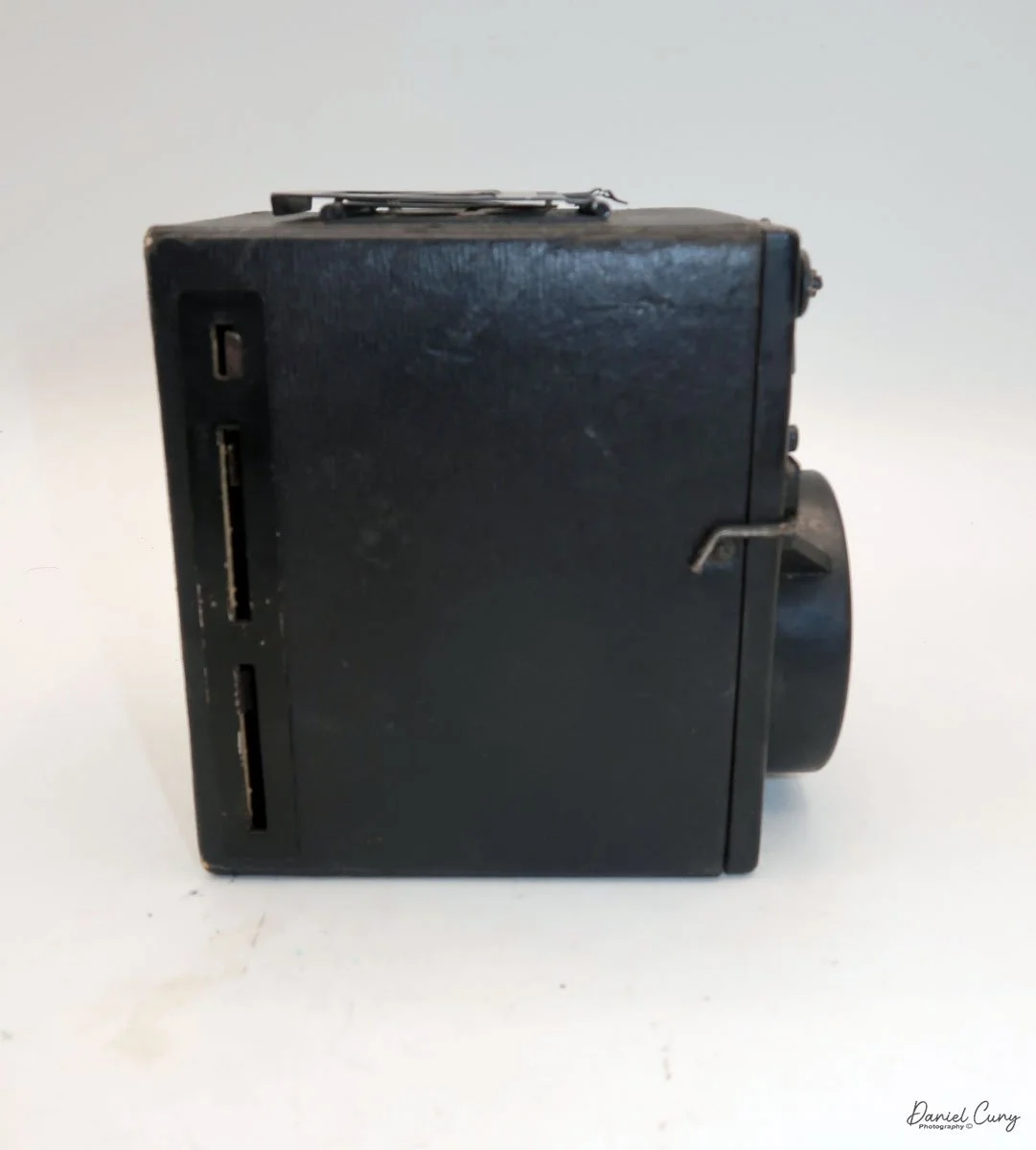
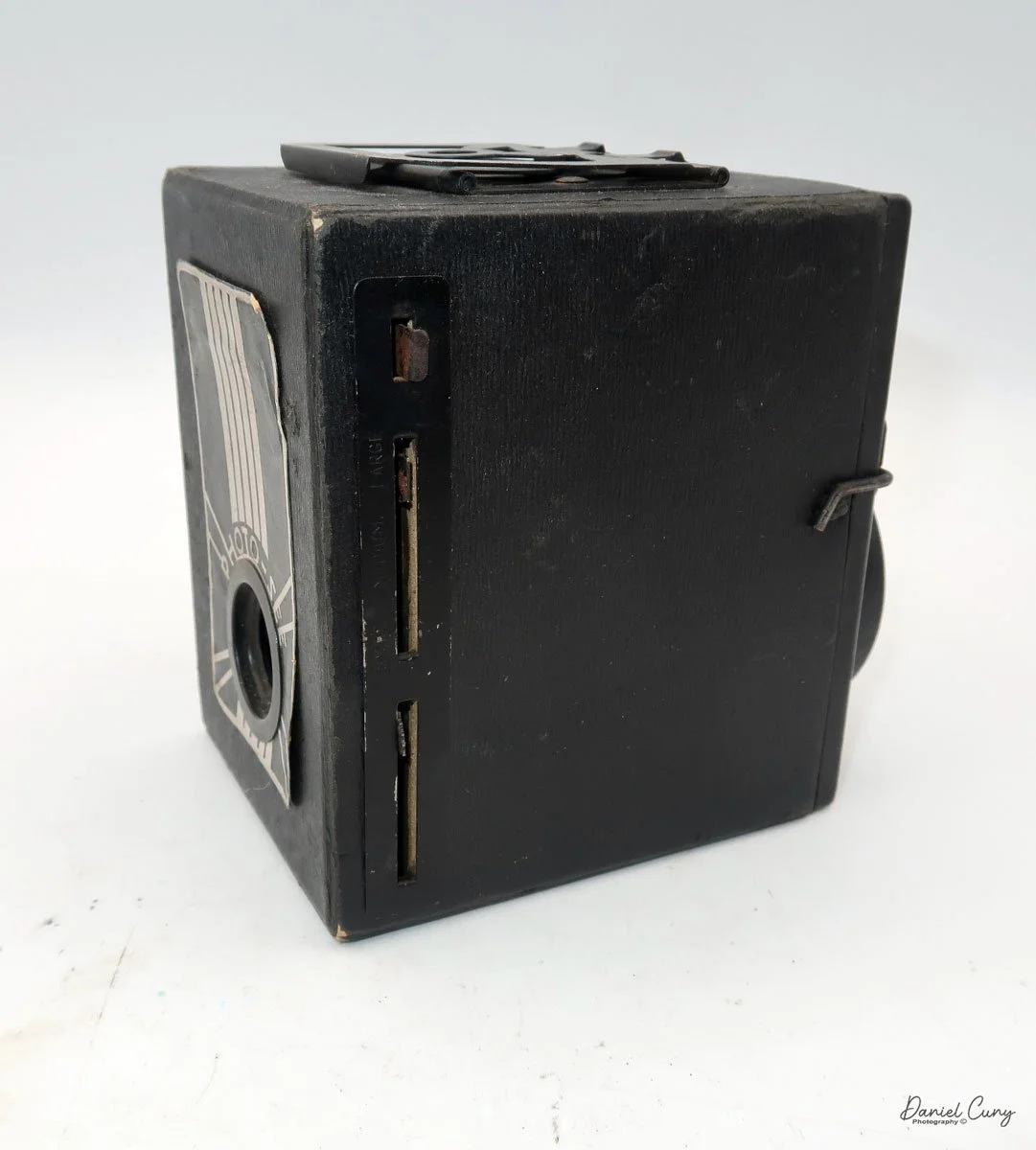
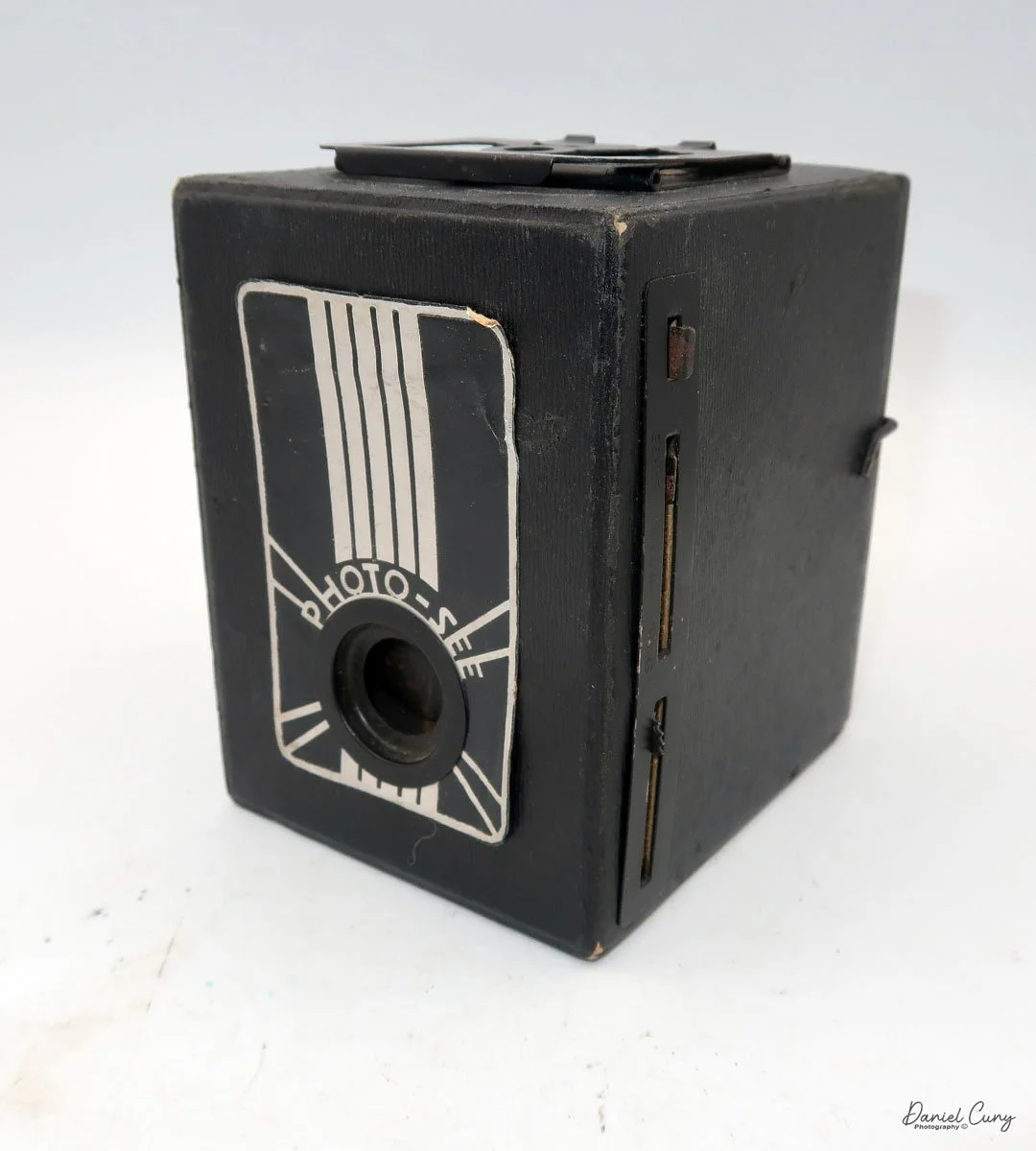
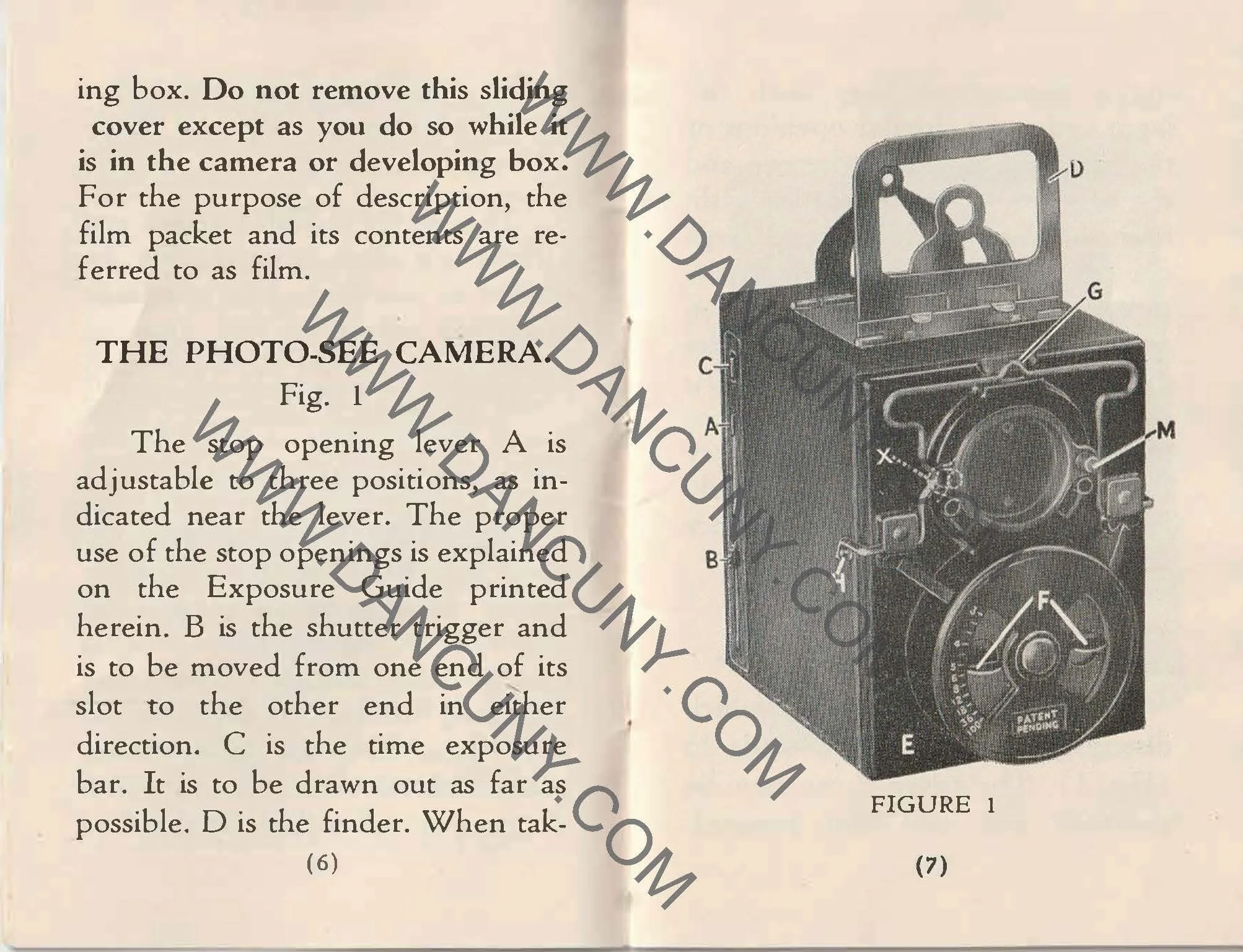
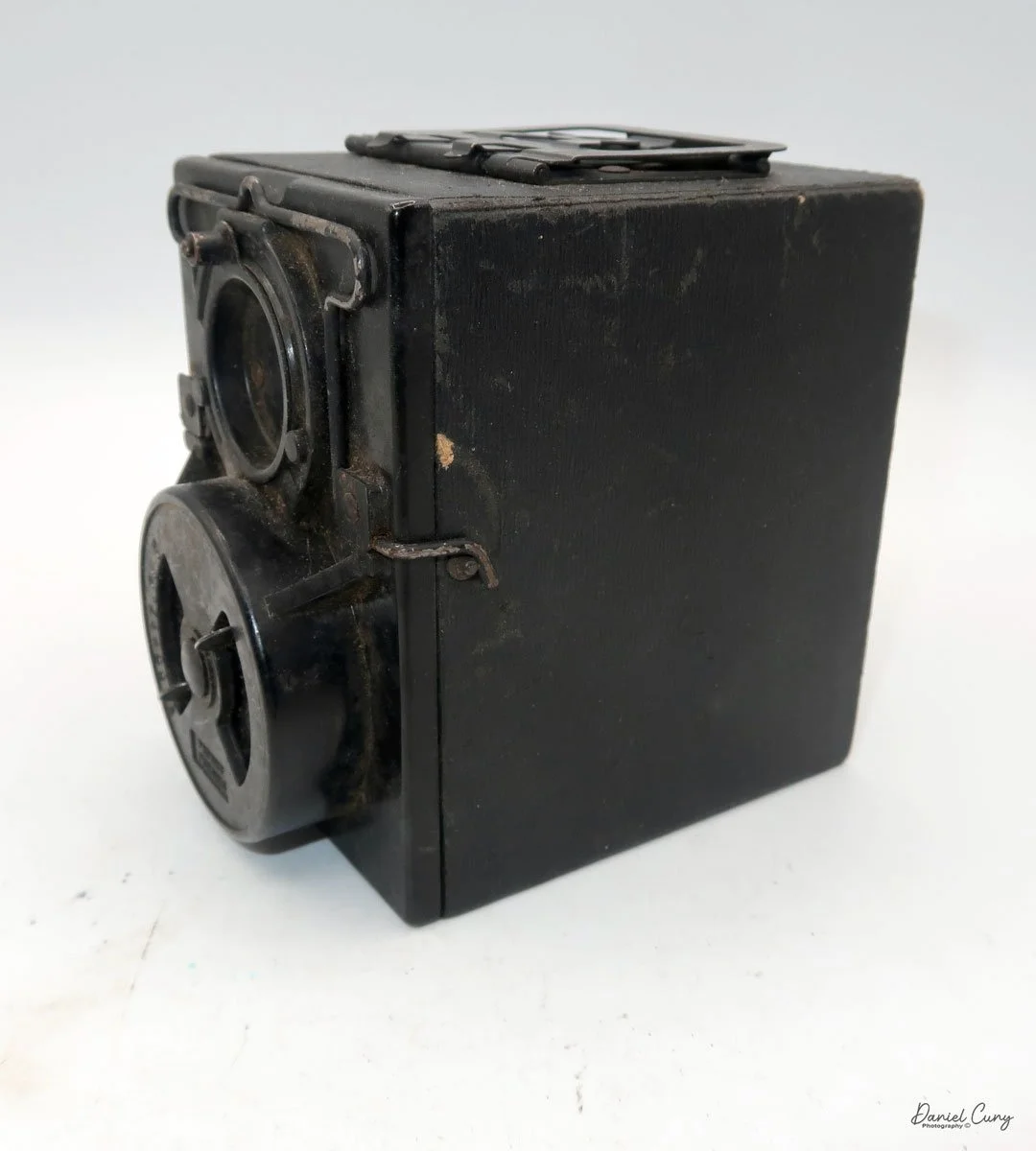
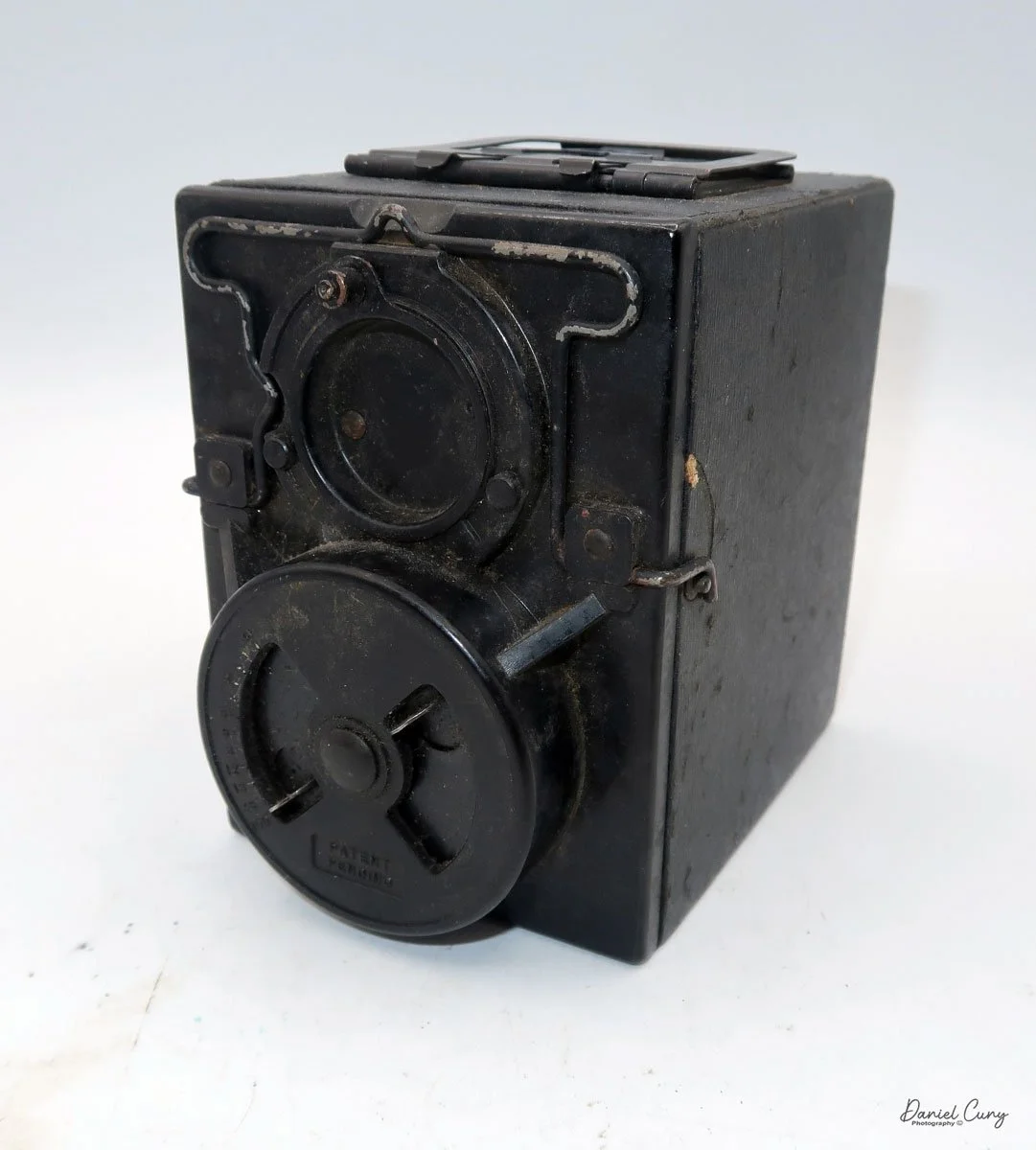
 The Photo-See camera is a straightforward box camera design with a few differences, which I'll explain. The camera is 4" tall by 3 "wide by 4.5" deep, including the focusing device, and weighs 12.3 ounces.

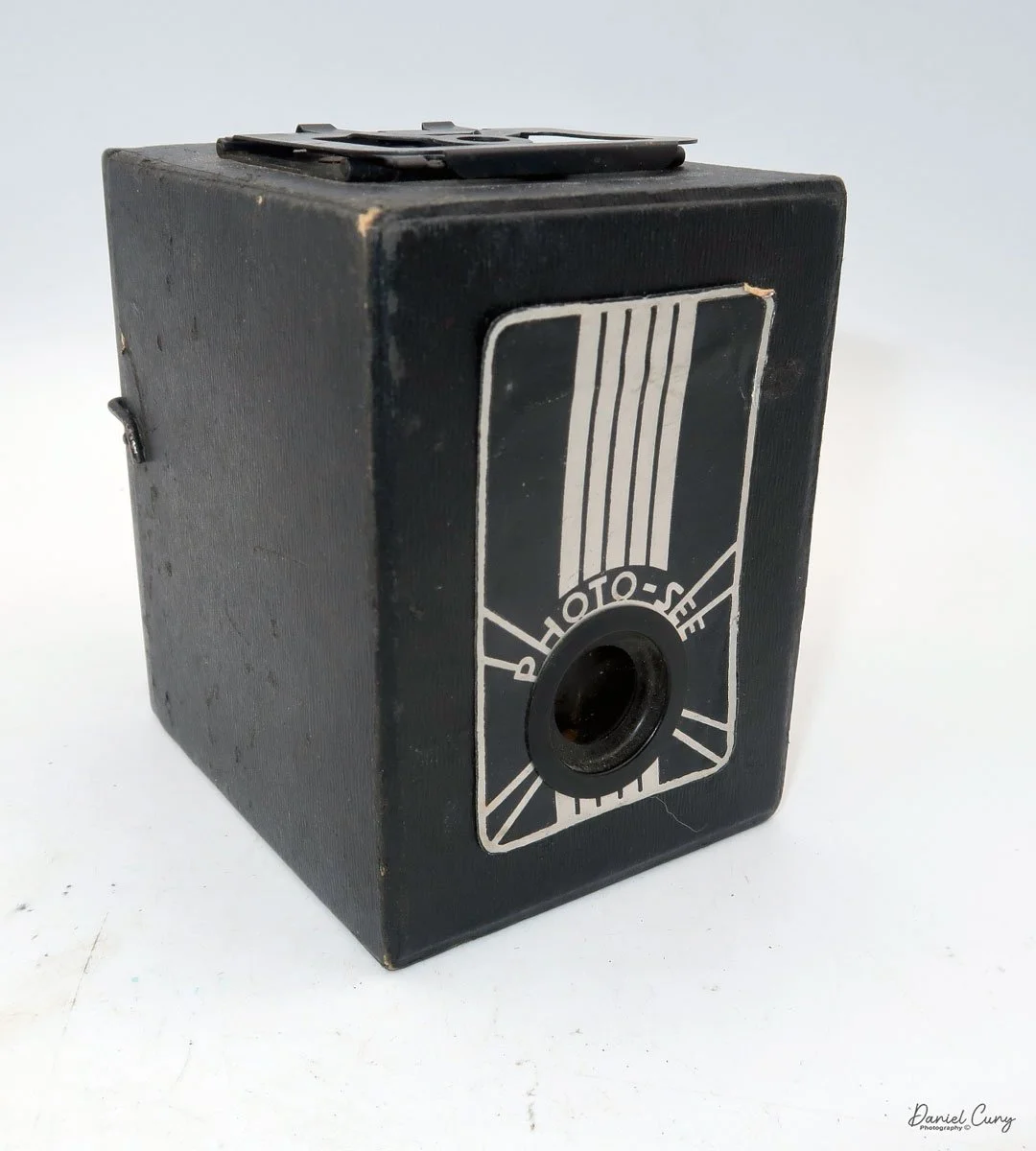
 The front of the camera features a distinctive Art Deco design, which is enhanced by a sticker applied to the front of the camera. The camera is made from a thicker cardboard material, featuring a two-part, fold-up viewfinder on top. It's said the viewfinder is put on backwards, but that's not the case, as I find it to work better than the other way.

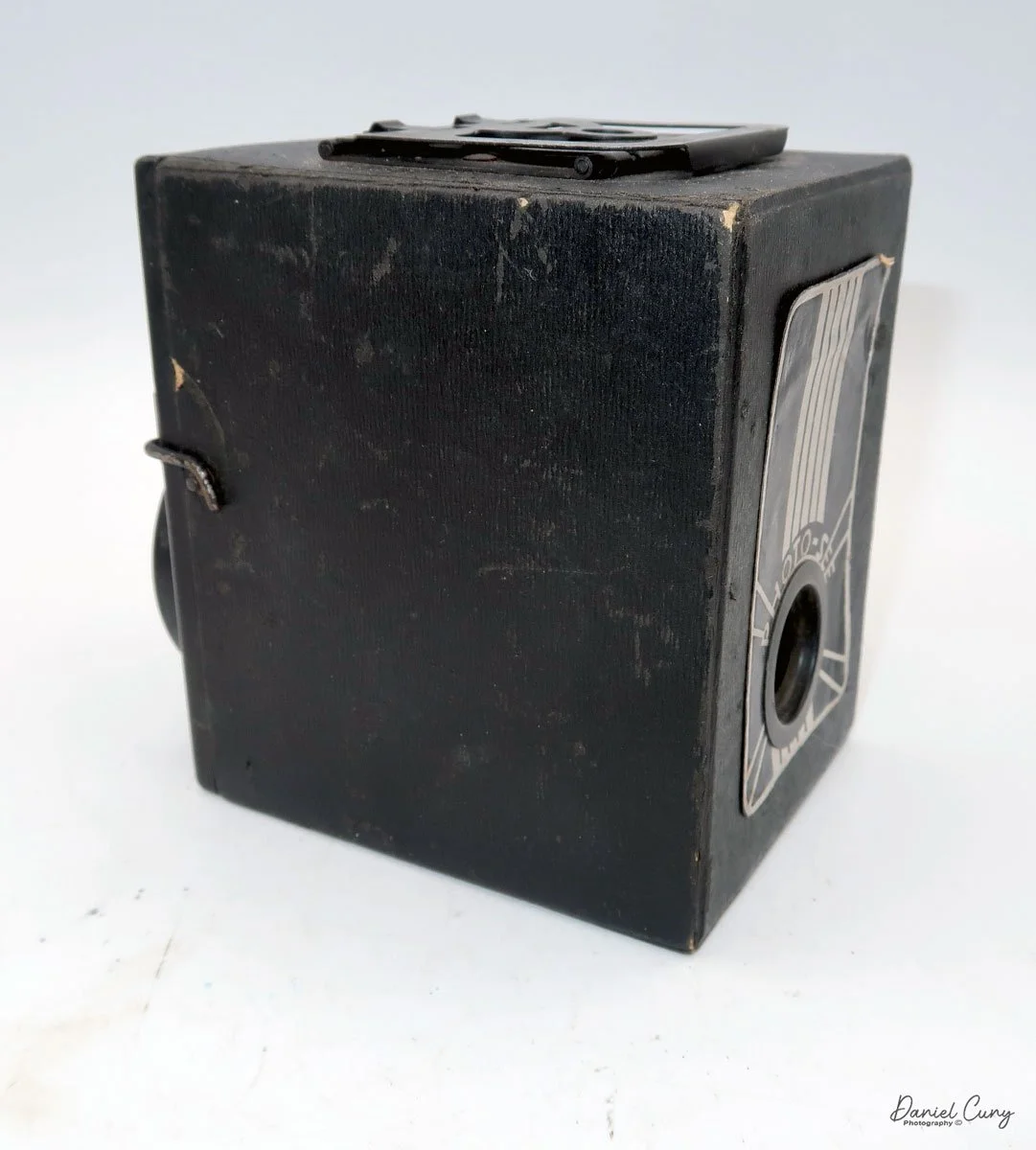
 On the left side of the camera are three controls; on top is the shutter control. When the bar is "in," the camera takes a regular snapshot, and when it's "out", the shutter stays open for a more prolonged exposure. This is similar to other box cameras from the same time period. The middle slider controls the aperture setting. They are Small, Medium, and Large. The bottom lever is the shutter release.

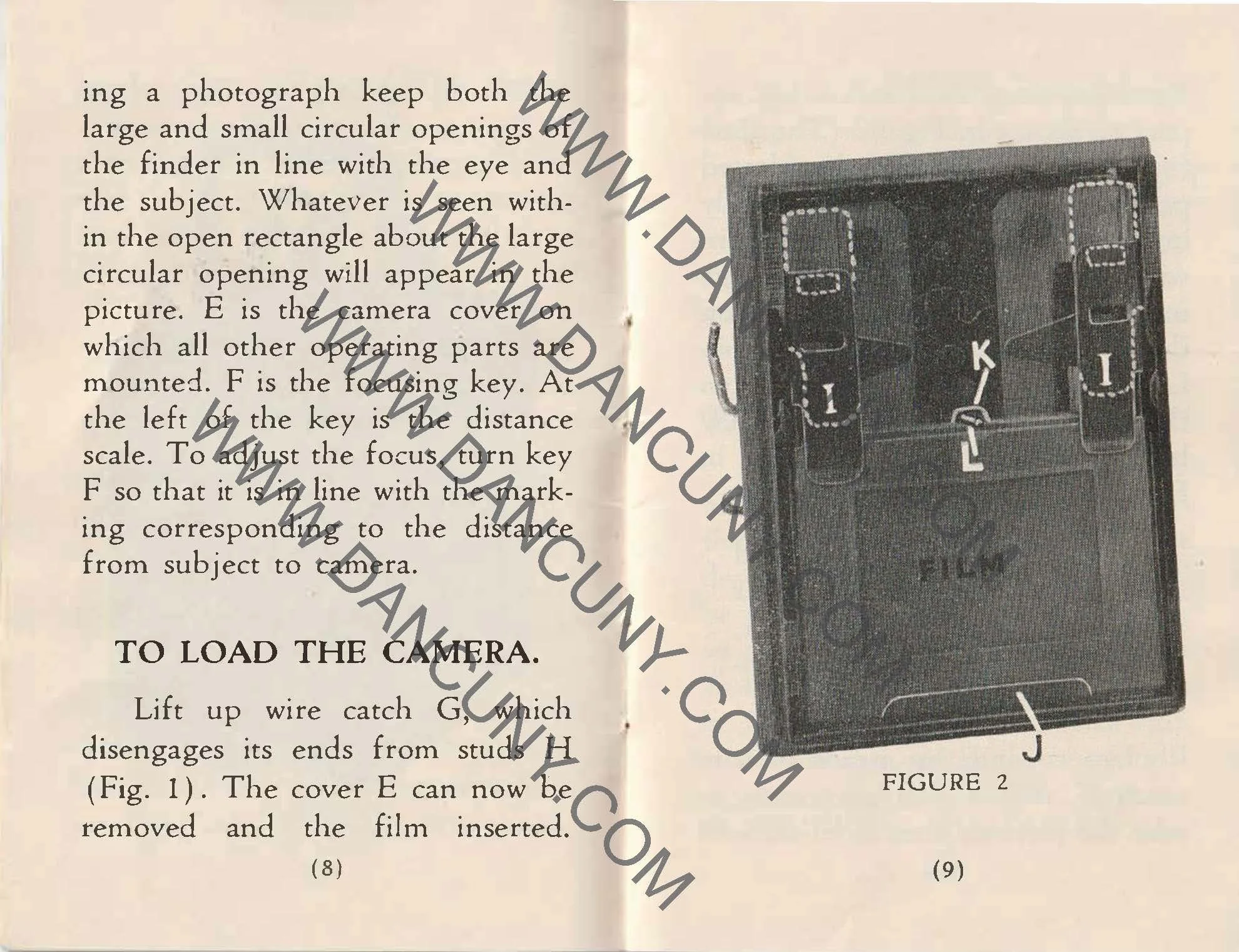
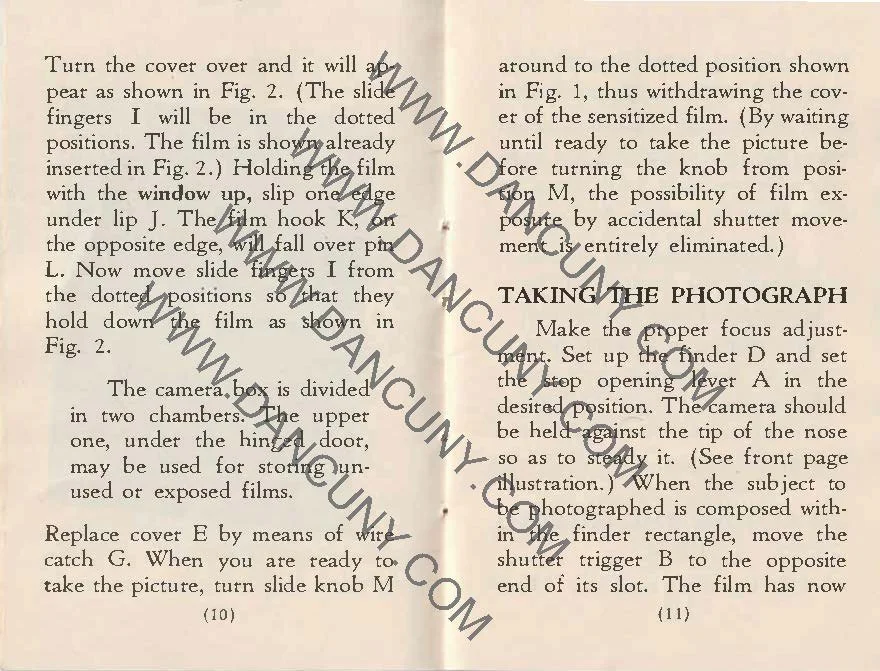
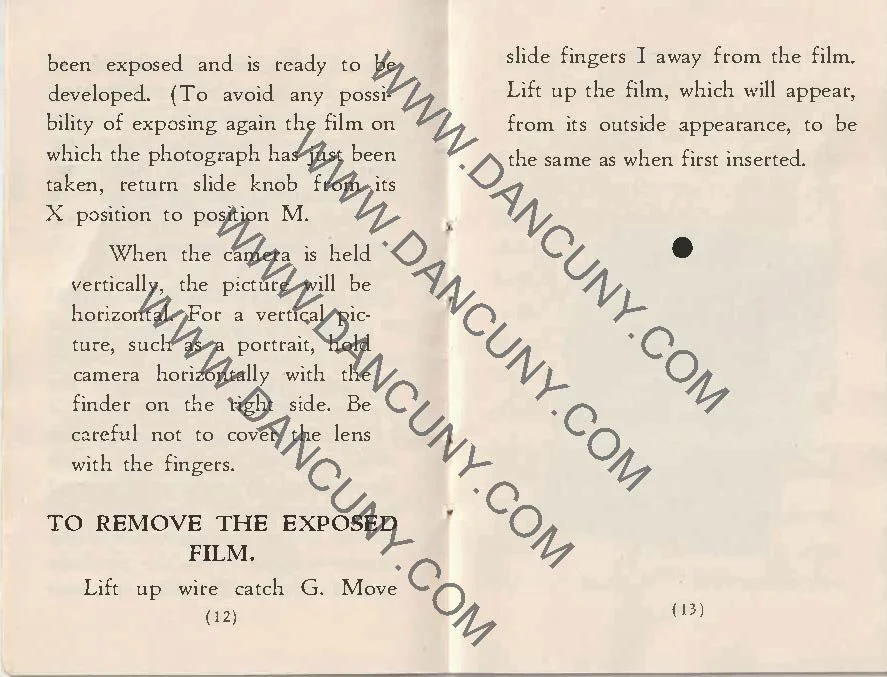
On the back of the camera, there are three main controls. The bar at the top is pulled down to remove the film from the camera. The smaller round disk on top is turned from the 3:00 to the 9:00 position to expose the film when you're ready to take a photograph. Then the disk is in the 9:00 position, which also locks the top bar, so you cannot take the back off when the film is ready to be exposed. Under the small disk is a larger disk, known as the focusing disk, which is turned to the desired distance from your subject. This is achieved by adjusting the internal focus of the film, moving it back, in, or out, which enables the film to shift its focus from 3 feet to infinity.

When you remove the film back and look inside, you'll see that it's spring-loaded, where you would load the film pack into the camera. The motion of the smaller disk on the outside of the back moved a pin on the inside up and down, which would open a dark slide, allowing light to hit the film once the shutter release was flipped. Moving the disk back to the original position closes the dark slide.

The Photo-See camera, when used in the vertical position, takes a horizontal image, and to take a vertical photo, you turn the camera to the horizontal position. Very similar to how half-frame cameras work.

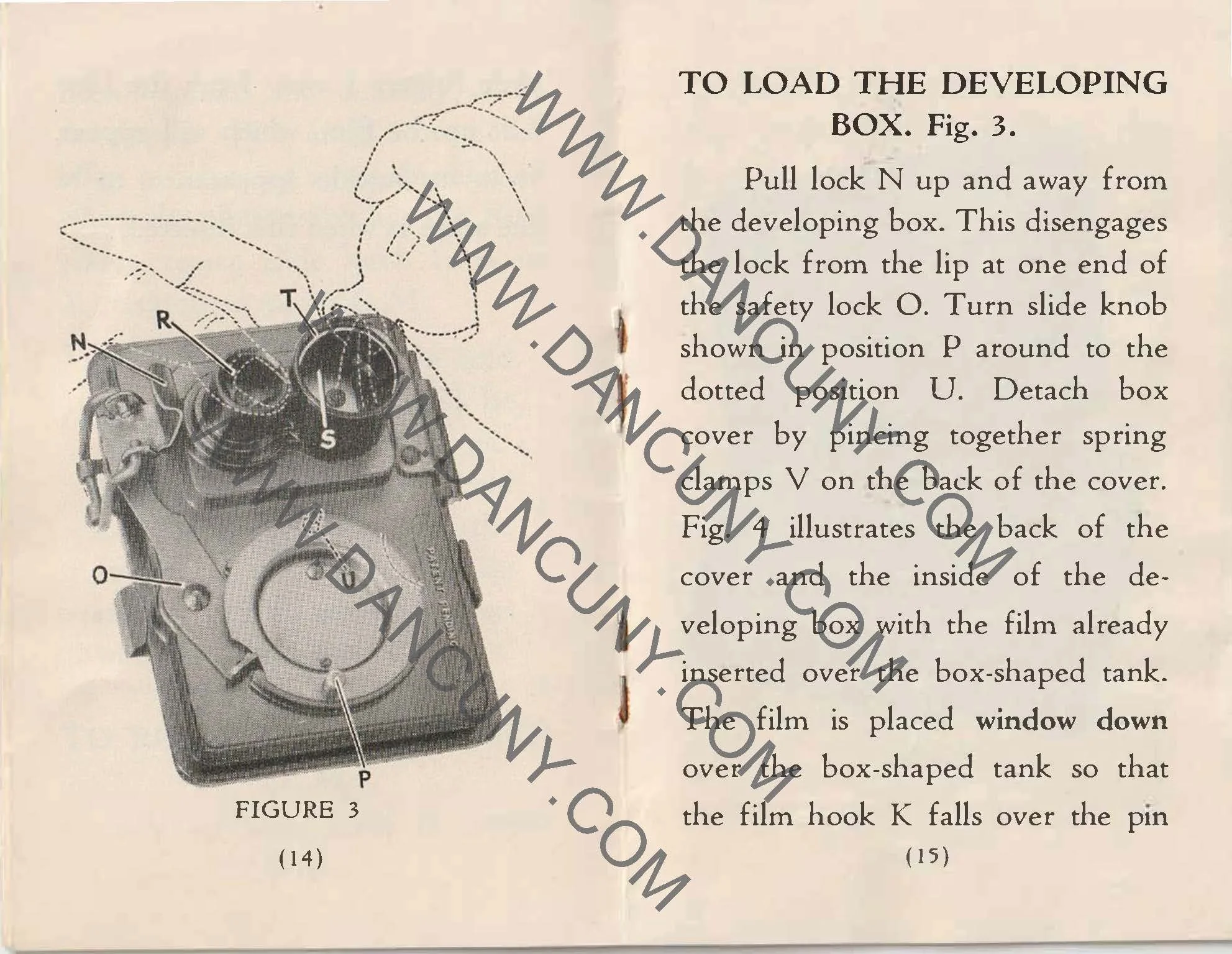
 The Developing tank is 4.5" long by 3.75" wide by 2.5" deep, and weighs 9.4 ounces. The tank is composed of two parts and held together by a locking arm and a clip that wraps around the tank. Unlocking the arm swings the bar out of the way. On the back side are two spring-loaded clips that need to be squeezed to disassemble the tank. 

Once apart, you slide the locking lever away and turn the disk on the tank to the "up" position. This allows the film to be loaded into the tank. Put the back onto the tank, and turn the disk to the "down position, which exposes the film to the chemicals. Once the film is in the tank, you assemble the two pieces and lock them together to initiate the processing. 

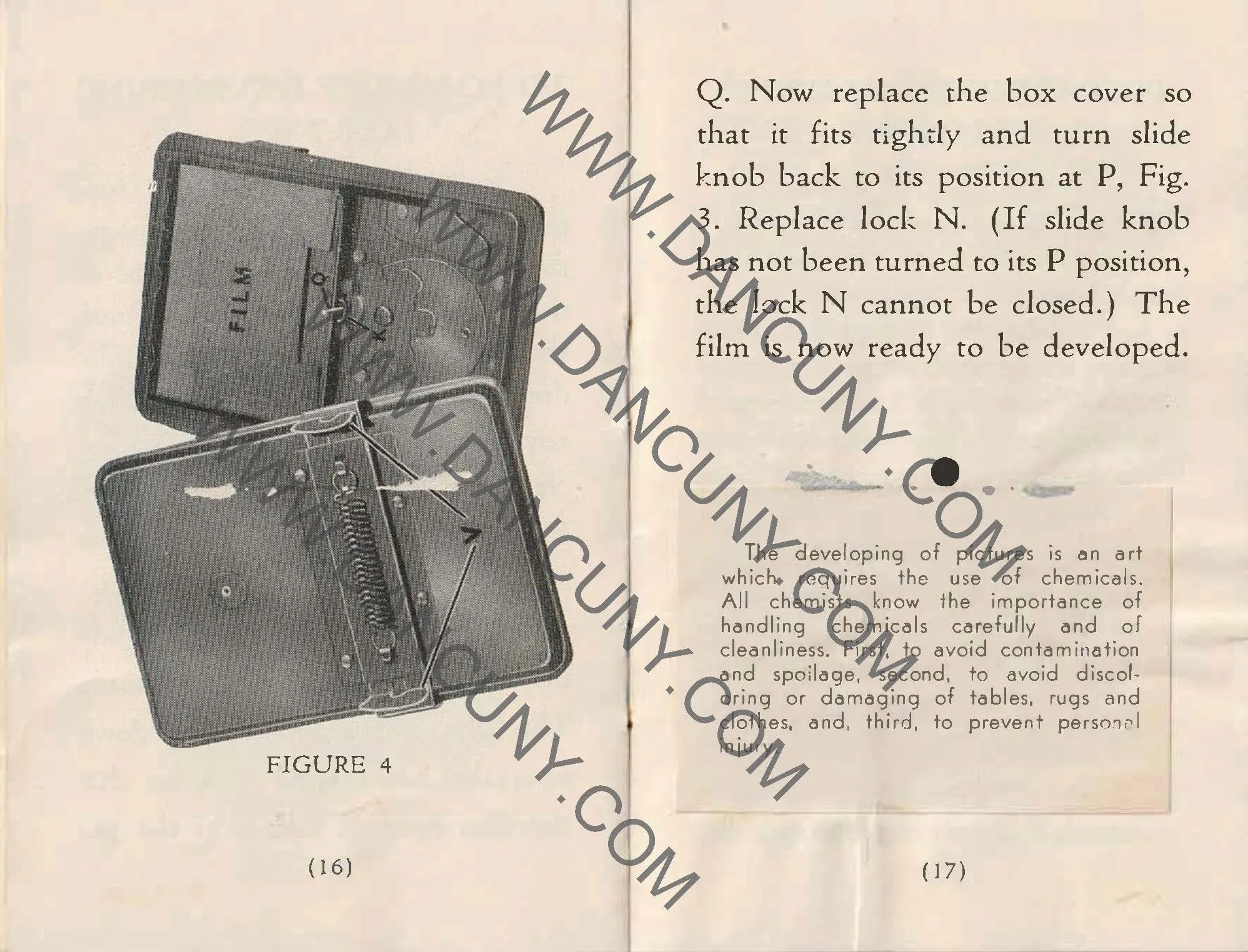
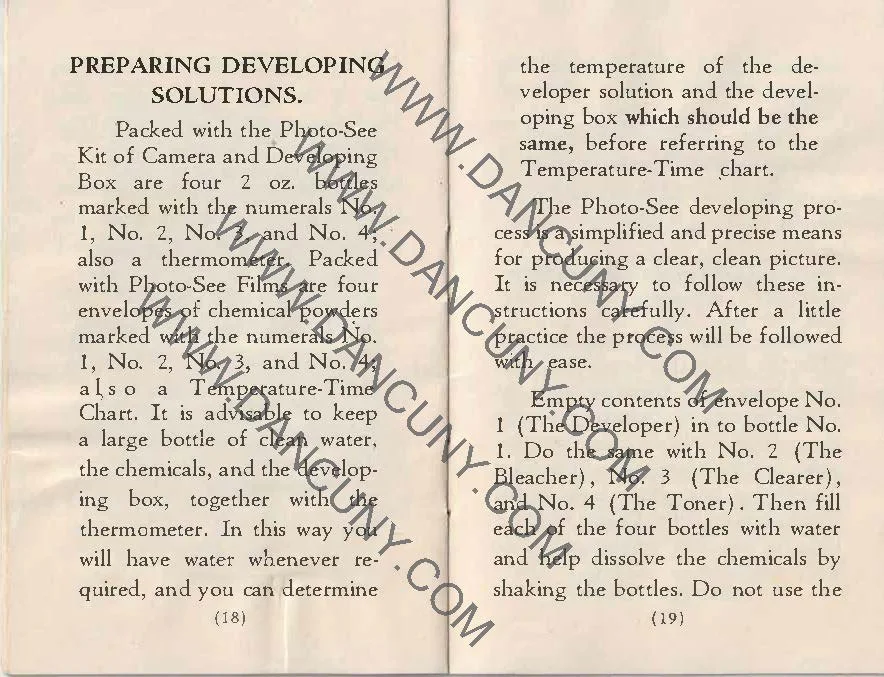
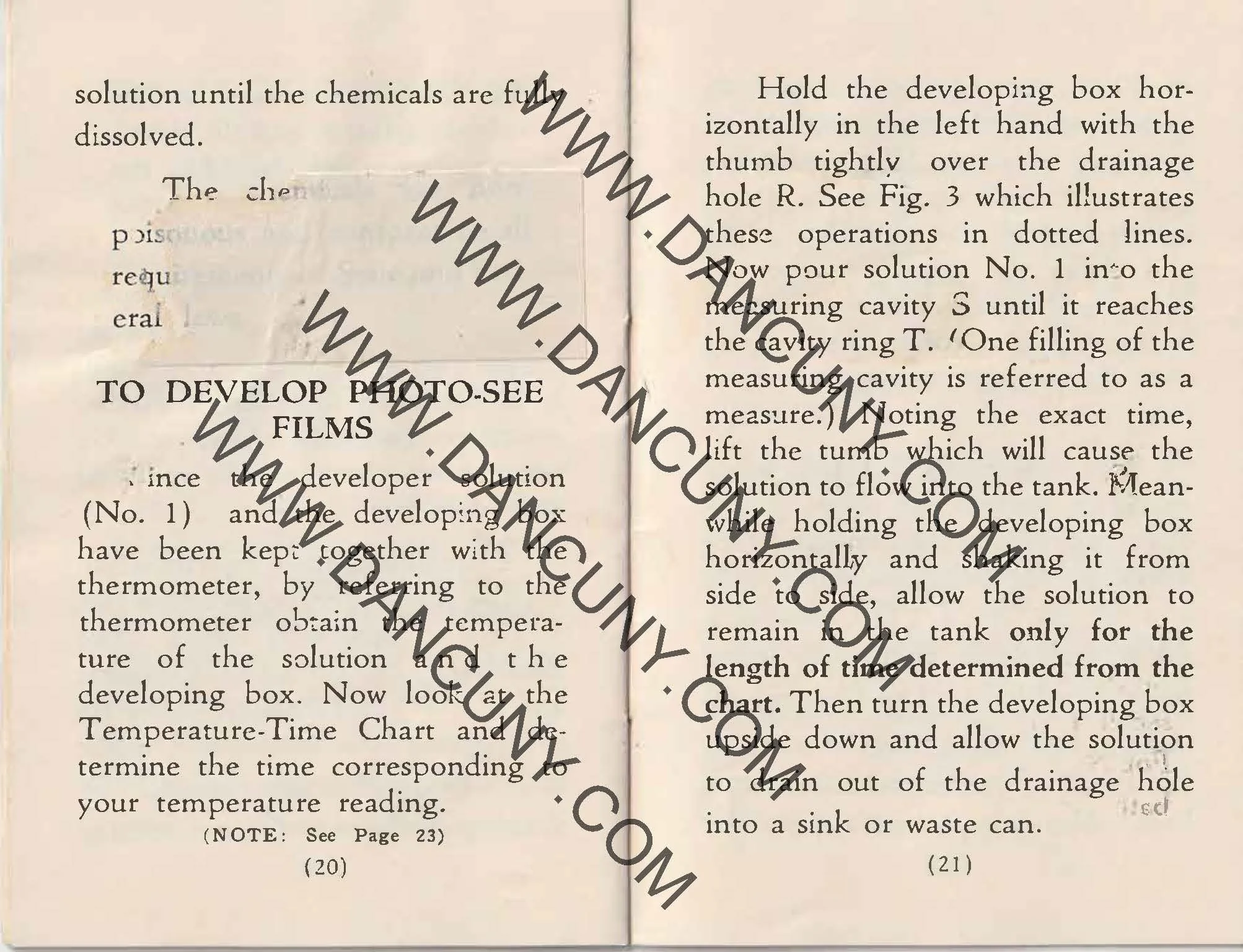
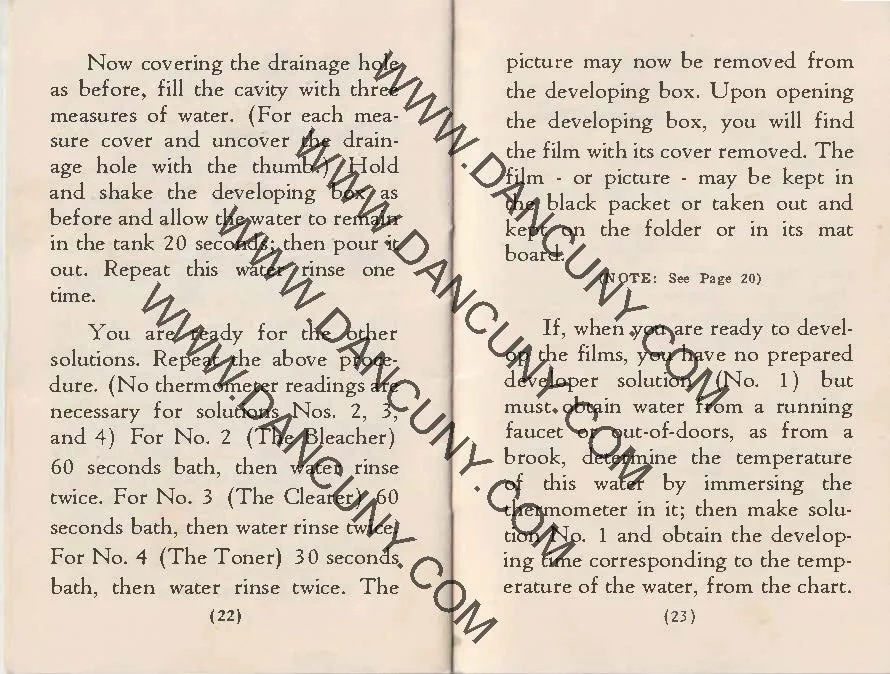
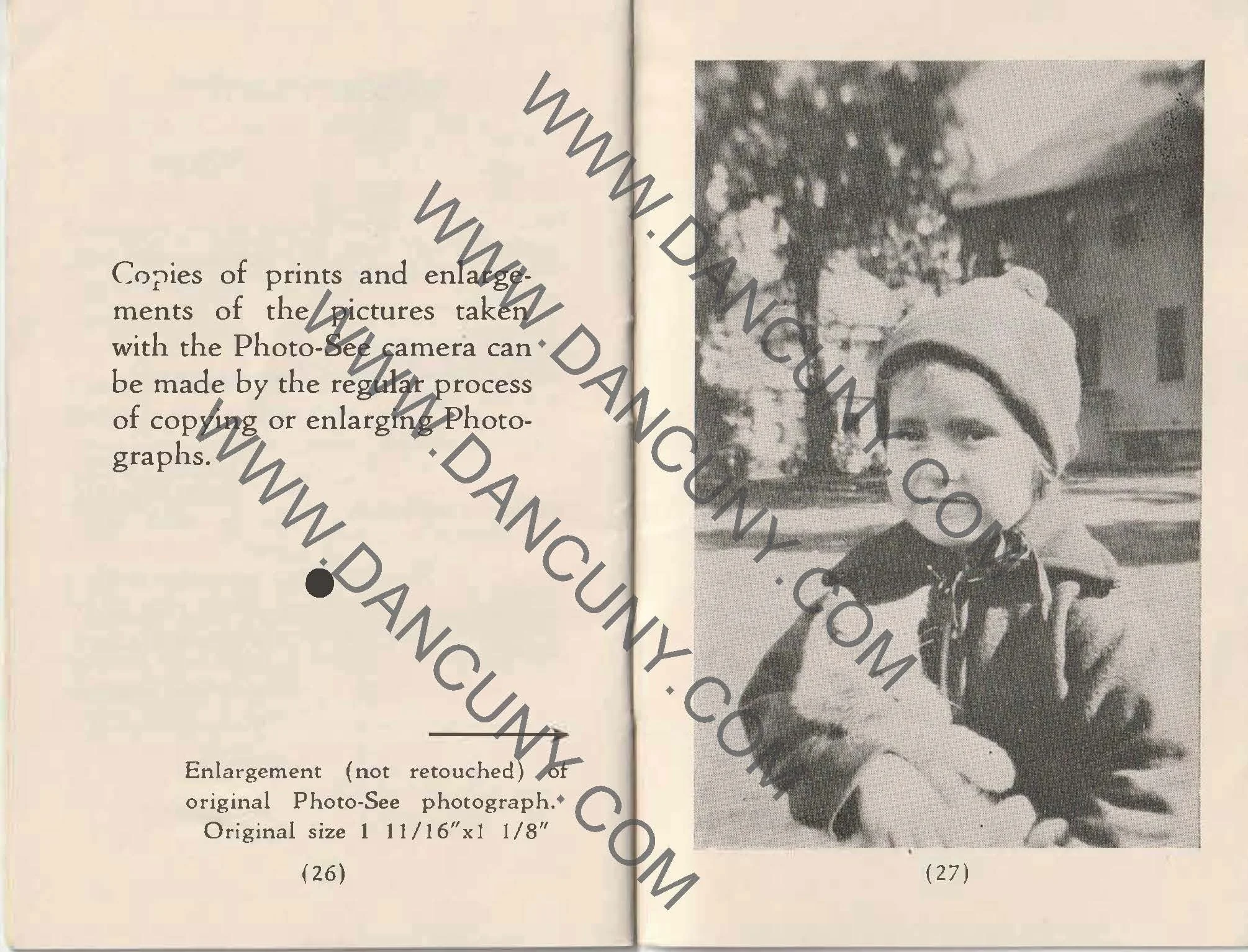
 According to the manual, four bottles and four packets of chemicals are needed for developing your image. #1 is the developer, #2 is the bleacher, #3 is the clearer, and #4 is the toner. Pour the packets into the numbered bottles, fill them with water, and mix. Pour the contents into the larger opening for developing. This camera produces photos and not negatives. Once developed, the final image size is 1 11/16 x 1 1/8 inches.


Results:

Unfortunately, the film for this camera isn't available, so I have no images to show from it. Heck, I've been looking for film for this for many years and have not seen one for sale anywhere.


Conclusion:

This camera is such an oddball, I couldn't resist writing about it, especially since it was many years ahead of its time. I understand that the process is lengthy, that you need to carry chemicals, and that the image size is small. These factors were the reason why this didn't gain popularity.

 It's nice to have an almost complete system in the collection. A film pack and the box would be nice, but having the camera, developing tank, and manual is good.

 Thank you for taking a few minutes to read about this odd and unusual camera from almost 90 years ago.

 Click on the link to see my other camera reviews.

 Cuny's Camera & Photo is my eBay store, where I sell some of the cameras I've reviewed, along with other camera-related items.

 Until next week, please be safe.