Coronet Cameo

My Coronet Cameo camera

It wasn't until I had been collecting cameras that I developed an interest in miniature and subminiature cameras. One of my earliest recollections of liking small miniature cameras was when I became a sales representative for a well-known Swiss large-format camera company (Sinar) and traveled to Sacramento to visit a store that displayed many different miniature and subminiature cameras at the cash register.

 I fondly remember spending time looking at the display, thinking many of the cameras seemed so odd and unusual, which is something I'm always looking for in what I collect. When I asked the owner of the store if any of the cameras were for sale, and his reply was a swift and hardy "no", in my mind, it triggered a need to find out more about this whole new world of cameras I was aware of, but had no interest in collecting.

 While I don't have a large collection of miniature and subminiature cameras, the ones I do have have a special place in my collection because they are all very unique. I have the majority of the miniature and subminiature collection on my desk, which I'm at the majority of the time I'm in my office, or what I call my camera oasis. It's the one room in our house where I can do what I want, within reason. Another terrific part of the collection is that they don't take up much room, so I have many of them in a small area that reminds me of the display at the camera store I went to well over 30 years ago.

 I came across the Coronet Cameo camera on a trip to London about two to three years ago. For me, one of the main objectives of the trip was to visit Portobello Road to see some of the camera and photo stalls we had visited on a previous trip to London many years earlier. When my wife and I visited the outdoor market, I found that things had changed, and many of the vendors only showed up on weekends. This was a massive disappointment for me, especially since my wife and I were leaving on Saturday afternoon.

Coronet Cameo size comparison.

 The main person I was to meet was Juliano of Cameras London, who shows his cameras only on Saturday. Somehow, I convinced my wife that I would take the bus to Portobelo Road and back in time for us to go to the airport. 

 As I took the bus to Portobello Road that Saturday morning, I remember I needed to be mindful of the time and hurry. I arrived early as Juliano was still setting up. He had a fantastic display of cameras and some negatives. There were several cameras I wanted to purchase, one being an Ilford Advocate, which you can read about. He said he had a cleaner version and would ship it to me. 

I got together a small group of cameras, and just before I paid him, I saw the Coronet Cameo. It was in poor condition, but it was odd and unusual, so I threw it into the pile. We made a fair bundle price for the items, including the Advocate and Cameo camera. I paid him for the items, put the cameras in my backpack, and made my way back to the hotel. We had plenty of time to make it to the airport.

History:

 The Coronet Camera Company was a significant English camera manufacturer, founded in 1926 in Birmingham, England, by Frederick W. Pettifer. The company began at 48 Great Hampton Street, Aston, focusing on producing an inexpensive line of cameras for the mass market. Their early focus was on simple box and folding cameras.

Photo of old Coronet building depicted from Historic Camera website

 A key aspect of Coronet's operations was its utilization of local Birmingham businesses. They partnered with the British Optical Lens Co. for lenses and, notably, with Edwin Elliott, a local plastics manufacturer, who fabricated molded plastic cameras for them. This collaboration led to popular pre-war models, including the small and stylish Coronet Midget and the Coronet Vogue, which were often made from colored Bakelite. By 1933, the company had reportedly sold a remarkable 510,000 cameras.

 The company became Coronet Ltd. in 1946. After World War II, the company specialized in low-cost, molded-plastic cameras. Due to French import restrictions, Coronet formed a partnership with the French company Tiranty of Paris. This collaboration led to several Coronet models, such as the Rapide, being manufactured in France, sometimes using Boyer lenses, to bypass trade barriers. Coronet also produced accessories and its own brands of film, including Corochrome.

 The company continued to manufacture cameras from its Birmingham headquarters (later located at 308-310 Summer Lane) until it finally ceased operations in 1967. Over its four-decade history, Coronet played a vital role in making photography accessible to the public by providing thousands of simple, affordable cameras, many of which remain popular collector's items today.

My Camera:

 This portion of the blog will be sparse, as there's not much to this camera. The Coronet Cameo camera is small and will almost fit into a 35mm film container. It's 2" wide by 1.5" deep and 2" tall with the front viewfinder extended and only 1.25" tall when it's retracted. The camera only weighs 1.6 ounces. The Cameo has a fixed 25mm F/11 Meniscus lens and a single shutter speed range of 1/25-1/50, with the shutter release on the right side of the camera body.

The camera is made from plastic and was manufactured between 1948 and 1952.  Coronet attempted to revive the success of the Pre-War Midget camera, which was highly successful for the company at the time.

 The Coronet Cameo takes a roll of 16mm film and produces six 12mm x 18mm negative-sized images per roll. The camera loads and winds like any other roll film camera, with the unexposed film loaded on the left and the leader threaded into the take-up spool on the right via the film winding lever.

The back of the camera is held in place by two clips on the right side of the camera. To open the back, lift it from the two clips; it will open, exposing the film chamber. Unfortunately, my camera, like many Coronet Cameo models, is warped, and the back doesn't fit properly to the body.

 A sliding front viewfinder can be pulled up, and when the rear viewfinder is lifted on the back of the camera, it exposes the red window displaying the frame number of the image you'll be taking on the roll of film.

My Results:

 Unfortunately, there is no longer film for this camera, and with the warped camera back, I wasn't able to take photos with it.


Conclusion:

 As I was taking photos of the Coronet Cameo, I had an empty 35mm film tube and tried to see if the camera would fit inside it, but it's just a tad too big.

 The Coronet Cameo camera is sitting right next to my Whittaker Micro 16 Pixie camera, which I considered writing about for this blog post. Still, I'll leave that camera for another day. I do enjoy all the miniature and subminiature cameras in my collection; it just took me a few years of collecting them to appreciate them for what they are.

 Thank you for taking the time out of your day to read about this small plastic camera from about 75 years ago. I'm sure many people owned and enjoyed them when they were made.

 If you're interested in reading about other cameras I've reviewed, here's a link to my other Camera Reviews.

 I also have a store on eBay, Cuny's Camera and Photos, where I sell items I've reviewed, as well as many other camera oddities.

 Until next week, please be safe.

Rajar No. 6 Camera

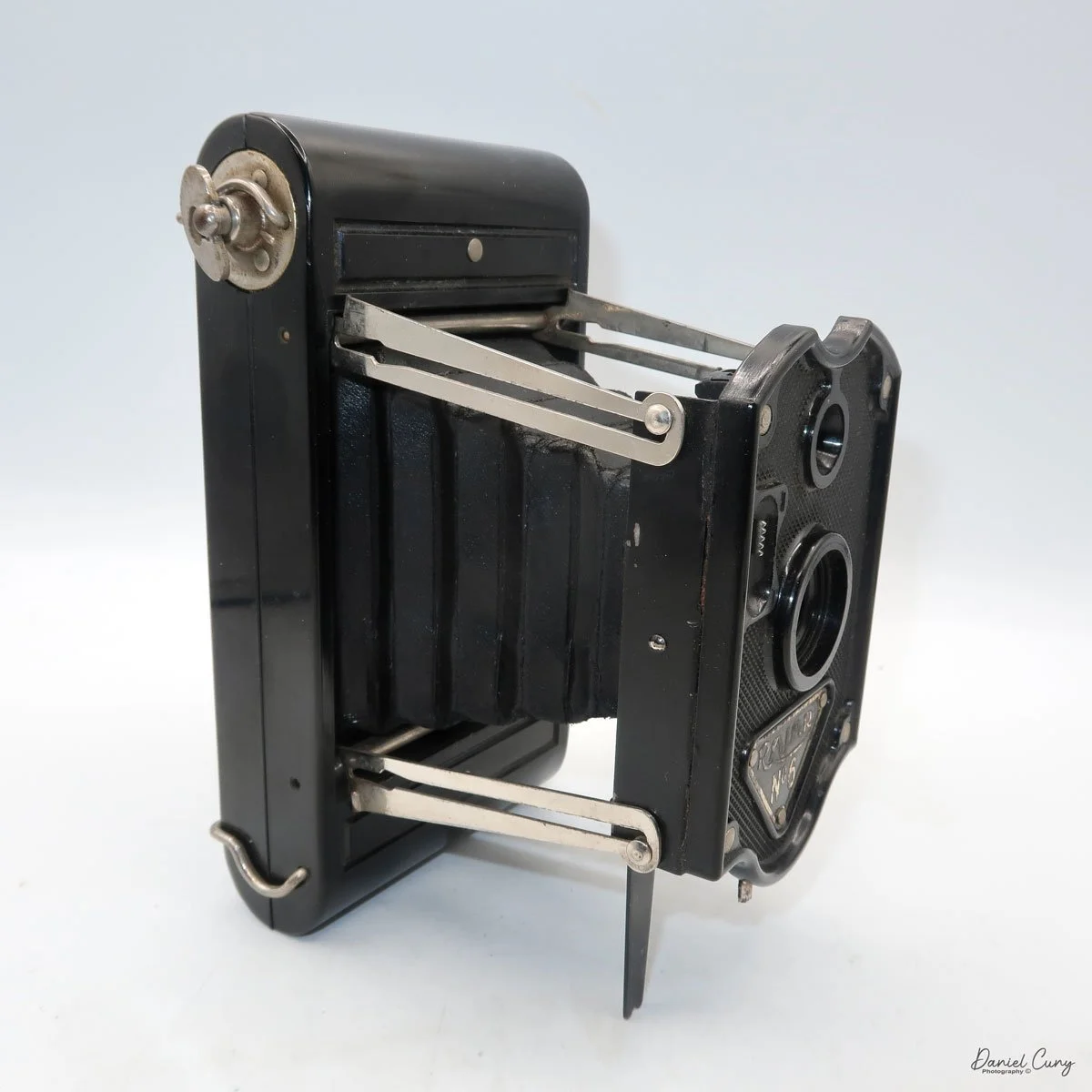
My Rajar No. 6 camera

I don't know what it is about the Rajar No. 6 camera, but ever since I purchased my first McKeown's camera guide more than 40 years ago and spent hours leafing through the pages learning about all the different styles and shapes of cameras, I've always desired to have one in my collection.

 It wasn't until just a few months ago that I pulled the trigger and purchased one from a great reseller in the U.K. It was listed for parts that were not working. The seller was selling the camera for a friend and wasn't sure if it was in good working condition. They mentioned the shutter fired but couldn't guarantee the other working parts of the camera, so I took a chance and purchased it. I don't know why it took so long to get one.

 The shape of the face and the crosshatching on the camera's face drew me to it. It has a very classy and classic look, which is something I find on many cameras made during this timeframe.

 It took a while for the camera to arrive from the U.K., but it arrived last week, and I was anxious to see its physical condition. To my surprise, the camera was not only in excellent physical condition with no chips in the Bakelite, but the shutter was firing, and there was a roll of film still in the camera, which the seller failed to mention, so I was doubly happy.

 I took hold of the film advance knob to see if the film was advancing, and it was so at this point, I didn't see anything wrong with the camera. Not knowing how old the film was, I went outside to take the last few frames on the included old roll of film, and it wasn't until I got to the final frame I found out what was wrong with the camera. 

 I wasn't aware of what was so different in the film spool until I took the film out of the camera, which I needed to do in a dark bag since the camera stopped winding right after I took the final photo on the roll of film included with the camera.

 The Rajar No.6 camera has a special take-up spool written right there on the back of the camera, "only the Rajar No. 6 spool will fit this camera". I saw that when the camera arrived and at first I thought I couldn't shoot with it because it took a different or special size of film. Nope, it's the take-up spool. At least in my camera, the take-up spool is special and has a square tip that fits into the take-up spool instead of a slot that fits into most 120 spools. 

 It appears the Rajar No.6 has a brass item attached to the metal take-up spool that had become loose, making it impossible for the camera to wind the film to the next frame. The drive portion came loose, and the film wouldn't advance anymore. The disconnect of the brass piece and the take-up spool must have happened during the winding of the film, as it was working for a few frames. Another explanation is that the brass portion was stuck to the take-up spool and became loose after the film was with a few frames.

The Company:

Rajar No. 6 nameplate

Rajar Ltd. was established in 1901 as an offshoot of Brooks-Watson Daylight Camera Company Ltd., which had a facility in Liverpool. The company produced camera film, paper, and Rajar film backs for daylight loading film. In 1904, it moved to Moberly and was renamed Rajar Ltd.

 In 1921, Rajar Ltd. They merged with six other companies to form APM, Amalgamated Photographic Manufacturers Ltd. In London, in 1928, four companies involved in film manufacturing formed APeM, Amalgamated Photographic Equipment Manufacturers Ltd. APeM, which would eventually be rolled into Ilford, which is still one of the major film companies today.

 The Rajar No. 6 camera was introduced in 1929, just a year after APeM started. APeM also produced box camera as well.

The one thing that makes the Rajar No.6 camera unique is that the camera body, faceplate, and back are all made from Bakelite. The Rajar No. 6  was the first camera to have the majority of the camera built with the new material. As I mentioned earlier, it's incredible that after almost 100 years, the Bakelite is still in fabulous condition. There are no chips to be found, and the camera still has the gorgeous shine of the new camera.

My Camera:

My Rajar camera measures 6.5" tall by 4" wide, including the winding key, by 4.5" deep when the camera is extended. My camera weighs 1 lb. 0,6 oz., so the camera is very light. The camera is extremely simple as it has a meniscus lens, and an "Everest" shutter, meaning it doesn't cock. When you move the shutter release from one side to the other, the shutter fires, and then when you move it back, the shutter fires again, so you'll need to wind the film right after taking the photo to avoid double exposures.

There is no aperture setting, as the lens aperture is set to what I'm guessing at F8. The only shutter speed setting is for instant or timed exposures. The Rajar No.6 camera is a strut-style folding camera, which means the camera body pulls away from the body on four chrome rigid arms, as opposed to the traditional folding bed style.

 It took me a few minutes to figure out how to pull the faceplate away from the body, but when I held the camera upside down, the faceplate dropped, and it was easy to pull it away from the body and lock it into position. To close the camera, you only need to pull outward on the four strut corners, and the faceplate folds back into the camera body. There is a small viewfinder on the top of the camera, but this only works for vertical photos. There is no viewfinder for horizontal images unless you tilt your head, which is very uncomfortable.

To open the back of the camera to load film, two clips hold the back onto the camera's body. Just flip back the clips, and the back can be lifted off easily. The Rajar No. 6 camera is a 6x9 format camera and takes eight exposures on a roll of 120 film. Yes, the only difference between the No. 6 spool is the take-up spool. It's not a different film size, as 120 film fits the camera well. I've even seen that Rajar made an adapter to fit onto its square proprietary film take-up end to fit into 120 film spools. I don't have one of the adapters, so I'll need to keep my special take-up spool and reuse it with each roll of film.

My Photos:

Since the take-up spool appeared to be broken and I couldn't pull the film from it, I glued the special square drive area directly onto the metal spool that it was spinning freely on. After waiting an hour or so for the glue to dry, I loaded a roll of 120 film into the camera and onto the special take-up reel. The take-up spool worked wonderfully, and I got through the roll of film without a hitch. In fact, the film transport was extremely smooth.

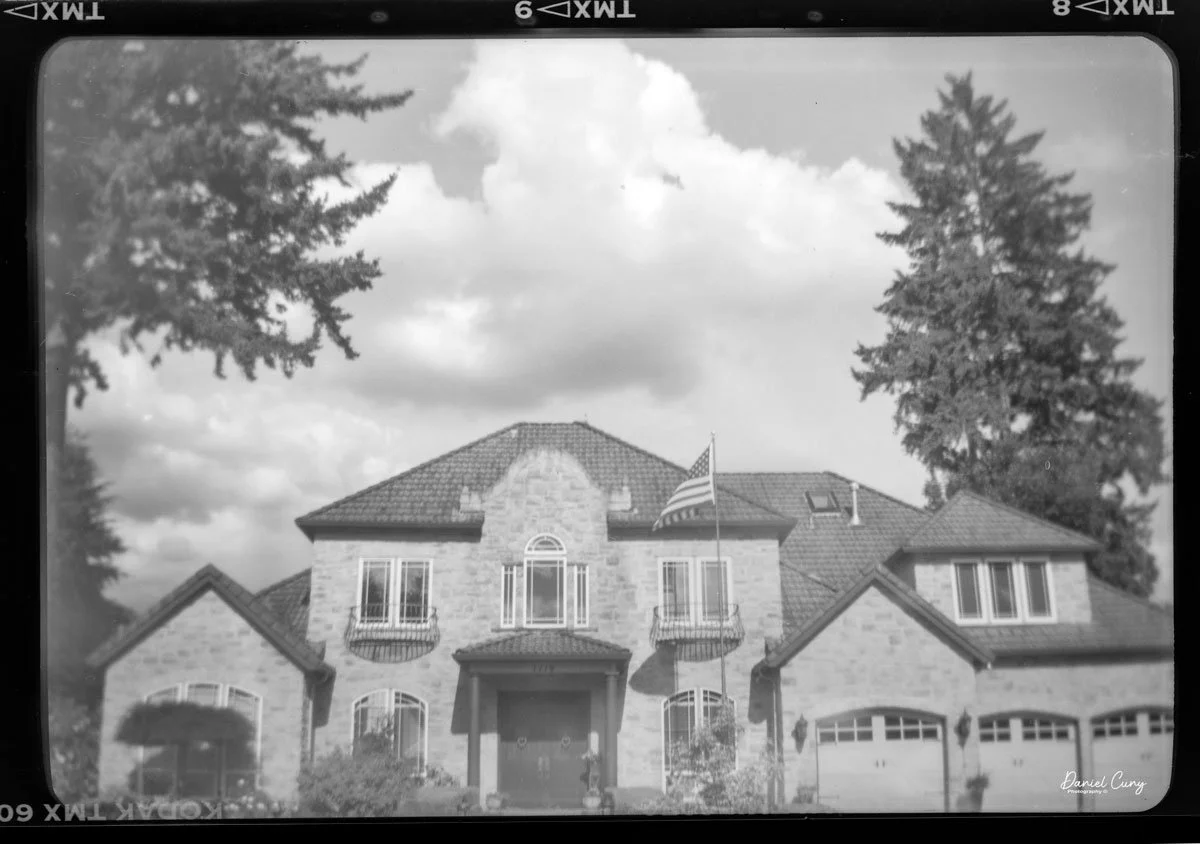
 Here are some results from walking through my neighborhood with the Rajar No. 6 camera.

Conclusion.

The images have a softness that I find appealing. They are very similar to Lomography-style cameras like the Diana. They seem a bit sharper than a Diana, but the lens has a creamy effect on the images (in my opinion). I enjoy that the corners are rounded on the negatives. I also see that the images extend into the rebate portion of the film's border, as I can see the film name and other information in the image area.

 The camera worked great. The shutter was smooth, and the film transport was even smoother. Once I glued the two pieces together and dropped the film into the camera, the photo-taking experience went flawlessly.

 The camera is compact, rugged, and a real "point-and-shoot" style camera. I aimed the camera for horizontal images and figured the lens on the camera was most likely for wide images, which proved to be true.

 Thank you for taking a few minutes to read about this fun and easy camera to shoot with.

 I'd love to hear from you, so if you have any experience with this camera or any of the others I've written about, please email me.

 Until next week, please be safe.